
Eaton is the center of gravity of Preble County — the county seat with the courthouse and the government square, the commercial spine along US-35 and Barron Street, the fairgrounds that host the Preble County Fair and the Pork Festival crowds every fall, and the neighborhoods that run from Victorian streets around downtown to postwar blocks and newer edges backing straight onto crop ground. It is also where Greater Dayton Pest & Rodent’s Preble County routes anchor: about half an hour west of our Salem Ave office on US-35, on the schedule multiple days a week, with every service on this site — rodent exclusion to bed bug work to WDI inspections — delivered at Dayton standards and Dayton prices. This page is the Eaton file: what the county seat’s buildings actually face, block by block and season by season.
Whether you call it pest control or an exterminator, what Eaton actually needs is somebody who will find where they are getting in rather than spray where you saw them.
Three Eatons, three pest profiles
The historic core — the Victorian and early-1900s streets around downtown and the courthouse — runs the old-housing playbook our historic-district pages detail: stone foundations aging out of their mortar, balloon-frame chases, deep porches hosting wasps, and cellar moisture feeding the basement guild; mice work these blocks year-round, and the density means one neglected property feeds its neighbors. The mid-century and postwar neighborhoods — the ranches and capes filling the blocks between downtown and the bypass — are the sealable stock: finite entry lists (garage corners, utility penetrations, basement windows), the twelve-doors inspection done in an afternoon, permanent results. The edges — anywhere Eaton meets the fields, which is every direction — inherit the rural pressure the county hub page maps: the October field-mouse push after harvest, cluster flies and lady beetles massing on sunny siding, and the open-country insect economy keeping spiders busy at every porch light. Most Eaton properties are two of the three at once, and our inspections read the house accordingly.
The commercial side of the county seat
Eaton’s business corridor carries the county’s commercial pest load — restaurants and food service along Barron Street and the US-35 strip, the grocery and retail anchors, offices and clinics around the courthouse economy, and the warehouse and light-industrial spaces off the highway. Our commercial programs run here on the same route days: scheduled service with the documentation health inspectors expect (restaurant program details), rodent station networks for the food-adjacent businesses, and the 48-hours-before-inspection response when a sighting meets a deadline. County-seat businesses also inherit a county-seat quirk: courthouse-square buildings are some of the oldest commercial structures in the region, with shared walls and cellars that make treat-the-building logic apply forty minutes from downtown Dayton. Block programs for adjoining storefronts are quoted gladly.
Fair week, festival week, and the pest calendar they bend
Eaton’s two great gatherings — the Preble County Fair in late summer and the Pork Festival crowds each fall — are wonderful for the town and instructive for its pest map. Event season concentrates food waste, props doors, and stages livestock and vendors in ways that pulse the local yellowjacket and fly economy for weeks — late-summer wasp pressure around the fairgrounds neighborhoods is a real annual pattern, and the businesses feeding festival crowds run their sanitation hardest exactly when the scavenger insects peak. Our event-adjacent advice mirrors the downtown-Dayton venue playbook: tight lids and prompt dumpster rotation during the weeks that matter, wasp response on speed-dial rather than a shrug (ground nests near foot traffic are priority calls), and for the food businesses, a program cadence that anticipates the surge instead of reacting to it. The fairgrounds themselves have their own management; the streets around them have us.
An Eaton seasonal calendar
- March–May: ants wake in the village blocks; termite swarm season — the county seat’s older stock makes any winged swarm worth a same-day photo; cluster flies exit the farm-edge attics
- June–August: wasp colonies scale up on porches and outbuildings; carpenter bees work the barns and older soffits; mosquitoes rise off Seven Mile Creek’s corridor and every downspout barrel
- September–October: the edge-of-town surge — harvest pushes field mice at every structure while lady beetles, stink bugs, and cluster flies mass on sunny walls; the September barrier-and-exclusion visit is Eaton’s highest-value appointment
- November–February: interior rodent season in the old stock; overwintering invaders trickle at windows; the quiet season for exclusion carpentry and WDI inspections ahead of spring listings
Real estate, rentals, and the courthouse economy
As the county seat, Eaton clears the county’s paperwork — and a healthy share of its real estate. For transactions: Category 12 WDI inspections with NPMA-33 reports, scheduled against closing dates, on everything from courthouse-square Victorians to township farmhouses (our realtor page covers the workflow agents use). For the rental stock — Eaton’s mix of village doubles, converted older homes, and small complexes — the property management programs apply at county-seat scale: turnover inspections, documented response timelines, and the building-wide logic that keeps one unit’s problem from becoming a block’s. Landlords west of the county line get the same route-day economics as everyone else, and the documentation habit that wins disputes before they start.
The Eaton pest lineup, ranked by expected call volume
- Mice — year-round in the historic core, surging town-wide at harvest; exclusion-first, always (rodent control)
- Ants — odorous house ants own the village kitchens (the supercolony story); carpenter ants work the mature shade streets and older porches (their guide)
- Wasps & yellowjackets — porches, outbuildings, and the event-season surge (removal guide)
- Fall invaders — cluster flies, lady beetles, stink bugs; the farm-edge signature, answered by the September barrier
- Spiders — the open-country insect economy keeps every porch light webbed (the friendly census and the service)
- Termites — the old-stock risk the county seat’s housing age demands respect for (treatment + annual inspections on the older streets)
- Bed bugs — the travel-and-turnover introductions every county seat processes; early photos, fast response, guaranteed protocol
- Moles & voles — big village lawns meeting field edges (trapping program)
Eaton questions we hear
Are you actually out here regularly, or is Eaton a special trip?
Regularly — Eaton anchors the Preble route days, which run multiple times a week in season, so ordinary jobs book a day or two out and urgent ones jump the queue like anywhere else on the map. The half-hour from Salem Ave is a commute, not an expedition, and no Eaton quote has a mileage line. The photo-first habit still pays: send the picture with the call and the truck arrives loaded for the actual problem.
Our house backs up to the fields. Is the October mouse invasion just life here?
The pressure is life; the invasion is optional. Field-edge homes cannot change what harvest does to the local rodent map, but the twelve-doors exclusion standard was practically written for them — seal the finite list in September, erase the scent history, and the annual tradition ends at the siding. Our field-edge Eaton customers are the proof: same fields, same combines, quiet Octobers.
Can one visit cover the house and the outbuildings?
That is the default out here, not the upgrade — Preble inspections scope the property campus (house, garage, shed, barn where present) and the quote itemizes honestly by structure so you choose what gets sealed versus managed. The county hub page explains the campus logic in full; the short version is that treating the farmhouse while ignoring the feed room is a subscription, and we sell endings.
Preble County coverage: the county hub · Camden · Lewisburg · West Alexandria · New Paris · full service area.
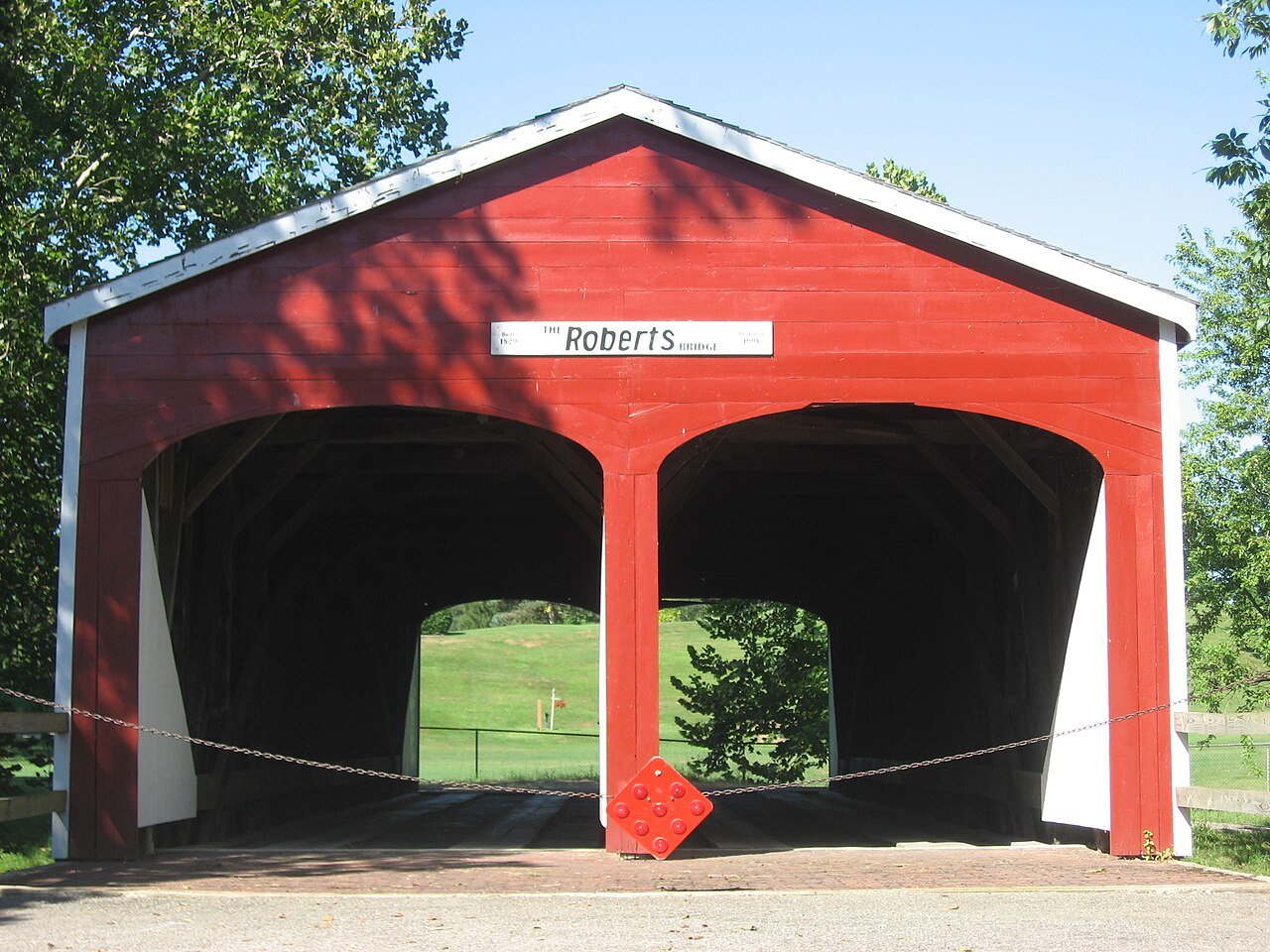
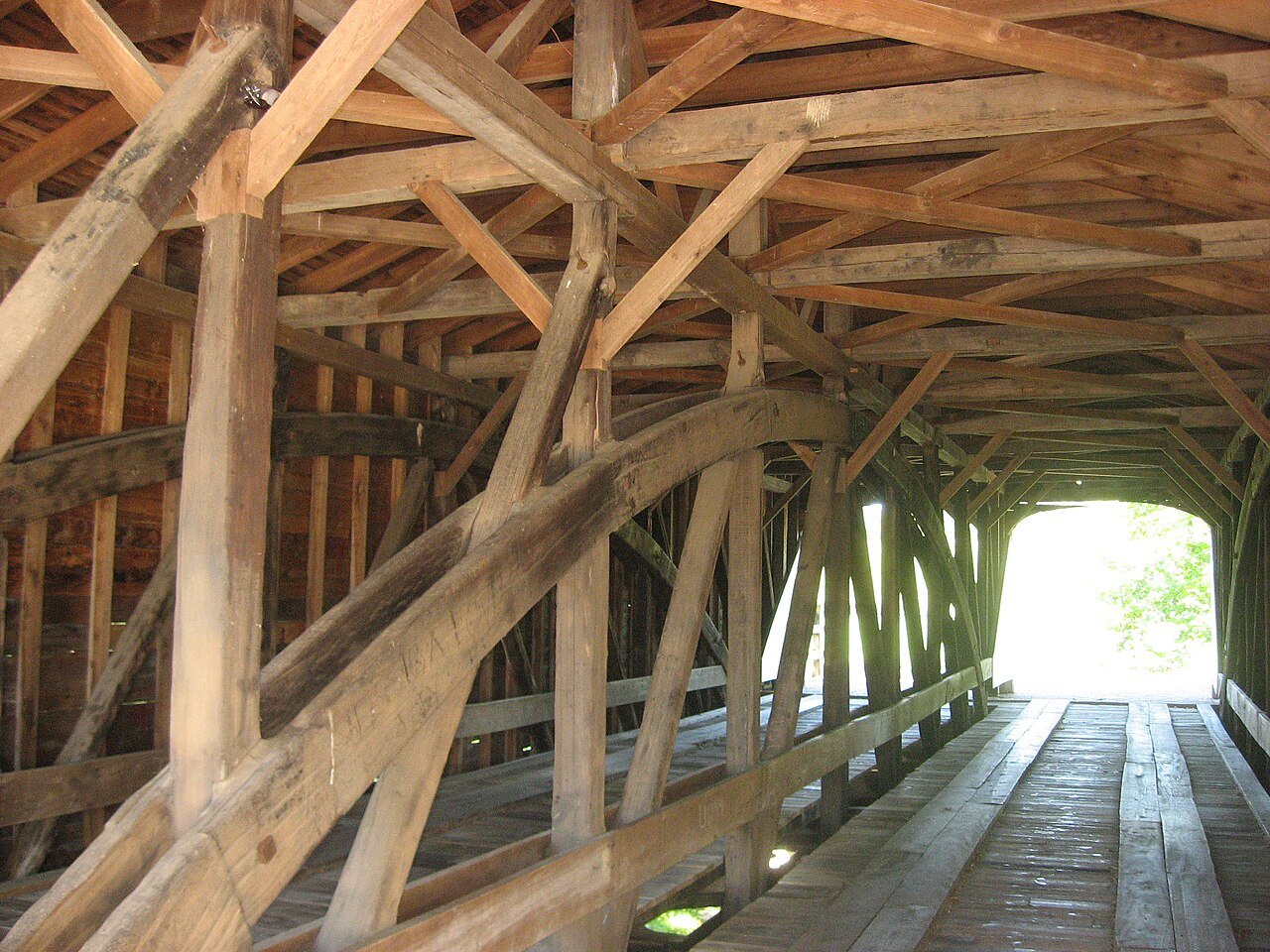
The 1829 lesson: what Roberts Bridge teaches about Eaton’s buildings
The double-barreled covered bridge in the photos above has stood since 1829 — the oldest in Ohio, older than the courthouse, older than nearly every structure it now neighbors — and it survived fire, floods, and two centuries of weather on one maintenance philosophy: keep the water off the timber and the timber lasts indefinitely. Eaton’s older housing stock runs on the same physics in reverse: nearly every serious pest finding we make in century homes — the carpenter ant satellite in the window header, the termite tubes at the buried sill, the basement guild thriving below — traces to a specific moisture failure with a specific fix. The gutter overflowing at one corner for five years. The grading that settled toward the foundation. The flashing seam above the porch roof. Our inspections in Eaton’s historic blocks are therefore half pest work and half building-envelope reading, and the written findings name the water problems alongside the insects, because treating the symptom while the cause keeps raining is the cycle this whole site argues against. The bridge-keepers of Preble County figured this out with hand tools and no entomology degree; we bring both, plus a guarantee, to the same tradition.
The bottom line for the county seat
Eaton gets the full playbook: historic-core exclusion craftsmanship, sealable mid-century efficiency, field-edge September defense, commercial programs with inspector-ready paperwork, transaction inspections on real-estate deadlines, and the event-season awareness a fair-and-festival town deserves — all riding route days that put our trucks on US-35 west several mornings a week. Free quotes, free photo identification, the re-treatment guarantee in writing, and Ohio licensing (Pesticide Business License #115079; applicator #170858, categories 10A, 10B, 12) covering everything from the courthouse square to the last lane before the township line: (937) 569-3330, Monday–Friday 8–6, Saturdays by appointment. Greater Dayton Pest & Rodent — Preble County’s newest regular, Eaton’s included.
Deep dive: the harvest fortnight, hour by hour
Because it is the single most predictable pest event on Eaton’s calendar, the anatomy of the October push deserves its own section. When the combines open the fields around town — usually across two to three weeks spanning late September into October — the rodent carrying capacity of hundreds of acres collapses in days: the standing crop that fed and sheltered a summer’s breeding is suddenly stubble, night temperatures are dropping through the 40s, and every field mouse, deer mouse, and vole on the section goes looking for winter quarters at once. Structures within sight of the fields feel it first and hardest — the edge subdivisions, the farmsteads, the businesses along the bypass — and the pattern inside is always the same: garage evidence first (the corners, the seed bags, the camper), then the kitchen perimeter a week or two later as the successful entrants map the interior. The counter-programming writes itself from the timeline: exterior exclusion checked and sealed in early September before the push, not November after it; snap-trap lines pre-positioned in garages and outbuildings the week the neighbors’ combines start; bird seed and pet food into steel before the siege; and for the properties that run our fall visit, all of it handled in one scheduled stop that also lays the invader barrier for the lady beetles arriving on the same calendar. The fields will do what fields do — the only variable is whether your structure is ready the week it happens, and out here, the week is nearly circled on the calendar in advance.
For Eaton’s older-home buyers: the pre-purchase hour that pays for itself
A specific word for the families moving into the county seat’s wonderful old housing stock, because the moment of purchase is the cheapest hour in a house’s pest history. Before closing on anything built before mid-century, buy the real inspection hour: the WDI report your lender may require anyway, done by inspectors who work this exact stock weekly rather than a checkbox vendor; the moisture-and-entry walk that maps the stone foundation’s gaps, the cellar’s humidity, and the porch structure’s wasp and ant history; and the written baseline that turns every future “is this new?” question into a comparison instead of a guess. Sellers use the same hour in reverse — a clean pre-listing inspection heads off the mid-transaction surprise that costs closings — and agents on both sides get reports written to be forwarded. An Eaton Victorian with its file in order is a joy to own and a straightforward thing to protect; the same house bought blind spends its first year surprising people. One phone call decides which story you get, and the call is free: (937) 569-3330.
What does service cost out here compared to Dayton?
The same — genuinely. Route-day scheduling absorbs the drive, so an Eaton exclusion job, wasp treatment, or quarterly program prices off the work exactly as it would in Kettering, quoted free and firm before anything begins. The one Preble-specific economy worth knowing: neighbors booking the same route day — two houses on a street, a farm and its tenant house, the storefronts sharing a block — make the routing tighter still, and we are happy to coordinate the calendar so the savings land on your side of it. Small towns are good at organizing themselves; we are good at rewarding it.
Do you service the townships around Eaton or just the city limits?
Everything — Washington Township surrounds and interleaves the city, and our Eaton routing treats the whole US-35/US-127 crossroads area as one map: the city blocks, the township lanes, the farmsteads out to the county lines in every direction. Rural addresses simply note the campus scope from the county page when booking, so the visit is scheduled for the property it will actually find. City limits are for the zoning office; the mice have never once checked.
Why we wanted Eaton on the map
A closing word about why this expansion happened at all. The county seats west of the metro have long been served from a distance — franchises routing trucks from Cincinnati or Indianapolis suburbs, national call centers reading Eaton’s zip code off a screen — and the service reflects it: long windows, rotating technicians, and pest advice written for no place in particular. Eaton deserves what the Dayton neighborhoods on this site get: a company close enough to know that the fairground blocks run wasp-heavy in August, that the courthouse square’s cellars connect, that the harvest fortnight is a schedulable event, and that a Preble farmhouse is a campus rather than an address. That local literacy is the actual product on every page of this site, and extending it west was the point of building these twelve pages. The trucks are routed, the knowledge is written down where you can read it, and the phone number works the same on both sides of the county line: (937) 569-3330 — free quotes, honest answers, guaranteed work, now including the town where Ohio’s oldest bridge still keeps its timber dry.
Whether the first call is a mouse in the mudroom, a swarm at the sill, or just a landlord tired of the long-distance franchise experience — welcome. The county seat has a local option now, and it answers its own phone.
Who actually turns up in Eaton: Greater Dayton Pest & Rodent is owned and operated by Bryan Camden, licensed by the Ohio Department of Agriculture — firm #115079, commercial applicator #170858, categories 10A, 10B and 12. When you call, you talk to the person who does the work. No call center, no rotating crews, and the same technician on every visit.
Frequently asked questions
Do you provide pest control in Eaton?
Yes — the Preble County seat anchors our western routes: courthouse square to the fairgrounds to every township lane beyond.
What pests are most common in Eaton?
County-seat farm-belt blend: the harvest rodent surge (Preble’s defining event), historic-core foundation mice, fairground-season fly files, farmstead wasps and the county’s famous fencerow globes, stored-grain pests, and September’s certain flights.
How much is pest control in Eaton?
County formula, western distance irrelevant: most homes $39–$55/month quarterly; campuses walked; free: (937) 569-3330.
Do you know the historic courthouse-square blocks?
The 1800s stock gets preservation protocols — masonry-safe exclusion, reversible work, cavity experience — the county seat’s architecture deserves the same craft as Oakwood’s.
What about the fairgrounds season?
A real calendar item — event-season fly and wasp pressure gets prep treatments, and the surrounding blocks feel the traffic; we plan around the fair the way the county does.
How fast can you reach Eaton?
Weekly-or-better western rotation — days typically, priority arranged, no travel charges.
Do you serve Eaton businesses?
Yes — the square’s restaurants and shops, the corridor retail, and the ag operations, each with matched programs and documentation.
How strong is the harvest surge at the county seat?
Full Preble strength — acreage on every side aims the displacement wave at town; September sealing is municipal-grade advice, and our fall calendar fills accordingly.
What about the county’s bald-faced globes?
Eaton’s trees grow the region’s best — the honest triage stands: remote specimens get free frost verdicts, traffic-zone globes get the protocol, and the photos are always welcome.
How do I start service in Eaton?
Instant quote, free photo ID, or (937) 569-3330 — free estimates, route days weekly, first visits typically within the week.
Eaton Pest Control, Service by Service
Eaton’s pest files, written from the county seat’s fair circuit and rural edges — specific, not templated:
- Cockroach control in Eaton — the fair-week file, audited in the off-season
- Termite control in Eaton — the farmstead perimeter, all five buildings read
- Ant control in Eaton — the mound file, acquitted or treated colony-deep
- Rodent control in Eaton — the project-pen file, closed out clean
- Wasp & hornet removal in Eaton — the harvest cab, scanned before startup
- Termite inspection in Eaton — what an inspection actually covers, what it costs, and why a sale here rarely forces one.