If you crush the little brown ant marching across your Dayton kitchen counter and catch a whiff of rotten coconut — sweetish, chemical, oddly like blue cheese gone wrong — you have just identified Ohio’s most common and most misunderstood house ant. The odorous house ant (Tapinoma sessile), known to most people as the “sugar ant,” is the species behind the majority of the ant calls we run across the Miami Valley, and nearly everything the average homeowner does to fight it makes it stronger. This is the complete species guide: identification, why your kitchen, the supercolony biology that breaks spray-based control, and the approach that actually clears them out.
Identification: the smell test and three lookalike checks
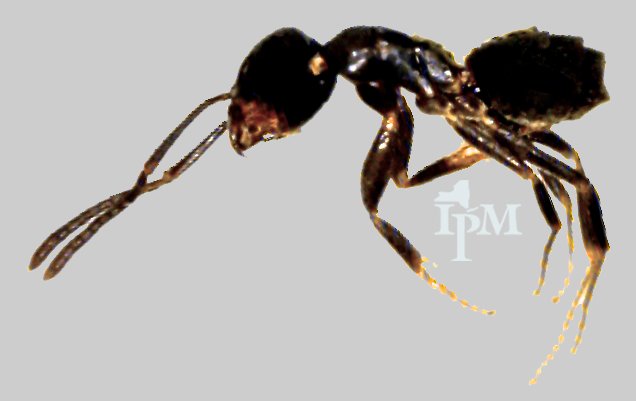
Workers are small — about 1/8 inch — uniformly dark brown to black, with no spines and one flattened, hidden node at the waist. The trails move fast and erratically, often in loose columns rather than the neat single-file lines pavement ants draw. But the field test that ends all debate costs nothing: crush one and sniff. That rotten-coconut odor is unique to the species and is literally its name. The lookalike checks, in case you want certainty before crushing anything: pavement ants are slightly larger, redder-brown, trail more slowly, and leave little soil volcanoes in driveway cracks; citronella ants smell like lemon, not coconut, and mostly show up as fall swarms; carpenter ants are two to four times the size and never trail in daytime kitchen columns (their guide is here).
Ohio’s kitchen ant has many queens and many nests, so spraying the trail splits the colony. Baiting it properly is ant control in Dayton.
“Sugar ant” is a lifestyle description, not a diet plan
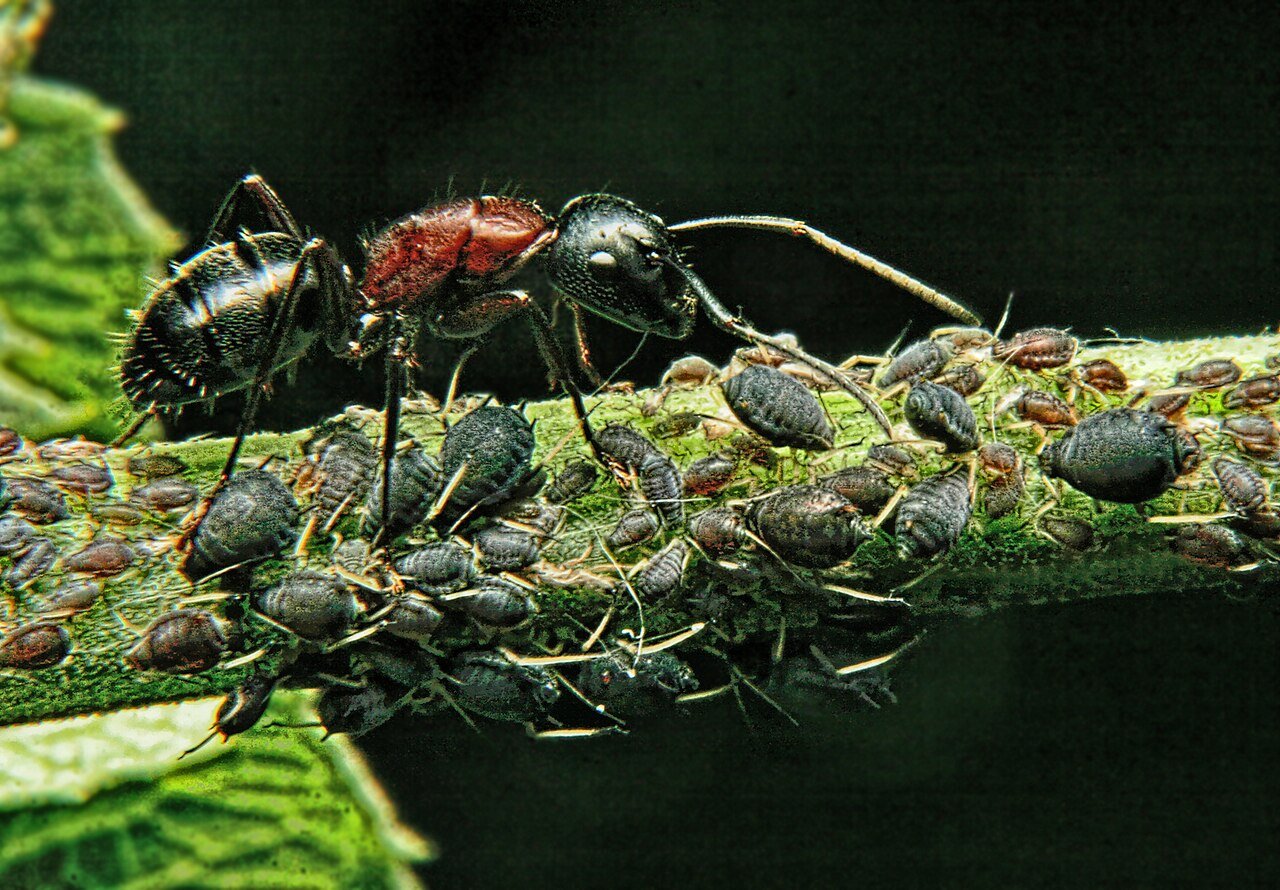
The nickname is earned — odorous house ants are obsessive sugar feeders, running trails to anything sweet: the honey drip, the juice ring, the overripe banana, the hummingbird feeder, and above all the honeydew excreted by aphids on your foundation plantings and street trees (the outdoor economy funding most indoor invasions — the same one our canopy-neighborhood pages describe). But the colony’s diet shifts with the brood cycle: come high summer, protein hunger spikes and the same species that ignored the dog food in April is all over it in July. This seasonal switching matters practically — it is why a sweet bait that worked in May can go untouched in August, and why our professional baiting rotates matrices instead of betting the job on one flavor.
The supercolony problem: why this species breaks normal ant control
Most ant species run one queen, one nest, one address — kill the queen, end the colony. Tapinoma sessile threw out that rulebook. Around human structures, odorous house ants form polydomous, polygyne supercolonies: networks of dozens of connected satellite nests sharing hundreds of egg-laying queens, spread through wall voids, slab gaps, mulch beds, potted plants, and the bath trap you have never opened. Researchers studying urban T. sessile have documented single interconnected networks spanning entire properties — while the same species, out in the woods, lives in modest single-queen colonies under a rock. Your house did not just attract ants; it upgraded them.
Every practical frustration flows from that structure. There is no “the nest” to find and destroy — there are fifteen, and they relocate on days’ notice (a rainstorm, a mulch delivery, or your vinegar attack will do it). Killing trails accomplishes nothing a thousand replacement workers cannot undo by Thursday. And the network’s signature stress response — budding, where queens scatter with brood to found new satellites when repellents hit — means every over-the-counter spray campaign is functionally a colony expansion program. We covered the chemistry side in the vinegar guide; the biology side is this paragraph. Together they explain the household you may be living in right now: three years of spring sprayings, and more trails every year.
Where the nests actually are
- Mulch and pine straw against the foundation — the number one outdoor satellite site we find; moist, warm, food-adjacent
- Under slabs and stoops — entering through expansion joints and the gap where stoop meets foundation
- Wall voids around plumbing — especially kitchen and bath walls warmed by pipes; the bath trap void is a classic
- Under potted plants, landscape stones, and tarps — lift one and watch the brood-grab evacuation
- In wall insulation and window headers — often revealed only when trails emerge from outlet plates
- Bird boxes, grill carts, and hose reels — anything hollow, dark, and dry near the sugar economy
Notice what is not on the list: wood damage. Odorous house ants excavate nothing and harm no structure — they are squatters, not carpenters. The damage they do is to counters (contamination — they walk through grime before your fruit bowl), to sanity, and to wallets via failed treatments.
The playbook that beats a supercolony
The winning strategy accepts the network and turns its own logistics against it. Bait, never spray: slow-acting sweet gel baits placed beside every active trail get carried home and shared mouth-to-mouth through workers, brood, and the many queens; because the network shares food across satellite nests, one well-placed bait line can poison nests you never located. Feed the seasonal appetite: sweet baits in spring aphid season, protein-included rotations in high summer; when a bait goes ignored, the menu changed, not the strategy. Hit the network at multiple points: interior placements at trails plus exterior stations at foundation entry lines, so the network’s food-sharing web pulls toxicant inward from every direction. Do not clean mid-campaign: the trails are your delivery infrastructure; erase them after collapse, not before. Then strip the economy: aphid-heavy plantings treated or pruned, mulch pulled back to expose a foundation strip, the drip fixed, the hummingbird feeder moved off the porch rail. A supercolony without a sugar economy shrinks back toward its modest woodland manners.
The professional version of this — what our ant control service actually runs on odorous house ant jobs — adds two tools the retail shelf does not sell: non-repellent liquid treatments the ants cannot detect (they walk through, share the dose, and never learn to avoid it — the anti-budding chemistry), and enough placements, matrices, and follow-through to collapse a whole network inside a few weeks. Plus the part that matters most on this species: the re-treatment guarantee, because supercolonies are exactly the opponent where a second pass is sometimes biology, not failure.
Prevention: the five habits that keep them out
- A visible dry strip of foundation all the way around — mulch, soil, and ivy pulled back six inches
- Aphid management on foundation shrubs and the branches over them — no honeydew, no highway
- Sweet spills owned instantly; sugar, honey, and syrup in sealed containers; the recycling rinsed
- Caulk on the routine entries: window sills, door thresholds, the gap where the counter backsplash meets the wall, plumbing penetrations under sinks
- Springtime vigilance: the first scouts of March get the bait-card treatment before the first trail ever forms
A year in the life of Ohio’s sugar ant
March–April: the network wakes; scouts appear at kitchen sinks within days of the first 60-degree stretch, following pipe warmth up from overwintering sites. This is the cheapest month to win — a colony baited now is a colony that never has its summer. May–June: aphid season opens the honeydew economy; outdoor trails run fence lines and tree trunks; indoor pressure follows rain (flooded satellite nests relocate indoors — the “ants after every storm” pattern is real). July–August: peak population, protein appetite, and the season of failed sweet baits; networks reach maximum spread. September–October: consolidation; trails thin but nests pull into structures for warmth — fall exclusion pays double. November–February: quiet but present; a January trail to the dog bowl means a nest inside the envelope, warmed by your furnace, and is worth a call rather than a shrug.
Odorous house ant questions we hear
Are they harmful — do they bite or carry disease?
No meaningful bite, no sting, no disease vectoring in the medical sense — the health concern is ordinary contamination: trails cross garbage grime and pet waste on the way to your counters, ferrying kitchen bacteria the way any unwashed foot traffic would. They are a sanitation problem and a peace-of-mind problem, not a danger. (Big black ants with sawdust are the structural story — different species, different page.)
Why are they in the bathroom? There is no food there.
Water and warmth. Supercolony satellites love the humid voids around tubs and toilets, and workers drink at the condensation and toothpaste film. A persistent bathroom trail usually flags a nest in the wet wall itself — prime placement territory for a bait card, and a classic site our technicians check first.
I found the nest under a paver and destroyed it. They came back. How?
You found a nest — one node of the network. The queens and brood evacuated mid-destruction (they are spectacular at it) and re-founded two nodes by the weekend. It is the single most instructive odorous-house-ant experience a homeowner can have: the species does not live anywhere in particular; it lives everywhere convenient. Bait the network; stop hunting nodes.
Keep going: the vinegar myth, tested · pet-safe ant control · carpenter ants · professional ant service.
Why Miami Valley homes grow such good supercolonies
Our region hands this species everything it wants. Housing stock: slab additions, mulched foundation beds, and brick veneer with weep-hole access — three of its favorite nest structures — are default features from Huber Heights starter homes to Washington Township estates. Landscape: the mature canopy neighborhoods that define Oakwood, Kettering, and old Dayton run industrial-scale honeydew economies every summer (aphids on maples and oaks feeding trails you can watch climb the trunks). Climate: freeze-thaw springs push satellite nests indoors early, and our wet Mays trigger the rain-relocation cycle repeatedly. And the human factor: two decades of retail repellent sprays have budded and re-budded the region’s networks into resilient, structure-adapted populations. When we say this is the Miami Valley’s number one ant, it is not a marketing line — it is the call log, spring after spring, from every neighborhood page on this site.
The bottom line
The odorous house ant wins against instinct and loses against patience. Identify it with the coconut crush-test, accept that you are facing a many-queen network rather than a nest, and run the bait playbook in the right order — bait beside the trails, let the surge run, rotate the menu if consumption stalls, clean and seal only after the collapse, then dismantle the sugar economy that invited them. Do that once, thoroughly, and most kitchens stay quiet for years. Or hand the whole campaign to the people who run it weekly, with non-repellent chemistry the network cannot dodge and a guarantee that makes the outcome our problem: Greater Dayton Pest & Rodent, (937) 569-3330 — free quotes, free coconut-smell second opinions, same-week scheduling everywhere in the Miami Valley.
How long does it take to get rid of sugar ants completely?
With disciplined baiting: expect the surge for two to four days, visible decline inside a week, and functional quiet in two to three weeks — longer for networks that previous spray campaigns have budded across the house, because more satellites means more shares of bait to distribute. Professional non-repellent programs run the same arc faster and with fewer stalls, because the chemistry recruits the network’s own food-sharing against every node at once. What no honest method delivers is the overnight kill — the only things that work overnight are the things that make it worse.
Do coffee grounds, cinnamon, or chalk lines stop them?
They divert trails for a day or two — the ants route around strong scents and disturbed ground — and change nothing about the network producing the trails. Every barrier remedy shares the same flaw at different prices: it argues with the workers and never addresses the queens. If a scent line kept a supercolony out of kitchens, our industry would sell scent lines.
For landlords and restaurants: the multi-unit wrinkle
One more audience needs one more paragraph, because odorous house ants in attached structures behave like their downtown cousins the German roach: the network ignores your property lines. In doubles, apartment buildings, and strip-mall kitchens, a supercolony threads shared walls and slab lines across units, so the unit-by-unit response — tenant A sprays, tenant B baits, unit C does nothing — keeps the network permanently fed and permanently mobile. The fix is the building-wide logic we run for property managers and restaurants: every unit baited on one schedule, exterior stations ringing the structure, and the trails mapped as one network because that is what they are. Landlords get documentation per visit; kitchens get placements that pass inspection. If your sugar-ant story involves a shared wall, skip the aisle products entirely — you cannot bait a building you only rent a slice of, but we can.
Whoever you are on this page — homeowner three springs deep, new landlord, line cook watching a trail behind the soda station — the free first step is identical: a photo, a text to (937) 569-3330, and an honest answer about whether this is a fifteen-dollar bait-card fortnight or a network that needs professionals. Rotten coconut has a solution either way.
What the research says (for the skeptics we love)
Everything above tracks the entomology literature, and the highlights reward a skim. Urban-ecology studies comparing T. sessile populations found the woodland form living in single-queen colonies of a few hundred, while structure-associated populations of the same species ran networks of tens of thousands with queen counts in the hundreds — among the most dramatic habitat-driven social flexibility documented in any ant. Bait-transfer studies confirm toxicant sharing across satellite nests via trophallaxis, the mechanism that makes network-wide collapse from local placements possible. And repellent-exposure trials document the budding response directly: colonies fragmented within days of pyrethroid contact, multiplying nest counts rather than reducing them. None of this is folklore or sales copy — it is why the playbook is the playbook, and why the spray aisle keeps this species in business.
Do odorous house ants ever just leave on their own?
Seasonally, yes — and misleadingly. Trails vanish when outdoor honeydew opens in May or when a satellite nest relocates after your counter campaign, and the household declares victory. The network, unharmed, simply shifted its foraging; October or next March brings it back through the same unsealed sill. Genuine departure — the network abandoning your structure entirely — follows only from the boring fundamentals: no accessible sugar, no damp harborage, no open entries. Ants audit relentlessly; make the audit fail and the quiet becomes permanent.
And if the trail you are staring at right now is your third species guess of the week — coconut smell inconclusive, size ambiguous, patience exhausted — end the guessing the easy way: one clear photo next to a coin, texted to (937) 569-3330. Species determines strategy, strategy determines success, and the identification is free every business day.
Frequently asked questions
How do I get rid of odorous house ants?
Bait with sweet liquids beside their trails and never spray — this is the one species where repellents actively multiply the problem via colony budding. Expect the bait scrum, give it a week to ten days, and clean trail routes only after traffic dies.
Why do these ants smell like coconut when crushed?
A defensive gland compound — the rotten-coconut (some say blue-cheese) odor is the species’ namesake diagnostic. One crushed scout identifies your kitchen invader more reliably than any photo.
Why did spraying make my ant problem worse?
Budding — odorous house ant colonies run multiple queens, and spray stress triggers the colony to split into several new nests, each viable. The most common DIY move on this species is the one that turns one trail into three.
Where do odorous house ants nest?
Everywhere shallow and warm: under mulch and stones, in wall voids, behind siding, under floors — often several satellite nests linked by highways, relocating readily when disturbed. It is why nest-hunting fails and bait logistics win.
Why are odorous house ants so hard to get rid of?
The trifecta: multiple queens (no single kill-shot), satellite nesting (mobile real estate), and spray-triggered budding (DIY backfires). None of it resists bait — the workers still share food with every queen — it just resists everything else.
What attracts odorous house ants indoors?
Sugar first — they are honeydew specialists, and your kitchen’s syrup drips and fruit bowls read as a superior aphid farm. Outdoors, actual aphid farms on your shrubs fund the colonies that scout you; the hose-blast on the roses is kitchen defense.
Do odorous house ants bite or carry disease?
No meaningful bite, no sting, and only mechanical germ-tracking — the file is nuisance-grade. The response stays proportionate: bait, seal, and patience beat any nuclear option.
How long does baiting take on this species?
Longer than single-queen ants — ten days to three weeks for established multi-nest networks, with traffic spiking before it collapses. Persistent trails past three weeks mean a network worth professional non-repellent treatment.
Why do they show up in the bathroom in summer?
Moisture runs — dry weeks send colonies after water, and bathrooms are the reliable oasis. Same bait protocol; fix the standing water and the trail loses its purpose.
When should I call about odorous house ants?
Two failed bait cycles, trails that relocate room to room (satellite behavior), every-spring recurrence, or winter trails (an in-structure nest) — the professional toolkit of non-repellents and colony mapping ends what the spray can multiplied: (937) 569-3330.