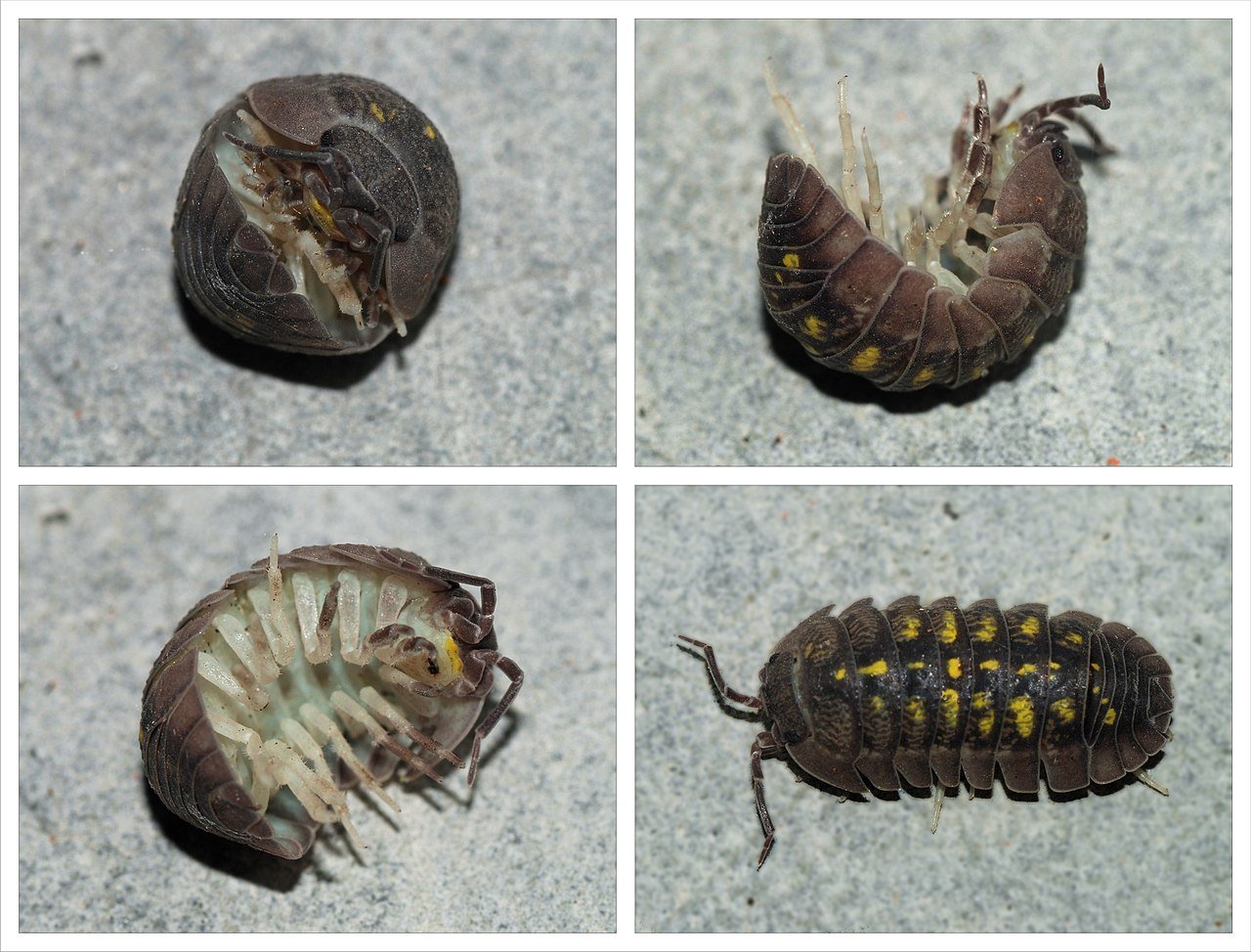
Every Ohio childhood includes the rolly polly — the gray armored pillbug that curls into a perfect sphere in a five-year-old’s palm — and every Ohio adulthood eventually includes finding a few dozen of them dead along the basement wall and wondering, for the first time, what they actually are and whether they matter. Both questions have better answers than expected. What they are: not insects at all — crustaceans, genuine land-dwelling relatives of shrimp and lobsters, breathing through gill-like structures, carrying their young in pouches, and representing one of evolution’s few successful crustacean invasions of dry land (“dry” being the operative struggle of their entire existence, and the key to every practical question below). Whether they matter: almost never as a pest — they eat decaying matter, damage essentially nothing, cannot bite, sting, or infest, and serve as one of the yard’s hardest-working decomposition crews — but always as a message, because an indoor rolly polly count is a moisture reading with legs, the fourth and final member of the basement wing’s messenger corps. The full file: the pillbug-versus-sowbug distinction (only one can roll), the crustacean biology that explains the basement die-offs, what they eat and the one seedling scenario where they earn a gardener’s attention, the woodlouse hunter (the spider that specializes in them, and startles everyone who finds it), and the moisture program that answers the whole question. Greater Dayton Pest & Rodent: (937) 569-3330.
Pillbug or sowbug? The roll test settles it
“Rolly polly,” “roly-poly,” “pill bug,” “potato bug,” “woodlouse,” “doodle bug” — the folk names all point at the same armored profile, but two different animals share it, and the distinction is the field guide’s easiest: pillbugs (Armadillidium — the genus name says it) are the rollers: dome-backed, smooth-edged, and capable of the full defensive sphere (“conglobation,” for the household’s trivia ledger). Sowbugs (Porcellio and kin) are the flatter, wider cousins with two small tail-like appendages at the rear — and they cannot roll: threatened sowbugs run or flatten instead. The distinction is ninety percent charm and ten percent practical: sowbugs tolerate slightly drier conditions and run faster, so the basement census skews sowbug in most Miami Valley homes, while the garden’s stone-and-mulch layer runs both. Everything else on this page applies to the pair equally — same crustacean biology, same diet, same message, same verdict — and both answer to “isopod,” the proper name for the whole armored order, fourteen legs and all. (The “potato bug” alias, for the record, also gets applied to the Jerusalem cricket of western states — an insect Ohio doesn’t host, whatever the search results imply; the local potato bug rolls.)
Pill bugs are a moisture problem before they are a pest problem, which is why the perimeter matters more than the spray — see how we approach pest control in Dayton.
The fix: dry first, seal second, spray almost never
- Drop the humidity: a properly sized dehumidifier holding the basement under 50% is the single decisive move — populations collapse within weeks because the animals literally cannot breathe dry air
- Fix the water: downspouts extended, grading corrected, the slow leak under the sink and the sweating pipe insulated, window wells cleaned and covered
- Starve the harborage: mulch pulled back to a six-inch visible foundation strip, leaf litter cleared, stones and boards lifted, cardboard off the concrete onto shelving
- Seal the routes: door sweeps that touch the threshold, caulk at the sill plate and basement window frames, weep holes screened
- Chemical control: honestly optional — a perimeter treatment knocks down a heavy outdoor population while you fix the fundamentals, and that is the one context where it earns its cost; interior sprays for woodlice are theater against animals already dying of dryness
Notice this is the same moisture playbook our earwig and bathroom bug guides prescribe — the whole damp-basement guild falls to one dehumidifier. When we treat “pillbug jobs,” the invoice usually reads like a building consultation with a light perimeter application, because that is what actually works, and the re-treatment guarantee means we would rather fix your gutter angle than sell you a quarterly crustacean subscription.
The crustacean handicap (and why they die on your basement floor)
The land-crustacean inheritance explains every rolly polly behavior the household observes. They breathe through pleopodal gills — modified swimming limbs that must stay moist to exchange oxygen — which chains them permanently to humid microhabitats: under mulch, stones, flowerpots and logs by day, active in the open only at night and after rain. They drink through their rear end (uropod capillary action — the trivia ledger grows), molt in halves (rear first, front days later — the two-toned individuals in the flowerpot are mid-wardrobe, not diseased), carry their broods in a fluid-filled pouch like the marsupials of the mulch, and can live three-plus years — ancient by yard-arthropod standards. And the basement scene that generates this page’s searches: isopods wander indoors through the same ground-level gaps as everything else in the fall roster, discover that conditioned interior air sits far below their survival humidity, and desiccate within a day or two — the scatter of curled gray shells along the wall is not an infestation dying of poison; it’s a landing party dying of dryness, usually within feet of the entry gap it used. Which converts the find into the diagnostic this library loves: live, active indoor isopods in numbers mean genuinely damp interior conditions (a wet slab margin, a leaking wall, the crawl-space humidity underneath) — the messenger corps’ standard testimony — while the dead-shell scatter means only that the door-sweep audit has an address. Read the bodies before sweeping them; they died delivering a moisture report.
The diet file: decomposer first, seedling nibbler rarely
Isopods eat decay — leaf litter, rotting wood, fungal threads, their own molted shells, the occasional deceased colleague — and their ecological job description is soil-building: an active isopod population shreds and pre-digests the yard’s organic fall, accelerating the decomposition economy alongside the worms and the millipede-and-springtail guild, and they’re studied for a genuinely remarkable party fact: isopods sequester heavy metals from contaminated soils, quietly detoxifying ground other decomposers avoid. The gardener’s one honest grievance: in wet springs, dense populations under mulch occasionally graze seedlings and soft fruit at the soil line — strawberry undersides, cucumber and bean sprouts, the hosta’s newest emergence — damage that gets blamed on slugs until the night flashlight shows the armored crew at work. The proportional responses, in order: elevate and dry (strawberries onto straw, seedlings in collars cut from cups — isopods won’t cross dry barriers), relocate the buffet (pull mulch back from stems the same six inches the vole doctrine already prescribed — the moat pays again), trap by attraction (the halved-cantaloupe or board trap: irresistible shelter, lifted and relocated each morning — the gentlest control in the entire library), and never insecticide — a chemical response to a decomposer aggregation is the fogger fallacy composted: it taxes the soil crew that feeds your beds to solve a problem a strawberry’s straw bed solves free. The garden keeps its janitors; the seedlings keep their collars; everyone winters happy.
The woodlouse hunter: the specialist that startles everyone
One isopod-adjacent discovery earns its own section because it generates disproportionate alarm: the woodlouse hunter (Dysdera crocata) — a spider evolved to eat exactly one thing, and equipped accordingly with the most alarming-looking fangs-per-inch in the local spider fauna: long, forward-projecting chelicerae built to pierce isopod armor, on a red-orange cephalothorax over a cream abdomen, hunting at night wherever the prey concentrates — which means under the same flowerpots, stones and mulch where curious hands go. The alarm is understandable and the verdict gentle: woodlouse hunters are medically insignificant — the impressive fangs deliver a bite comparable to a bee sting in the rare pressed-against-skin scenario, with no venom of consequence to humans; they build no webs (a silk retreat under cover, nothing more), wander alone, and their presence indoors follows their prey’s — a woodlouse hunter in the basement is a predator tracking the isopod moisture report one trophic level up, the same food-web logic as the centipede page. Response: cup-and-card, admire the specialist equipment through the glass, and file the sighting as one more signature on the moisture memo. The red spider with the big jaws was never the problem; it was the problem’s auditor.
Rolly polly questions, answered
My kid keeps a jar of them. Safe?
Completely — the isopod is arguably the perfect first pet: harmless to skin, allergen-light, hardy in a ventilated container with damp soil, leaf litter and a piece of bark, and genuinely educational (the roll, the molt-in-halves, the brood pouch — a biology curriculum in a jar). The husbandry note: keep the substrate damp, not wet, and release or refresh the crew seasonally. The hobby has an adult version — exotic isopod-keeping is a real and growing trade with collector species at collector prices — which the household’s jar-keeper can be told at the strategic moment of your choosing.
Hundreds appeared on the patio overnight after rain. Invasion?
Dispersal, not invasion: saturating rain floods the soil-level shelters and drives the population surface-ward simultaneously — the same synchronized displacement that carpets garages with millipedes in wet springs. The crowd retreats as the ground drains; the patio needs sweeping, not treatment; and the count is a free census of how rich your yard’s decomposition economy runs (rich is good — ask the compost).
Do they damage foundations or wood like termites?
No — the wood an isopod eats is already decaying; sound structure holds no interest and their mouthparts couldn’t take it anyway. The useful inversion: isopods congregating against a sill line or porch post flag that the WOOD there is staying damp — the termite-conducive condition worth fixing for reasons far beyond the rolly pollies enjoying it. They don’t cause the rot; they RSVP to it.
What actually gets rid of them indoors?
The basement wing’s standing program, fourth verse: dry to 50 percent (they desiccate below it — the dehumidifier is, once again, the treatment), sweep the door-line gaps per the twelve-doors audit, pull the mulch-and-leaf layer back from the foundation (their staging habitat IS the wall-adjacent moisture zone), and skip the perimeter spray — a barrier treatment for an animal that dies of indoor air within 48 hours is the library’s definition of paying to accelerate the inevitable. Persistent live populations indoors get the moisture inspection, because they’re never the story — they’re the bibliography.
The gentlest verdict in the book
The rolly polly closes the basement messenger corps as its most charming member: a pocket crustacean that harms nothing, teaches children, builds soil, detoxifies ground, feeds a specialist spider with magnificent jaws, and dies on basement floors solely to report your humidity in the most legible handwriting the building will ever produce. Read the report, run the dry-and-seal program one final time, collar the seedlings in wet springs, and let the armor division keep its mulch. For the moisture inspections the shells keep recommending, and the photo line that grades armored finds with genuine affection: (937) 569-3330, Greater Dayton Pest & Rodent, Dayton and all eight counties — where the yard’s smallest tank battalion gets the verdict it earned three hundred million years ago: not guilty, load-bearing, and welcome under every stone it owns.
The isopod in the ecosystem: a closing appreciation
Since this is the page where the library’s gentlest subject gets its full hearing, the wider frame: land isopods process a meaningful share of temperate leaf-fall — a single healthy yard’s population shreds pounds of litter annually into the fragments the microbial economy finishes — and the armored profile in your flowerbed is the same body plan working every continent except Antarctica, from desert species that huddle by day to the giant isopods patrolling ocean floors at crushing depth (the deep-sea version runs to sixteen inches, a fact that improves every jar-keeper’s afternoon). Their sensitivity runs the useful direction too: as moisture-and-metals indicators, isopod counts feature in soil-health and contamination research — the same messenger duty they perform on your basement floor, performed for science at scale. None of which a household needs to manage anything; all of which reframes the management correctly: the rolly polly is the yard working as designed, the basement shells are the building reporting as built, and the entire “control” question resolves — as the basement wing’s questions always have — into one hygrometer, one caulk gun, and one six-inch mulch gap, deployed once, effective against the whole damp-loving guild at a stroke. Four messengers, one memo, one fix: the wing closes with its cheapest and cheerfulest chapter, and the five-year-old with the jar had the right relationship with the subject all along.
The moisture memo, consolidated (the basement wing’s final exam)
With the messenger corps complete — silverfish, centipedes, sprickets and now the isopods — the consolidated read a homeowner can run in one basement visit: silverfish present = humidity high plus starch-and-paper food (storage triage joins the fix); centipedes present = humidity high plus a standing prey base (census the sticky cards for what’s feeding them); camel crickets present = humidity high plus dark undisturbed harborage (declutter joins the dehumidifier); live isopods present = humidity high at the FLOOR level specifically (slab moisture, wall seepage, or the crawl space breathing up — the reading that points below); dead isopod shells only = entry gaps at grade, interior actually dry (the one all-clear in the set — caulk and done); two or more messengers together = the full program, run once: dehumidifier to 50, vapor barrier if the crawl is bare, gutters and grading outside, twelve-doors seal at grade, storage into totes. One weekend, roughly $400 at the top end, and the entire four-species corps — plus the Oriental roaches, the termite-conducive margins and the mold nobody photographs — loses its habitat in the same stroke. The messengers were never four problems; they were one memo with four signatures, and the building has been trying to hand it over for years. Signed, sealed, dehumidified: delivered.
The eight-county isopod census
The local distribution notes, brief and familiar by now: the stone-foundation historic cores host the densest wall-adjacent populations (seeping masonry keeps the staging zone humid — Oakwood window wells run isopod condominiums), the mulch-generous suburbs of Beavercreek and Centerville supply the foundation-bed aggregations the six-inch gap disperses, the garden-and-strawberry properties of the rural counties file the springtime seedling grievances the collars answer, and every county’s walkout basements and patio doors collect the post-rain landing parties whose shells write the door-sweep memo. Nothing on the map changes the verdict; everything on it confirms the pattern this wing has documented four times over: the damp-loving guild goes where buildings stay damp, and stops where they don’t. One more stone lifted, one more armored crew beneath it doing honest work — and one more page closed with the animal better understood than feared, which remains the only conversion this library has ever really sold.
The board trap: the library’s gentlest control, illustrated
Closing with the technique that best fits the subject: the board trap, for the garden that wants its isopod numbers trimmed without a drop of anything. Lay a scrap board, a halved cantaloupe rind, or a damp rolled newspaper on the soil near the seedling casualties at dusk; by morning the local isopod population has aggregated beneath it — irresistible shelter plus food in one — and the entire management operation is lifting the board and relocating the crew to the compost pile, where the same appetite that nicked your bean sprouts becomes a processing asset. Repeat for a week and the bed’s population rebalances; leave a permanent board at the compost as the designated staging area and the yard runs its own relocation program indefinitely. It’s the designated-nest-site trick translated to the ground floor, the gentlest entry in a library that has graded every control from caulk to antivenom — and the right note to end on: a pest page whose treatment section is, in full, a melon rind and a short walk. Some problems require the truck; this one requires breakfast’s leftovers. The library’s scale runs the whole distance, and knowing where each problem sits on it was always the entire product.
Fourteen legs, one roll, zero offenses — the palm-sized armadillo of every Ohio childhood, acquitted with honors and returned to its stone.
Look-alike check: what else is armored and gray down there
Three basement residents get filed under “roly-poly” by mistake, and two of them matter more. Millipedes — longer, rounder, many more legs, and they coil into a spiral rather than a ball; same moisture message, same fix, slightly more odor when crushed. Silverfish — teardrop-shaped, silvery, three tail bristles, fast: unlike woodlice these do eat things you own (book bindings, starched fabric, wallpaper paste) and a standing silverfish population earns actual treatment along with the humidity work. Carpet beetle larvae — fuzzy, banded, slow, found near baseboards and closets: also a genuine fabric pest, covered in their own guide. The sorting rule: armor plates and fourteen legs, relax and dehumidify; bristles or fuzz, keep reading this site. And when the flashlight verdict is ambiguous, the photo-text to (937) 569-3330 remains the free tiebreaker it has been all along.
Do pillbugs mean my house has termites or wood rot?
They flag the conditions, not the pests. Woodlice eat wood only after fungus has already softened it — so a cluster feeding on a sill plate or joist end is announcing rot in that wood, and chronically damp wood is also the welcome mat subterranean termites look for. Finding woodlice on structural lumber (rather than floors and litter) upgrades the situation from “dehumidify” to “get the wood looked at” — a free call for us either way, and one of the odd little early-warning services this humble crustacean provides.
The crawl-space chapter: where woodlouse populations actually live
The heaviest indoor populations we find are never in finished basements — they are under the additions. Crawl spaces with bare-earth floors, the standard construction under countless Miami Valley family rooms and sunrooms, run at ground humidity year-round and stock everything a woodlouse economy needs: damp soil, fallen insulation, scrap lumber from the original build, and darkness. A colonized crawl space seeds the rooms above through every plumbing penetration and duct chase — the mystery of “pillbugs upstairs in the hall bathroom” is almost always a crawl space downstairs running its own climate. The fix scales with the finding: a vapor barrier over bare earth (six-mil plastic, lapped and taped — a weekend job that transforms the space), insulation refitted off the ground, scrap wood removed, vents balanced seasonally, and where chronic wetness persists, the conversation about drainage happens with facts instead of guesses. We inspect crawl spaces on every rodent and moisture-guild job because they are where the building tells the truth — and if yours has been farming crustaceans under the family room, better to learn it from a flashlight than from the floor joists a decade later.
What about diatomaceous earth for pillbugs?
It works where it stays dry — which, for an animal that only lives where it is damp, is the whole joke: the places DE would kill woodlice are places woodlice refuse to be. A thin band in a genuinely dry entry gap or under a raised threshold can intercept wanderers; everywhere else the humidity that sustains the pillbugs deactivates the powder within days. Our full DE guide covers the chemistry; the woodlouse-specific verdict is: fix the moisture and you will not need the powder, keep the moisture and the powder will not work. There is no product on any shelf that outperforms sixty dollars of dehumidifier against this particular guest — and any company that quotes you a quarterly spray program for roly-polies without once saying the word “humidity” has told you everything you need to know about the quote.
So the next time a small gray tank trundles across the laundry-room floor, you will know the whole story: an ancient, harmless, lobster-blooded decomposer, lost indoors, breathing your basement’s report card through its gills. Roll it gently onto a dustpan, return it to the mulch it came from, and go check what the report card said — and if the answer needs more than a dehumidifier, the free inspection is one call away.
Frequently asked questions
What are rolly pollies, really?
Crustaceans — pill bugs are terrestrial woodlice, closer kin to shrimp than to insects, breathing through gill-like structures that chain them to moisture. The backyard’s most charming pseudo-bug is functionally a tiny land shrimp.
Are pill bugs harmful to people, pets, or houses?
Completely benign — no bites, no stings, no disease, no structural anything; a curious dog can even eat one consequence-free. Indoors they are moisture refugees dying of dryness; outdoors they are the compost workforce.
What is the difference between pill bugs and sow bugs?
The roll: pill bugs (rolly pollies) conglobate into perfect spheres; sow bugs are flatter, with tail-like appendages, and cannot roll. Identical ecology otherwise — both are moisture-bound detritus recyclers with the same management file.
Why are pill bugs in my basement?
A moisture report — they survive indoors only where humidity stays high, so a standing basement population certifies damp: seepage, condensation, or ventilation failure. Dry the space below 50% and they cannot remain; the dehumidifier is the whole treatment.
How do I get rid of rolly pollies inside?
Vacuum the visitors, dry the room, and close the grade-level routes — sweeps, thresholds, and the foundation-line cleanup (mulch and leaf litter pulled back to a dry band). No spraying warranted, ever, for this species.
What attracts pill bugs to a foundation?
The damp-organic band: deep mulch, leaf drifts, stones and stepping pavers over moist soil, downspout discharge zones. Every item doubles as harborage for the pests that matter, which is why the moat program keeps appearing across this library.
Do pill bugs damage gardens?
Marginally — primarily detritus-eaters, they occasionally graze seedlings and strawberries at high densities in wet years. Morning-watering discipline and a dry mulch surface mostly resolves it; they prefer the dead matter they evolved for.
Why do they curl into balls?
Conglobation — armor-plating against predators and, crucially, against drying out; the sphere conserves moisture. It is also the ID: the roll distinguishes the pill bug from every superficial look-alike.
Are pill bugs a sign of other pest problems?
Directionally, yes — a pill-bug-friendly foundation (damp, mulched, sheltered) is also ant-friendly, millipede-friendly, and camel-cricket-friendly. Their presence grades your moat; treat them as a free perimeter audit.
When would pill bugs ever need pest control?
The species, never — the conditions, sometimes: standing indoor populations mean a moisture problem worth professional diagnosis, and mass foundation congregations mean the perimeter band needs the drainage-and-habitat work: (937) 569-3330 for the audit, with the rolly pollies as star witnesses.