
New Paris is the far edge of the map — the last Ohio village on the old National Road before the Indiana line, tucked into Jackson Township in Preble County’s northwest corner, with Whitewater valley country beginning just beyond the state marker. Out here the pest file is pure west-county: pike-era village stock, farm sections in every direction, and the particular self-reliance of a community that has always been a long way from everyone’s service area. That last part is the point of this page: Greater Dayton Pest & Rodent runs New Paris on the western leg of our Preble route days — the full service list, no mileage lines, and the same guarantee that anchors the whole site, delivered to the state line and the lanes beside it.
The west-county file
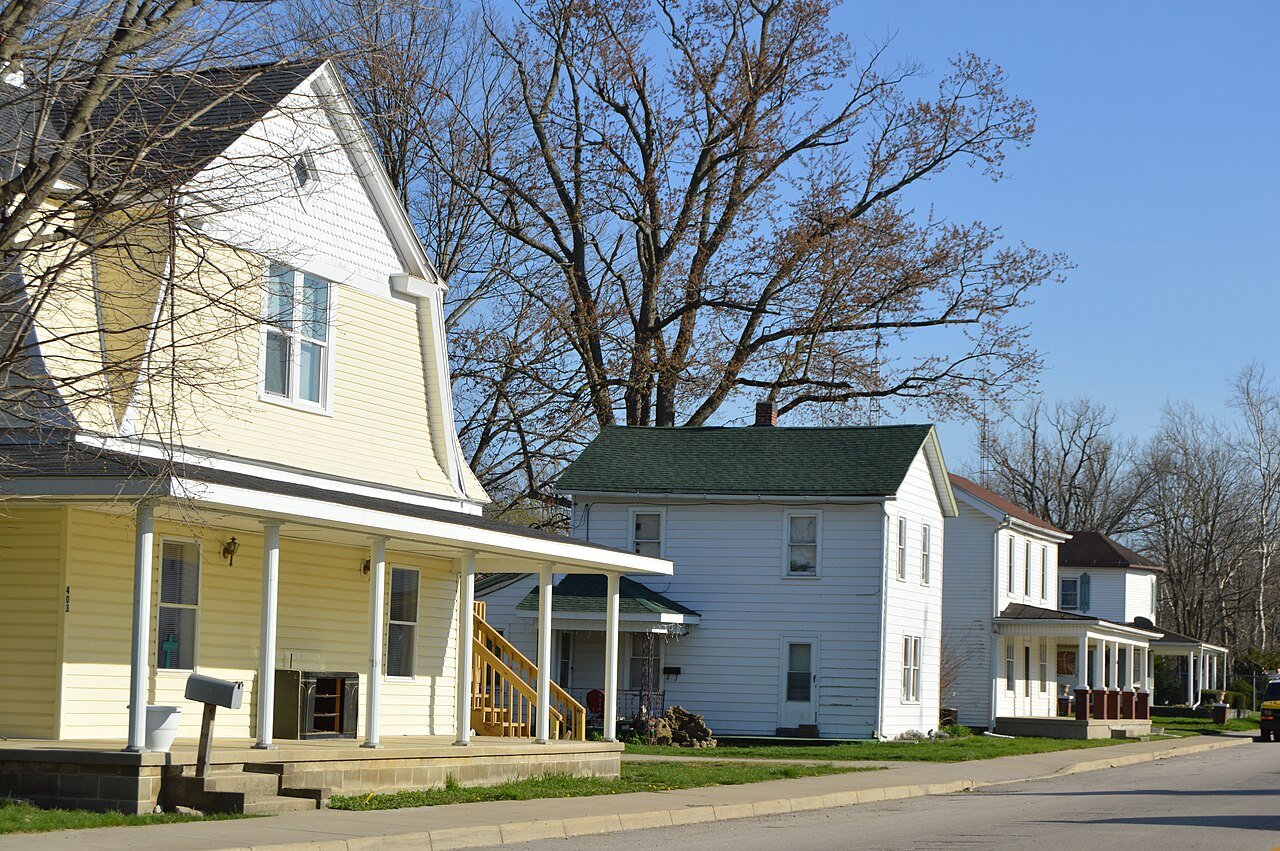
New Paris runs the county playbook at full strength. The village stock — National Road-era homes and their twentieth-century neighbors — carries the old-foundation exclusion work, porch wasp seasons, and cellar moisture chapters the county hub details. The surrounding sections deliver the rural calendar undiluted: the harvest mouse push hits the westernmost farms first most years, cluster flies and lady beetles mass on every sunny farmhouse wall, barn and shed wasp populations scale all summer, and the campus logic — house, barn, feed room, equipment — governs every township quote. The border adds one practical wrinkle worth naming: state-line properties whose ground straddles Ohio and Indiana are fully serviceable on their Ohio structures under our Ohio licensing, and for the rare job that genuinely crosses the line, we sort the jurisdiction honestly on the phone before anyone schedules anything. The mice do not carry maps; the license rules do; we know both.
The New Paris playbook
- September defense — the west county harvests early and the barrier visit is timed to it
- Campus scoping — every township address read as a whole property, feed room first
- Old-stock exclusion — mortar, mesh, and steel on the pike-era foundations
- The photo-first habit — at the map’s far edge, the free ID line saves more diagnostic trips than anywhere else in the county
- Transaction inspections — Category 12 WDI reports for village and farm real estate, scheduled against closings
A New Paris seasonal calendar
- March–May: village ants wake; termite swarm season in the pike-era stock; cluster flies exit the farm attics on the first warm week
- June–August: barn and porch wasps scale; carpenter bees work every unpainted board; the open-country insect economy webs the porch lights nightly
- September–October: the west county’s early harvest opens the mouse push; invader flights follow on the sunny walls; the scheduled September visit answers the season in one stop
- November–February: interior mouse season; sunny-day cluster flies; the quiet months for exclusion carpentry and pre-listing inspections
New Paris questions we hear
Honestly — will a Dayton company really keep showing up this far west?
The route economics say yes, and the structure of the promise matters: New Paris rides scheduled western route days rather than ad-hoc dispatch, which is precisely what makes the distance sustainable for both sides — your jobs book onto trucks already crossing the county, follow-ups and guarantee visits ride the same rhythm, and no invoice ever carries the drive. The dishonest version of serving the west county is the long-window, maybe-Thursday franchise experience this area knows too well; the honest version is a calendar, kept. Ours is, and the county page explains the whole system.
Our problem is in the barn, not the house. Worth a call?
Absolutely — outbuilding-only jobs are half the west county’s work: wasp colonies over the equipment, the feed room’s mouse economy, deer mice in the stored camper, carpenter bees rebuilding the shed’s eaves annually. Barns get honest triage (manage the structure, harden the rooms that matter) rather than fantasy quotes to seal a century of board gaps, and the barn call often becomes the campus walk that catches the house problem still small. Send the barn photo like any other — the free ID line does not care which building the specimen came from.
Preble coverage: county hub · Eaton · Lewisburg · Eldorado · full service area.
Jackson Township and the border farms
The sections around New Paris — Jackson Township running to the state line, the lanes north toward the Darke County seam — hold some of the county’s prettiest farm campuses and its most weathered ones, and both get the same reading: the house sealed to the twelve-doors standard, the feed and shop rooms hardened with steel, the barns triaged honestly, and the September calendar kept. Border-country properties add two local notes. First, the wind: the westernmost farms take the county’s weather first and hardest, and wind-worn siding, lifted flashing, and storm-loosened soffits open pest doors faster here than anywhere east — our fall visits double as envelope checks for exactly this. Second, the distance discipline: at the map’s far edge, the households that photograph early and book the scheduled visits simply have quieter years than the ones that wait for problems to mature — a pattern true everywhere, sharpest here. The National Road’s last Ohio village has always known how to keep things running a long way from town; we are pleased to be part of the supply line now.
The bottom line for the state line
New Paris gets the county playbook at full strength and the route commitment in writing: scheduled western days, campus-literate technicians, September defense timed to the early harvest, exclusion craftsmanship on the pike-era stock, and every guarantee this site makes, honored to the last lane before Indiana. Free quotes, free photo identification, Saturdays by appointment: (937) 569-3330. The road through town has connected New Paris to everywhere for two hundred years — consider us its newest regular traffic, westbound with steel and a schedule.
What about the hunting cabins and weekend places out this way?
The west county’s cabins, weekend farms, and seasonal properties run the vacant-structure playbook: anything closed for weeks becomes winter quarters for deer mice (the safe-cleanup protocol on that page is written for exactly the spring-opening scene), wasps claim the eaves uncontested, and cool vacancy preserves whatever arrived in a sleeping bag. The ownership habits that work: the fall close-up done defensively (traps set, food out, gaps sealed), the spring opening done with gloves and the wet-method cleanup, and our vacant-property monitoring for the places worth more protection — scheduled walk-throughs with a photo report each visit, the same service our estate-lot page describes, priced for cabins rather than estates. The best weekend place is the one that does not start every season with a shovel and a grimace; twenty minutes of protocol per transition gets you there.
Who actually turns up in New Paris: Greater Dayton Pest & Rodent is owned and operated by Bryan Camden, licensed by the Ohio Department of Agriculture — firm #115079, commercial applicator #170858, categories 10A, 10B and 12. When you call, you talk to the person who does the work. No call center, no rotating crews, and the same technician on every visit.
Frequently asked questions
Do you provide pest control in New Paris?
Yes — the westernmost Preble village on the Indiana line rides the rotation; the state line is not a service line.
What pests are most common in New Paris?
Border-belt files: harvest surges at full strength, older-core mice, farmstead wasp economies, stored-grain pests, and the flights off acreage in two states.
How much is pest control in New Paris?
County formula, border distance irrelevant: most homes $39–$55/month quarterly; campuses walked; free: (937) 569-3330.
Does living on the state line change anything?
Only trivia — the pest pressure is bi-state and identical; service, pricing, and route days match the rest of the county exactly.
Why the annual fall surge?
The belt equation at its purest — maximum acreage, minimum buffer; September sealing plus sentries is the whole defense.
How fast can you reach New Paris?
Weekly western rotation — days typically, no travel charges to the county’s far edge.
Do you serve New Paris businesses?
Yes — village spots and ag operations, matched programs, documentation included.
What about the farmsteads?
Campus model — systems quotes, harvest calendars, grain protocols, deer-mouse defaults; the border lanes are standing work.
Is the Protection Plan right here?
The farm-adjacent majority, clearly; honest triage for the village core.
How do I start service in New Paris?
Instant quote, free photo ID, or (937) 569-3330 — free estimates, route days weekly.