
The shield-shaped brown bug on your curtain has already answered one question on this site — yes, stink bugs fly, noisily and badly — and its household file has two questions left, both worth straight answers because both change behavior. Do stink bugs bite? No — and not the way the gnat answer was no: a stink bug is anatomically incapable of biting anything, human or otherwise, because it has no jaws at all — its mouth is a straw. What do stink bugs eat? Everything that straw reaches in your garden and orchard — which is why the insect that can’t hurt you personally costs American agriculture tens of millions annually and put a $37 million dent in mid-Atlantic apples in a single infamous season. That inversion — harmless houseguest, expensive field pest — runs this entire page: the piercing-straw anatomy that settles the bite question forever, the honest explanation for the welts people blame on stink bugs, the crop-and-garden damage file with its signature dimpled fruit, the egg clusters worth recognizing on your tomato leaves (and the famous parasitic wasp that polices them), and the household playbook that’s mostly about September, not sprays. Greater Dayton Pest & Rodent — the fall-invader file’s final chapter, photo verdicts free: (937) 569-3330.
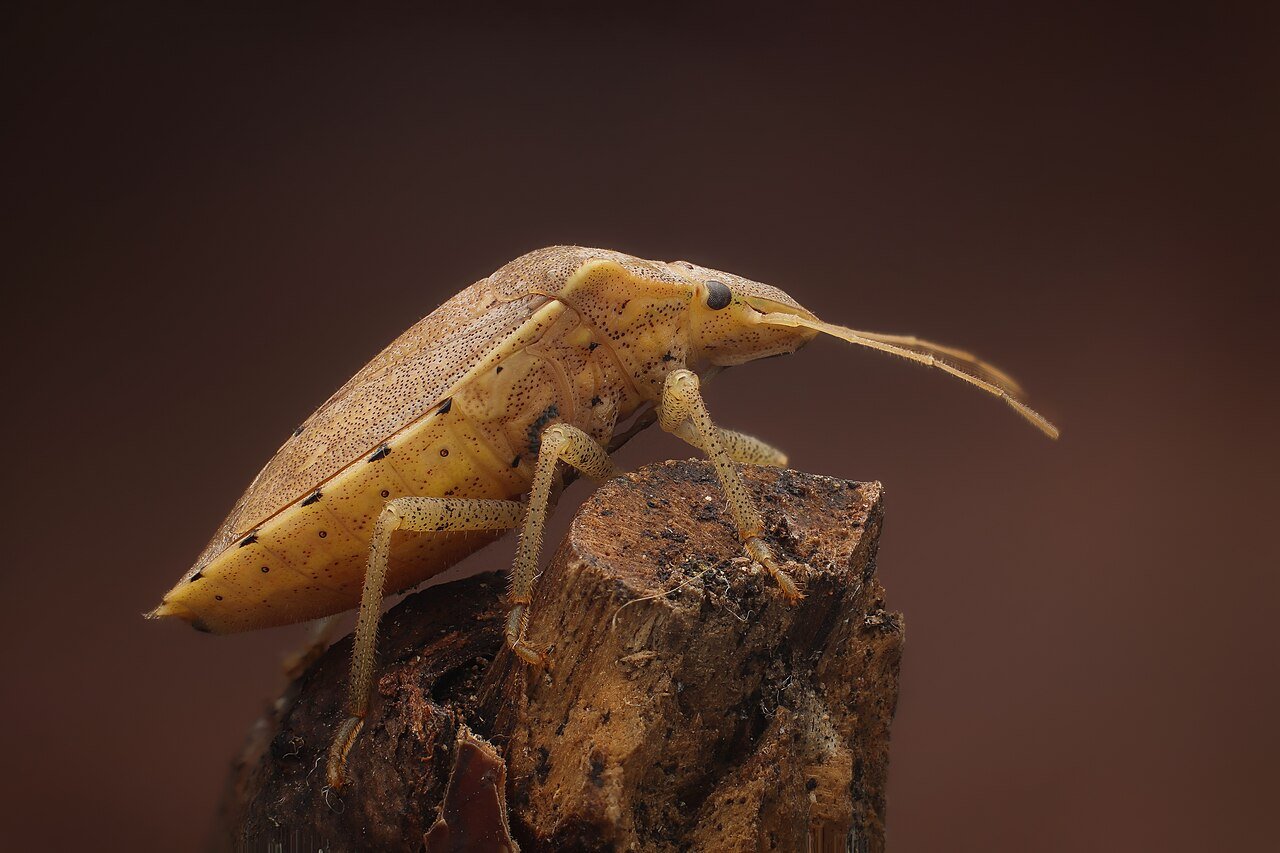
The straw, not the jaw: why a stink bug cannot bite
Stink bugs belong to the “true bugs” (Hemiptera), and the order’s defining equipment settles the question at the anatomical level: instead of mandibles, every true bug carries a rostrum — a segmented, straw-like beak folded flat beneath the body, containing needle-thin stylets built for one job: piercing plant tissue and drinking. A brown marmorated stink bug’s rostrum is engineered for apple skins and soybean pods; deployed, it works like a drinking straw pushed into a juice box — and it has no cutting, gripping or chewing function whatsoever. The insect cannot bite you for the same reason a soda straw cannot: wrong tool, no motive, no mechanism. Handled roughly, a stink bug’s entire defensive repertoire is the one the name advertises — the cilantro-and-burnt-rubber spray from its thoracic glands, unpleasant and unpersuasive — plus, in genuinely rare pressed-against-skin cases, an exploratory probe with the rostrum that a handful of people ever feel: a brief pinprick, a tiny red dot, gone by morning, no venom, no saliva reaction of consequence, essentially the insect mistaking a sweaty palm for a leaf. The distinction from actual biters is total — no anticoagulants, no feeding interest, no repeat customers. So the welts that get blamed on the curtain bug have other authors, and the roster is familiar from this library’s what’s-biting-you triage: sleep-window clusters go to the bed bug inspection first, ankle work to fleas, fall itches to dry-skin dermatitis — and the stink bug, whose file contains exactly zero confirmed feeding events on humans in the entire scientific record, goes back to the curtain with its reputation intact. On this one charge, at least.
What the straw actually drinks: the $37 million appetite
Acquitted on assault, convicted on grand larceny: the stink bug’s straw is one of agriculture’s most expensive instruments. The brown marmorated stink bug — the Asian import that arrived stateside in the 1990s and reached Ohio by the 2010s — is a generalist with documented feeding on well over a hundred host plants, and its technique is what makes the damage distinctive: the stylets pierce fruit skin, inject digestive enzymes, and withdraw liquefied cell contents, leaving dimpled, cratered, corky-fleshed fruit — the “cat-facing” disfigurement that renders apples and peaches unsellable, the cloudy spot in tomatoes, the aborted pods in soybeans, the shriveled kernels at the tips of sweet corn. The infamous 2010 season cost mid-Atlantic apple growers alone that headline $37 million, and Ohio’s specialty growers — the orchards and truck farms threaded through our Preble and Miami County routes — now scout for it as a standing line item. The backyard version reads smaller but identical: dimpled tomatoes blamed on blight, raspberry patches gone bland (stink bug feeding drains the drupelets), pepper walls with corky patches, and the general late-summer garden malaise that a hand lens and this paragraph diagnose in minutes. The tell that separates stink bug work from disease or blossom-end rot: external dimples with a pale puncture point at each crater’s center, scattered shotgun-style rather than concentrated at the blossom end — each dimple one insertion of the straw that cannot bite you.
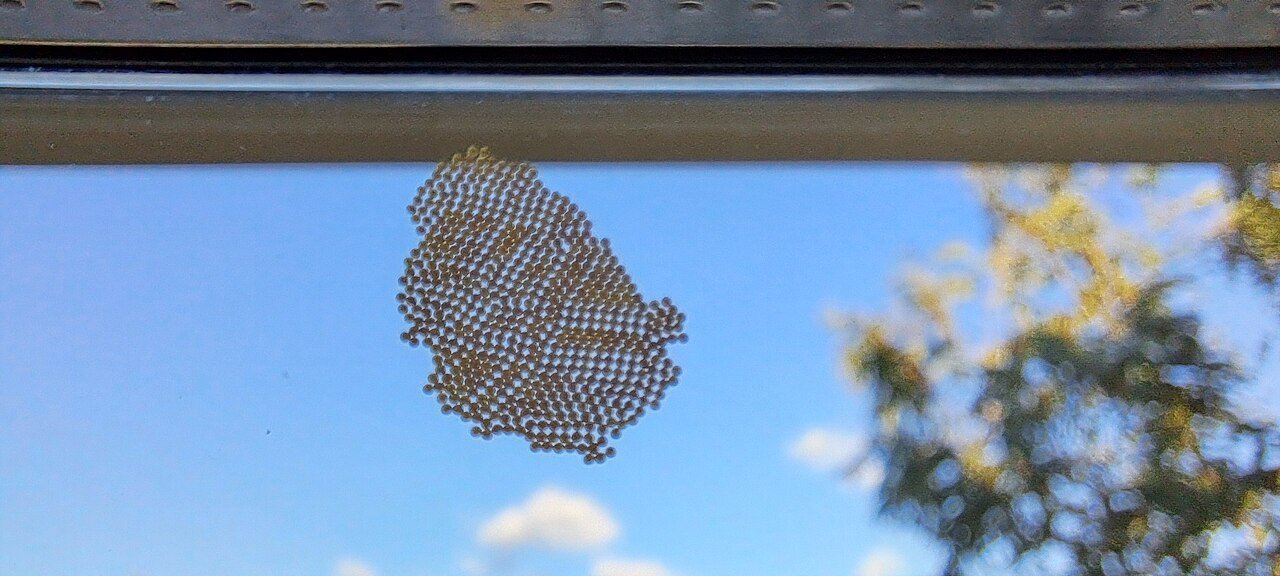
The egg file: barrels on the leaf underside
Garden-side stink bug control runs through the eggs, and they’re unmistakable once seen: clusters of 20 to 30 pale barrel-shaped eggs, packed in tidy hexagonal geometry on leaf undersides — light green to pearly white when fresh, darkening before hatch, with each barrel’s lid showing a ring of tiny spines. Females lay repeatedly from June through August (a single female placing 200-plus eggs across a season), favoring tomatoes, peppers, beans, sunflowers and the weedy margins — and the just-hatched nymphs cluster on the empty barrels for days, black-and-red ladybug-adjacent dots that generate their own share of misidentified photos. The household protocol is gratifyingly manual: flip leaves weekly during the laying months, and crush or drop any cluster into soapy water — each removed cluster is thirty fewer September window visitors, and the math compounds across a garden. But check one thing before crushing: black barrels with no spine-rings and a metallic sheen may be parasitized — the samurai wasp (Trissolcus japonicus), a gnat-sized parasitoid that followed its host from Asia and now operates in Ohio, lays its own eggs inside stink bug eggs, and each parasitized barrel launches another wasp instead of another stink bug. Dark, discolored or oddly metallic clusters are the biological control working; leave them to finish, and enjoy having a yard where the beneficial-wasp file keeps gaining chapters. The samurai wasp is, at continental scale, the most promising long-term answer to the whole BMSB invasion — and it fits in this sentence because it fits on a pencil eraser, twenty at a time.
The household playbook: September decides the winter
Indoors, the stink bug question was always a calendar question, and the full doctrine lives on our fall invaders page — here’s the stink-bug-specific distillation. The fall aggregation instinct sends BMSB seeking overwintering crevices on the first cool-after-warm days of September, guided by aggregation pheromone toward the same sunny south-and-west walls every year — which means the entire indoor season is decided in the two weeks before they fly: the caulk-and-sweep pass (window frames, siding gaps, utility penetrations, chimney flashing, the attic vent screens), the twelve-doors audit run for insects, closes the building to the aggregation before it forms; after the flight, every sealed gap is a bug overwintering in your wall void instead of your den. Once inside — and some always get inside — the winter protocol is mechanical and scent-aware: the jar-and-flush or the dedicated shop-vac (a nylon stocking in the hose collects them without perfuming the vacuum — the trick every heavy-pressure household learns by February), never the swat-and-smear that releases the namesake defense onto curtains, and never, per the standing fogger verdict, an indoor insecticide response to an insect that neither breeds nor feeds indoors — the winter walkers are dormant survivors emerging on warm days, not an infestation, and they die or leave by May regardless. What the professional layer adds where pressure is heavy — the woods-adjacent homes and historic stock with unsealable envelopes: a timed exterior barrier treatment on the aggregation walls in early September, intercepting the landing party at the siding — part of the Protection Plan’s fall anchor visit, and the one chemical intervention in the whole stink bug story with honest returns.
Stink bug questions, answered
Something bit me and there was a stink bug in the room. You’re sure it wasn’t the bug?
Anatomically sure — the equipment cannot do what the welt claims. The stink bug is the insect world’s most visible alibi: conspicuous, slow, and present at the scene of crimes it cannot commit. Run the standard triage — bite location, pattern, timing — and the real author turns up on the usual-suspects list; the sleep-window inspection outranks every curtain-bug theory, tonight as always.
Is the stink actually harmful? My dog ate one.
The spray is an irritant, not a toxin: the dog got a bitter mouthful and a life lesson (most learn in one), with drooling or a brief upset stomach the worst typical outcome — no veterinary emergency in an otherwise healthy pet. For humans, the compounds can irritate skin and eyes on direct contact (wash, rinse, done), and the smell on fabric yields to laundering. The bug’s chemistry, like its straw, was never aimed at your household.
Why does my house get hundreds and my neighbor’s gets none?
Aggregation pheromone plus architecture: scouts that find good overwintering crevices mark the site chemically, recruiting the neighborhood’s population to proven real estate — and the winning houses share a profile: sun-warmed south/west exposure, woods or crop fields within flight range, and gap-rich cladding (cedar, historic wood, stone). Once a house wins a few autumn elections it keeps winning — unless the September seal-and-barrier program changes the ballot, which is precisely its job.
Do stink bugs damage the house itself over winter?
No — they don’t chew, nest, breed or feed indoors; the overwintering crowd is inert cargo in your wall voids, guilty only of staining fabric when crushed and startling the occasional January afternoon. The house damage file for this species is empty; the garden and orchard file, as documented above, is where the species does its stealing.
The file closes
So the stink bug’s household dossier completes across two pages: it flies (badly), it cannot bite (structurally), it costs orchards millions while costing your family nothing but odor and startle, its eggs are findable and crushable all summer, and its entire indoor season is won or lost at the caulk line in early September. The response budget follows the evidence — garden vigilance in June, leaf-flipping through August, the seal-and-barrier pass before the flight, the stocking-vac after, and not one dollar of indoor insecticide ever — with the heavy-pressure houses adding the fall anchor visit’s exterior barrier, the one treatment this insect has ever justified. For the aggregation-wall assessment, the September scheduling, or the photo of whatever else the curtain hosts: (937) 569-3330, Greater Dayton Pest & Rodent, Dayton and all eight counties — where the fall invaders meet a sealed building, and the library’s latest batch meets its final period.
The invasion story, told properly
The brown marmorated stink bug earns a fuller telling of how it got to your curtain, because the story explains both the problem’s scale and its trajectory. Native to East Asia, BMSB reached Pennsylvania in the mid-1990s — the accepted account runs through shipping containers into Allentown — and found a continent with its food everywhere and its enemies nowhere: the parasitoid wasps that hold it to minor-pest status in Asia stayed behind, and North America’s generalist predators found the shield bug’s chemical defense discouraging. The result was textbook invasion ecology — exponential spread through the 2000s, the mid-Atlantic fruit catastrophe of 2010, detection in Ohio shortly after, and today a range covering most of the continental U.S. But the second half of the story is quietly turning: the samurai wasp arrived on its own (first detected stateside in 2014, now established across much of the BMSB range including Ohio), native predators from wheel bugs to praying mantises have been learning the menu, and long-term monitoring in the earliest-invaded regions shows populations well off their catastrophic peaks — not gone, but negotiating toward the managed-pest equilibrium invasions eventually reach. Your house is a data point in that arc: the fall aggregations of the 2010s were the invasion’s high-water mark in most Ohio neighborhoods, and the September seal that protects your den this year is a bridge to the decade when the wasps, the wheel bugs and the odds finish the job at landscape scale. Few pest stories in this library end with “the ecosystem is handling it”; this one, cautiously, does.
The eight-county pressure map
Local calibration for the September planning: stink bug pressure tracks the woods-and-crops interface, so the heaviest aggregation-wall houses sit where field meets forest meets siding — the wooded subdivisions of Beavercreek and Waynesville, the orchard-adjacent properties threading Miami and Warren counties, and every farmhouse on the Preble grid backing onto soybeans, where the harvest-eviction that fills field-edge houses with mice runs a parallel insect edition — combines roll, the soybean buffet closes, and the BMSB population lifts toward the nearest warm wall the same week. The historic cores add the gap-rich cladding factor: cedar and century wood from Oakwood to the courthouse squares gives the aggregation more doors than any caulk gun fully closes, which is where the exterior barrier earns its keep. The newer vinyl suburbs draw the lightest crowds — tighter envelopes, fewer crevices — and mostly meet the species as a garden matter. Wherever your address lands on that map, the calendar is identical: leaf-flips through August, caulk by Labor Day, barrier on the sun walls if history warrants, stocking-vac standing by for the stragglers — and the whole file, like the insect, quiet by May.
Batch complete: what this library now covers
This page closes a twenty-one-chapter expansion of the pest library, built — like everything on this site — from the questions the Miami Valley actually types at midnight: the moles-versus-voles yard diagnosis, the humane mouse doctrine, the drain fly and gnat source-fixes, the basement moisture trilogy with its fastest resident, the roach files from nymph to waterbug to flight myth, the droppings decoder, the tick and red-bug outdoor files, the swarm-day manual, the borax verdict, and the great acquittals — crane flies, wolf spiders, mud daubers, cicada killers, and this shield-shaped defendant — alongside the hornet triage that tells you which winged giant actually warrants the call. One standard ran through all of it: identify first, treat the source, respect the evidence, and say plainly when the answer is free. That’s the library; that’s the company. (937) 569-3330 for everything the pages can’t settle — and there’s always something, which is why the trucks still roll.
And the shield bug itself, cleared of biting and convicted of everything orchard-shaped, returns to the curtain it never should have left — flightworthy, jawless, mildly fragrant, and thoroughly documented. Jar, lid, windowsill, done: the gentlest eviction in the book, for the batch’s final defendant. See you at the caulk line in September.
Twenty-one questions asked at midnight; twenty-one honest answers by morning. The library grows, the phone line holds, and the Miami Valley sleeps a little easier per page.
Straw, not jaw. Seal, not spray. September, not panic. File closed.
Twenty-one for twenty-one, every page past the mark.
Frequently asked questions
Do stink bugs bite humans?
Cannot — the brown marmorated stink bug’s mouthpart is a plant-juice straw physically incapable of piercing skin. Every “stink bug bite” is either another insect or skin irritation from the defensive fluid, which can redden sensitive skin on contact.
Can stink bugs hurt you at all?
The complete injury list: the odor, potential fabric stains, and a rare mild skin irritation from handling the defensive chemicals barehanded. No bites, no stings, no venom, no disease — the shield bug’s entire defense budget went into the smell.
What bit me if a stink bug was nearby?
Coincidence plus a lineup: mosquitoes and no-see-ums for exposed-skin welts, fleas at the ankles, mites in rodent-history rooms, and the masked hunter or minute pirate bugs for genuinely sharp surprise pokes. The stink bug alibi is airtight; run the differential on the actual suspects.
Are stink bugs harmful to dogs or cats?
A mouthed stink bug delivers a taste lesson — drooling, head-shaking, occasional brief vomiting — and no toxicity beyond it. Most pets retire from stink bug hunting after one seminar.
Why did my skin get irritated after touching one?
The defensive secretion — the same aldehyde chemistry behind the smell can redden or mildly blister sensitive skin with direct contact. Wash with soap, done; and adopt the jar-and-card handling that never touches the bug at all.
Do stink bugs sting like a wasp?
No stinger exists — the “sting” reports trace to the leg spines of a startled bug gripping skin, a prickle without injection. Alarming in the moment, medically nothing.
Can stink bugs damage anything in the house?
Fabric stains from careless crushing and… the list ends there. No chewing, breeding, or eating indoors — the full winter-tenant biology is on our stink bugs in house page, along with the no-stink removal methods.
What is the stink bug smell and why does it linger?
Aldehyde compounds — cilantro-meets-burnt-rubber — released from thoracic glands when crushed, threatened, or vacuumed carelessly. It clings to fabric and hands; soap and time clear it, and gentle removal methods prevent it entirely.
Do stink bugs bite plants at least?
That they do — the same straw that cannot pierce you punctures fruit and seed pods, making them genuine orchard and soybean pests. The damage file is entirely agricultural; your house is just the hotel.
Should I worry about stink bugs at all?
Only as an annual nuisance with a known playbook: seal in August, barrier in September for flyway houses, jar-and-card all winter. The worry-free verdict comes with a working defense — both live on our stink bug pages, and the September slot books at (937) 569-3330.