
“It’s not a roach, it’s just a water bug.” That sentence has protected more basement cockroach populations than any crack in any foundation, and this page exists to retire it. Here is the situation in one paragraph: there IS a real insect properly called a water bug — a large aquatic predator that lives in ponds, hunts fish, and could not survive a week in your basement — and there are dark, glossy cockroaches that live in damp basements and drains which generations of Americans have politely called “waterbugs” because it sounds better at a dinner party. One of these is a wildlife encounter that requires nothing from you. The other is the start of the roach conversation nobody wanted. The difference takes about ten seconds to see once you know the tells, and the cost of getting it wrong runs in one direction only: calling a roach a water bug buys it a breeding season. Ten seconds, then: what each insect actually is, the side-by-side ID, what a “waterbug” sighting in a Dayton-area basement usually means, and the honest response to each. Free photo verdicts as always: (937) 569-3330, Greater Dayton Pest & Rodent.
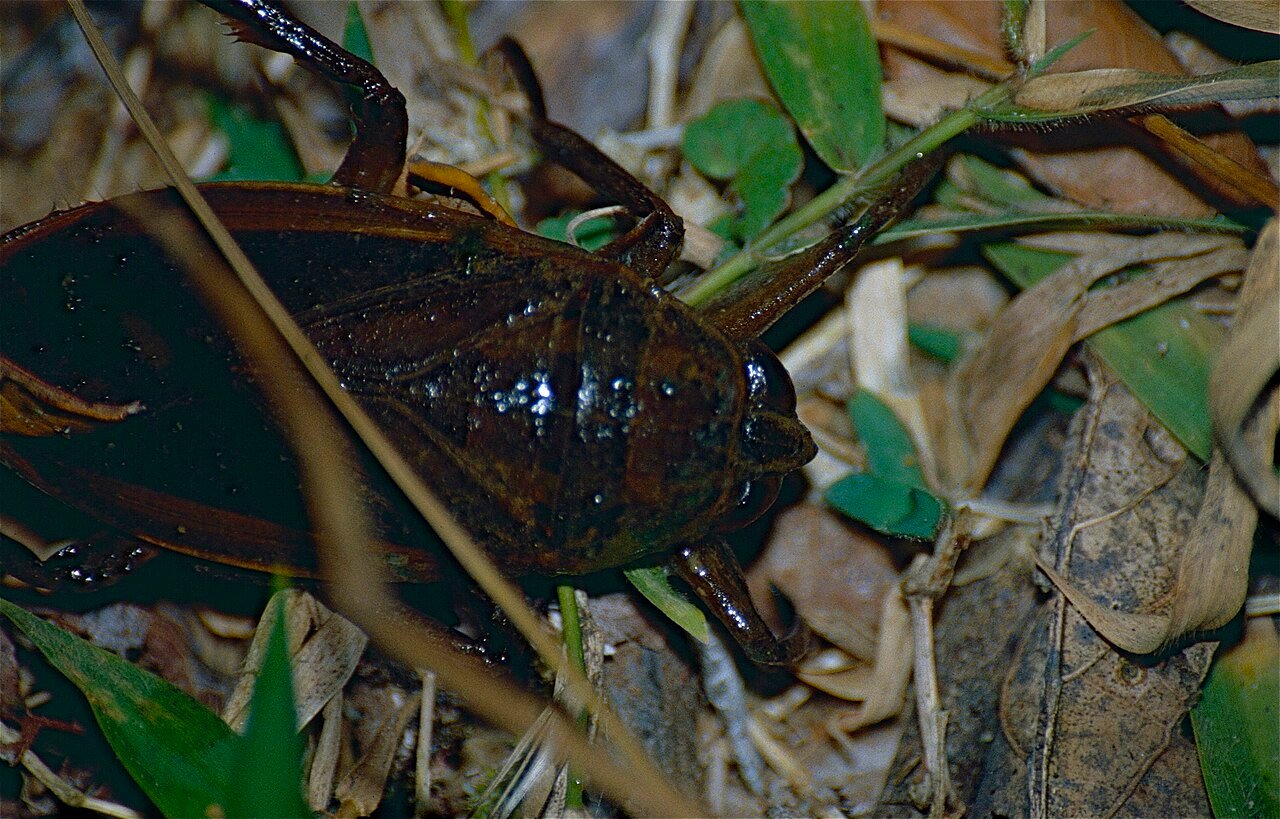
The real water bug: pond predator, occasional porch celebrity
True water bugs are the giant water bugs of family Belostomatidae — and “giant” is honest: Ohio’s largest run two inches and beyond, among the biggest true bugs in North America. They are flattened, oval, mud-brown insects built entirely for aquatic ambush: hind legs flattened into oars, front legs thickened into raptorial grabbers (mantis-style), and a short, stout beak that injects digestive enzymes into tadpoles, small fish, snails and other insects. They live in ponds, lake margins, slow stream pools and farm-pond shallows — the retention ponds behind Beavercreek subdivisions and the stock ponds of Preble County qualify — and they leave the water for exactly one reason: strong fliers, they navigate by moonlight and get catastrophically confused by parking-lot and porch lighting on warm nights, which earns them their other folk name, electric light bugs. Two things worth knowing if you meet one: they genuinely can bite a bare hand that grabs them (locals call it the “toe-biter” for a reason — painful, medically minor, and entirely avoidable by not picking it up), and they cannot live indoors — no pond, no prey, no interest. A giant water bug on the driveway is weather, not a warning. Admire it, leave it, or scoot it onto a dustpan and back toward the pond; there is nothing at your house it wants.
The “waterbug” in your basement: a roach with a publicist
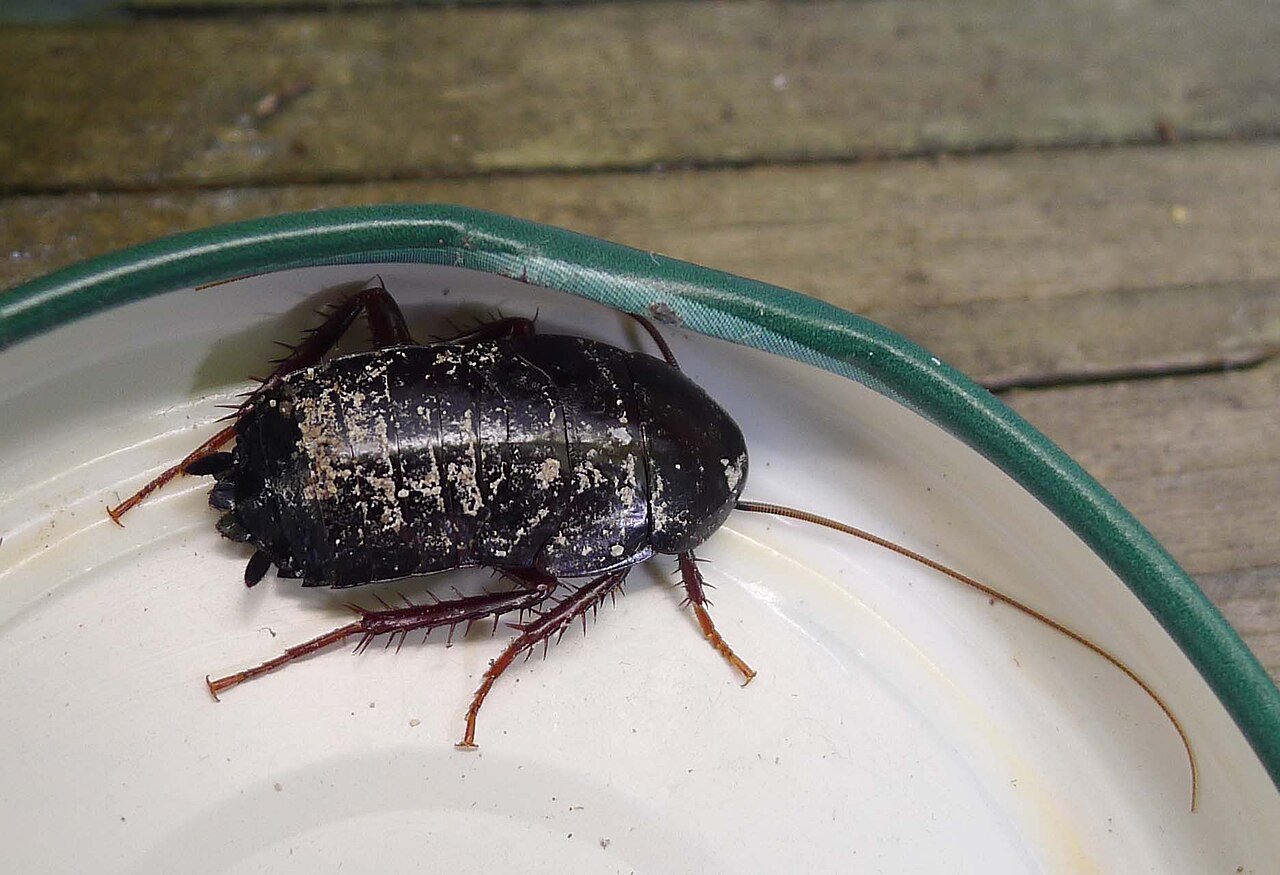
Now the insect the euphemism was invented for. Across most of America, “waterbug” as used indoors means one of two cockroach species, both covered at species depth in our Ohio roach guide. The Oriental cockroach is the classic: an inch to an inch and a quarter, glossy black to deep mahogany, heavier and slower than other roaches, flightless (males carry stubby wings, females mere pads), and devoted to cool damp — floor drains, sump pits, crawlspaces, stone-foundation basements, the mulch against the north wall. It even smells damp: heavy infestations announce themselves with a musty odor. The American cockroach takes the title in furnace rooms and commercial basements — bigger still (to two inches, Ohio’s largest indoor roach), reddish-brown, fast, and a capable glider that occasionally makes an entrance from a high shelf. Both run the same playbook: they live in the wet infrastructure layer of a building — drains, chases, pits — and commute upward as populations grow or drains dry. Calling them water bugs isn’t entirely slander, ecologically speaking; they are genuinely moisture-bound insects. The problem is what the polite name does to the response: nobody baits a “water bug,” nobody inspects for its egg cases, and eighteen months later the basement has a population with a founding generation and a story.
The ten-second ID, side by side
- Where you found it: pond edge, pool skimmer, parking lot under lights = water bug. Basement floor, drain margin, under the sink at midnight = roach. Location alone calls 90% of cases.
- Antennae: the roach’s are long, obvious, endlessly sweeping threads; the water bug’s are short and tucked, nearly invisible. Fastest visual tell on a photo.
- Front legs: water bug forelegs are thick grabbing arms held mantis-style; roach legs are six spiny runners, all business, all similar.
- The rear: giant water bugs often show two short breathing straps at the tail tip; roaches show two segmented feelers (cerci) and, on nymphs, nothing else.
- Movement: a stranded water bug is clumsy on land — it paddles awkwardly and would rather play dead; a roach at floor level is one of the fastest sprinters in the insect world and vanishes edge-wise.
- Size and shape: both are flat ovals, but the water bug is broader-shouldered and boat-shaped with oar legs; the Oriental “waterbug” roach is slimmer, glossier, and never exceeds an inch and a half.
Still torn? The phone settles it in minutes — a photo to (937) 569-3330 gets a species verdict and an honest “do nothing” when do-nothing is the answer, which for true water bugs it always is.
What a basement “waterbug” sighting actually means
Diagnose the sighting the way our technicians do, because Oriental and American roaches are infrastructure messengers before they’re anything else. A first sighting near a floor drain asks the drain questions from our drain fly guide: has the trap run dry (an empty P-trap is an open subway door from the sewer lateral), and is the biofilm feeding more than flies? A bucket of water in every seldom-used drain monthly closes that door for pennies. Sightings after heavy rain track the water table: wet summers push populations out of saturated exterior harborage — window wells, mulch beds, meter pits — and through whatever gaps the foundation offers, which converts the roach problem into the same twelve-doors exclusion audit we run for mice, one size class down. A steady trickle in a stone-foundation basement — the housing stock of Oakwood, Troy’s historic district and every century square in our eight counties — usually means an established damp-layer population whose two levers are moisture and access: the dehumidifier doctrine applies with full force (Orientals are as drought-fragile as silverfish), alongside sealing at the sill line. And daytime sightings upstairs mean population pressure — the basement is full enough to push commuters up the plumbing chases, which is protocol territory, not caulk territory. Every version has a fix; none of the fixes begin with deciding it’s “just a water bug.”
The response, honestly scaled
For a true water bug: nothing. Turn off the porch light earlier during the late-summer flight weeks (the same warm-LED bulb swap from our crane fly page cuts these arrivals too), keep the pool skimmer basket emptied with a net rather than a hand, and enjoy having met one of North America’s most impressive insects. For the roach kind: scale to the evidence. One or two rain-week stragglers, found dead or sluggish = perimeter pressure; tighten door sweeps, water the drains, watch. Regular sightings, any live nymphs (see the baby cockroach guide for why nymphs change everything), droppings at drain margins, or the musty note = an established damp-layer population, and the effective program is the one our roach method runs for these species: moisture correction and exclusion as the foundation, gel baits and dusts placed into the drain-adjacent voids where these roaches actually live (broadcast spraying the basement floor is theater), IGR to cut the egg pipeline, and monitors to verify the trend line. Orientals are slower breeders than Germans — the good news — but their infrastructure harborage makes them stubborn, so the program measures success in monitor counts over weeks, not corpses over days. Plan members get the whole arc under the re-treatment guarantee.
The tree roach and the palmetto bug: the euphemism’s southern cousins
Two more aliases orbit this confusion and deserve their paragraph, because search habits travel with people. “Palmetto bug” is the Southeast’s dinner-party name for the American cockroach (and in Florida, several outdoor species besides) — same insect, same social function as “waterbug”: a roach wearing a resort shirt. Transplants from the Carolinas and Florida arriving in our eight counties keep the vocabulary; the biology upstairs doesn’t change. “Tree roach” is Texas-and-Gulf vernacular for the same big outdoor-breeding American roaches that stroll indoors on summer nights; Ohio’s honest equivalent is the wood roach — the tan, daylight-flying, porch-light-blundering outdoor species our species guide profiles, which cannot breed indoors and needs no treatment at all. Notice the pattern across all these names: every euphemism sorts into one of exactly two bins — outdoor visitor, no action (wood roach, true water bug, the summer stroller) or infrastructure resident, real response (Oriental, American, German). The name on the bin matters less than which bin it is, and the ID takes ten seconds. That’s the entire doctrine of this page, and honestly, of this whole library: identify first, and half of everything turns out to need nothing.
Water bug questions, answered
Can giant water bugs hurt my kids at the pool?
Only if someone grabs one. They don’t seek people, and the bite — painful, briefly swollen, medically minor for almost everyone — happens to bare hands doing the grabbing. Net it out of the skimmer, show the kids the oar legs from a respectful foot away, and release it toward the pond. It’s a better nature lesson than most field trips.
Why do I only see these “waterbugs” in summer?
Both stories peak together, confusingly. True water bugs fly (and hit porch lights) on warm nights, mostly mid-to-late summer. Oriental roach populations also crest in warm months and get pushed around by summer storms. Same calendar, opposite meanings — which is exactly why the ten-second ID earns its place on your refrigerator of mental notes.
Do “waterbugs” mean my house is dirty?
No — they mean your house has water. Orientals and Americans live on the moisture layer: drains, pits, condensation, stone seepage. The cleanest basement in the county grows them if the humidity and access cooperate. It’s plumbing-and-envelope news, not housekeeping news — often the cheaper kind to fix.
Is one dead roach by the floor drain worth a service call?
By itself, no — watch and water the drains. It earns the call when it has company: repeat sightings, live nymphs, droppings, odor. What it always earns is the free version: a photo to our line for the species read, which calibrates everything after. We tell people “wait and watch” weekly; it’s a fine answer when the evidence supports it.
Ten seconds, well spent
Every “waterbug” in every basement in America is a vote on whether the polite name or the accurate one runs the response — and the accurate one is cheaper every single time. Pond hunter on the driveway: wildlife, wave it home. Glossy sprinter at the floor drain: the roach conversation, started early, while it’s still small and the fixes are a bucket of water, a door sweep and a dehumidifier setting. Greater Dayton Pest & Rodent will make the call with you for free and treat only what needs treating — that’s been the deal on every page of this site, and it holds here: (937) 569-3330, serving Dayton and all eight counties.
Why the euphemism survives (a short cultural autopsy)
The “waterbug” politeness deserves the same autopsy we gave the mosquito hawk legend, because it’s the same machinery pointed indoors. The word exists because “cockroach” carries a social verdict — dirtiness, negligence, shame — that the biology doesn’t support (Orientals colonize plumbing, not character), so generations of hosts, landlords and realtors reached for a softer noun, and the softer noun stuck precisely because it lowered the stakes. An insect with lowered stakes doesn’t get inspected, baited or reported to the landlord in writing; it gets a paper towel and a changed subject. Multiply that by every basement in a century-old housing stock and the euphemism functions as the roach population’s best friend — unpaid PR, renewed nightly. The fix costs nothing: use the accurate name in your own head, respond on the ten-second ID rather than the social comfort, and let the shame piece go entirely — moisture is a building condition, not a moral one, and the households that respond fastest are simply the ones that never argued with the noun. Language is pest control’s cheapest tool; this page just sharpened it.
The eight-county waterbug map
Local pattern recognition, for calibration: true water bug encounters cluster wherever big lights meet real water — the retention-pond subdivisions of Beavercreek and Mason, pool decks everywhere, the Little Miami and Great Miami corridors, and farm-pond properties across Preble and Miami counties, peaking on the humid flight nights of July and August. Oriental-roach “waterbugs” cluster in the pre-war basements — Dayton’s historic neighborhoods, Oakwood, the courthouse-square towns — and in any building with floor drains that only see water when something goes wrong. American roaches dominate the commercial version: restaurant basements, boiler rooms, institutional kitchens, all territory our commercial program monitors as infrastructure rather than treats as surprise. Two insects, two maps, one lesson: the county tells you the odds, the ten-second ID tells you the answer, and the phone line settles the ties — free, five days a week, photo first.
The pool-season protocol
One practical appendix, since pools generate more water-bug questions than any other setting on our line. Giant water bugs end up in pools by mistake — chlorinated water holds no prey, but a lit pool at night reads as a lake from the air — and a stranded swimmer paddling the deep end at 7 AM is the classic summer service call that needs a net, not an invoice. The protocol: skim it out with the leaf net (never bare hands — the toe-biter reputation is earned), release it on grass away from the deck, and if arrivals repeat, change what the night sky sees — pool light off earlier, landscape lighting aimed down and warm-toned, the deck fixtures on the same 2200K bug bulbs that tame the porch. A pool cover on flight-season nights ends the story completely. What never helps: shocking the water (they aren’t breeding in it — nothing insect breeds in a maintained chlorine pool), perimeter-spraying the deck (you’d be treating flight paths), or the “pool-safe insect repellent” products that annually separate pool owners from twenty dollars. The insect is lost, not invading; give it the net and the darkness, and it stops arriving. Total program cost: one bulb and an earlier timer — the cheapest complete solution in this entire library, for the insect that least needed one.
Two insects, one borrowed name, ten seconds to the truth — and a basement that never again gets to hear “it’s just a water bug” while something with an ootheca listens from the drain.
Frequently asked questions
What is the difference between a water bug and a cockroach?
In Dayton usage, usually nothing — “water bug” is the polite regional name for the American or Oriental cockroach found in basements and near drains. TRUE water bugs (giant water bugs, backswimmers) are aquatic pond predators that bite hard and almost never enter houses; the basement “water bug” is a roach wearing a euphemism.
Is the big black bug in my basement a water bug or roach?
Almost certainly an Oriental cockroach — the glossy, dark, slow-moving “water bug” of cool damp basements — or a mahogany American cockroach off the drain line. Both are infrastructure travelers covered by the where-do-roaches-come-from playbook: wet drains shut, gaps sealed.
Do true water bugs come inside houses?
Rarely and accidentally — giant water bugs (“toe-biters”) fly between ponds at night and occasionally crash-land near bright lights, ending up on driveways and pool decks. Indoors they are lost, temporary, and best escorted out with a cup and genuine respect (the bite is real).
Does calling it a water bug change the treatment?
Only if it is genuinely aquatic (escort it out; no treatment exists or is needed). If it is the euphemism — and in a basement it is — the treatment is the roach infrastructure program: drain traps watered monthly, sump sealed, sweeps and gaps closed, moisture dried.
Why do “water bugs” show up in bathrooms and basements?
Because the roaches wearing the name are moisture-and-infrastructure species: dry drain traps are their doorways, damp basements their climate. The appearance pattern (summer, near plumbing, ground floor) is the American/Oriental signature exactly.
Do water bugs bite people?
The euphemism roaches, no. The genuine aquatic giant water bug delivers one of the most painful insect bites in Ohio — but exclusively when handled or stepped on in ponds. Two different insects, two different answers, one more argument for the ID-first habit.
Are water bugs a sign of a dirty house?
No — same verdict as the whole roach origins file: infrastructure arrivals are about drains and gaps, not housekeeping. A bone-dry, freshly-bleached basement with a dry floor-drain trap gets exactly as many as a cluttered one.
How do I get rid of water bugs permanently?
The infrastructure checklist: a quart of water into every floor drain monthly (plus a spoon of mineral oil to slow evaporation), sump pit sealed, door sweeps and foundation gaps closed, basement dehumidified — and gel bait only if sightings persist past the sealed month.
Why do I only see water bugs at night?
Because they are roaches keeping roach hours — the circadian night shift from our are-roaches-nocturnal page. The 11 p.m. basement tourist is running standard infrastructure-species behavior; the flashlight census rules apply.
When should water bug sightings prompt a call?
Multiple sightings after the drain-and-seal month, any sign of on-site breeding (nymphs, egg cases), or sewer-event clusters (post-backup blooms): (937) 569-3330 — and photos welcome, since “water bug” covers three species with two very different files.