Somewhere on your property right now — the porch ceiling, the garage eave, behind the shutters, the barn’s back wall — there is probably a lump of dried mud that looks like a construction mistake. And patrolling near it, a long, thread-waisted wasp that has every household on edge and no interest whatsoever in earning it: the mud dauber, the most misjudged stinging insect in Ohio. The core facts up front, because they invert the usual wasp math: mud daubers are solitary — no colony, no soldiers, no alarm-pheromone squad — and a wasp with no colony to defend has essentially nothing to sting you over; documented mud dauber stings are among the rarest in the medical literature, essentially requiring you to press one against your skin. Meanwhile the mud architecture on your wall is a spider-hunting operation: every cell of every tube is packed with paralyzed spiders — including, notably, black widows, which mud daubers hunt with specialist enthusiasm. This page gives the mason its full profile: the three Ohio species and their signature buildings, the spider-stocking biology (astonishing, and settled science), what the nests do and don’t mean for your house, the honest removal guide (timing, technique, and the one staining caveat), and the short list of situations where daubers genuinely warrant a call. Greater Dayton Pest & Rodent, photo verdicts free: (937) 569-3330.
Meet the masons: Ohio’s three mud daubers
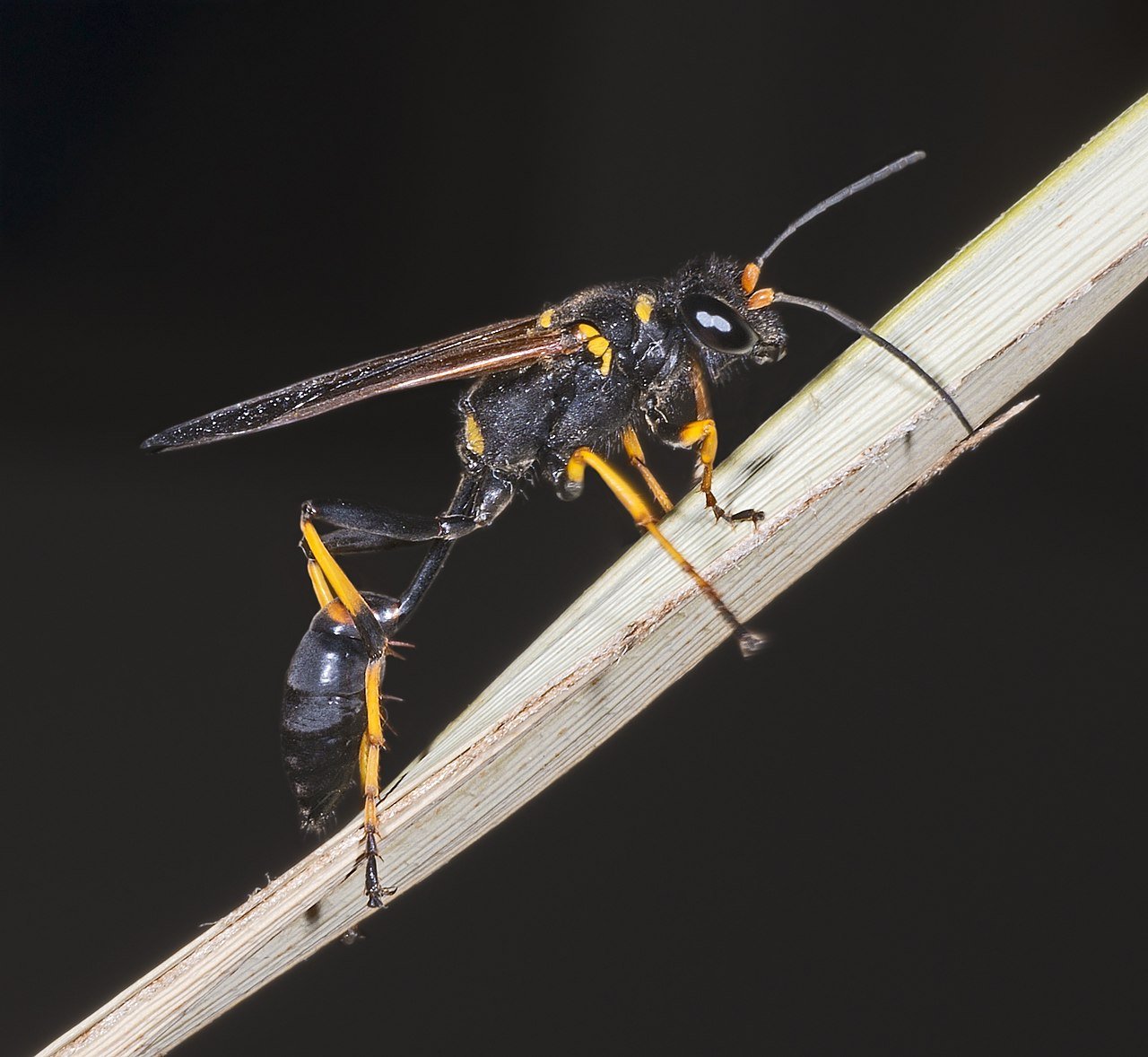
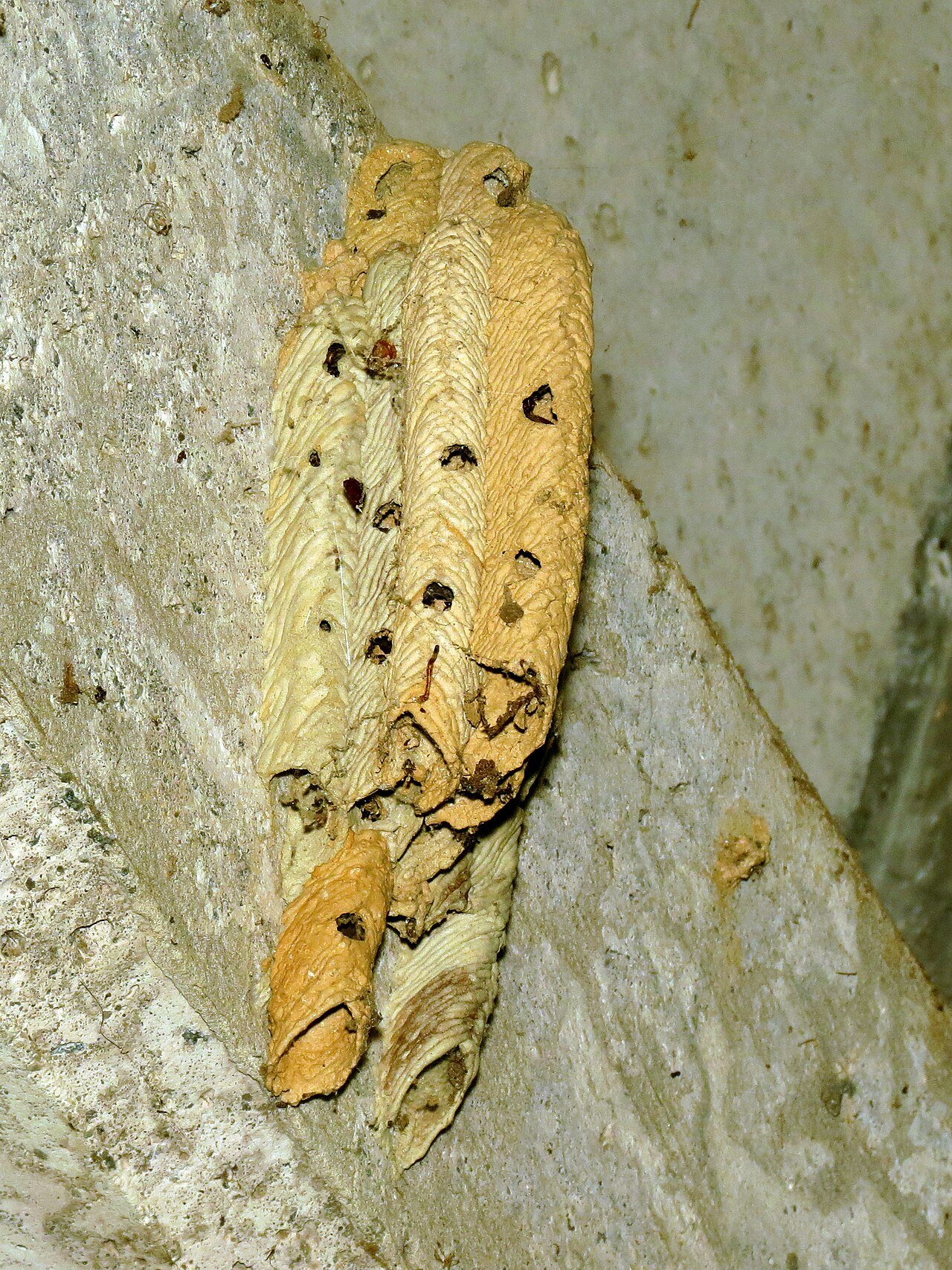
Three species build the mud you’ll find, each with an identifiable signature. The black-and-yellow mud dauber (Sceliphron caementarium) is the classic: an inch of black wasp with yellow legs and that impossibly thin “thread waist,” building fist-sized globular nests of side-by-side cells smoothed into a lump on sheltered vertical surfaces. She works like a bricklayer on piece rates: collecting mud balls from puddle edges (the humming commute between the birdbath margin and the porch ceiling, repeated dozens of times daily, is the behavior most people actually observe), forming each cell, then switching to the hunt. The organ-pipe mud dauber (Trypoxylon politum) is the artist: glossy blue-black, builder of the unmistakable fluted vertical tubes — the “pipe organ” ranks on barn walls, bridge undersides and porch corners — and notable for a rarity in the wasp world: males guard the nest while females forage, an actual two-parent household. The blue mud dauber (Chalybion californicum) is the specialist and the freeloader: brilliant metallic blue, rarely building from scratch — she remodels other daubers’ abandoned nests, carrying water instead of mud to soften and re-work old cells — and she is the continent’s premier black widow hunter, a professional predator of exactly the spider our venomous guide flags as Ohio’s most medically real. A metallic blue wasp inspecting your woodpile is, quite literally, running the safety audit you’d pay for.
What’s inside the mud (the part worth a museum placard)
Crack open an active mud dauber cell — something our techs do for demonstration more often than customers expect — and the contents explain the whole animal: a dozen to twenty-five spiders, alive but paralyzed, stacked like preserves, with a single wasp egg laid on the first victim. The female’s sting — the one she almost never spends on humans — is a precision instrument for spider surgery: venom placed to paralyze without killing, keeping the prey fresh (refrigeration by neurology) for the weeks her larva needs. Each cell gets provisioned, sealed, and abandoned; the larva eats through its pantry in order, pupates through winter inside the mud, and chews out as an adult the following spring — the round exit holes in old nests are graduation records, and a nest with holes is a building whose occupants have all left. Multiply the arithmetic across a season — each female provisions multiple cells per nest and multiple nests per summer — and one porch’s dauber population removes hundreds of spiders annually, with documented prey lists dominated by exactly the species people mind: orb weavers off the eaves, jumping spiders, crab spiders, and the widows and near-widows of the woodpile and meter box. The punchline this library keeps arriving at from new directions: the scary-looking thing on the wall is frequently the pest control, and the mud dauber is the thesis’s cleanest exhibit — a wall-mounted, self-funding, spider-removal service whose entire fee is a lump of mud you were going to hose off anyway.
Dauber or danger? The two-second wall check
The identification that matters is nest-versus-nest, because mud architecture shares real estate with the genuinely defended kind. Mud = dauber = relax: any nest built of actual dried mud — globular lump, organ pipes, or single thumb-sized cells — belongs to a solitary mason; there is no colony inside, no defense response possible, and you can stand beneath it indefinitely at zero risk. Gray paper = social wasp = the other playbook: the papier-mâché comb of paper wasps (open cells visible, umbrella form) or the enclosed bald-faced envelope means colony, defenders and the location-over-size triage. The confusion cases our photo line actually receives: mud tubes climbing a foundation from the soil line are not daubers at all — they’re termite highways, the one mud structure on your house that IS urgent (daubers build on walls and ceilings from above, in sheltered spots, with visible lumpy artistry; termite tubes run soil-to-wood, flat, root-like); and the barn swallow’s mud cup under the eave, which announces itself with feathers and residents. Mud lump high and sheltered: mason, harmless. Mud line low and climbing: inspection, this week. It’s the highest-stakes two-second read in the mud category, and now you own it.
The honest removal guide (and when to skip removal entirely)
Since mud dauber nests carry no defense response, removal is a housekeeping decision, not a safety operation — the only questions are timing, technique and staining. The calculus first: an active nest in an out-of-the-way spot is doing spider work at zero risk to anyone; the genuinely reasonable move for the barn wall and the shed eave is nothing at all. Removal earns its minutes where the mud offends (the front porch ceiling, over the door, the freshly painted gable) or where it accumulates year over year. Timing: any time works safety-wise — even an occupied nest won’t mobilize anything — but late fall through winter removes only sealed, overwintering cells (no adult commuting), and if your goal is maximum spider control per nest, let summer cells finish their graduation first. Technique: dry-scrape with a putty knife into a bag, then — the one caveat this cheerful page owns — deal with the stain: mud daubers select their mud, and its mineral content can shadow paint and stone; a stiff dry brush first, then a damp sponge, beats the immediate hose-blast that drives mud into paint texture. On brick or stone, dry-brushing alone is usually cleaner. Prevention, if you want it: daubers choose sheltered, still-air surfaces — sealing the porch ceiling’s gaps and corners, a coat of gloss paint (they prefer matte grip), and addressing the puddle-edge mud sources nearby all reduce repeat construction; so does leaving one unobjectionable nest site unbothered as the designated build zone, a landlord trick our farm-route customers have run for generations. What no one needs: sprays. There is no colony to treat, and insecticide on a mud lump is money aerosolized.
When daubers genuinely warrant a call
Four scenarios move the mason from wildlife to work order. Volume: barns, stables and warehouse eaves can accumulate dozens of nests a season — at that density the droppings-adjacent mess, the paint damage and the occasional equipment-cavity nest (see next) justify a scheduled knockdown-and-prevention pass, which our commercial routes fold into regular service. Equipment cavities: the dauber’s taste for sheltered tubes extends to machinery — grill burners, outdoor outlet boxes, irrigation valves, boat and RV vents, and most consequentially aircraft pitot tubes and instrument ports (mud dauber nests have contributed to genuine aviation incidents, which is why every rural airstrip owner on our routes covers ports religiously). Seasonal covers and spring checks are the fix; a clogged burner venturi hissing gas the wrong direction is the reason it’s not optional. The prey-base signal: an unusually booming dauber population is, remember, a spider census — and heavy construction over a woodpile or meter box occasionally flags the widow habitat our venomous guide maps; worth a professional look at what’s being hunted. And the misdiagnosis insurance: any “mud dauber problem” described with words like “swarming,” “aggressive” or “they came after me” is not daubers — solitary masons do none of those things — and the photo that proves it’s actually paper wasps or yellowjackets in a dauber’s old neighborhood changes the response entirely. The species sets the playbook; the playbook is why the free ID exists.
Mud dauber questions, answered
One keeps hovering near me while I’m on the porch. Is it sizing me up?
She’s commuting — your porch is between her mud source and her build site, and the hover is navigation, not reconnaissance. Solitary wasps have no stake in you whatsoever: no colony to defend means the sting exists for spiders and emergencies only, and you are neither. Share the porch; the construction season is short and the spider ledger runs in your favor.
I knocked a nest down and wasps keep returning to the spot. Colony after all?
No — you’re watching the owner (and occasionally a blue dauber assessing the salvage) revisiting a remembered address. Daubers navigate by landmark memory and will inspect a removal site for a few days before re-siting. Persistent rebuilding on the exact spot is the cue for the gloss-paint-and-seal treatment above, not for any spray.
Do mud daubers damage the structure the way carpenter bees do?
No — the mason builds ON surfaces, never INTO them; the mud is additive and comes off with a putty knife. The genuine structure-borers — carpenter bees drilling fascia and the moisture-following carpenter ants — are different pages with different budgets. The dauber’s entire structural footprint is cosmetic, and mildly so.
Old mud nests are all over the shed. Is anything still in there?
Check the exit holes: cells with round holes have graduated (empty); intact sealed cells may hold overwintering pupae — or the remodeler’s next generation, since blue daubers and various beneficial tenants (mason bees among them) reuse old cells. Winter-scrape if tidiness demands; otherwise old dauber mud is the insect world’s affordable housing, and the tenants are uniformly better neighbors than what the shed would host instead.
The mason’s verdict
The mud dauber closes this library’s stinging-insect wing as its gentlest member: a wasp that files no defense response, stings functionally no one, builds honest architecture out of literal dirt, and spends every working day removing the spiders this same library fields anxious calls about — the widow-hunting blue dauber alone justifying the whole family’s porch privileges. Learn the mud-versus-paper check and the lump-versus-climbing-tube check (the one place mud means money), scrape what offends with a putty knife and a dry brush, cover the grill burners and the pitot tubes, and let the rest of the masonry work. For the volume cases, the equipment protection programs, and every “wasp” photo that needs a species verdict before a response: (937) 569-3330, Greater Dayton Pest & Rodent — where the answer to a third of all stinging-insect calls is “good news,” and this page is why.
The naturalist’s minute: watching a build
If a dauber has chosen your porch this summer, you’ve been issued free tickets to one of entomology’s best shows, and the viewing guide takes a paragraph. The build runs on a strict production schedule: mud runs early (mornings after dew or watering, when puddle edges offer working clay — follow her flight line and you’ll find her quarry, usually within a hundred feet), each ball kneaded airborne and troweled into the course with an audible buzz — she vibrates her wing muscles to liquefy the mud like a concrete vibrator, which is the humming you hear from a working nest. A cell takes about a day; then the hunting phase — watch her return cadence change from mud-ball-every-few-minutes to spider-every-half-hour, each victim slung beneath her like cargo. Egg, seal, repeat: a summer female may complete twenty-plus cells across several nests. The blue dauber’s remodeling act is rarer viewing but unmistakable — water instead of mud, old nest instead of new wall, and the metallic flash that means the widow-hunter is on shift. None of this requires distance, protective equipment, or nerve: you can watch from two feet away, and children reliably do once someone tells them the secret. A wasp you can watch build a house at arm’s length, all summer, without incident — there is no better standing rebuttal to the idea that everything with a waist and wings is out to get you, and it’s playing nightly above the porch swing, admission free.
The eight-county mud map
Where the masons concentrate locally: the farm belt leads by an order of magnitude — every barn, stable and machine shed in Preble and western Miami County hosts organ-pipe colonies-of-one by the dozen, where they’ve been the unofficial spider control since the barns went up; the volume-management pass rides along on existing farm-route visits. The river and trail corridors run second — abundant puddle-edge mud plus bridge undersides make the Great Miami and Little Miami greenways dauber highways, and the river towns’ porch ceilings collect the spillover. The historic districts offer the masons their favorite substrate — rough stone, deep porch shelter, matte-painted beadboard from Oakwood to the courthouse squares — and the new-build suburbs host the fewest (smooth gloss surfaces, sealed soffits, irrigation-controlled mud): the rare pest map where the newer the neighborhood, the less the wildlife, and nobody’s worse off either way. Wherever the mud rises on your wall this summer, the read is now yours: lump high and sheltered, mason at work, spiders in escrow, porch entirely yours to enjoy — and one more page of this library closed with the pleasant verdict its subject deserved all along.
One thread waist, zero grudges, twenty spiders per tube — the porch’s quietest contractor takes her place among the library’s acquitted, and the mud on the wall reads, at last, as the invoice it always was: paid in full, in widows, every summer. Two pages left in the batch: the cicada killer’s July patrol, and the stink bug’s last two questions.
And if tonight’s discovery was the lump over the doorway and this page found you mid-worry: stand down, putty knife optional, schedule clear. The mason finished her shift hours ago, the tubes are full of exactly what your porch is better off without, and tomorrow she’ll hum past your coffee on the mud run, entirely uninterested in everything about you except your birdbath’s excellent clay.
Mud high: mason. Mud climbing: inspection. Everything else: coffee.
The library’s gentlest verdict, delivered in dirt: not guilty, never was.
Frequently asked questions
Are mud daubers dangerous?
About as dangerous as the mud itself — solitary, defense-free, and holding one of the emptiest sting files in the wasp world; entomologists handle them barehanded. The organ-pipe nests look ominous and house a single peaceful mason.
What are the mud tubes on my walls and ceilings?
Mud dauber nurseries — each tube holds cells provisioned with paralyzed spiders for the larvae. Organ-pipe rows, neat clay pots, and rough blobs are different dauber species running the same program.
How do I remove mud dauber nests?
Putty knife, any time, zero risk — a water squirt softens old mud. Round exit holes mean the occupants already matured and left; intact tubes in season just relocate one gentle insect’s project.
Do mud daubers sting people or pets?
Essentially never — no colony means no defense instinct, and females reserve venom for spiders. Documented stings involve trapping one against skin; even then it is bee-sting-grade and briefer.
Why do mud daubers keep building on my porch?
Sheltered masonry plus mud supply plus — the informative part — abundant spiders: daubers provision exclusively with them, so heavy dauber construction is a free census announcing a healthy spider population. Treat the prey base and the masons relocate on their own.
Are mud daubers good for anything?
Genuinely — they are specialist spider hunters (black widows are a documented favorite of one common species) and minor pollinators. The strongest case on this site for tolerating a wasp: free arachnid control with no sting risk.
What is inside a mud dauber nest?
Paralyzed spiders packed per cell with one egg each — cracking an old tube open reveals the pantry: dozens of spiders per tube, an inventory of exactly what your porch’s spider community offers. Empty tubes with exit holes mean graduation happened.
Do mud daubers reuse their nests?
The builders rarely; squatters often — other solitary wasps and bees recycle old tubes. Scraping spent nests each winter keeps the masonry clean and removes the squatter housing.
How do I keep mud daubers from coming back?
Reduce the two supplies: the spider prey base (the de-web and amber-light program from our spider guides) and wet soil access nearby. Sealing porch-ceiling texture with paint also slows attachment. Full prevention is rarely worth pursuing — the tenant is harmless.
When should I actually call about mud daubers?
Almost never for the daubers — but call if the “mud dauber” traffic turns out to be many wasps sharing one entrance (that is a yellowjacket void, a different file entirely) or if heavy construction signals a spider population worth professional attention: (937) 569-3330.