
Every July, the same phone call reaches us from somewhere in the Miami Valley: an enormous wasp — two inches, black and rust with yellow markings, loud as a small drone — is patrolling the yard at knee height, diving at anyone who crosses the lawn, and excavating dirt piles beside the patio. The caller has usually already searched “giant hornet” and arrived somewhere terrifying. The actual answer is the eastern cicada killer (Sphecius speciosus): Ohio’s largest wasp, one of its most alarming performances, and — this is the whole page in one sentence — one of its least dangerous insects, a solitary digger so disinclined to sting people that entomologists handle females bare-handed. Here is the full file: what they are, the sting question answered honestly for every family member including the dog, why your yard specifically, the murder-hornet confusion, and the narrow cases where control genuinely makes sense — plus how we do it without carpet-bombing a beneficial insect.
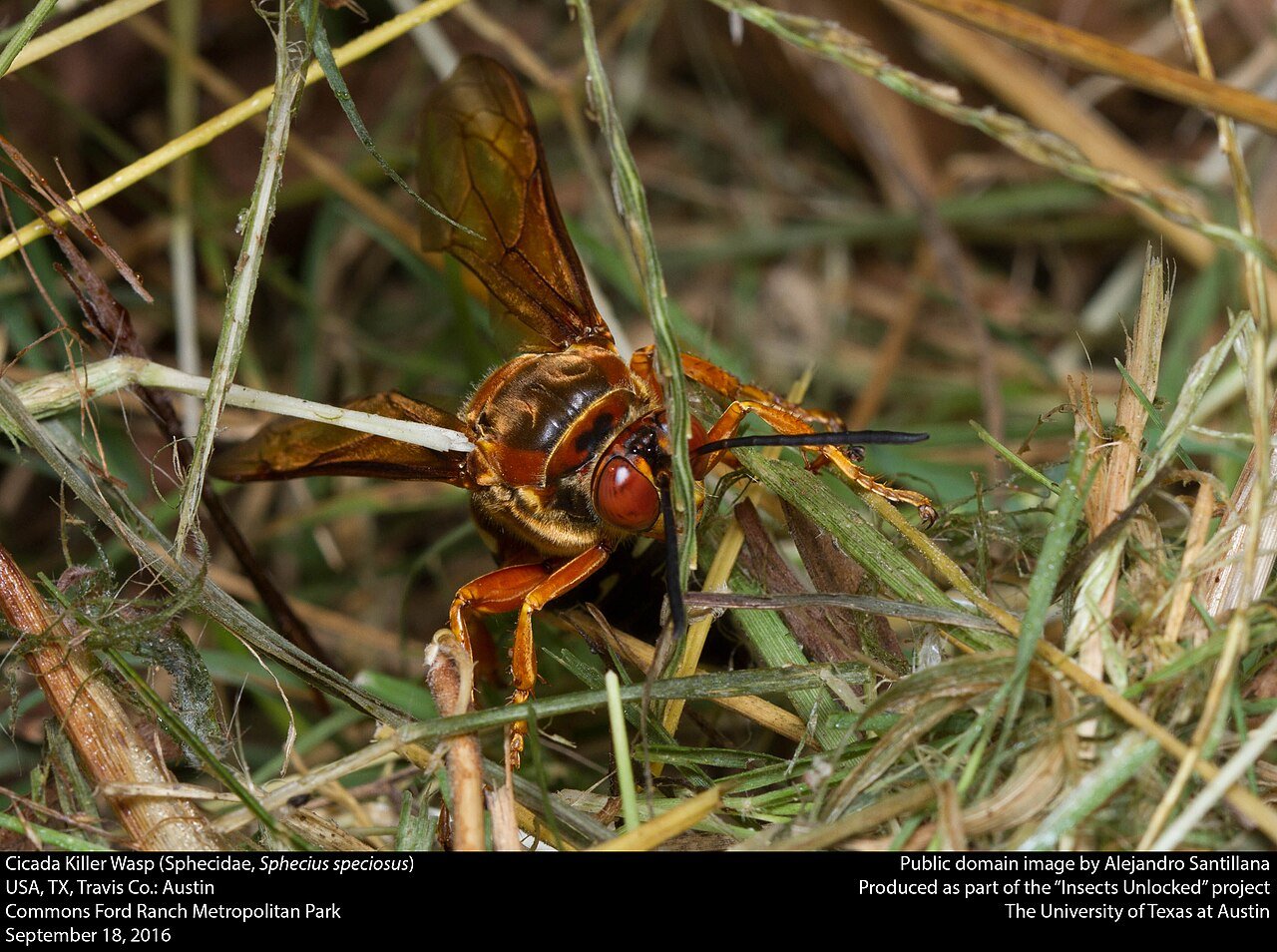
Meet the excavator: one wasp, one burrow, no colony
The fear template most people carry — wasp equals nest equals swarm — simply does not apply here, and everything calming follows from that. Cicada killers are solitary: each female digs her own burrow (a half-inch hole with a signature U-shaped soil apron, running a foot down and several feet long underground), provisions it alone, and defends nothing — there is no colony, no shared nest to trigger group defense, no guard caste, and none of the alarm-pheromone cascade that makes yellowjackets genuinely hazardous. The females spend their six adult weeks on exactly two projects: digging, and hunting cicadas — which they sting into paralysis high in the trees, then haul (flying, barely, with prey heavier than themselves) back to the burrow as living provisions for their eggs. A yard with twenty burrows is not a hive of twenty cooperating wasps; it is twenty independent contractors ignoring each other, and you.
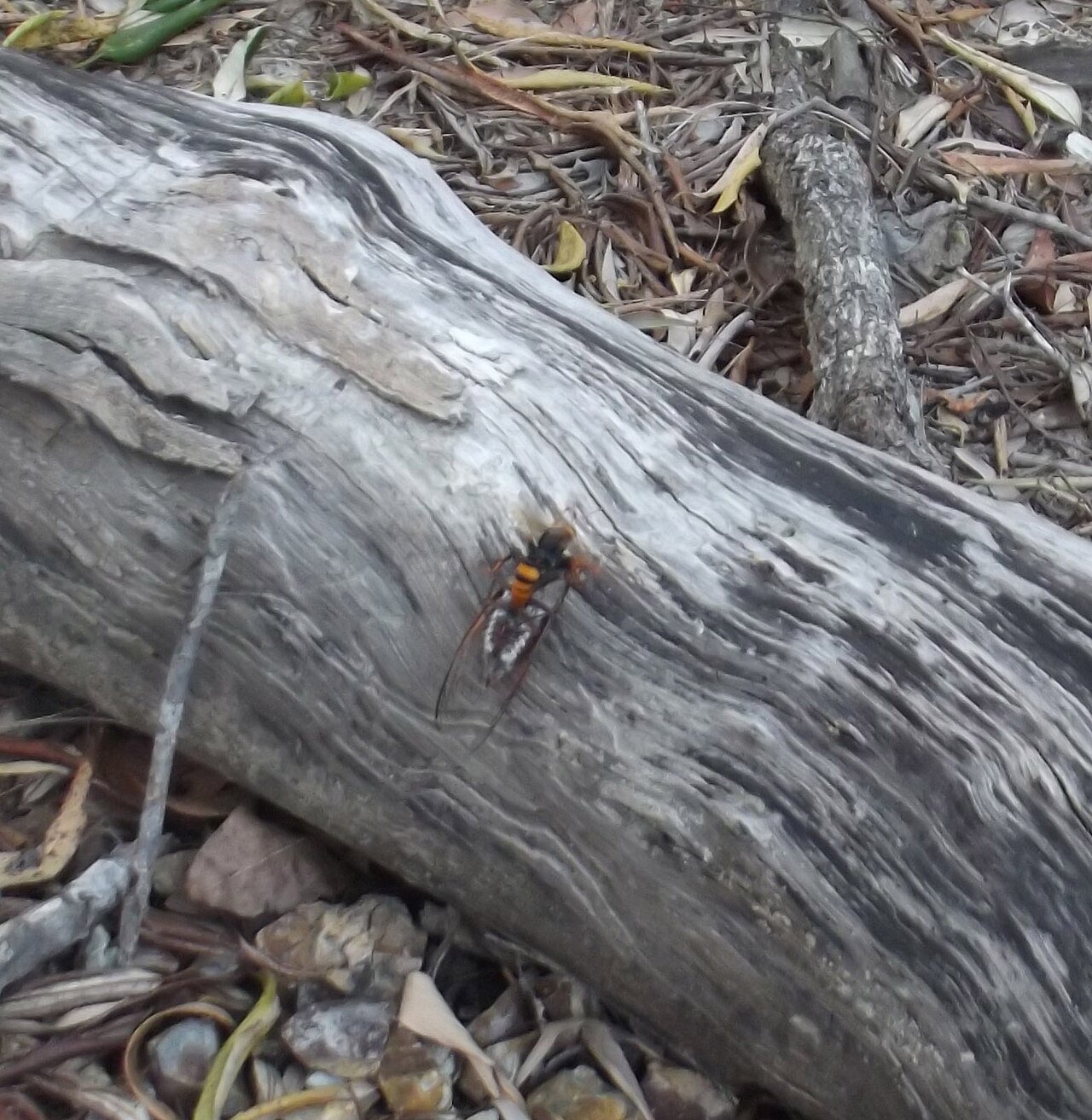
The dive-bombing males: all show, no stinger
The behavior generating ninety percent of the fear is performed by the half of the species that cannot sting at all. Male cicada killers emerge first each summer, claim airspace over promising ground, and spend their lives aggressively investigating everything that enters it — hovering at face height, chasing rivals, buzzing gardeners, bouncing off patio doors. It is pure territorial theater: males have no stinger (stingers are modified egg-laying equipment; males lack the hardware), and the confrontation ends the moment you keep walking. The females, which can sting, are meanwhile too busy hauling cicadas to notice humans and rank among the least defensive stinging insects in North America — stings essentially require grabbing one barehanded or stepping on one barefoot, and even then the venom is mild: pain reports consistently rank it below a honeybee. For perspective: children run lemonade stands over active cicada killer colonies every Ohio summer without incident. The two-inch drone menacing your walkway is a bluffing bachelor with no weapon, defending dirt.
Do cicada killers sting humans? The complete honest answer
Collecting the cluster of questions this page exists for: Can they sting? Females yes (males never), and the sting is real equipment — it paralyzes cicadas for a living. Do they sting people? Almost never: no colony defense instinct, no interest in humans, and a temperament so placid that field researchers report handling females without incident; documented human stings overwhelmingly involve barehanded grabbing, barefoot lawn-stepping, or a wasp trapped in clothing. How bad is it if it happens? Mild by stinging-insect standards — sharp, brief, consistently ranked below honeybee — with the universal caveat that anyone with known wasp-sting allergy treats every stinging insect seriously (standard sting first aid and their physician’s existing guidance apply; the venom is not special, but allergy is allergy). Kids and pets? The realistic risks are the barefoot step near a burrow and the dog that snaps one out of the air — a startling mouth-sting, transient, vet-worthy only if swelling seems outsized. House rule during the six-week season: shoes on the burrow lawn, and let the drama fly. That is the entire threat profile of Ohio’s scariest-looking insect — a profile our scariest bugs countdown already spoiled: appearance and danger are barely correlated.
“Is this the murder hornet?” — the identification everyone actually needs
The northern giant hornet (the “murder hornet” of 2020 headlines) has never been found in Ohio — its only North American detections were in the Pacific Northwest and were eradicated — but it colonized the region’s imagination permanently, and cicada killers have been paying for it since. The sorting checks: cicada killers show a black-and-rust body with broken yellow bands and amber-tinted wings, versus the giant hornet’s solid orange-yellow head and cleanly striped abdomen; cicada killers patrol low over open ground and dig in bare soil, versus hornets working tree lines and cavities; and any two-inch wasp in a Miami Valley yard in July is a cicada killer at essentially 100% odds. The European hornet — Ohio’s actual big social hornet, an inch-plus, brown-and-yellow, night-active around porch lights — is the one legitimate lookalike with colony defensiveness, and it nests in cavities, not lawn burrows. Burrow plus soil apron plus low patrol equals cicada killer, full stop; photograph anything ambiguous against a coin and the free ID line settles it in minutes: (937) 569-3330.
Why your yard: the real-estate criteria of a digging wasp
Cicada killers are fussy tenants, and their criteria explain every colonized lawn in the Miami Valley: bare or thin soil (the non-negotiable — they cannot dig through dense turf thatch), full sun, sharp drainage (sandy and light soils, slopes, the edges of retaining walls), and cicadas within flight range — which, in our mature-tree region that hums all July, is everywhere. Translated to landscape features: the south-facing bed with thin mulch, the bare strip where the pool deck meets lawn, the sandy children’s play area, the thinning slope the sprinklers miss, the volleyball court — and once a site proves out, daughters return to natal ground, which is why the same corner hosts burrows every July and why colonies grow over years. The flip side is the honest long-term control insight: cicada killers are a lawn-condition symptom. Thicken the turf, irrigate the bald spots, deepen the mulch past two inches, and the real estate delists itself — the only permanent eviction there is, and it doubles as lawn care you wanted anyway.
The case for doing nothing (most yards)
For the typical scattered-burrow lawn, the professional recommendation is a six-week truce, and not out of laziness: the season is brief (males die by mid-August, females shortly after; by Labor Day the yard is silent until next July), the digging is minor aeration rather than damage at low densities, and the services rendered are real — every provisioned burrow removes cicadas from the trees your ornamentals would rather keep, and the adults pollinate meanwhile. There is also a dignity argument we make without embarrassment: a two-inch wasp that hunts by paralyzing prey twice its weight in mid-air, digs like machinery, and bluffs like a poker champion is one of the more magnificent things an Ohio backyard produces, and kids walked through the biology usually convert from terrified to obsessed inside one afternoon. Truce terms: shoes on that stretch of lawn, a note to the mower crew (run the loud pass in early morning when females are in burrows), and the camera ready for the cicada-hauling flights, which are genuinely worth filming.
The cases where control genuinely makes sense
The truce has honest exceptions, and they are the calls we accept without argument. Density: established multi-year colonies can reach dozens-to-hundreds of burrows in prime ground — at that scale the excavation genuinely undermines walk edges and bed borders, and the sheer traffic overwhelms reasonable coexistence. Location conflicts: burrow clusters in playground sand, beside pool decks where barefoot traffic is the whole point, in golf bunkers and sports turf, or along commercial entrances where two-inch wasps are a customer-relations problem regardless of their gentle hearts. Sting allergy in the household: the one context where “females almost never sting” is not reassurance enough, and nobody should have to run probability math on their own lawn. And structural digging: the occasional colony working the sand under pavers or against foundation drainage. Our treatment approach matches the insect: targeted burrow-by-burrow work — each active burrow dusted at the entrance in the evening (when females are home) so returning wasps carry the product in, rechecked and re-treated across the emergence window — paired with the habitat prescription (turf thickening, mulch depth, irrigation) that makes next July’s treatment unnecessary. What we do not do: broadcast-spray lawns for a solitary beneficial insect, a practice that kills everything else in the grass to miss the point entirely. Precision, then prevention — the same philosophy as every page on this site, aimed at the rare wasp that mostly deserves an apology.
Cicada killer questions we hear
They come back every July. Does treatment even matter?
Burrow treatment ends the current season’s conflict; only habitat change ends the tradition, because next year’s females — your yard’s daughters plus scouts reading the same bare-soil advertisement — re-shop the address annually. Every treatment we run comes with the delisting plan (seed, water, mulch), and the yards that execute it graduate; the yards that keep the bald sunny slope keep the wasps. Fix the listing, not just the tenants.
Are the burrows damaging my lawn or foundation?
Lawn: at typical densities, the tunnels aerate more than they harm, and the aprons rake out in September; at colony scale, edge undermining is real and joins the treatment case above. Foundation: the burrows run shallow and horizontal — structural risk is essentially nil, though pavers-on-sand and retaining-wall backfill at heavy density earn attention. The dirt pile is drama; the engineering is modest.
What is the difference between cicada killers and ground-nesting yellowjackets? This feels important.
It is the most important distinction on the page, because the two share an address type and nothing else. Yellowjackets in the ground are a social colony — thousands of workers, aggressive collective defense, escalating through late summer, responsible for most serious sting events in Ohio — and their hole shows constant two-way traffic of small, fast, bright-yellow wasps with no soil apron. Cicada killers are the opposite on every axis: enormous, slow, solitary, apron-marked burrows, no defense instinct. The response protocols are opposite too — yellowjacket ground nests are a genuine priority-response situation near any foot traffic, while cicada killers get the truce or the precision dusting. If the hole in your lawn has heavy traffic of inch-long yellow wasps, close this tab and call us today; if it has an apron and an occasional two-inch giant, finish the article at leisure.
My dog keeps hunting them. Problem?
Mutual harassment with low stakes: males (stingerless) make up most of the airborne targets, a caught female delivers at most a startling mouth-sting, and the wasps carry no venom load dangerous to a dog beyond ordinary sting reaction. Watch for outsized swelling as with any sting, discourage the sport near dense burrow clusters, and know that most dogs retire from cicada-killer hunting after one educational catch. The cicadas themselves — which dogs also eat all July — are harmless crunch.
The stinging-insect shelf: wasp & hornet removal · professional nest removal · bees in Ohio · bumblebee vs carpenter bee · are cicadas harmful?
Six weeks in the life: the season, hour by hour
For the yard hosting its first colony, here is the full arc so nothing surprises you. Late June–early July: males emerge first, establish patrol territories over the natal ground, and begin the dive-bombing theater at full intensity — the scariest week of the season is also its most harmless, an air force with no armament. Mid-July: females emerge, mate (the males’ entire purpose, concluded), and begin excavation — fresh soil aprons appear, and the first cicada-hauling flights follow within days: the female stings a cicada in the canopy, glide-drags it home (sometimes climbing a tree to relaunch, physics being unkind to a wasp carrying 150% of body weight), and entombs it with an egg. Late July–mid-August: peak provisioning — each burrow cell gets one to three cicadas; males begin dying off and the air show quiets noticeably. Late August: females finish, seal their burrows, and die; the yard falls silent. Underground, September through next June: larvae consume their provisions, spin cocoons, and wait out winter to emerge as next year’s class — which is why the July census reflects last year’s conditions, and why habitat changes made this fall pay their dividend next summer. Six loud weeks, forty-six silent ones, and a life cycle that has run in Ohio soil since long before lawns had opinions about it.
The eight-county killer map
Where the giants concentrate locally: sandy and well-drained soils host the aggregations, so the glacial outwash banks along the Great Miami and Stillwater corridors — the same river-terrace geography that runs through Troy, Miamisburg and the valley’s trail towns — lead the census, along with golf-course sand margins, playground edges and every south-facing bare bank in the eight counties. The mature-tree neighborhoods supply the prey base: Oakwood’s oak canopy, Kettering’s maples and the courthouse squares’ giants all sing with the dog-day cicadas that make nesting nearby worthwhile. The farm belt sees them at lane edges and barn banks and has never once called about them — rural Ohio filed this insect under “July” generations ago, which is where it belongs. And the new subdivisions host the fewest until their trees mature and their lawns thin — a decade’s grace, then the amber patrols arrive with the first good cicada chorus. Wherever the giant shows up on your particular map: big and solo over open ground, rust head, U-shaped diggings, six weeks and gone — the season’s most impressive insect, and the last acquittal in a batch full of them. The library’s stinging-insect wing closes with its scariest-looking resident wearing the friendliest verdict of all.
Two inches of wasp, zero functional menace, one cicada at a time — summer’s biggest bluff called at last, and called kindly. One page remains in the batch: the stink bug’s final questions, and then the library rests until the next export finds its next hundred mysteries.
Big and solo: bluff. Small and swarming: appointment. Lemonade either way.
The bottom line
The eastern cicada killer is the Miami Valley’s annual masterclass in the gap between looking dangerous and being dangerous: a giant solitary digger whose males cannot sting, whose females will not, whose burrows aerate more than they injure, and whose six-week season asks nothing from most households but shoes on one stretch of lawn and a little narration for the kids. Learn the apron-and-patrol ID (and its life-or-death cousin, the yellowjacket distinction), grant the truce where the yard allows it, and reserve the response — ours is precision dusting plus the habitat delisting that actually ends the tradition — for the density, location, and allergy cases that genuinely earn it. And whichever giant is patrolling your yard right now, the sorting costs nothing: one photo, one text, one honest verdict from people who love this absurd insect and will still treat it when it crosses your lines. (937) 569-3330 — Greater Dayton Pest & Rodent, defenders of both the pool deck and the truth.
Do cicada killers control the big cicada years — and do broods make more wasps?
They ride the ordinary annual cicadas (the green July “dog-day” species), not the seventeen-year periodical broods — the timing mismatch means brood years neither depend on nor dramatically boost the wasps, though a cicada-rich summer does fatten provisioning and can swell the next season’s class modestly. As natural control, each female’s dozens of harvested cicadas add up to real but local suppression — enough to notice around a heavily burrowed yard, never enough to silence an Ohio July. Ecology grades them the way this page does: a specialist doing honest, bounded work with maximum theatrical flair.
One last summer image, offered as inoculation against next July’s panic: somewhere in Kettering right now, a wasp the size of a pocketknife is dragging a paralyzed cicada up a fence post to get enough altitude for the glide home, while a stingerless male performs air superiority over a lawn that has nothing to fear from either of them. That is the whole phenomenon — spectacular, brief, and benign — and now you are the neighbor who can explain it over the fence. The ones that genuinely need us know who they are; for everything else patrolling at knee height, enjoy the show.
Frequently asked questions
Are cicada killer wasps dangerous?
Functionally no — females can sting and essentially never do (you would have to grab one barehanded), and the dive-bombing patrol males have no stinger at all. The scariest-looking insect in an Ohio July is also among its most harmless; the intimidation is the entire act.
Why are giant wasps digging holes in my lawn?
Nesting — each female digs her own burrow (quarter-sized hole, U-shaped soil kick-out), stocks it with paralyzed cicadas for her larvae, and ignores you completely. Sandy, bare, well-drained soil is the draw; the lease expires naturally by early September.
Do cicada killers sting people or pets?
People: vanishingly rarely, and only when handled or stepped on barefoot. Dogs that snap at them occasionally take a defensive sting — a bee-sting-grade event. The males doing the aggressive-looking patrol flying cannot sting anything, ever.
How do I get rid of cicada killer wasps?
Mostly: wait — the season runs six weeks and the burrows empty by September. The durable fix is soil, not spray: overseed and water the bare patches they favor, and next July they dig elsewhere. Chemical treatment is reserved for dense aggregations in high-traffic spots — genuinely rare.
What is the difference between cicada killers and ground yellowjackets?
Traffic arithmetic: cicada killers run one wasp per burrow across scattered holes; yellowjackets run a continuous two-way stream through a single entrance. The giant loner gets an acquittal; the busy small hole gets the professional call.
Are cicada killers the murder hornets I read about?
No — northern giant hornets never established in Ohio, and every local “murder hornet” photo we receive is a cicada killer or European hornet. Send yours anyway; we enjoy answering them and would genuinely want to know otherwise.
Do cicada killers damage lawns?
Cosmetically and briefly — the soil kick-outs look untidy for a few weeks and rake flat in seconds. Dense aggregations in loose soil can disturb patio-paver sand; re-sand and fix the soil exposure, and the “damage” file closes.
Do cicada killers control the big cicada years?
They hunt annual “dog-day” cicadas, not the 17-year brood emergences — so the spectacular periodical years neither feed them much nor boost their numbers meaningfully. Their July hum tracks the ordinary summer cicada chorus.
Why does the same spot get cicada killers every July?
Soil memory — the sandy bank, thin lawn strip, or south-facing bed that suited last year’s females suits their daughters, who often emerge from it. Change the soil condition (turf density, moisture, mulch) and the tradition ends without a drop of product.
When should cicada killers actually be treated?
Dense aggregations where people must walk barefoot or children play, sting-allergy households wanting the risk zeroed, or paver-sand undermining — the honest short list. Everything else earns the acquittal and the September soil fix: (937) 569-3330 if yours makes the list.