
No household arthropod generates a scream-to-danger ratio like the house centipede. It explodes from under the bathroom vanity at midnight moving like a wind-up nightmare — thirty legs rippling, faster than anything that size has a right to be — and the human response is instant, ancient and unanimous. So let’s get the twist in early: that sprinting horror is the most useful predator in your house, a professional hunter of the roaches, silverfish, spiders, moths and roach nymphs you actually don’t want — it cannot meaningfully hurt you, it damages nothing, spreads nothing, and its presence in numbers is less a problem than a report: your basement is running humid enough to support a resident predator and its prey base. This page gives the house centipede its due process: what it is and why it moves like that, the real (tiny) sting risk, the millipede cousin it gets confused with, why “get rid of the centipedes” actually means “drain the food web,” the dehumidifier doctrine one more time (third member of the moisture trilogy, after silverfish and the basement waterbugs), and the honest line where a centipede population justifies a call. Greater Dayton Pest & Rodent, photo verdicts free: (937) 569-3330.
The animal behind the panic
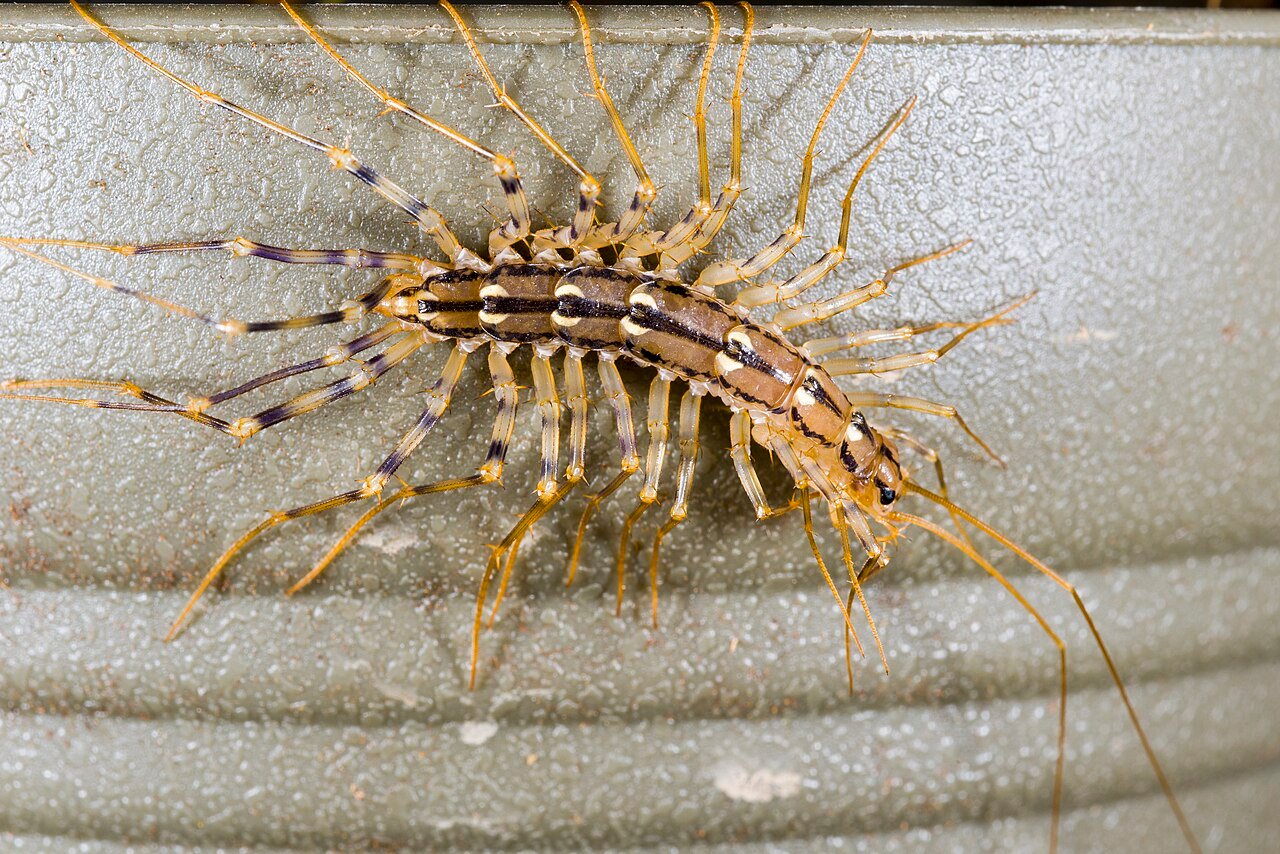
The house centipede (Scutigera coleoptrata) is a Mediterranean import that found global central heating agreeable and now lives wherever basements do. The body is an inch to an inch and a half; the fifteen pairs of banded legs — longest at the rear, so the animal reads as four inches of blur — are the whole show: they make it one of the fastest arthropods on earth for its size (over a foot per second in sprints), able to run on walls and ceilings, and equipped with a party trick — grabbed legs detach and keep twitching while the owner escapes (the same disposable-limb insurance the crane fly carries). The eyes are excellent by arthropod standards, the antennae longer than the body, and the front pair of “legs” are actually forcipules — venom-injecting graspers unique to centipedes, which sounds alarming and scales small: house centipede forcipules can rarely even break adult human skin, and the uncommon confirmed “stings” (technically pinches) rate below a bee — brief local pain, done. It hunts at night, runs down or lassos prey with those legs (researchers have documented one pinning multiple insects simultaneously, a leg apiece — nothing else in your house can do this), and spends days in the damp dark: floor drains, sump margins, under slabs, wall voids. Lifespan: up to seven years — your basement’s centipede may have seniority over your furnace filter subscription.
Centipede or millipede? (The other midnight mix-up)
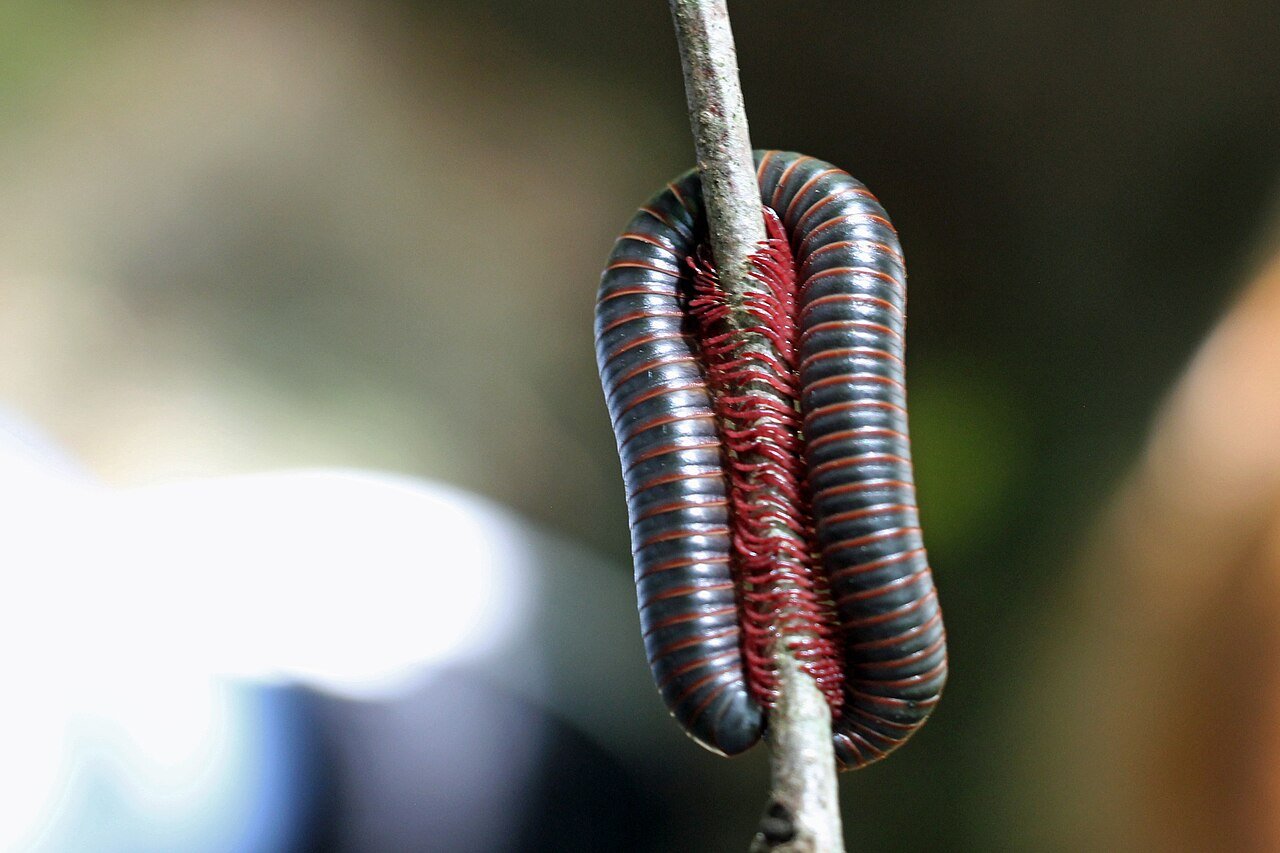
Half our “centipede” photos are millipedes, and the response differs, so: house centipede — long legs held wide, fast, flattened, hunts alone, one pair of legs per segment; millipede — short legs tucked under, slow as a parade, cylindrical and hard-shelled, curls into a coil when touched, two leg pairs per segment, and arrives in numbers after wet weather (the spring and fall “millipede migrations” that carpet Ohio garage floors and window wells after saturating rains). Millipedes are detritus-eaters — harmless composters that wander indoors, dehydrate and die, no treatment needed beyond sweeping, door-sweep repair, and patience with the weather that sent them. Their one trick: some species release a mildly irritating defensive fluid when crushed, so sweep rather than smash, and wash hands after handling. Response summary: millipede invasion = weather event plus threshold-sealing reminder; centipede residents = the food-web report this page unpacks next. Both, always: photo to the line if unsure — it’s free and takes minutes.
What a centipede population is telling you
Here’s the reframe that turns the scream into intelligence: a predator maintains residence only where prey does. One centipede a season is a wanderer; regular sightings mean your home is running a food web — a standing population of the silverfish, roaches, spiders, carpet beetle larvae, drain-fly adults and sowbugs that a seven-year predator needs to make rent. Which means “too many centipedes” is never actually the diagnosis; it’s the symptom bundle’s most visible member, and the useful question is what’s underneath. Run the census the way our inspections do: sticky monitors along basement baseboards for a week don’t just count centipedes — they inventory the prey base (the same card that catches the hunter catches the hunted), and the catch list writes the treatment plan. Silverfish-heavy card: the humidity file. Roach nymphs: the protocol. Sowbugs and millipedes: exterior moisture at the foundation line. Drain flies: the biofilm method. In every case the centipedes shrink on their own as the prey base drains away — predators follow food out the door. Treating the centipedes first is killing the smoke detector because it beeped.
The moisture doctrine, third verse
Readers of this library’s basement series can sing along now: house centipedes need humidity — they lack the waxy waterproofing of insects and desiccate quickly in dry air, which is why they live in the drain-and-sump latitude and hunt the same damp that grows their prey. So the permanent fix is the one that has now closed three consecutive pages: dehumidifier to 45–50 percent, hose-drained, hygrometer-verified; bathroom and dryer venting actually functioning; downspouts and grading moving water off the foundation; the vapor barrier where a crawlspace runs bare; and the crack-sealing pass at sill and slab that denies both predator and prey their commuting routes (copper mesh and caulk, the usual kit). Dry the theater and the whole cast leaves — hunter, hunted, and the spiders working the same room. One appliance, four pest categories, no chemistry: it remains the best ratio in structural pest control, and the centipede — ironically the scariest-looking beneficiary of damp — is the reason another few hundred Miami Valley households will finally buy one.
The honest treatment tiers
Tier zero (most cases): nothing, or relocation-by-cup for the squeamish — a solo hunter in a generally dry house is doing free work; the cost-benefit of killing it runs negative. Tier one (regular sightings): the census-and-source program above — monitors, prey ID, targeted source fix, moisture work; centipedes resolve as a side effect within a season. Tier two (heavy populations, or the phobia case): honest professional scope — crack-and-crevice treatment of harborage voids and drain margins knocks down the standing population fast while the moisture work does the permanent part; we’ll say plainly that the chemical layer without the humidity layer is a subscription, and we’d rather sell the fix. And a word for the phobia case, because it’s real and we take it seriously: needing the basement to not contain sprinting arthropods is a legitimate service request — no lecture about beneficials attached — and the program that delivers it is the same one above, executed aggressively, with the Protection Plan’s quarterly rhythm keeping the theater dry and the cast gone. What we won’t sell: broadcast basement spraying as a standalone — it kills this week’s visible centipedes, leaves the prey base and the humidity, and books its own repeat performance. The messenger dies; the message keeps arriving.
House centipede questions, answered
Can a house centipede actually hurt me, my kids, or the cat?
Functionally, no. The forcipules rarely pierce adult skin; the rare pinch runs milder than a bee sting with no lasting effects for the overwhelming majority (the standard anaphylaxis caveat applies to any venom, at vanishing rarity here). They don’t seek contact — every encounter is the centipede fleeing at maximum speed, which is the entire visual problem. Cats bat them, sometimes eat them, and are fine; the centipede usually isn’t. Kids should learn the leave-it rule they should learn for everything with legs — but the honest risk table puts this animal below the family dog, the staircase, and the toaster.
Why do I only ever see them in the bathroom and basement?
Humidity and hunting grounds. The bathroom’s overnight steam economy and its drain access make it a satellite hunting territory off the basement’s home range; sightings there peak at night when both predator and prey clock in. A centipede in a consistently dry upstairs bedroom is a genuinely lost animal; a centipede in the shower at midnight is a professional at the office.
They dart at me — are they aggressive?
They dart, full stop — startled centipedes launch in whatever direction their head already pointed, and a bathroom’s geometry makes some fraction of those launches toward the human. It’s the flying-roach illusion at floor level: you’re terrain, not target. The animal that could genuinely outrun you has never once chosen to chase.
One just ran under my baseboard. Do I need to do anything tonight?
No. It was already living there, it’s hunting things you want hunted, and tonight’s only assignment — if any — is noting which room, for the census. If the sightings become a pattern, run the sticky-card week and read the prey list; if the card comes back all-centipede-no-prey, that’s rare and interesting and worth a photo to the line. Either way, nothing about this animal requires a midnight decision — which, after fourteen pages of things that occasionally do, is its own kind of good news.
A closing word for the defense
This library has now defended the crane fly (harmless), the giant water bug (wildlife), the opossum (tick vacuum) and the remote hornet nest (fly control) — and the house centipede completes the set as the only defendant that actively works your property nightly, year-round, for free, on the exact pest list this company charges to suppress. We are, in the most literal sense, recommending mercy for a competitor. The verdict this page asks for: identify it, understand what its presence reports, fix the moisture and the prey base if the report warrants, and let the individual hunters hunt. And when the population — or the prey base under it, or the humidity under that — crosses your line, the same evidence-first crew that just defended it will happily manage it: (937) 569-3330, Greater Dayton Pest & Rodent, Dayton and all eight counties. Scream first if you need to; everyone does. Then read the message.
The natural history worth knowing (because it explains the encounters)
A little biology converts the midnight encounter from horror to documentary, so: the house centipede hunts by a combination of speed, vibration-sensing and those remarkable compound eyes — unusual among centipedes, most of which are blind — and its hunting repertoire has made it a minor celebrity in arthropod research. The documented moves: the lasso (whipping the long rear legs over fleeing prey to entangle it), the multi-pin (holding several prey items at once, one per leg pair, while eating the first — efficiency no mammalian predator matches), and the drumming retreat (detached legs left twitching to occupy a predator’s attention during escape). It grooms obsessively after every meal, threading each of its thirty legs through its mouthparts — the same fastidiousness that makes boric-acid dusting effective against its prey works on the hunter too, one reason crack-dust programs suppress whole basement food webs at once. Females live those five-to-seven years, produce dozens of offspring annually in damp soil and voids, and the hatchlings start with four leg pairs, adding more at each molt — a small centipede with fewer legs is a juvenile, not a different species. None of this needs to make anyone love the animal. It’s offered for the same reason everything in this library is: the creature you understand costs you less — in money, in chemicals, and in 2 AM adrenaline — than the creature you only scream at. The house centipede, understood, costs approximately nothing, and pays.
The basement food web, fully mapped; the trilogy of damp — silverfish, waterbugs, and now their fastest neighbor — complete. One dehumidifier to rule them all, and a photo line for whatever sprints across the tile next.
The eight-county centipede map
Where the sightings cluster locally, for calibration: the stone-foundation belt leads as always — Dayton’s historic districts, Oakwood, the courthouse-square towns of Troy, Lebanon and Eaton — where seeping masonry keeps the humidity and the prey base generous; these are the seven-year-resident houses. The finished-basement suburbs run second: carpet-on-slab humidity pockets in Beavercreek, Centerville and Mason, where the sightings shock harder because the basement looks like a living room. The farm properties of Preble and Miami counties round it out with the crawlspace-and-cellar version, plus the millipede migrations that follow every wet spell across the grain belt’s field edges. Same animal, same message, every address: the moisture number runs the show. Fix the number, thank the hunter, and reclaim the midnight bathroom — the Miami Valley’s fastest arthropod will take the eviction gracefully, provided you evict its groceries first.
The DIY weekend, scheduled
For the household ready to close the whole basement file in one pass, here’s the order of operations, weekend-sized: Saturday morning — hygrometer readings in every below-grade room (write them down; you’ll want the before), then the dehumidifier purchase and hose-drain setup while the readings settle the sizing question. Saturday afternoon — the flashlight-and-caulk pass: sill-plate seams, slab cracks, pipe penetrations, the door sweep to the garage; copper mesh in anything finger-width. Sticky monitors go down last, baseboard-adjacent, six or eight of them, labeled by location. Sunday — the storage triage from the archivist’s corner: cardboard out, gasketed totes in, bottom shelves six inches up, and the floor-drain bucket-of-water ritual while you’re down there. The following weekend — read the cards. Humidity down fifteen points, prey catches identified and their source-fixes queued, centipede count already thinning: that’s the normal report, and it cost a Saturday and about $300 all-in. The alternative — years of intermittent screaming, sporadic spray purchases and a standing arthropod cast — costs more and fixes nothing, which by now is the most familiar sentence in this library. One weekend, one appliance, one food web dissolved: the fastest thing in your basement will simply run out of reasons to be there — and so, at last, will everything it was hunting.
And should one last hunter cross the tile mid-project, thirty legs blurring toward the sump — consider a nod instead of the shoe. It kept the roach count down while you were deciding to read this page; the least the management can do, on its way to a drier building, is note the service rendered. Few pests earn an exit interview. This one did.
Fifteen pairs of legs, seven years of tenure, zero bites worth the name — and one page that finally read its résumé before reaching for the shoe. The basement trilogy closes dry, quiet, and understood.
Next up in the library: the tiny red bugs on the windowsill, the winged termites in the spring air, and the rest of the questions the Miami Valley asks at midnight — answered the same way, one honest page at a time.
Centipedes in Ohio: which ones you actually have
Ohio has a modest centipede list and only one that routinely lives indoors. The house centipede, Scutigera coleoptrata, is the long-legged sprinter in the bathtub, and it is the species behind nearly every centipede question we get. It is not native, having arrived from the Mediterranean well over a century ago, and it has settled into Ohio basements permanently because our basements are exactly the damp, dark, insect-rich habitat it evolved for.
Outdoors, Ohio also has soil centipedes, the thin thread-like ones found under logs and in leaf litter, and the stone centipedes, which are shorter, flatter, reddish brown, and faster than they look. Both turn up under mulch, landscape timbers, and flowerpots, and both occasionally wander inside. Neither establishes indoor populations the way the house centipede does, and neither is a concern beyond the startle.
What Ohio does not have is any centipede capable of causing a person real harm. The large tropical centipedes that deliver medically significant bites do not occur here, and our species have fangs too small and too weak to reliably break human skin. A house centipede bite is uncommon enough that most people who keep them in the basement for years never experience one, and when it happens it is comparable to a small sting.
What attracts centipedes in homes
Two things, in this order: moisture and prey. Centipedes lose water rapidly through their cuticle and will die in a dry environment within days, which is why they are found in bathrooms, basements, crawl spaces, and around floor drains rather than in the middle of a dry living room. Anywhere in the house that stays reliably damp is a place a centipede can live, and anywhere that does not is a place it is only passing through.
The second attractant is the one people miss, and it is the more useful one. House centipedes are predators, and they are in your basement because something else is. Their diet is spiders, silverfish, cockroach nymphs, ants, firebrats, small flies, and the occasional bed bug, which means a persistent centipede population is not a centipede problem at all; it is a reading on the insect population you cannot see. A basement with several centipedes has a food supply supporting them, and eliminating the centipedes without touching that supply simply produces new centipedes.
The specific conditions that produce them in the Miami Valley are consistent: a crawl space with bare soil and no vapor barrier, a basement with a humidity problem or a slow leak under the stairs, downspouts discharging at the foundation, mulch piled deep against the siding, firewood stacked against the house, and window wells full of wet leaves. Fix the water and the food supply falls; fix the food supply and the centipedes leave. Our crawl space and moisture guide covers the structural half of that in detail, and springtails covers the most common prey species people never notice.
One thing that does not attract them is food debris in the kitchen. Centipedes have no interest in crumbs, sugar, or grease, and cleaning the kitchen more thoroughly will not change a basement centipede population by a measurable amount. The lever is water, and after water, the insects the water supports.
Frequently asked questions
Are house centipedes dangerous?
No — the many-legged sprinter that horrifies everyone is venomous only to its prey; its delicate fangs rarely pierce human skin, and the rare pinch rates below a bee sting. The horror is aesthetic, the record nearly spotless.
What is the fast bug with a hundred legs in my bathroom?
The house centipede — fifteen leg pairs, shockingly fast, moisture-loving, and hunting at night for exactly the roster you want hunted: roach nymphs, silverfish, carpet beetle larvae, spiders, and fly pupae.
Should I kill house centipedes?
The honest answer nobody wants: they are among the most beneficial predators in the house — every centipede is a one-insect pest patrol working free. Squeamishness is legitimate (relocate or vacuum); just know each removal retires a night-shift exterminator.
Why do I have house centipedes?
Because you have their food and their climate — centipedes announce a moist house with prey insects: basement dampness feeding silverfish, drain issues feeding flies, clutter harboring everything. The census logic again: the predator marks the prey.
How do I get rid of house centipedes?
Dry and starve: dehumidifier below 50%, moisture leaks fixed, the prey-base program run (drains, sanitation, sealing), and door sweeps on the ground-level entries. Centipedes leave when the hunting fails — the same subtraction program as the spider guide, same result.
Do house centipedes bite people in bed?
Vanishingly rare — they flee humans at speed and hunt insects, not sleepers. Overnight “bites” belong to the standard differential (fleas, mites, bed bug evidence-check) before any centipede conviction.
Where do house centipedes come from?
Mediterranean origin, now permanent indoor residents across North America — yours likely walked in at ground level and stayed for the humidity and hunting. Unlike most invaders they can complete their entire life cycle indoors, in the right (damp) house.
Why are they always in the bathroom and basement?
Moisture triple-play: humidity they need (no waxy cuticle — they dehydrate fast), prey concentrations (drain flies, silverfish), and dark cover. A dry bathroom fan-and-fix routine relocates them more reliably than any spray.
How long do house centipedes live?
Three to seven years — remarkable for a household arthropod — molting toward the full thirty legs over their first year. The one patrolling your basement has likely held the territory for seasons.
When do centipedes warrant a call?
When their abundance flags the real problem — a moisture-and-prey economy worth professional diagnosis — or when the sightings simply exceed household tolerance: (937) 569-3330. We treat the causes; the centipedes depart with their prey base either way.