Of all the spiders that cross an Ohio floor, the wolf spider generates the most 9 PM phone photos — because it’s the biggest thing that does the crossing, it does it at speed, and it does it in September, right through the living room, while everyone’s watching. So the verdict up front, before the biology: Ohio’s wolf spiders are not dangerous — not one of the state’s medically significant species (that short list is two spiders long and covered honestly in our venomous spiders guide), not aggressive, not web-builders colonizing your corners, and not breeding indoors in any sustained way. What they are: the yard’s most effective ground-level predator taking an occasional wrong turn — and, this page’s real subject, the source of three durable myths (the brown recluse mix-up, the “it jumped at me” report, and the vacuum-full-of-babies legend, which is the only one with truth in it). The full treatment: identification against the look-alikes that matter, why the September living-room crossing happens on schedule, the honest “pest control for wolf spiders” answer (mostly: control their groceries), and the handful of scenarios where the population itself earns professional attention. Greater Dayton Pest & Rodent, photo verdicts free and same-evening during spider season: (937) 569-3330.
Meet the hunter: what a wolf spider actually is
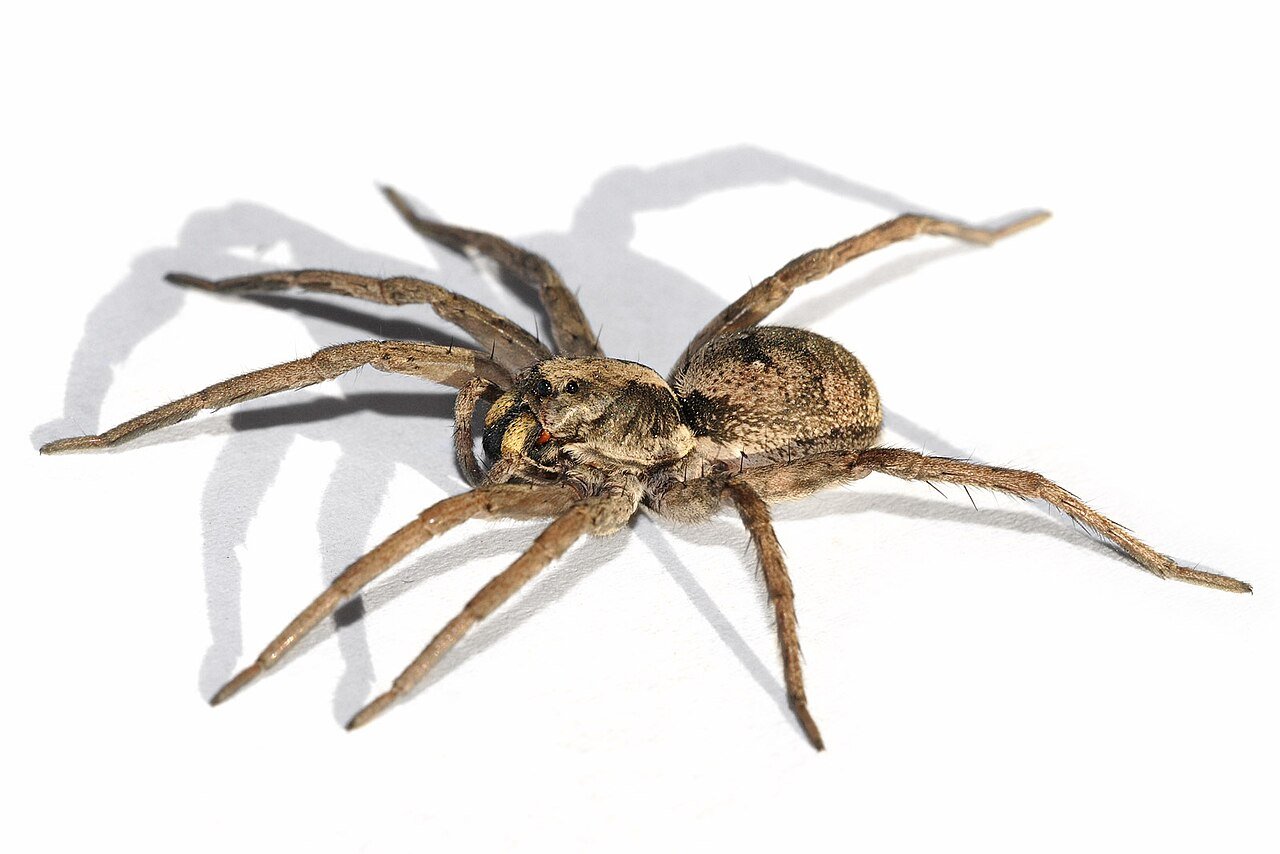
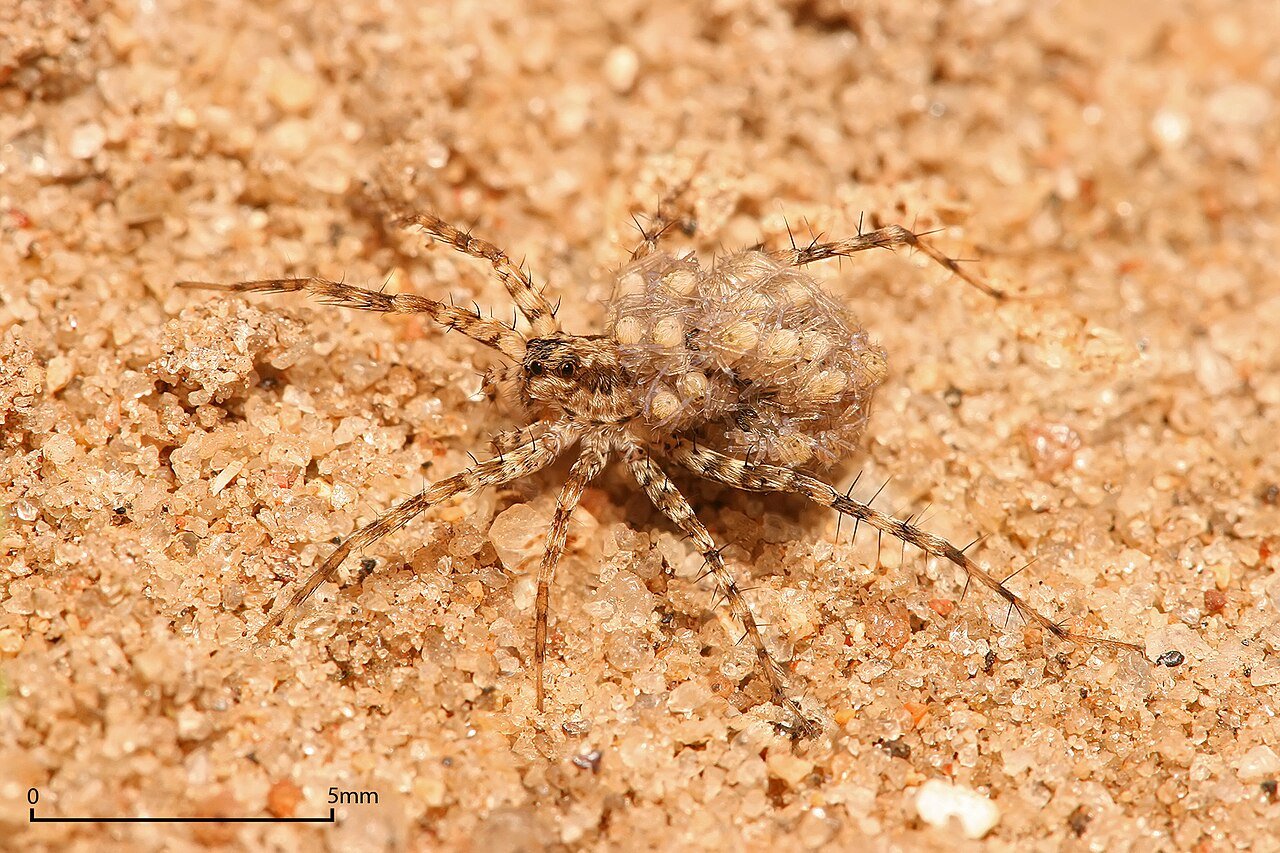
Wolf spiders (family Lycosidae) are Ohio’s dominant ground-hunting spiders — several dozen species statewide, from pea-sized field runners to the big Hogna and Tigrosa species whose leg spans push two-plus inches and star in every autumn photo sent to our line. The design brief is pursuit predation, no webs involved: stout hairy bodies in earth-tone camouflage (browns and grays with lengthwise striping — the pattern is a field mark), eight legs built for sprinting, and the giveaway feature for any phone macro: the eye array — four small eyes in a bottom row, then two huge forward-facing headlights, then two more on top of the head. Those big anterior eyes deliver some of the best vision in the spider world, and they produce the identification trick every flashlight owner should know: eyeshine. Sweep a flashlight held at your temple across the lawn on a summer night and the grass glitters back with tiny blue-green sparks — wolf spider eyes reflecting like cats’ — a census of the hundreds quietly working every healthy yard. They hunt crickets, roaches, fall invaders, earwigs, and each other; they live one to two years; and the females run the family business this page’s second photo celebrates: egg sacs carried attached to spinnerets, then dozens of spiderlings riding their mother’s back for a week-plus after hatching — unique among spiders, endearing or horrifying by temperament, and the true source of the vacuum legend addressed below.
The look-alike docket: recluse, grass spider, fishing spider
Three mix-ups account for nearly all wolf spider anxiety, and two of them matter. The brown recluse confusion is the consequential one, in both directions: recluses are smaller (body under half an inch, legs delicate rather than athletic), uniformly tan with NO striping or pattern on the legs, six eyes in three pairs (not eight in the wolf’s tiered array), and the famous violin mark — useful mostly in reverse, since a big, striped, hairy, fast spider has already failed the recluse test three ways before anyone squints at violins. Our venomous guide covers the recluse’s genuinely limited Ohio picture; the practical point here is that the overwhelming majority of “recluse” photos our line receives are wolf spiders, and the correction always lands as relief. The grass spider / funnel weaver is the harmless one: similar coloring and speed, but it builds the sheet webs with funnel retreats that silver every dewy lawn and window well — a web disqualifies a wolf instantly (wolves own no real estate). The fishing spider is the size-record correction: the huge, longer-legged spider on the pond-side tree, the dock post or occasionally a basement wall near the river-town waterline is a Dolomedes — bigger than any wolf, flatter, legs spread wide, equally harmless, and the correct ID for most “biggest spider I have ever seen in my life” submissions from the Great Miami corridor. Striped, sprinting, web-free, eight eyes in tiers: wolf. Everything on the docket: photo line, free, minutes.
The September crossing: why the big one is in your living room
Wolf spider indoor sightings run a sharp seasonal spike — late August through October — and the mechanism is worth knowing because it reframes the encounter completely. The autumn walkers are overwhelmingly mature males on mating patrol: after a summer of growth, males abandon their home ranges and walk, sometimes hundreds of yards a night, hunting female pheromone trails — and a fraction of those journeys route under a garage door, through a fall-invader-season gap, across your carpet. The crossing spider isn’t moving in; it’s passing through on the worst navigation of its life, it has zero interest in your bed or your shoe closet, and left alone (or cup-and-carded outside) it resumes the search immediately. The same season stacks the deck: fall invader traffic peaks, harvest pushes field arthropods — and their predators — toward foundations (the harvest-eviction pattern that runs our whole September calendar), and cooling nights make heated slabs attractive rest stops. Which delivers the practical read: a September wolf spider is weather, not evidence — but a pattern of them (weekly sightings, multiple sizes, sightings continuing into winter) means the building is admitting ground-level arthropods generally, and the response is the same door-sweep-and-gap audit that closes the fall to mice, crickets and ladybugs at once. The spider is six millimeters of clearance away from never being your problem; the weatherstripping aisle sells the fix for twelve dollars.
The legends, adjudicated
“It jumped at me.” Wolf spiders pounce on prey inches away and can startle-sprint in any direction, including yours — but they do not leap at humans; the perceived attack is the flying-roach illusion yet again: a panicked animal, an open floor, and a human standing where the exit was. (The actual jumpers — the fuzzy, curious jumping spiders that watch you back — max out at fingernail size and star in nature documentaries, not nightmares.) “If you squish one, hundreds of babies scatter everywhere.” The one legend built on real biology: crush a female in her spiderling-carrying week and yes, the survivors scatter — a memorable spectacle with zero infestation consequence (the spiderlings were headed outdoors to disperse regardless; indoor survival for them is essentially nil). The practical lesson isn’t horror, it’s technique: cup-and-card wins over shoe in every scenario — cleaner, calmer, and no scattering plot twist. “Wolf spider bites rot your skin.” Recluse folklore wearing the wrong spider’s name: wolf spider bites — rare, defensive, essentially requiring you to grab or trap one against skin — produce brief bee-sting-grade pain and minor local swelling, no necrosis, no medical drama; the standard wash-ice-watch protocol from our bite guide covers it entirely. Three legends, one partial conviction, and a shared moral: this spider’s reputation is borrowed — from movie spiders, from recluses, from the general principle that speed reads as malice. The animal itself has never once earned it.
“Pest control for wolf spiders”: the honest answer
The search that titles this section deserves a straight response from a company that sells the service: wolf spiders are rarely the correct treatment target — they’re an index of one. Because they neither breed indoors nor persist without prey, a wolf spider “problem” decomposes into one of three real situations. Situation one: occasional seasonal walkers. The September males, the garage wanderer — no treatment meaningfully addresses an animal that arrives individually from the entire surrounding landscape; the fix is exclusion (sweeps, thresholds, foundation gaps, garage-door side seals — the twelve-doors list at ground level), and it’s permanent. Situation two: a heavy resident population indoors — regular sightings across seasons, multiple sizes, basement window wells stocked like terrariums. That’s a prey-base report, the same logic as the centipede page: something (crickets, sowbugs, roaches, silverfish) is feeding a predator population, and the effective program treats the prey and the moisture that sustains it — monitors to inventory, source-fixes per the inventory, dehumidification below grade — with the spiders resolving as a side effect. Situation three: exterior pressure worth managing — wood piles against siding, dense English ivy at the foundation, mulch mountains, window wells full of leaf litter: harborage landscaping that concentrates hunting grounds at your envelope. The perimeter program’s exterior treatments plus the gravel-moat and harborage cleanup genuinely reduce the population at the wall line — and that, plus exclusion, is the entire legitimate “wolf spider control” industry. What we won’t sell: interior broadcast spraying for wandering hunters — ineffective against animals that walk in from the property line weekly, and precisely the subscription-shaped non-solution this library exists to name.
Wolf spider questions, answered
One was on my pillow. I need to burn the house down now, correct?
Understandable, incorrect. A wolf spider on a bed is a navigation catastrophe (for the spider) — they hunt ground level and have no interest in sleeping humans, who radiate exactly the vibrations they avoid. Cup, card, yard, and a check of the window screen and the gap under the bedroom door, which is the actual finding. Statistically your pillow hosts more drama from dust mites nightly — a fact we offer in the spirit of perspective, not comfort.
Are wolf spiders good for anything, or just cardio?
They’re among the yard’s heaviest-lifting pest control: a healthy lawn’s wolf spider population takes crickets, beetle larvae, roach nymphs, earwigs and fall-invader stragglers by the thousands per acre per season — free, nightly, chemical-less. The eyeshine census is genuinely worth running once just to see the size of the workforce. Every one relocated outdoors returns to the payroll immediately.
Do they come up drains?
No — the P-trap’s water seal blocks that route (the same physics from the silverfish tub question). Tub and sink wolf spiders fell in from the rim hunting moisture and can’t climb porcelain — the tub is a passive pitfall trap, and the morning discovery is your cue about bathroom-window and vent gaps, not plumbing.
I’m genuinely arachnophobic and “they’re beneficial” doesn’t help. What’s the real program?
Respected, and same policy as the centipede page: needing your home to not produce two-inch spiders is a legitimate service request, no ecology lecture attached. The aggressive version of everything above — full exclusion pass, exterior perimeter treatments on the quarterly rhythm, harborage landscaping, below-grade dehumidification, window-well covers, and monitors to verify the trend — reliably takes indoor encounters to near-zero, which for phobia purposes is the number that matters. The Protection Plan keeps it there with the re-treatment guarantee behind it. Call and say the word “spiders”; we’ll build exactly that.
The verdict, September edition
Big, fast, striped, and headed somewhere else: the wolf spider closes this library’s spider file the way the crane fly opened the harmless-giants wing — an animal whose entire offense is looking like trouble while performing services. Learn the eye-tier ID and the recluse disqualifiers, cup-and-card the autumn travelers, read any persistent population as the prey-and-gaps report it is, and spend the response money where it works: sweeps, seals, sources, and the perimeter rhythm. For the photo verdicts, the phobia program, or the basement census that’s outgrown DIY: (937) 569-3330, Greater Dayton Pest & Rodent, Dayton and all eight counties — where September’s biggest walker gets an honest trial, and your living room gets its floor back either way.
A night with the flashlight: the eyeshine census, step by step
Because it’s the best free nature show in the Miami Valley and the fastest cure for wolf spider dread ever discovered, the full instructions: wait for a dry summer or early-fall night, take the brightest flashlight you own, and hold it at your temple, beside your eyes — the trick is alignment, since eyeshine reflects straight back at the source. Sweep the beam slowly across the lawn, low and flat. Within a minute the grass lights up: dozens, often hundreds, of tiny blue-green sparks, each one a wolf spider’s headlight eyes tracking the night’s hunting from its own few square feet of territory. Walk toward one spark and it holds position until the last moment — you’ll find a modest brown spider standing over its patch, unbothered, working. The census delivers three things no paragraph can: proof that the yard has hosted this workforce all along without incident (the fear was of discovery, not danger), a genuinely impressive datum for the household’s resident child (or the household’s resident adult who is definitely not going to try it, and then does), and the correct frame for every future September crossing — that living-room wanderer was one spark out of hundreds, lost between territories, and the yard it came from has been protecting your foundation line every night for years. Some pest problems this library solves with a dehumidifier, some with a caulk gun; this one mostly dissolves under a flashlight, which is the cheapest resolution in a hundred and forty pages.
The eight-county spider geography
Local calibration to close: wolf spider encounters track habitat edges, so the field-adjacent suburbs lead the fall call log — Huber Heights, the newer rings of Springboro and Tipp City, and every subdivision whose back fence meets corn — where September’s harvest-eviction sends the whole field-edge food web toward heated slabs. The farm campuses of Preble and western Miami County live with the richest populations and mind them least (barn wolf spiders are unpaid staff, and every farmer knows it). The river and trail corridors — the Great Miami and Little Miami greenways — add the fishing-spider showstoppers to the photo line each summer. And the historic cores’ stone basements host the year-round window-well populations that the moisture-and-prey program addresses alongside their centipede housemates. Wherever the address, the arithmetic is the same one this page has run throughout: the spider is the visible percent of an ecosystem doing mostly useful work, the indoor encounters are a gap report, and the fixes — sweeps, seals, sources, moat — are the same dozen unglamorous dollars that close the fall to everything else. The biggest walker in Ohio’s spider book, filed at last where it belongs: impressive, innocent, and eminently manageable.
Eight eyes in three tiers, one borrowed reputation, zero medical significance — and a September visitor that was always just passing through. Cup, card, flashlight, census: the spider file closes with the yard’s night shift still on duty, sparks in the grass, exactly where they’ve always been and exactly where they belong.
Three pages left in this batch of the library: the mud daubers on the porch ceiling, the cicada killers over the sidewalk, and the stink bugs asking their last two questions. The Miami Valley’s midnight searches, nearly all answered.
Frequently asked questions
Are wolf spiders dangerous to humans?
No — the bite is rare (they flee first, always), bee-sting-grade when provoked into it, and carries no medical significance for non-allergic people. Ohio’s most alarming-looking common spider is also one of its most overqualified acquittals.
What is the huge fast spider that ran across my floor?
Almost certainly a wolf spider — big-bodied, hairy, visibly fast, hunting on foot rather than webbing. It came in through a ground-level gap chasing prey, wants nothing from you, and will take the cup-and-card exit gratefully.
Is it a wolf spider or a brown recluse?
Size and legs settle it: wolf spiders run larger, with stout banded or patterned legs and eight eyes in three rows (two large headlights); recluses are smaller, uniformly tan with unbanded slender legs and six eyes. The headlight eyeshine under a flashlight is a wolf signature.
Why do wolf spiders come inside in fall?
Cooling nights push the ground-hunting population through door gaps and foundation seams — accidental tourists following prey and warmth, not colonists. The heated indoor desert kills or exits most within days; door sweeps end the tradition.
Do wolf spiders jump at people?
No — they lunge at prey short distances but flee humans at speed; the “jumped at me” stories are escape sprints that happened to point your way. Genuinely jumpy spiders (the charming jumping spiders) are a different, smaller family.
What is the wolf spider carrying on its back?
Spiderlings — mothers carry egg sacs at the spinnerets, then ferry dozens of hatchlings on their abdomens for days: the best parental care in the spider world. Crushing a carrying female scatters the nursery, which is the origin of every “it exploded into babies” story — one more argument for the cup.
Do wolf spiders make webs?
No hunting webs — they are pursuit predators using silk only for egg sacs and retreat linings. A big spider ON a web is something else (orb-weaver, funnel weaver); a big spider sprinting across open floor is the wolf.
Are wolf spiders good for anything?
They are the lawn’s night-shift pest patrol — crickets, roach scouts, lawn insects by the thousand, hunted on foot at densities that surprise people who see the dew-lit eyeshine field a flashlight reveals on a September lawn. Outdoor wolves are unpaid staff, full stop.
How do I keep wolf spiders out of my house?
Ground-level exclusion: door sweeps and garage thresholds (their number-one entrance), foundation-seam caulk, cleared mulch moats — plus the prey-base and lighting program from the main spider guide. What does not work: repellent sprays and scent products, per the standing grades.
Should I ever call about wolf spiders?
If ground-floor entries keep happening despite the sweeps (an exclusion audit finds the gaps), or if the population signals a prey boom worth diagnosing — otherwise the file is cup, card, and respect: (937) 569-3330 for the audit version.
The “Rabid” Wolf Spider: Worst-Named Spider in America
One species query deserves its own answer because the name does so much unearned damage: the rabid wolf spider (Rabidosa rabida) — common across Ohio fields and yards — has nothing to do with rabies and no unusual aggression; the nineteenth-century namers simply thought its fast, erratic hunting sprints looked “rabid.” It’s a mid-sized striped wolf spider with the family’s standard résumé: free pest control, reluctant biter, mildly uncomfortable bite at worst, mother carrying her spiderlings aboard. If you searched the name in a panic after an ID app offered it: the scariest thing about this spider was decided in 1837, by a taxonomist.