
Maineville is the village the growth found — a nineteenth-century crossroads core in Hamilton Township, Warren County’s booming southeast, now ringed by the subdivisions and school campuses of one of Ohio’s fastest-growing corners. The pest file reads accordingly: an old village heart running the heritage playbook, growth-phase neighborhoods running the new-construction file in every direction, and the Little Miami’s valley country close enough east to lend its corridor pressure to the township’s edges. Greater Dayton Pest & Rodent covers Maineville and Hamilton Township on the southern Warren loops — full service list, two-tier structure, no mileage lines, and the old-core-plus-new-ring literacy this particular geography demands.
The village-in-the-boom file
Maineville’s two housing worlds sit a street apart and need opposite playbooks. The crossroads core — the frame houses and brick survivors along the old roads — runs the compact-village heritage file: cellar-era foundations meeting the fall push, porch wasp calendars, the moisture guild where humidity holds, and exclusion craftsmanship that rewards these finite old perimeters permanently. The growth ring — phase after phase of the township’s subdivision boom — runs the complete county growth-homework file: builder-gap penetrations awaiting steel, field-displacement Octobers as former farm ground converts, sod-and-irrigation mole economies installing on schedule, and the year-one baselines that decide each street’s first decade. The township’s pace means the ring grows yearly while the core holds; our era-read discipline — which Maineville your address is — starts every quote, and the Mason page’s phase-cycle doctrine applies here at village-adjacent scale.
Hamilton Township’s growth math
The township around the village runs Warren’s heaviest current construction, and the growth math the county hub codified compounds here: every new phase inherits its ground’s displaced rodent population the first fall, every school campus and retail strip serving the boom adds its commercial file, the surviving farm parcels between phases run campus properties on borrowed time, and the Little Miami’s eastern valley lends corridor pressure — long mosquito seasons, woodland pushes — to every street within its reach. The doctrine holds throughout: baselines in year one, September as the anchor, the twelve-doors standard before each street’s first winter, and HOA-scale coordination (the township builds in associations) capturing the Mason page’s common-ground economics. Growth townships write pest maps in fast-forward; the calendar keeps up by design.
A Maineville seasonal calendar
- March–May: ants wake in core and ring alike; moles surge the new sod; termite swarms photograph same-day in the crossroads stock; the valley edge opens its mosquito season
- June–August: deck and porch wasps scale; cicada killers patrol the sandy new lawns; school-campus and retail programs run their summer maintenance windows
- September–October: the boom-township double — displacement pushes off converting ground meeting invader flights on every sunny wall; the September visit anchors both Mainevilles
- November–February: interior mouse season; exclusion weather for the core; the ring’s newest streets meet their first winters and learn why the baselines mattered
Maineville questions we hear
Our subdivision didn’t exist three years ago — what should we actually be doing?
The growth-ring starter kit, in order: the year-one baseline inspection while builder accountability lives (mapping the penetrations, ledgers, and grade lines every production build leaves), steel at the findings before your first October, the landscaping watched as it embeds (mulch off the foundation, irrigation heads off the siding), and September adopted as the standing calendar. New streets inherit their ground’s history the first harvest — the county file explains the mechanics — and three-year-old phases sit exactly in the window where the cheap fixes are still cheap. Your street’s twins two phases over already wrote the year-five story; the baseline is how yours reads better.
Does the old village get anything the new streets don’t?
Craftsmanship — the core’s cellar-era stock earns the heritage-grade exclusion the ring never needs (mortar-and-mesh work, reversible materials, the deep-stock reading at neighborly scale), and the old houses’ standing termite vigilance runs annual where the ring runs baseline-then-watch. Same calendar, same promises, different toolkits — the era-read at the door decides which truck-side of the doctrine your quote draws from, and both Mainevilles get their right version at the same no-mileage price.
Warren coverage: county hub · South Lebanon · Morrow · Mason · full service area.
The Maineville lineup, ranked
- Ants — the supercolony species across both eras; bait-led always, wet-spring surges on the valley edge
- Mice — displacement Octobers in the ring, cellar-era files in the core (rodent control)
- Moles — the boom’s irrigated sod running township-wide pressure (trapping program)
- Wasps — decks, playsets, and porch structures on the August calendar (removal guide)
- Fall invaders — lady beetles on every sunny wall the converting fields can still see (the October file)
- Mosquitoes — the valley edge’s season plus every new pond and gutter (seasonal service)
- Termites — core vigilance annual, ring baselines standing; WDI reports for the township’s hot market
- Spiders — the growth ring’s lighting meeting the valley’s insect economy (the census)
Schools, strips, and the boom’s institutional file
Growth townships build institutions as fast as houses, and Maineville’s campus-and-commerce layer gets the programs its categories demand: school facilities run documentation-first service scheduled to academic calendars with the family-safety placement standards as bedrock; the retail-and-dining strips serving the boom run food-service-grade programs with new-construction commissioning (fresh commercial builds carry the same builder-gap file as fresh houses, at dock-and-drive-through scale); and the medical-and-professional stock filling the corridors runs the quiet-suite office file. Institutional Maineville is mostly newer than its students — which makes commissioning-stage pest architecture (device networks and exclusion planned before opening day) the township’s standing opportunity, and the facilities that seize it simply never develop the histories the retrofit accounts spend years correcting.
What a Maineville first visit looks like
Era-read first, always: core addresses get the heritage hour (foundation lap with mortar attention, cellar truth-telling, porch structures, the finite-perimeter craftsmanship read), ring addresses get the growth circuit (builder-gap hunt, landscape-line audit, the settle-stage assessment matched to the phase’s age), and township parcels get the campus read wherever more than one structure shares the deed. Findings photographed, homework separated from invoice, quote before scheduling, and the two-tier conversation had honestly — the ring’s young streets often stay one-time-plus-baseline; the valley edges and the households done thinking about it hear the plan case on its merits. Southern-loop scheduling books a couple days out; photo-first booking lands the right toolkit the first trip.
The bottom line for the village in the boom
Maineville holds two Ohios on one crossroads — the nineteenth-century village that named the place and the twenty-first-century township growing around it faster than almost anywhere in the state — and it gets a program fluent in both: heritage craft for the core, growth doctrine for the ring, commissioning-stage opportunity for the institutions, campus reads for the holdout farms, and every site-wide promise (free quotes, free photo identification, no mileage lines, the two-tier guarantee) at full strength on the southern loops. (937) 569-3330, Monday–Friday 8–6, Saturdays by appointment: both Mainevilles, one calendar. Greater Dayton Pest & Rodent, Ohio licensed — ODA Pesticide Business License #115079 — the boom’s corner covered by name.
The holdout-farm file: campus properties on borrowed time
Between the township’s phases sit the holdouts — the farms and acreage parcels whose families have watched the subdivisions arrive fence line by fence line — and their pest file carries a poignant double character worth naming plainly. As working campuses they run the full county doctrine: whole-parcel reads, feed-room hardening, barn triage, equipment protocols, September kept. As islands in the boom they run concentrated-pressure arithmetic in reverse — each surrounding phase’s conversion pushes its displaced ground-dwellers toward the remaining habitat, which is the holdout, making the farm’s structures busier every year the ring tightens. And as eventual transactions (most holdouts sell eventually, on their own schedules) they benefit enormously from maintained files: the documented, inspected, sealed farmstead enters its someday-negotiation with its structures’ history in writing rather than in rumor. We service the holdouts with particular care — they are the township’s memory, their families kept this corner worth building toward, and their pest pressure genuinely is everyone else’s displaced problem landing on their barns. The boom owes its islands good service; ours delivers it, September by September, for as long as each family keeps its ground.
And the valley edge’s corridor blocks?
The township’s eastern streets within the Little Miami’s reach run the corridor file the Morrow page details in full — long mosquito seasons, woodland pushes, moisture-honest cellars — at edge-of-reach intensity: real enough to shape the September checklist, mild enough that the standard defense holds it easily. Valley-edge households read Morrow’s doctrine and apply the calmer dose; the corridor grades its pressure by distance, and Maineville’s east sits at the comfortable end of the gradient.
For the township’s HOAs and the boom’s boards
Hamilton Township builds in associations, and the Mason page’s HOA doctrine applies here at the boom’s freshest scale: common-ground contracts for the retention ponds and entrance landscaping being installed right now (commissioning-stage pest architecture at association scale — device networks and breeding-site design reviewed before the first annual meeting), coordinated-street programs written into new communities’ vendor rosters from year one, and the phase-wide baseline projects that let a whole new neighborhood start sealed rather than retrofit later. Young associations hold a leverage mature ones envy: nothing has embedded yet, every standard is settable, and the board that writes pest architecture into its founding vendor decisions hands every future owner a quieter decade. The township’s newest boards are deciding their defaults this year; this page is the memo, and the consultation — like everything else — is free.
One Maineville tip worth the page: date your street, book its stage
The Mason compression, boom-township edition: your street’s construction date is its pest horoscope — under five years reads builder-gap baseline, five-to-fifteen reads settle-watch, the core reads heritage annual — and one stage-matched September visit outruns the township’s whole call log. The deed knows the date; the Plan automates the ladder; and the phone sorts any ambiguity free: (937) 569-3330. Boom corners run on timelines — defense included.
Family standard, township edition
A township of young families gets the site’s family doctrine as bedrock: placed applications never broadcast, tamper-resistant rodent equipment as policy, stand-off buffers for the play structures and vegetable beds the boom’s backyards fill with, product conversations at the door before anything opens, and the non-chemical fix leading wherever it honestly can — the full placement-over-potions playbook, applied to subdivisions statistically fuller of toddlers, retrievers, and swing sets than anywhere else on the county roster. The boom’s households chose this township for its family arithmetic; our placements honor the same math, visit after visit, and the technicians’ dog-treat diplomacy works as well on the new cul-de-sacs as it does everywhere else on the map.
What does township work cost?
The unchanged answer at the boom’s freshest edge: job-priced, never map-priced, the cost guide’s ranges intact, free firm quotes before work — with the growth-township bonus that new-street coordination and young-association contracts capture the roster’s best batch economics. The ring’s houses were priced by the phase; their defense prices by the job, and both Mainevilles pay the same honest number: (937) 569-3330.
DIY or call: the two-era fork
Maineville’s honest split runs by era, as everything here does. Genuinely DIY: the ring’s caulk-and-sweep year-one homework (production-build gaps are the most homeowner-fixable on the map while they are young), the twelve-doors Saturday on any street past its settling, standing-water patrol as the ponds and gutters multiply, and the reachable paper-wasp umbrella at dusk. Professional territory: the core’s heritage-fabric exclusion, anything the era-read flags structural (settling-stage moisture questions, the holdouts’ campus files), void and ground yellowjackets per the never-plug doctrine, association and institutional programs entirely, and the third-failure situations where the aisle has already lost. The photo line arbitrates free, both eras, every day — and the boom’s young households, statistically newer to homeownership than most of the map, get the patient version of every answer. Nobody is born knowing what a builder gap looks like; the pictures teach fast.
The crossroads’ long view
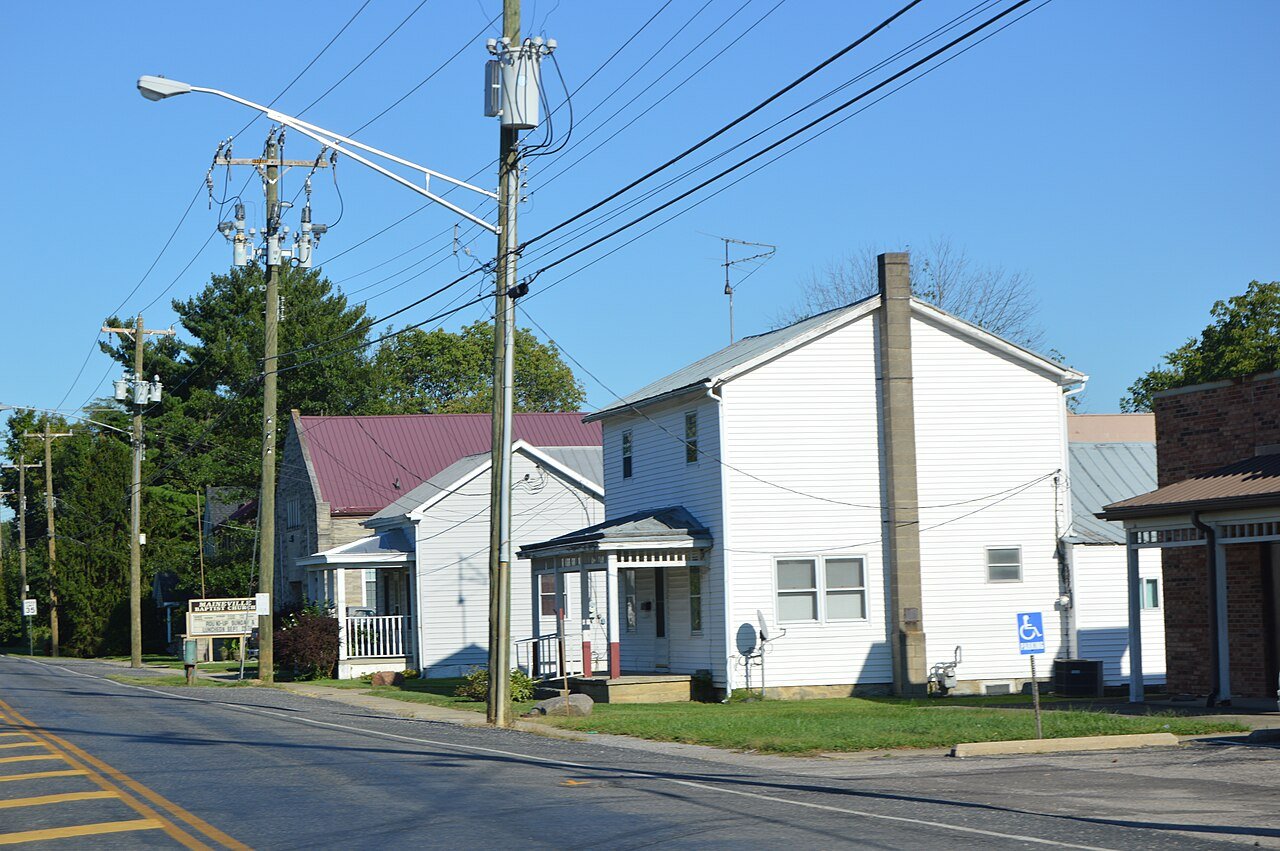
The houses in the photograph above watched Hamilton Township’s whole transformation from their Maineville Road porches — farm wagons to school buses, crossroads store to retail strips, fence lines to phase lines — and their endurance is the page’s closing argument: communities absorb their booms best when their oldest fabric stays sound and their newest fabric starts sound, and pest work sits quietly inside both halves of that sentence. The core’s survivors, maintained era-appropriately, anchor the township’s memory; the ring’s phases, baselined and sealed young, skip the retrofit decades their older suburban cousins spent learning; and the calendar that serves both — September’s anchor, the era-read’s discipline, the free photo line’s daily arbitration — is the same one this site has now written across eight counties. Maineville’s crossroads has watched everything change and kept its porches; we intend our work here to age exactly that well. The village in the boom is covered — both of it, by name, on schedule.
The commuter file, southern edition
Hamilton Township commutes in every direction — Cincinnati south, Mason’s corridors west, the county seat north — and the commuter-village doctrine scales to the boom: problems announcing on weekends, garages and gear cycling unobserved, the yard’s edges tended in bursts, and scheduling-over-vigilance as the working answer — monitoring devices for the weekday watching, the September anchor as calendar item, the Plan as autopilot for households whose daylight belongs to the highway, and photo-first booking that converts Saturday discoveries into next-loop route stops. The township’s families imported the region’s longest average commutes when they chose its schools and square footage; their pest program should be the one thing on the calendar that runs without them. Ours is built to — boom-tested, weekend-friendly, and answered by owners whose own commute ends at Salem Ave.
And when something urgent hits a township this far south?
The priority-response rules hold county-wide: stings at entries, rodents meeting deadlines, and commercial exposure jump every queue, the southern loops’ multi-day cadence means the jumping truck is rarely far, and the no-crisis-markup policy prices urgency at zero everywhere on the map. Save the number ahead of the need — boom townships generate their share of August yellowjacket surprises and closing-week discoveries, and the households with (937) 569-3330 already saved skip the worst part of both. The township grew fast; the safety net grew with it, and it answers on the first ring.
Licensed by the Ohio Department of Agriculture (Pesticide Business License #115079; applicator #170858 — categories 10A, 10B, and 12), insured, locally owned, and riding the southern loops on schedule — from the crossroads’ oldest porch to the phase poured this morning, Maineville is on the map by name. Free quotes and photo identification every business day; the boom’s corner has its number.
Two eras, one crossroads, zero mileage lines — the village the growth found has found its coverage.
September is the appointment; the crossroads keeps the rest.
Welcome to the roster, Maineville.
Who actually turns up in Maineville: Greater Dayton Pest & Rodent is owned and operated by Bryan Camden, licensed by the Ohio Department of Agriculture — firm #115079, commercial applicator #170858, categories 10A, 10B and 12. When you call, you talk to the person who does the work. No call center, no rotating crews, and the same technician on every visit.
Frequently asked questions
Do you provide pest control in Maineville?
Yes — the fast-growing village and Hamilton Township plats sit on the southern Warren route days.
What pests are most common in Maineville?
Growth-plat files: new-landscaping ant colonies (the construction boom’s standing import), sod-line yellowjackets on fresh lawns, first-frost garage mice in young subdivisions, retention-pond mosquito seasons, and the disturbed-ground displacement pushing everything toward the newest streets.
How much is pest control in Maineville?
Published formula: most Maineville homes run $39–$55/month quarterly (newer footprints read honestly); one-time flat. Free: (937) 569-3330.
Why does my brand-new Maineville house already have pests?
The boom pattern — sod and nursery stock ship colonies, construction gaps host scouts before the punch list closes, and grading displacement drives field populations toward fresh foundations. The first-year package (perimeter, seal, sentries) is the answer, and it compounds.
What about the retention ponds every plat here has?
The suburban variable — managed or stocked ponds are fine; scummy fishless ones breed. The audit says which, Bti handles the undumpable, and pond-adjacent patios get the barrier program.
How fast can you reach Maineville?
Southern route days run regularly — days typically, priority faster, no travel charges.
Do you serve Maineville businesses?
Yes — the corridor retail and services on matched programs; HOA common-area work with the documentation communities expect.
Do new builds need termite attention this early?
Inspection-grade yes — construction debris in backfill is classic first-colony food, and young landscaping matures fast. Free annual checks from year one; stations when the conducive conditions arrive (they will).
Is the Protection Plan overkill for a new subdivision?
Often the honest answer is “lean first year, plan when the landscape matures” — and we say it: young tight builds with clean histories can run on the first-year package plus habits, upgrading when the mulch economy funds real pressure.
How do I start service in Maineville?
Instant quote, free photo ID, or (937) 569-3330 — free estimates, route-day scheduling, first visits typically within the week.
Buying or selling in Maineville? A lender-ready termite and WDI inspection in Maineville is $99 flat on the NPMA-33, next business day, PDF the day we inspect.