
The most common “mystery pest” in Ohio homes isn’t a mystery at all — it’s the carpet beetle, and the odds are excellent that your house hosts a few right now. That’s not an alarm; it’s a baseline. Carpet beetles live quietly in nearly every structure in the state, and most households never notice the small population cycling through window sills and closet corners. The calls we get start when quiet stops: sweaters emerging from storage with holes, a wool rug shedding in patches, fuzzy striped larvae appearing along baseboards, tiny mottled beetles gathering at spring windows — or, most confusingly, a family member developing itchy welts that every search engine insists are bed bug bites. This guide is the complete Ohio carpet beetle file from Greater Dayton Pest & Rodent: the species, the larva that does all the damage, the bed-bug confusion that sends half our carpet beetle calls to the wrong page, and the closet-by-closet program that actually ends an infestation. Free identification as always — a clear photo to (937) 569-3330 sorts beetle from bed bug in minutes, and the difference matters enormously.
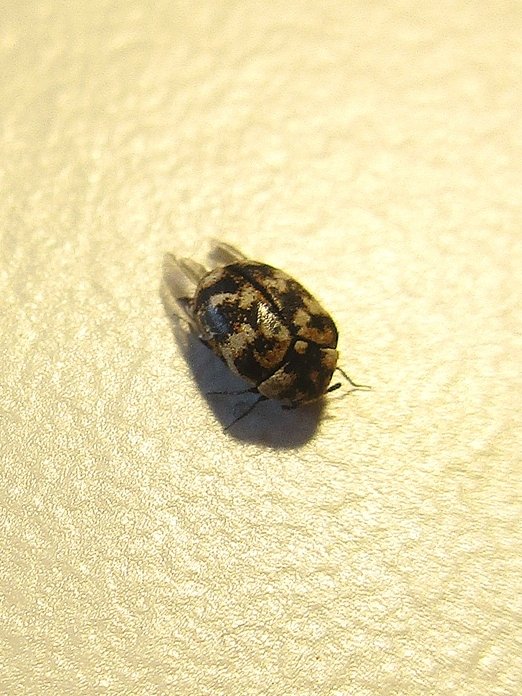
Meet Ohio’s carpet beetles: three species, one problem
Three dermestid species do essentially all of Ohio’s fabric damage. The varied carpet beetle is the headliner — smaller than a ladybug, rounded, with a mottled camouflage of white, brown, and yellow scales that make it look dusted with paint. The furniture carpet beetle runs similar with brighter white-and-orange mottling, and the black carpet beetle — slightly longer, uniformly glossy black-brown — rounds out the trio and tends toward pantry and lint diets. Adults are harmless flower-feeders: they eat pollen, which is why spring finds them on window sills — hatched indoors, they fly toward light seeking the outdoors and a mate. The damage is entirely larval. Carpet beetle larvae are small, bristled, and distinctive — the varied and furniture species look like fuzzy striped “woolly bears” a quarter-inch long with a tail-tuft of bristles; black carpet beetle larvae are smooth, golden-brown torpedoes. What they eat is keratin: wool, silk, fur, feathers, felt, hair, hide — the animal-origin materials synthetic moths ignore — plus the protein debris every house produces: pet hair drifts, lint, dead insects in window troughs and light fixtures, dried food spills, even the felt under furniture pads. They work in darkness and stillness — closet floors, under heavy furniture, along baseboard cracks, inside heat vents, in the folds of stored textiles — for months per generation, which is why damage accumulates invisibly and announces itself all at once.
Carpet beetles eat wool, feathers and dander rather than the pantry, so the fix is a different one entirely. See pest control in Dayton.
Carpet beetle or bed bug? The confusion that matters most
Here is the single most valuable identification in this guide, because the two problems cost wildly different amounts and the internet routinely sends families down the wrong path. The overlap: both can be found in bedrooms, both leave shed skins, and both get blamed for waking up with itchy welts. The differences are decisive. The bite question: bed bugs bite; carpet beetles never do. The welts some people develop around carpet beetles are an allergic reaction to larval bristles — carpet beetle dermatitis — which looks remarkably bite-like but behaves differently: it affects only sensitized individuals (one partner welts, the other never does, in any bed), appears where skin contacted infested bedding or floors, and stops immediately when the larvae are gone. The evidence question: bed bugs leave rust-black fecal dots on seams and mattress piping and live bugs hide within feet of the sleeper; carpet beetles leave bristled shed skins, sand-grain droppings, and damage to the blanket’s wool binding, with larvae under the bed rather than in it. The skin question: shed skins tell it instantly under a phone camera — bed bug skins are translucent amber bug-shapes; carpet beetle skins are fuzzy, bristled husks. Getting this wrong in either direction hurts: treating carpet beetles with a bed bug protocol wastes a four-figure response on a two-figure problem, while dismissing real bed bugs as “just beetles” gifts the infestation a month of growth. Our bed bug page covers that fork’s other branch; the photo line covers the fork itself, free.
Where they’re feeding: the household audit
- Closet floors and stored textiles: wool coats, sweaters, blankets, and anything with fur or feather trim — damage concentrates in folds, collars, and cuffs where larvae feed undisturbed for months
- Under heavy furniture: the wool rug’s fatal zone is the part under the couch nobody vacuums; check pile-loss patterns there first
- Baseboards, vents, and floor cracks: pet hair and lint accumulate in these seams into a complete larval diet — the infestation’s usual reservoir even in wool-free homes
- Window troughs and light fixtures: dead flies and lady beetles are dermestid protein; every fixture bowl of expired fall invaders is a nursery
- Taxidermy, hide rugs, and feather decor: the classic sources — one neglected trophy head can seed a house for years
- Air ducts and cold-air returns: hair-and-lint drifts inside ductwork feed populations that reseed rooms after every cleanup; the vent-grille check takes ten seconds
- Pantry margins: black carpet beetles cross over to grain, pet food, and that spilled kibble behind the dryer
- Abandoned nests: bird nests in vents and eaves, old wasp nests in attics, and rodent caches are natural dermestid habitat — the structural reason our exclusion work doubles as carpet beetle prevention
Ending an infestation: the program that works
Carpet beetle control is a cleaning-led, treatment-supported campaign — run in the right order, it’s decisively winnable. Find the reservoirs: the audit above, executed with a flashlight — you’re looking for live larvae, bristled skins, and pile damage, and the heaviest concentration marks your source. Eliminate by heat and machine: infested washables get hot water and high dryer heat (lethal to all stages); dry-clean the wool that can’t; freeze delicate items a week in sealed bags. Vacuum like it’s the treatment it is — slow passes on carpets and edges, crevice tool along every baseboard, under furniture, vent grilles off — and empty the machine outside. Protect what survives: clean textiles into sealed totes and garment bags (larvae eat soiled fabric first — food and sweat residue are the appetizer), cedar and lavender rate as mild deterrents not solutions, and true storage means sealed, not just enclosed. Treat the seams: our targeted application puts residual product where larvae travel and cleaning can’t fully reach — baseboard cracks, closet-floor edges, carpet-tack lines, under-furniture perimeters, duct margins — never broadcast over living surfaces. Verify: sticky monitors along suspect baseboards read the rebound; adults at spring windows the following year in small numbers are normal background, larvae reappearing in monitors are not. Most infestations resolve in one thorough cycle; heavy, source-obscure cases (the duct-seeded house, the taxidermy estate) run a second round under the same guarantee as everything we do.
Prevention: the boring habits that starve them
Because carpet beetles run on neglect, prevention is scheduling rather than spending. Rotate and disturb stored textiles seasonally — the sweater refolded twice a year never feeds anyone. Vacuum the margins monthly: baseboards, under beds, closet floors, the couch’s shadow. Empty light fixtures and window troughs of insect fallout each spring and fall — especially after a heavy lady beetle winter, whose die-off is a citywide dermestid banquet. Groom pets somewhere vacuumable, keep duct filters current, screen vents against birds and wasps, and give wool and fur the sealed-storage treatment before every summer. Households that adopt the list watch the spring window-sill count — the honest census of the resident population — dwindle toward zero within a couple of years, no treatment required. It’s the least dramatic victory in pest control, achieved with a vacuum crevice tool and a calendar reminder, and it’s exactly the kind of honest advice that costs us treatment revenue and earns us the phone number on the fridge.
Carpet beetles and the things you actually treasure
The costliest carpet beetle damage in the Miami Valley isn’t carpet — it’s heirlooms. The wedding dress in the cedar chest whose seal dried out a decade ago; the military uniforms and flags folded in an Kettering attic since Korea; the quilt collection, the mounted pheasant, the horsehair-stuffed antique chair, the wool Persian that survived four moves and met its match under a couch in Oakwood. Dermestids specialize in exactly the materials families keep for love, and time in undisturbed storage is their whole strategy. The protection protocol for irreplaceables is worth its paragraph: inspect annually (photograph condition while you’re there), clean before storage (residues attract first feeding), seal genuinely — archival garment boxes, gasketed totes, vacuum bags for the robust items — and station a sticky monitor in the chest or closet as a sentinel that reports problems while they’re still cosmetic. For pieces already hit, stop the feeding first (freezing is the conservator’s friend for delicate textiles), then talk restoration; a textile conservator can do remarkable things with a caught-early quilt and nothing with a hollowed one. We’ve walked plenty of families through exactly this triage, and the calls that start “my grandmother’s…” are the reason this section exists.
Carpet beetle questions, answered
I keep finding the beetles on window sills every spring but no damage. Do I have a problem?
You have the Ohio baseline — a small resident population cycling on lint and insect fallout, announcing itself each spring on the way out. A dozen sill beetles a year with clean closets calls for the prevention list, not treatment. Rising counts, or any larvae in monitors and textiles, moves you up this page.
Can carpet beetles really cause the rash my doctor can’t explain?
Carpet beetle dermatitis is real, underdiagnosed, and worth raising — bristle allergy produces bite-like papules in sensitized people, classically one member of a household, on skin that contacts infested bedding, floors, or upholstery. The clinching evidence is environmental: find larvae or skins in the bed’s orbit, eliminate them, and the “bites” stop. We’ve closed the loop on several such cases alongside a dermatologist’s shrug — bring the possibility to both of us.
Do synthetic carpets make me safe?
Safer, not safe. Pure synthetics aren’t food, but wool blends are, pet hair in synthetic pile is, and the baseboard lint economy runs regardless of your flooring. The wool-free house still hosts carpet beetles — it just confines them to the margins, which is where the vacuum wins the war anyway.
When is it time to call instead of clean?
Three triggers: damage or larvae across multiple rooms (a source you haven’t found), recurrence after a thorough cleaning cycle (a reservoir in ducts, walls, or an unfound nest), or anything involving heirlooms where the learning curve costs more than the visit. The evaluation is free, the treatment is targeted and guaranteed, and the identification photo costs nothing at all: (937) 569-3330.
The museum problem, scaled to a house
Museums call dermestids their most feared pest — institutions with climate control and full-time conservators still run permanent monitoring programs against exactly the beetles in your closet — and understanding why illuminates the home version perfectly. Dermestid larvae are nature’s cleanup crew, evolved to finish carcasses after the larger scavengers: keratin digestion is their superpower, patience is their strategy, and darkness is their cover. A museum fights them with quarantine (everything entering gets frozen or inspected), monitoring (sticky traps read weekly), housekeeping (no organic debris, ever), and sealed storage — and a household wins with the same four tools scaled down: inspect what enters (that estate-sale wool coat, the vintage taxidermy, the rolled rug from the auction), monitor the closets that matter, vacuum the margins, seal the treasures. The parallel is worth keeping because it reframes the problem correctly: carpet beetles aren’t an invasion to repel once but a permanent low-level ecological pressure to manage — like humidity, like dust — and the households that internalize that rhythm never lose anything to them again. Yours can be one of them by the weekend, and if the audit turns up more than the vacuum can handle, the targeted program is a phone call away — free evaluation first, guarantee behind it, and the same honest triage this site applies to everything with more legs than you.
The Ohio carpet beetle year
- March–May: adult emergence — the window-sill season, when overwintered larvae pupate and new beetles fly to light; the annual census of your resident population, and the natural deadline for the spring closet audit
- June–August: egg-laying on and near food materials; outdoor adults feed on flowering shrubs (spirea and similar pollen favorites) and some re-enter homes through screens — the season sealed storage earns its keep
- September–November: larvae feeding heavily as temperatures drop; the fall-invader die-off in fixtures and voids restocks the protein economy — clean the troughs after the lady beetles quit
- December–February: slow larval feeding in the warm dark; damage accumulates in stored textiles precisely because nobody opens the chest until spring — which is the argument for the January five-minute check on anything irreplaceable
One species trio, one larval appetite, one closet-by-closet program, and a calendar with two audit dates on it — that’s the entire Ohio carpet beetle file, and it beats the mystery-rash-and-ruined-sweater version by every measure that matters. Photo line open as always; the woolly bear in your baseboard corner photographs beautifully next to a coin.
One more look-alike worth naming: the clothes moth question
Because wool damage has two suspects, the final identification this page owes you is beetle-versus-moth. Ohio’s webbing clothes moth attacks the same keratin wardrobe, but the crime scenes differ readably: moth larvae spin — expect silken webbing, feeding tubes, and cocoon cases on damaged items, with grazed patches that look sheared — while carpet beetle larvae leave clean-edged holes, scattered bristled skins, and no silk whatsoever. Adult evidence differs too: clothes moths are furtive golden slivers that scuttle and avoid light (a moth you see flying at lamps is almost certainly a harmless pantry or outdoor species), while carpet beetle adults are the light-seeking sill-sitters of spring. The distinction matters mostly at the margins — freezing, hot laundering, sealed storage, and crevice treatment defeat both — but moth infestations lean harder on pheromone trap monitoring (species-specific lures exist and work) and on treating the garments themselves. If your evidence says silk and shear, mention it when you send the photo; the trap we bring will match the culprit, which is the whole point of looking closely first. Either way, the sweater’s enemies are finite, findable, and beatable — and the free ID line has settled the beetle-or-moth question for half the closets in the Miami Valley: (937) 569-3330.
And a closing note of perspective from the people who see every pest this region produces: of everything on this website, the carpet beetle is the most democratic — it inhabits the manicured colonial and the cluttered farmhouse with equal comfort, asks nothing but stillness, and surrenders to nothing but attention. The vacuum you already own, run along edges you already pass, on a schedule you already keep for other things, defeats it almost entirely. Few pests offer that bargain. Take it, set the two calendar reminders, and spend the treatment budget this page just saved you on something that flowers.
Frequently asked questions
What are carpet beetles and why are they in my house?
Small domed beetles (mottled or black) whose bristly larvae eat keratin and dried protein: wool, fur, feathers, dead insects, lint, pet hair. Adults fly in from flowers each spring or ride in on cut blooms; larvae then work the undisturbed corners. Nearly every Ohio house hosts a few; infestations are a density problem.
What do carpet beetle larvae look like?
Bristly, banded, carrot-shaped crawlers up to a quarter inch — slow-moving, light-avoiding, found under furniture, along baseboards, in closet corners, and (their giveaway) leaving molted bristle-skins that people mistake for live bugs.
Are carpet beetles harmful to people?
No bites, no disease — but the bristles trigger genuine dermatitis in sensitive people (“carpet beetle rash” mimics bite lines and gets blamed on bed bugs constantly). The health file is allergic, not parasitic; the differential matters.
Carpet beetles or bed bugs — how do I tell?
Evidence types: carpet beetles leave bristly larvae, shed skins, and fabric damage with NO blood spotting; bed bugs leave seam spotting, flat bugs, and bites without fabric holes. The look-alike confusion runs both directions weekly; the free photo ID settles it.
What damage do carpet beetles do?
Clean-edged holes and grazed patches in wool rugs and stored textiles, shed-bristle debris, and — the museum-world version — ruined taxidermy and natural-fiber heirlooms. Synthetic fabrics are safe; the damage maps your keratin inventory.
How do I get rid of carpet beetles?
Source-and-subtraction: locate larvae concentrations (under furniture, closet floors, air vents, wool rug undersides), vacuum those zones relentlessly for weeks (the single best tool), launder or freeze affected textiles, seal wool storage, and fix upstream feeders — abandoned nests in eaves, dead insects in voids, pet-hair accumulations.
Why do carpet beetles keep coming back?
A standing reservoir: wall-void insect die-offs (post-fogger houses especially), bird or wasp nests in the eaves feeding larvae that migrate indoors, wool carpeting edges, or the lint economy under never-moved furniture. The reservoir hunt is the fix — and often our actual job.
What attracts adult carpet beetles indoors?
Light and flowers — spring adults fly to windowsills (where people find them) and ride in on cut lilacs and peonies. Adults eat pollen, not fabric; they arrive to lay, and the windowsill beetle is the season’s official warning to check the closet.
Do carpet beetles infest food too?
The pantry overlap is real — larvae take dried pet food, meal, and grain products opportunistically, bridging the closet and pantry files. Airtight storage serves both defenses at once.
When do carpet beetles warrant professional help?
Recurring populations after honest vacuuming campaigns (a hidden reservoir — wall voids, eave nests, duct accumulations — wants finding), dermatitis cases needing confirmed ID, or heritage-textile stakes: (937) 569-3330.
Carpet Beetle “Bites”: the Rash That Isn’t a Bite
Search data says half the people on this page have itchy welts and a suspect — so here’s the medically honest answer: carpet beetles don’t bite. Adults eat pollen; larvae eat keratin. The rash blamed on them is real, though: carpet beetle dermatitis, an allergic reaction to the larvae’s barbed hairs (and shed skins) that contact skin — typically in bed, when bedding sits near an infested area. It shows as itchy red bumps, sometimes in rows, easily mistaken for bed bug bites; the sorting clue is that dermatitis follows contact with infested fabric zones and often affects only the sensitized person in the household, while bed bug bites hit anyone who sleeps there. Finding shed larval skins and adult beetles at windowsills settles it — and if the verdict is genuinely ambiguous, that’s an inspection question, because the two answers lead to completely different treatments. The good news either way: clear the infestation (vacuuming regime, hot-washing fabrics, source removal) and the “bites” end with it.