
Carlisle sits on the seam — a village whose streets literally straddle the Warren–Montgomery county line on the Great Miami’s west shelf, trading commuters, school districts, and mailing quirks across a boundary its residents mostly ignore. We serve it the way seam geography deserves: Carlisle rides both the northern Warren loops and the southern Montgomery routes, making it — like Verona on our Preble seam — one of the best-covered small communities on the entire map, with booking flexibility bigger towns envy. The full service list applies, the two-tier structure applies, and this page is the village’s own file: what Carlisle’s housing actually faces, valley shelf to field edge.
Exterminator is the word; pest control is the trade. Either way, Carlisle gets a technician out of the Salem Ave office rather than a call center in another state.
The seam-village file
Carlisle’s housing runs the valley-shelf spread in miniature. The village core’s older frame stock carries the standard old-foundation chapters — cellar-era mortar meeting the fall push, porch wasp calendars, the basement guild wherever humidity holds — at the modest scale that makes exclusion work here some of the most efficient on the routes. The postwar-and-later blocks that fill most of the village map are prime twelve-doors country: finite entry lists, garage-corner classics, permanent afternoon fixes. And the edges deliver the concentrated-pressure arithmetic every compact community on this site runs — the grid-village paradox — with Carlisle’s particular version fed by the valley’s field ground, the wooded draws toward Germantown’s hills, and the river corridor’s standing economy a shelf below. Small map, full spectrum, and a page of its own at last.
The valley-shelf pressure map
Three habitat systems press on Carlisle’s compact grid. The field ground west and south runs the harvest calendar — the October displacement testing every structure the same fortnight, answered by September exclusion as standing policy. The Great Miami corridor below the shelf runs its long mosquito seasons and wet-year wildlife pushes upslope, the same file the Franklin page maps across the river. The wooded seams toward the Twin Creek country bring the edge lineup — deer mice, carpenter ants off the mature timber, the invader flights massing on sunny siding each fall. Compact villages absorb all three undiluted; the counter is the September anchor visit plus sealed structures, and Carlisle’s size makes village-wide coordination genuinely achievable — a street on one route day is a street effectively sealed.
A Carlisle seasonal calendar
- March–May: village ants wake (bait, never spray); termite swarms in the older frame stock get same-day photos; valley wet springs push the moisture guild indoors on the low blocks; moles ridge the shelf lawns
- June–August: porch and shed wasps scale; the corridor’s mosquito season peaks below the shelf; spiders web every light on the valley’s insect economy
- September–October: the seam double — field displacement meeting invader flights; the September visit anchors the village year
- November–February: interior mouse season; exclusion carpentry weather; the quiet months when the village’s finite gaps get their steel
Carlisle questions we hear
Which county’s routes actually serve us — and does the line change anything?
Both, and nothing: Carlisle bookings flex onto whichever loop reaches you next — northern Warren or southern Montgomery — which in practice means seam-village response times that outrun towns twice the size. The line changes exactly one thing on our side: nothing. Pricing, promises, and the guarantee read identically on both sides of every boundary this company crosses, a doctrine the county pages repeat because customers keep asking. The auditors keep the line; we keep the calendar.
We’re a small village — do we really rate the full program treatment?
The Gratis answer travels: small-village work is efficient work — compact lots, findable problems, neighbors who coordinate — and every promise on this site was built village-sized by design. Carlisle’s scale is an advantage: the whole village’s pest pressure is legible in a way no city’s is, coordinated route days cover remarkable ground, and the referral economics of a place where everyone knows everyone keep our work honest better than any review site. Full standard, no asterisks, and a page with the village’s name on it to prove the point.
Coverage neighbors: Warren hub · Montgomery hub · Franklin · Springboro · Miamisburg · full service area.
Commuter-village housing: the maintenance rhythm of a town that works elsewhere
Carlisle lives the commuter-village pattern: households anchored here for the schools, the lot sizes, and the seam’s double access to Dayton and the corridor jobs, with weekday daylight hours spent elsewhere — and commuter housing runs a specific pest rhythm worth naming. Problems announce themselves on weekends (the Saturday discovery of a week’s droppings), garages and outbuildings go unvisited long enough for wasp colonies to establish unobserved, seasonal gear (campers, boats, mowers) cycles through storage on exactly the deer-mouse protocol’s timeline, and the yard’s edges get their attention in weekend bursts that miss the gradual encroachments — the mulch creeping up the foundation, the firewood migrating toward the siding. The commuter counter-rhythm is scheduling over vigilance: the September visit as calendar item rather than reaction, monitoring devices doing the weekday watching, the Protection Plan as the working household’s autopilot, and the photo-first habit converting weekend discoveries into Monday-morning route stops. Villages that commute deserve pest control that doesn’t require their presence; ours is built exactly that way.
The outbuilding-and-acre file
Carlisle’s lots run generous by suburban standards, and the sheds, pole barns, and workshop buildings behind the village’s houses carry their own chapter of the local file: wasp colonies scaling in unvisited rafters, the seed-and-mower economy funding shed mice, stored equipment hosting winter tenants, and the firewood-and-clutter margins that stage every fall’s push at the house itself. The campus-scoping doctrine the rural pages codified applies at village scale: quotes read the property, not the front door; outbuilding hardening (the shed threshold, the barn’s feed corner) ranks by return; and the honest triage — what earns steel, what earns management, what earns a shrug — comes written. An acre with buildings is a small campus wherever the mailbox stands, and Carlisle’s back lots hold more small campuses than the village lets on from the road.
What a Carlisle first visit looks like
The honest hour, village-scaled: the full perimeter lap (foundation line behind the plantings, garage corners against the daylight test, every utility penetration), the outbuildings walked as part of the property rather than ignored as accessories, the basement or crawl read for the valley’s moisture truth, and the yard’s staging areas — wood piles, seed storage, the mulch line — noted with the free-homework candor this site is built on. You get photographs, the plain-English entry map, and a written quote before scheduling, with the DIY-viable items (this village’s postwar stock rewards the twelve-doors Saturday as well as anywhere on the map) listed as yours to keep. Most Carlisle jobs resolve as efficient one-time work — the village’s scale favors it — and the plan conversation happens only where the property’s edges genuinely argue for it. Small-town quoting the way small towns remember it existing.
The bottom line for the seam village
Carlisle gets the double-route coverage its geography earns, the full-spectrum playbook its compact map contains, and the village-scale honesty that keeps companies welcome in places where reputation walks Main Street: efficient exclusion for the sealable stock, September defense against the shelf’s triple pressure, campus reads for the back-lot acres, commuter-friendly scheduling throughout, and every site-wide promise — free quotes, free photo identification, no mileage lines, the two-tier guarantee — at full strength on both sides of the line. (937) 569-3330, Monday–Friday 8–6, Saturdays by appointment: the seam village, served like the seam advantage it is. Greater Dayton Pest & Rodent, Ohio licensed — ODA Pesticide Business License #115079.
The Germantown hills and the western wooded seam
West of the village the shelf climbs into the Germantown hills country — the wooded ravines and creek draws running toward Twin Creek’s valley — and Carlisle’s western streets inherit that edge the way Hills & Dales inherits its MetroPark: as a standing subsidy to the local wildlife economy. The practical file: woodland deer mice supplementing the field push each fall, carpenter ant parent colonies in the mature draws sending satellites toward every roofline within trunk-trail reach, tick margins where yards trade edges with the brush, and the healthy insect base that keeps porch-light spiders prosperous all season. West-side households run the edge playbook — limbs off the rooflines, September barriers, wood-line habitat managed rather than fought — and get the compensation every edge page on this site acknowledges: the best evening views in the village, wildlife worth watching, and a defended house that lets both be enjoyed. The hills were here first; the doctrine makes the arrangement work.
Anything different about the village’s newer subdivisions?
They run the county’s standard growth-homework file at Carlisle’s calmer pace: builder-gap penetrations awaiting their steel, young landscaping installing its mulch-and-irrigation economies, and the first-October field inheritance wherever a phase borders working ground. The year-one baseline remains the cheapest visit any new address books, and the village’s slower build rhythm means our phase-cycle intelligence here is practically house-by-house. New Carlisle streets get old Carlisle treatment: known thoroughly, sealed early, visited on schedule.
The seam-village lineup, ranked
- Mice — the triple-source push (field, corridor, hills) against a compact grid; exclusion-first, September-timed (rodent control)
- Ants — the kitchen supercolony species plus wet-spring valley surges; carpenter ants off the western draws
- Wasps — porch, shed, and unvisited-rafter colonies on the commuter rhythm (removal guide)
- Fall invaders — lady beetles and cluster flies on every sunny wall the fields can see (the October file)
- Spiders — the valley’s insect economy at every porch light (the friendly census)
- Moles — shelf lawns bordering field and draw (trapping program)
- Termites — the older frame stock’s standing vigilance; WDI reports for the village’s transactions
- Mosquitoes — corridor-season pressure on the low blocks (seasonal service)
Every entry answers to the same two levers this site keeps handing back: sealed structures and the September calendar. Compact villages are where those levers move the most per dollar — and Carlisle is exactly compact enough to prove it street by street.
For Carlisle’s families: the pet-and-kid default
A village of yards, dogs, swing sets, and vegetable patches gets our family standard as the default rather than the upgrade, and it bears restating on every community page because it is the question behind half the first calls: applications are placed, not broadcast — cracks, voids, and exterior lines rather than the surfaces families live on; rodent work runs tamper-resistant equipment as policy; treatment plans assume the crawling baby, the countertop cat, and the tomato bed until told otherwise; and where the effective fix is non-chemical — the sealed gap, the moved woodpile, the dehumidifier — that fix leads the plan. The full doctrine lives on the pet-safe playbook page, the products and placements are explained at the door before anything opens, and the technicians carry dog treats with owner permission — which has resolved more Carlisle gate negotiations than any tool on the truck. Village families built this company’s book one referral at a time; the standard above is why the referrals keep coming.
One Carlisle tip worth the page: coordinate the street
The village-scale superpower every compact community holds and few use: organize the lane. Three neighbors on one route day tighten everyone’s scheduling; a street’s worth of September exclusions effectively seals the block against the fall push (the West Elkton page describes villages that have done exactly this); and the seam’s double-route access makes Carlisle uniquely easy to batch. The neighbor conversation costs nothing, the routing gratitude is real, and the winter that follows a coordinated street is the quietest testimonial in the county. Talk to the block; we will bring the calendar and the steel: (937) 569-3330.
Renters, landlords, and the village’s working stock
Carlisle’s rental file is the working village’s: singles and doubles held by local owners, the occasional converted farmhouse, and the small-portfolio landlords who know their tenants by name — and the site’s portfolio doctrine scales down to it gracefully. Turnover inspections at village prices catch what tenancies trade; documented response keeps the name-basis relationships honest when something does surface; the seam’s routing makes even single-unit calls economical; and the early-report culture — tenant photographs to us, findings to the owner, truck on the next loop — runs smoother in a village where the landlord answers their own phone than anywhere else on the map. Small-town renting at its best is neighborly; small-town pest programs keep it that way by making sure the building never becomes the argument.
And when something needs the emergency lane?
The priority-response rules read identically on the seam: stings at entries, rodents meeting real-estate deadlines, and commercial exposure jump every queue, the double-route geography usually means the jumping truck is closer than the map suggests, and the no-crisis-markup policy holds — the village price is the village price at any urgency. Save the number before the situation; the day it is needed, Carlisle’s seam becomes the fastest small-town address on the roster.
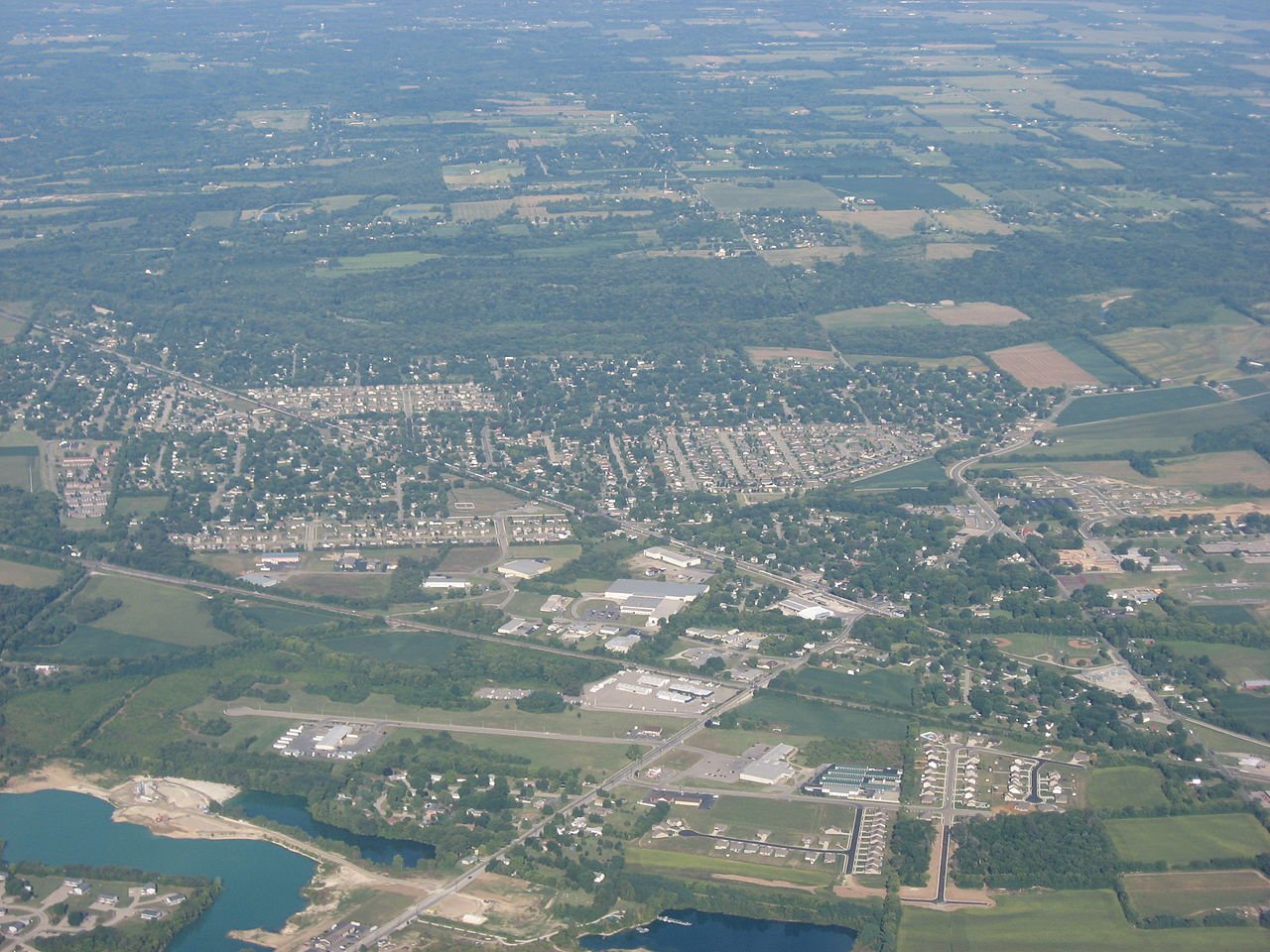
The aerial view, read like an inspector
The photograph at the top of this page shows what a route technician sees in miniature: the compact grid with its finite perimeter, the field ground pressing the edges, the tree lines threading the draws, the outbuilding-dotted back lots, and the river valley’s green ribbon beyond — the whole pressure map in one frame. Read it the way we do and Carlisle’s pest logic becomes almost diagrammatic: every arrow points inward from habitat toward structures, every structure’s defense is a known quantity of steel and scheduling, and the village’s size means the entire map is coverable — genuinely, house by house — in a way no city’s ever is. That legibility is the small village’s quiet gift to its residents: nothing about Carlisle’s pest situation is mysterious, everything about it is manageable, and the distance between the two is one free inspection. The seam village photographs beautifully from above; it defends even better from the ground.
What does typical Carlisle work cost?
Village economics at their friendliest: the postwar stock’s exclusion jobs run efficient (finite lists, honest hours), the seam routing erases any distance premium in either direction, and the coordinated-street savings above are real money for organized blocks. Specific numbers follow the site-wide rule — quoted free and firm before work, priced by the job and never the map — and the cost guide publishes the honest ranges the whole service area shares. The short version for the seam village: nothing about Carlisle’s address costs extra, several things about its geography cost less, and the first conversation remains the same free one it is everywhere: (937) 569-3330. The line down Main Street divides counties; it has never once divided a price.
The seam village closes its page the way it lives: efficiently, on both sides of a line that matters to everyone but its residents — and now with the double-routed, fully-written coverage its geography always deserved. Carlisle is on the map twice; once was never going to be enough.
Who actually turns up in Carlisle: Greater Dayton Pest & Rodent is owned and operated by Bryan Camden, licensed by the Ohio Department of Agriculture — firm #115079, commercial applicator #170858, categories 10A, 10B and 12. When you call, you talk to the person who does the work. No call center, no rotating crews, and the same technician on every visit.
Carlisle Pest Control, Service by Service
Deep-dive guides to how each service plays out in Carlisle specifically — the housing stock, the seasonal pattern, and the local pressure behind each pest:
- pest control new in Carlisle — what this service looks like locally.
- Termite inspection in Carlisle — what an inspection actually covers, what it costs, and why a sale here rarely forces one.
Frequently asked questions
Do you provide pest control in Carlisle?
Yes — Carlisle’s river-bluff neighborhoods and township edges sit on the Warren rotation alongside Franklin and Springboro.
What pests are most common in Carlisle?
The bluff-and-valley mix: Great Miami corridor mosquitoes below, garage mice and slab ants in the plats above, woodline wasps at the township edges, and the fall surges the surrounding open ground delivers.
How much is pest control in Carlisle?
County formula: most Carlisle homes run $39–$55/month quarterly; one-time flat. Free instant quote or (937) 569-3330.
Does the river valley affect Carlisle pest patterns?
Meaningfully — the corridor’s floodwater mosquito waves reach the lower neighborhoods after storms, and valley moisture feeds the basement guilds; elevation is destiny in Carlisle’s pest map, and the program adjusts by street.
Why does my Carlisle garage get mice each fall?
The open-ground-meets-plat pattern — township fields push their populations at first frost, and garage corners are the funnel. The threshold-and-steel-wool package is the local fix; September beats November.
How fast can you reach Carlisle?
Days typically on the near-daily Warren rotation, priority faster, no travel charges.
Do you serve Carlisle businesses?
Yes — the local storefronts, services, and corridor spots on matched programs; the township’s ag-adjacent operations get campus treatment.
What about ground wasps on the big lots?
The mower-discovery file runs strong — flag-and-dust priority protocol in season, burrow-filling in fall, and the standing advice to walk the lawn before the first cut of August.
Is the Protection Plan right for Carlisle?
Edge-and-valley houses, clearly; interior plat homes with clean histories can run leaner — the first-call triage says which honestly, as everywhere on the route map.
How do I start service in Carlisle?
Instant quote, free photo ID, or (937) 569-3330 — free estimates, first visits typically within the week.