
If you live anywhere in the Dayton area with a tree line, a field edge, a barn, or a shed — Washington Township, Bellbrook, the outskirts of Beavercreek, the corridors along our rivers — the mouse in your garage may not be a house mouse at all. Deer mice (Peromyscus maniculatus and the closely related white-footed mouse, Peromyscus leucopus) are Ohio’s native woodland mice, and they behave, nest, and carry risk differently than the city mouse most pest advice is written about. The difference is not academic: deer mice are the primary carriers of hantavirus in North America, and the cleanup rules for their droppings are genuinely different. This guide covers identification, the health facts without hype, and how we get them out of Miami Valley homes for good.

Deer mouse or house mouse? The 10-second ID
Hold the flashlight on it (or on the photo you take — text it to (937) 569-3330 and we will ID it free) and check three things. The belly: deer mice are sharply two-toned — warm brown or tawny gray above, crisp white below, like a tiny deer, which is where the name comes from. House mice are a uniform dusty gray-brown all over. The tail: a deer mouse tail is distinctly bicolored — dark on top, white underneath — and covered in fine fur; a house mouse tail is one color, nearly naked, and visibly scaly. The face: deer mice have noticeably larger, darker eyes and bigger ears for their size — adaptations for life outdoors at night.
Behavior tells you the rest. House mice live with people full-time, breed indoors year-round, and concentrate in kitchens near food. Deer mice live outdoors — woodlots, brush piles, tall grass, stone walls — and come inside seasonally, favoring the quiet parts of a structure: garages, sheds, attics, crawl spaces, wall voids, stored campers, and parked vehicles. If the droppings are in the engine bay of the car you store over winter, in the pop-up camper, or in the shed’s workbench drawer, deer mice are the better bet anywhere in our area.
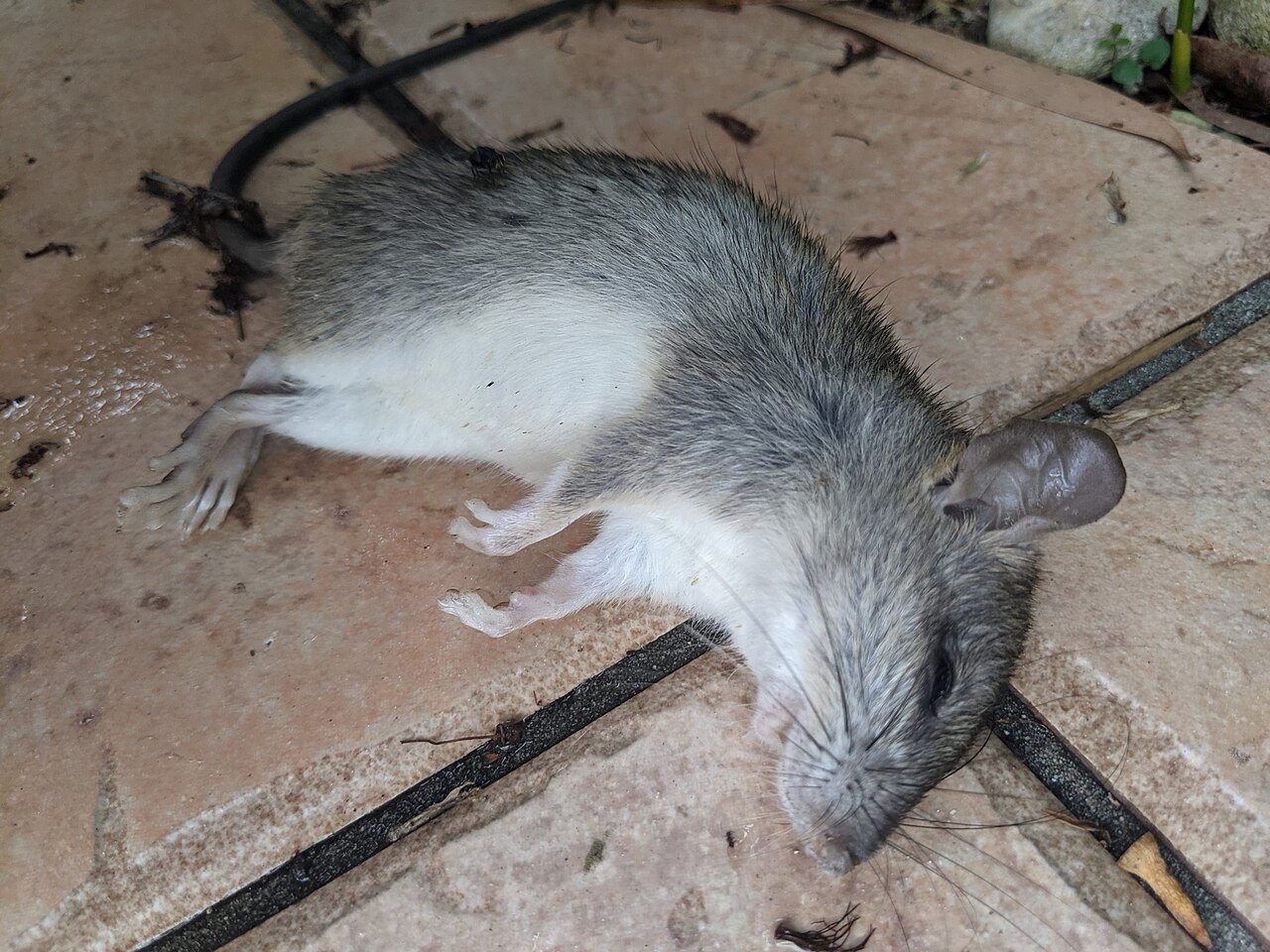
The hantavirus question, answered calmly
Deer mice are the main reservoir of Sin Nombre hantavirus, which can cause hantavirus pulmonary syndrome (HPS) in humans. Two facts belong side by side. First: HPS is genuinely serious. Second: it is genuinely rare — a few dozen cases a year nationwide, concentrated in the West, with Ohio cases being exceptional events. You do not need to fear every mouse dropping. You do need to respect the transmission route, because it is unusual: people are infected primarily by inhaling dust from disturbed droppings, urine, or nesting material — classically while sweeping or vacuuming out a long-closed shed, cabin, garage corner, or camper. The activity that feels like responsible cleanup is exactly the one that aerosolizes the risk.
The safe cleanup protocol (this is the part to save)
For any accumulation of mouse droppings in an enclosed space — especially a space that has been closed up for weeks — skip the broom and the shop vac entirely. Open doors and windows and let the space air out for 30 minutes before you work. Wear gloves and, for heavy accumulations, an N95. Wet everything down first: a disinfectant solution (or 1 part bleach to 9 parts water) sprayed until droppings and nesting material are soaked, left for five minutes. Wipe up with paper towels, bag them, seal the bag, and trash it. Mop or re-spray the surfaces after. The entire protocol exists to keep dust out of the air — wet it, wipe it, bag it, never sweep it dry. This is CDC guidance, it takes ten extra minutes, and it removes essentially all of the realistic risk.
Where deer mice show up around Dayton — and when
The pattern is edge habitat plus cold nights. Deer mice populations live year-round in the wood lines, fencerows, tall-grass margins, and brush of our area — the same edges that make Hills & Dales, Washington Township, Bellbrook, and the river-corridor neighborhoods so pleasant. In September and October, as night temperatures drop through the 40s, a share of that population moves into whatever heated or sheltered structure sits within range. Acorn-heavy autumns super-charge it: big mast years grow big mouse populations, and the following fall push is noticeably stronger — something we see across the Miami Valley in waves.
- Garages and sheds — the number one deer mouse habitat: quiet, cluttered, and connected to the outdoors
- Stored vehicles, campers, and boats — engine bays, cabin air filters, glove boxes, and upholstery are five-star deer mouse real estate; a winter-stored car is a nest box with wheels
- Attics and soffit voids — entered via roofline gaps, especially on homes backing to trees
- Crawl spaces and stone foundations — classic in older rural-edge homes
- Vacation properties and outbuildings — anything closed up for weeks becomes a colony’s winter quarters
Signs you have deer mice specifically
Beyond seeing one: food caches are the giveaway. Deer mice hoard — piles of acorns, seeds, and dog kibble stashed in a drawer, an air filter housing, a wall void, or a work boot are their signature (house mice rarely cache like this). Shredded-soft nests of insulation, fabric, and plant fluff the size of a softball, in quiet corners rather than kitchen zones. Droppings the same size and shape as a house mouse’s (rice-grain, pointed ends), which is why location and caching, not droppings, make the call. And activity in outbuildings or vehicles with no kitchen evidence at all — a house mouse infestation almost always reaches the pantry; a deer mouse infestation often never does.
How we remove deer mice — and why the playbook differs from house mice
The bones are the same as all good rodent work — exclusion first, trapping second, monitoring third — but three adjustments matter. First, the perimeter is bigger: because deer mice commute from outdoor habitat, we treat the yard’s edge features as part of the job. Brush piles against the shed, firewood on the ground, tall grass at the fence, bird seed in bags — each is a staging area, and our service reports flag them specifically. Second, the entry points are higher and quieter: deer mice are excellent climbers, so rooflines, soffit returns, gable vents, and the gap where the garage trim meets siding get as much attention as the foundation. Third, outbuildings and vehicles are in scope: sealing the house while the shed stays open just moves the colony thirty feet.
Trapping follows the caching biology: snap traps baited with peanut butter and — the deer mouse special — a sunflower seed or two pressed into it, placed along walls in the quiet zones, checked and re-set on a tight cadence. We do not lead with poison for deer mice, and in outbuildings we avoid it entirely: bait cannot compete with a shed full of cached acorns, poisoned mice die in wall voids and vehicle frames, and secondary exposure risks for the owls and foxes that eat deer mice are real. Trapping plus exclusion ends the problem and proves it ended — the trap line goes quiet.
Protecting stored vehicles and campers
A specific answer for the most Dayton-area version of this problem: the truck, classic car, or camper that winters in a barn or driveway. Before storage: vacuum food crumbs, remove every snack and dog treat, and set the cabin air system to recirculate (closes the fresh-air door many mice use). During storage: leave the hood open in a secure barn (mice prefer enclosed engine bays), set a snap trap or two on cardboard beside each axle, and check monthly. At spring startup: look before you crank — a cached acorn pile in the airbox or a chewed harness found early is an annoyance; found at 60 mph it is a repair bill. We winterize storage buildings for exactly this, and it is one of our favorite small jobs to do right.
Deer mouse questions we hear
Do deer mice in the garage mean I will get hantavirus?
No. Ohio HPS cases are vanishingly rare, and transmission requires aerosolizing infected material in an enclosed space. Respect the cleanup protocol, fix the entry points, and the realistic risk goes to essentially zero. We will not hype this risk to sell you a job — but we also will not sweep a sealed shed’s droppings dry, and neither should you.
Why do I only have mice in winter?
Because you have deer mice, not house mice. Your building is winter quarters, not home. That is actually good news: seasonal invaders are the easiest rodent problem to end permanently, because September exclusion work intercepts the entire migration.
The droppings came back in the same drawer — same mice?
Very possibly. Deer mice are strongly site-faithful and re-use good nest sites year after year, and they navigate partly by scent trails previous generations left. It is one more reason cleanup should be wet-method and thorough — you are erasing the map — and why the entry gap behind that drawer needs steel, not hope.
Related reading: Mouse or rat — which is in your house? · How mice get into your house · What smells do mice hate? · our full rodent control service.
White-footed mice: the local sibling you actually have
A precision note for Ohio readers: much of what people call a deer mouse in the Miami Valley is technically the white-footed mouse (Peromyscus leucopus) — a sibling species so similar that even biologists separate them reluctantly without measurements. White-footed mice dominate our deciduous woodlots and forest edges; classic deer mice hold the grassier, more open ground. For a homeowner the distinction changes nothing: identification marks, behavior, caching, seasonal invasion pattern, cleanup protocol, and exclusion strategy are identical, and both are hantavirus-competent (white-footed mice are also the primary reservoir of the bacterium behind Lyme disease in ticks, one more reason edge-lot rodent management earns its keep). We use “deer mice” on this page the way the region does — for the whole native, white-bellied, outdoor-living Peromyscus clan.
Prevention that actually works on a woodland edge
- Steel-wool-and-sealant or copper mesh in every gap over 1/4 inch — a deer mouse fits through a hole the width of a pencil
- Brush, firewood, and stored lumber up off the ground and 20+ feet from structures where the lot allows
- Bird seed, pet food, and grass seed in steel or heavy-duty sealed bins — a bag of black-oil sunflower on the shed floor is a deer mouse lottery win
- Garage doors adjusted so the corner seals actually meet the slab; daylight at the corner is an open door
- Gable and soffit vents backed with 1/4-inch hardware cloth; chimney caps checked
- Stored vehicles and campers on the protocol above, every winter
None of this requires making the property less wild — the wood line can stay exactly where it is. It requires making the buildings boring and the food inaccessible, which is the whole art of living next to habitat: enjoy the edge, seal the structures, and let the owls handle the rest of the population. When you want the sealing done professionally — with materials matched to the building and a guarantee behind the work — that is us: free quotes, same-week scheduling, and the Miami Valley’s edge neighborhoods are our home turf. (937) 569-3330.
Are deer mice dangerous? The honest risk ranking
Ranked by realistic likelihood for a Miami Valley household, the deer mouse’s dangers run: property damage first, disease a distant second. The damage column is where most families actually pay — chewed wiring in vehicles and equipment (rodent-chewed harnesses are among the most common storage-season repair bills in our area), contaminated insulation in attics and crawl spaces, ruined upholstery in campers, and stored belongings soaked in urine and cached seed. The disease column, hantavirus aside, includes the tick connection above and the ordinary sanitation concerns of any rodent (salmonella on food-contact surfaces). All of it is preventable with the same three moves: seal, trap, and store food and vehicles defensively. Fear is optional; the checklist is not.
When to call us
Call when the droppings keep coming back after your own trapping, when the activity is in a vehicle, camper, attic, or crawl space (access work and safe cleanup are where DIY stalls), when you have found a large accumulation in a closed space and want it remediated properly, or when you simply want the entries found and sealed once by people who do it daily. First visit: full inspection of the structure and the edge habitat, photographs of every finding, and a written quote before any work is scheduled. Every job is guaranteed as quoted — and our Protection Plan adds the full re-treatment guarantee — on our Protection Plan, if the mice come back between visits, so do we, free. Greater Dayton Pest & Rodent, Ohio licensed — ODA Pesticide Business License #115079, based on Salem Ave with the whole Miami Valley’s edge on our routes: (937) 569-3330, Monday–Friday 8–6, Saturdays by appointment.
A field note from our routes
The deer mouse call we see most often is not a house at all — it is the third stall of a garage, the pole barn, or the pop-up camper opened for the first spring trip, and the reaction is always the same mix of surprise and revulsion at the seed caches. What we want every customer to take from this page: that scene is normal biology on a wooded lot, it is safely cleanable in twenty minutes with the wet-method protocol, and it is completely preventable by next winter with an afternoon of sealing and smarter storage. The families who follow the checklist genuinely stop having the problem — we watch it happen every year, street by street, from the Stillwater corridor to the Sugarcreek edges. Native mice belong in the woods. With the right steel in the right gaps, that is exactly where they stay.
Do cats keep deer mice away?
Around the immediate house, somewhat; in the outbuildings and vehicles where deer mice actually concentrate, barely at all. A good mouser suppresses the bold individuals and leaves the cautious majority — and no cat patrols your camper’s bench seats in January. Cats are companions, not exclusion. The steel mesh does not sleep sixteen hours a day.
What about ultrasonic repellers for the garage?
Independent testing keeps reaching the same verdict: rodents habituate within days, and activity resumes behind the plugged-in device. Every winter we trap healthy deer mouse colonies in garages with a repeller glowing on the wall. Spend the money on hardware cloth and a good door seal instead — those work every night, forever.
One page cannot cover every rodent scenario, so use the free option liberally: photograph what you found — the mouse, the droppings, the cache, the chewed wire — and text it to (937) 569-3330. You will get a straight identification and an honest read on whether it is a DIY afternoon or a professional job, usually within the hour during business hours.
Frequently asked questions
How do I identify a deer mouse?
Two-tone coloring is the tell: brown-to-tawny back with a crisp white belly and white feet, larger eyes and ears than a house mouse, and a distinctly bicolored tail. Uniform gray-brown all over = house mouse; sharp color break = deer mouse.
Are deer mice dangerous?
They are Ohio’s hantavirus-associated species — the risk is inhaling dust from droppings, urine, or nesting material, not bites. Actual Ohio cases are rare, but the cleanup protocol difference is real and worth respecting rather than fearing.
How do I safely clean deer mouse droppings?
Never dry-sweep or vacuum — that aerosolizes the risk. Ventilate the space thirty minutes, mist everything with a 10% bleach solution, wait five minutes, wipe with paper towels into a sealed bag, and wear gloves plus — for heavy accumulations, sheds, or cabins — an N95 or better.
Where do deer mice live around houses?
The building edges: garages, sheds, barns, crawlspaces, cabins, stored vehicles, and camper interiors — they prefer structures adjacent to fields and woods over deep-interior living space, which is why the spring shed-opening is their classic encounter.
Do deer mice come inside houses?
Less than house mice, but yes — especially fall, especially rural and wood-adjacent properties, especially garages first. Interior deer mice raise the cleanup stakes and shift our protocol accordingly; the ID photo before cleanup genuinely matters.
What attracts deer mice to garages and sheds?
Stored birdseed and pet food, upholstered or boxed nesting material, undisturbed clutter, and gaps at grade — the same recruiting package as house mice, in buildings checked less often. Metal-bin storage and a spring glove-check habit cover most of it.
Is hantavirus really a risk in Ohio?
Documented but genuinely rare — the Midwest sees occasional cases against the Southwest’s concentration. The honest posture: zero panic, full protocol — the bleach-mist cleanup costs five minutes and removes the tail risk entirely.
How is deer mouse control different from house mouse control?
Same four moves (starve, trap, seal, verify) with three adjustments: cleanup at protocol grade, outbuilding-first inspection logic, and heavier emphasis on the field-edge exclusion since the source population lives in your landscape, not your neighbor’s kitchen.
What should I do before opening a closed-up shed or camper?
Open it to air for thirty minutes before working inside, glove up, and check for droppings before touching stored fabric or paper. That single habit — ventilate, then enter — addresses the main real-world exposure route.
When should I call about deer mice?
Any interior living-space evidence, heavy outbuilding accumulations, or a cabin/camper opening you would rather not do yourself — we handle protocol cleanups and the exclusion that keeps the field edge out: (937) 569-3330.