
The question usually arrives mid-mystery: droppings on the counter, the pantry’s top shelf raided, scratching in the ceiling — and a household staring at smooth walls wondering how anything without wings got up there. So the answer, delivered at the top: yes, mice climb walls — most walls, startlingly well — and the full version is worth the page, because understanding exactly what a mouse can and cannot scale rewrites the twelve-doors inspection from a ground-floor exercise into the three-dimensional audit it always needed to be. The file: the climbing kit (the paw engineering that makes brick a staircase), the honest can’t-climb list (short, specific, and the basis of every rodent-proofing trick that works), the jump-and-tightrope stats that explain the “impossible” countertop and ceiling arrivals, what climbing means for which floors get inspected, and the vertical exclusion checklist — the gutter lines, vine ladders and cable highways that ground-level audits miss. Plus the cousin comparison that matters locally: the deer mouse out-climbs the house mouse, and the roof rat — the family’s aerialist — gets its own new chapter in this library. Greater Dayton Pest & Rodent, exclusion-first since page one: (937) 569-3330.
The climbing kit: why a mouse treats your wall as a staircase
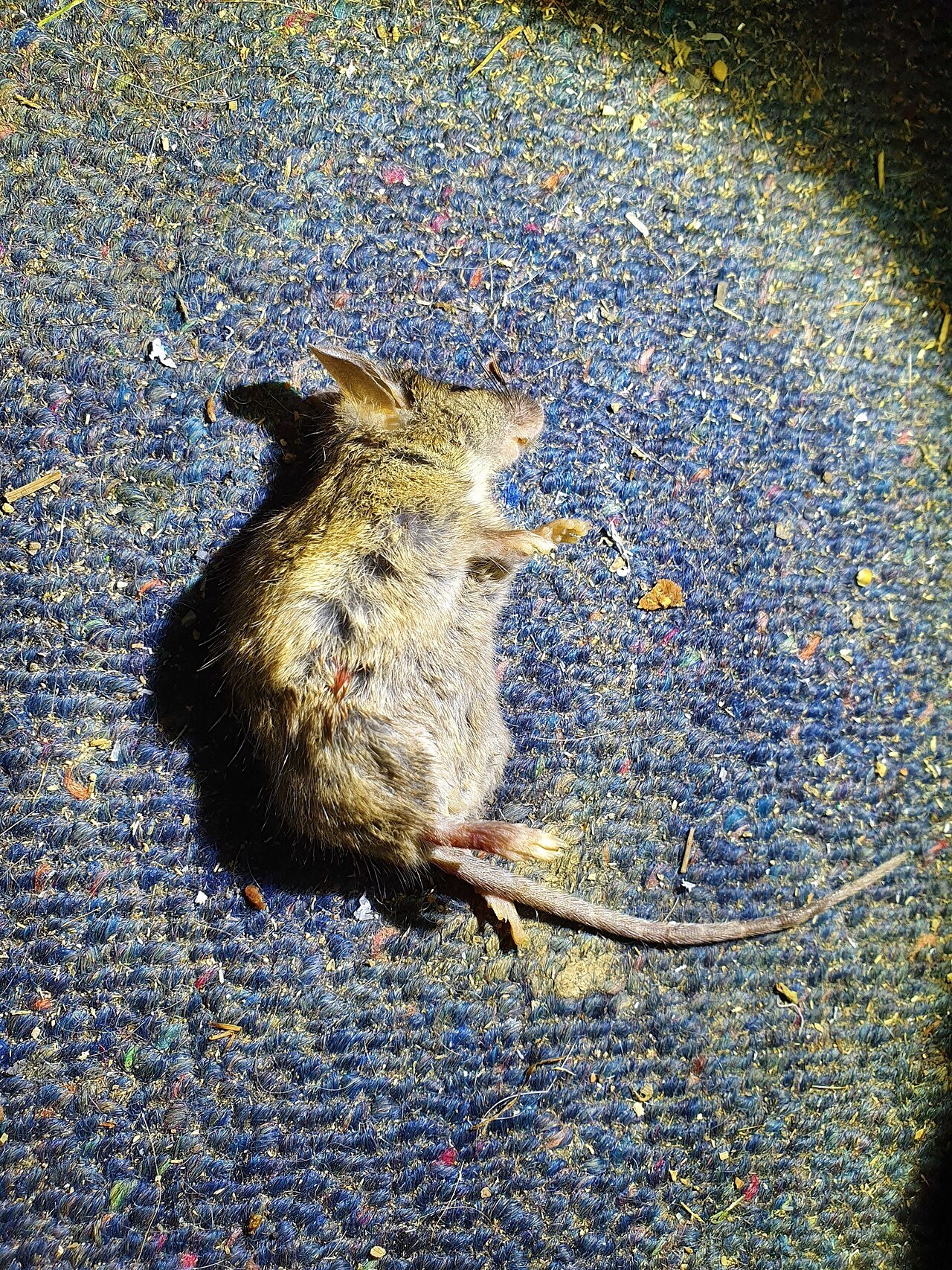
A mouse’s vertical talent runs on four pieces of equipment. The claws: each paw carries curved claws fine enough to catch texture invisible to human fingertips — mortar lines, wood grain, the pebbled surface of stucco and vinyl siding, drywall’s paper face — converting any microscopically rough surface into a ladder. The pads: footpads with surprising grip chemistry and conformability, adding friction on surfaces the claws barely bite. The power-to-weight ratio: at under an ounce, a mouse’s muscles move almost nothing — the physics that lets it haul itself up a vertical run of brick indefinitely and survive falls from any household height uninjured (drop-tolerance being the overlooked half of climbing confidence). The tail: a counterbalance rudder that turns ledges, wires and clothesline into walkable terrain — the tightrope talent below. The performance envelope, from the laboratory and the field: vertical climbs on brick, block, stone, wood, siding and most stucco, 13-inch standing jumps (a foot straight up, from a standstill — the pantry shelf’s first rung), horizontal leaps near two feet with a running start, wire-and-cable walking at any household height, and the squeeze that finishes every route: the dime-width gap rule from the exclusion pages, applied wherever the climb tops out. The practical translation is the page’s whole point: a mouse’s reachable territory is your building’s entire surface, not its bottom twelve inches — and the inspection that assumes otherwise finds only the ground-floor fraction of the entries.
The can’t-climb list (short, specific, and worth building around)
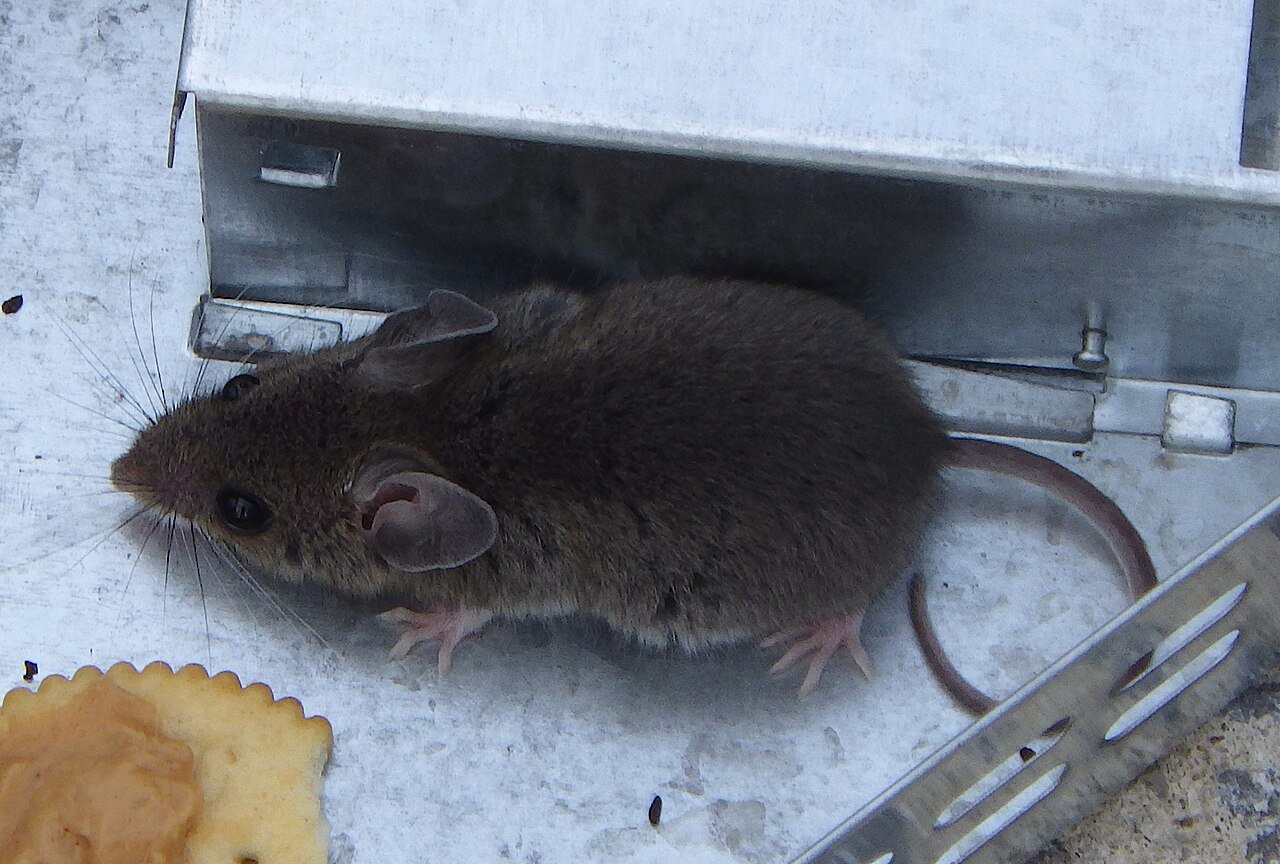
The honest limits are few, and every one is an exclusion tool. Smooth verticals defeat the kit: clean glass, polished metal, glazed tile and smooth uncracked PVC give claws nothing — the physics behind every classic rodent-proofing device: the metal guard cones on grain-bin legs and pole barns, the slick baffles under bird feeders, the smooth-plastic pipe sections farmers slide over the rope lines mice would otherwise walk. (The same principle runs the tub-as-pitfall physics one wing over — porcelain strands mice exactly as it strands isopods and wolf spiders: the mouse in the bathtub or empty chest freezer climbed in and couldn’t climb out, and needs a towel-ramp, not a theory.) Overhangs mostly hold: inverted surfaces exceed the kit except where texture is generous — a mouse can’t ceiling-walk your drywall, though it travels ceilings constantly the honest way: inside the joist bays. New unblemished paint on flat drywall is marginal terrain — which is why interior climbing runs up the corners, the trim, the curtains and the furniture instead. Everything else — and this is the audit’s reframe — is climbable: the fieldstone foundation is a boulevard, the brick veneer a ladder, the downspout a fire pole in reverse, the deck post a stair, the vinyl siding’s J-channel a marked trail. The building’s smoothest surfaces are its only passive defenses; the rest is managed access, next section.
The vertical audit: what the ground-floor inspection misses
Re-run the twelve doors with climbing in the model and a second tier of entries appears — the tier our attic-noise calls trace back to. The utility highways: every cable, conduit and line that runs up your wall is a mouse escalator ending at a penetration — the cable-TV entry hole, the AC line set’s gap, the porch light’s junction box; seal at the top, not just the bottom. The gutter-and-roofline tier: downspouts (climbable inside AND out), the fascia gaps behind gutters, the roof-return corners where three trims meet and never quite seal, gable and ridge vents with torn screen — the quarter-inch hardware cloth standard at altitude, and the reason our fall exclusion work carries ladders. The vegetation ladders: ivy on brick is a mouse interstate with landscaping approval; the maple limb four feet off the roof is within jump range on a bounce; the trellis, the espalier, the firewood stacked against siding — each one shortens the climb or replaces it, and the moat doctrine’s trim-back list pays its rodent dividend here. The interior verticals: once inside a wall, mice ride stud bays and plumbing chases between floors freely — why a basement entry becomes an attic population, why the droppings map’s upstairs evidence doesn’t imply an upstairs entry, and why exclusion’s ground-and-roofline pincer beats chasing interior signs floor by floor. The audit’s output: most Miami Valley homes carry two to five upper-tier entries their ground inspection never met — and the seal-all-but-one program that closes them closes the mystery of the impossible ceiling scratching for good.
The family ladder: house mouse, deer mouse, and the aerialists
The climbing question sorts the local rodent roster usefully, because the answer scales with species. The house mouse — this page’s subject — is the versatile all-rounder: strong climber, indifferent swimmer, urban-and-indoor specialist. The deer mouse out-climbs it — a semi-arboreal native that treats trees, outbuildings and cabin rafters as home terrain, which is why the countryside’s attic populations skew deer mouse (and why the hantavirus cleanup protocol follows rural attic evidence). The Norway rat — the region’s dominant rat per the size-sorting page — is the family’s ground-and-burrow heavyweight: it CAN climb, but prefers not to, running sewers, foundations and low routes. And the roof rat — the true aerialist, wire-walking and tree-traveling as its default commute — historically southern-and-coastal, occasionally sampled in Ohio’s river cities, and the subject of this library’s next new chapter. The identification dividend: WHERE the evidence sits is a species clue — ground-floor pantry sign reads house mouse or Norway; attic-first evidence in the countryside reads deer mouse; genuine rat sign at rooflines would be unusual enough here to warrant the photo line same-day. Height, in rodent forensics, is testimony.
Climbing questions, answered
Can mice climb into beds?
Physically, trivially — bedposts, dust ruffles and draped blankets are beginner terrain — and behaviorally, almost never: a bed is a predator zone with no food payoff, and mice route around occupied rooms’ centers entirely. The rare bedroom sighting is transit, not visitation; the fix is the room’s snack drawer and the standard program, and the sleep-zone anxiety this question carries belongs, statistically, to the other library wing.
Can they climb OUT of a bucket or trash can? My humane trap plan depends on this.
The five-gallon bucket’s smooth walls genuinely hold mice — the physics behind the classic ramp-and-bucket live trap — with the humane caveats the humane page attaches: checked every morning without exception, bedding material added, winter releases managed. A trash can with liner folds, label texture or dent lines, meanwhile, is an escapable climb — the difference between a trap and a delay is surface finish, measured in microns.
Do mice climb stairs?
Stairs are a stroll — each riser is a fraction of the standing jump, and staircases’ edge-lines are preferred runways (the droppings guide’s stair-edge evidence is classic). No floor of any house is passively out of range; the multi-story building is, to a mouse, a single continuous surface with carpeted sections.
Does climbing ability mean wall-mounted bait stations or high traps work better?
Placement follows traffic, not altitude for its own sake: runways hug edges wherever they run — baseboards on floors, sill plates in basements, joists and chases in walls — so the effective heights are the traveled ones the evidence maps. What climbing DOES change: attic and drop-ceiling placements become fully legitimate (the population up there never visits the floor), and the program’s station map should read like the building’s wiring diagram, not its floor plan.
The verdict, vertically integrated
Yes, mice climb walls — brick, block, siding, stucco, the downspout, the ivy and the cable line — and the twelve-door audit that absorbs the fact comes back with the upper-tier entries that ground-floor inspections donate to next winter’s population. Walk the vertical checklist, trim the ladders, screen the roofline at the quarter-inch standard, respect the short can’t-climb list enough to deploy it (smooth guards where the routes concentrate, and a towel-ramp for the stranded bathtub visitor), and let the family ladder’s species testimony aim the response. The building was always three-dimensional; the mice never forgot it; and the household that audits like a climber finally inspects the same house the mouse has been reading all along. For the roofline work, the vertical audits, and the attic evidence worth a species verdict: (937) 569-3330, Greater Dayton Pest & Rodent, Dayton and all eight counties.
The physics corner: why small means unstoppable (and fall-proof)
The climbing file’s deep explanation rewards the curious, because mouse verticality is a scaling-law story. Strength scales with muscle cross-section (length squared) while weight scales with volume (length cubed) — so as animals shrink, strength-to-weight ratios soar: a mouse hauls its own weight up a wall as casually as a human climbs a ladder rung, and the equivalent human feat would be scaling a building barehanded. The same cube-square law writes the fall-proofing: terminal velocity drops with size while relative air resistance rises, so a mouse reaches a survivable top speed within the first foot of any fall — the reason it launches off your counter without hesitation and lands running, and the reason “it’ll fall eventually” was never a control strategy. Add the whisker-and-balance suite (vibrissae reading surfaces in darkness, a vestibular system tuned for three-dimensional life) and the picture completes: the house mouse is a purpose-built vertical athlete operating in a world where gravity is a mild suggestion — which is precisely why this library’s rodent doctrine never argues with the athlete and always renovates the arena. You cannot make a mouse worse at climbing; you can only make the climb end at steel mesh — and the entire exclusion trade, from the dime rule to the roofline screens, is that single sentence, professionally applied.
The vertical exclusion checklist, printable
- Utility lines: every cable, conduit and line-set followed to its wall penetration — sealed at the TOP entry, copper mesh + sealant, not just the ground-level gaps.
- Downspouts & gutters: fascia gaps behind gutter runs checked; downspout tops screened where they meet roofline returns; the three-trim corners caulked.
- Roof vents: gable, ridge, bathroom and dryer terminations — quarter-inch hardware cloth, screwed; damaged louvers replaced.
- Vegetation ladders: limbs trimmed to 6+ feet off the roof; ivy off the brick (or accepted as managed access with the roofline sealed); trellises and espaliers audited; firewood off the siding per every other page’s advice.
- Deck & porch verticals: post tops, ledger-board gaps and the porch-roof junction — the intermediate tier between ground and roofline audits.
- Interior chases: plumbing and flue penetrations sealed at each floor — the between-floors highway closed at its on-ramps.
- The smooth-guard toolkit: metal cones on the pole-barn and grain-bin legs, slick baffles where routes concentrate, and the bucket-and-porcelain physics remembered for humane capture.
- Verify like always: monitors in the attic and basement post-seal; the date-stamped evidence stage; the workmanship guarantee behind every seal we place.
One ladder afternoon, one checklist, and the building’s second story of entries closes with its first — the vertical audit’s whole yield, in a printable column. The athlete keeps its medals; the arena keeps its mesh; and the ceiling, at last, keeps quiet.
A eight-county altitude report
The vertical file’s local texture: the stone-and-brick historic stock offers the region’s best climbing — mortar-line ladders from grade to gable on every pre-war street, which is why Oakwood and the courthouse districts’ exclusion jobs are ladder jobs by default; the vinyl suburbs climb via the J-channel-and-utility-line tier (smoother field, concentrated routes — fewer seals, higher leverage each); the farm campuses of Preble and Miami counties run the full syllabus — barn beams, grain-bin legs (cone-guard country), rope lines and the September harvest surge arriving at every height at once; and the wooded-lot neighborhoods’ maple-limb bridges write the trim-back line into every fall quote. Across the map, the pattern our attic-call log confirms: the “mystery” upper-floor populations trace to upper-tier entries at rates that embarrass ground-only audits — and close at the same rates once the ladder afternoon happens. The mice were never doing anything impossible; the inspections were just two-dimensional — a gap this page, and the checklist above it, permanently closes.
Climbing and the humane doctrine (the connection worth stating)
One closing integration, because the vertical file strengthens this library’s oldest rodent argument: climbing ability is precisely why exclusion beats killing on pure engineering grounds. A kill program fights the athlete — every trap and bait placement bets against an animal that reaches every surface, learns placements, and re-supplies from a landscape of climbers; the program’s wins are individual, its losses structural. Exclusion renovates the arena — steel mesh and sealed penetrations don’t care how well the next mouse climbs, and a building closed at the dime standard from footer to ridge vent is closed to the species, not the specimen. The vertical audit thus finishes what the humane page started: it’s not merely the kinder program, it’s the one aimed at the variable a household actually controls — the arena, never the athlete — and the quiet ceiling it produces is permanent for exactly that reason. Climb-proof was never on the menu; mouse-proof always was; and the difference between them is one ladder afternoon and a bag of quarter-inch mesh, which remains the best trade in the rodent wing.
Claws, pads, a counterweight tail and a cube-square law working overtime — the wall was never a barrier, the ceiling was never a mystery, and the audit that finally looks up finds what the mouse found on night one. Trim the ladders, screen the ridge, seal at the top, and let the building’s smoothest argument — steel mesh, professionally placed — end the climbing season for good.
Frequently asked questions
Can mice climb up walls?
Textured surfaces, yes — brick, stone, stucco, rough-sawn siding, and any wall with grip points fall to a mouse’s claws easily. What defeats them: clean vertical glass, smooth metal, and well-painted flat drywall. Design exclusion around what they CAN climb, which is most of your exterior.
Can mice climb inside walls between floors?
Fluently — wall voids are their highway system, with plumbing chases, wiring runs, and stud bays as ladders between floors. Scratching that moves from basement to bedroom ceiling over weeks is the colony commuting through the framing.
How do mice get to the second floor and attic?
Three routes: interior void-climbing, exterior masonry and downspout ascents, and the utility-line tightrope from pole or tree to roofline. Attic evidence with a clean first floor usually means an exterior top-entry — check gable vents and fascia gaps first.
Can mice jump?
A vertical foot from standing, eighteen inches with a running start, and safe landings from eight-plus feet — which is why counter-to-floor is commuting, not peril, and why pantry shelving height alone protects nothing.
Can mice walk on wires and ropes?
Like gymnasts — tightrope travel on cables, cords, and clotheslines is standard mouse locomotion. The cable entering your house at the second story is a bridge; the escutcheon gap where it enters is the door.
Can mice climb stairs?
Trivially — stair risers are speed bumps. No floor of a house is protected by elevation; protection comes only from sealed envelopes and locked-down food.
What surfaces can mice NOT climb?
Clean glass, polished metal, and glossy smooth plastics — the physics behind rodent guards on bird feeders and the smooth-metal kick plates on commercial doors. A strip of smooth sheet metal at the base of a climbable wall section is legitimate exclusion tooling.
Do mice climb into beds?
They can, and almost never want to — beds are high-risk, zero-calorie territory occupied by a giant predator. Bedroom mice are transiting to food (the nightstand granola bar is usually the actual destination); remove snacks and the visits end.
How does climbing change mouse-proofing?
It moves the audit up: gable vents, roofline gaps, fascia seams, and upper utility penetrations join the ground-floor list, and tree limbs get trimmed six feet off the roof. Ground-only exclusion is half an exclusion.
Can rats climb like mice?
Roof rats out-climb everyone — attics are their preferred address; Norway rats are diggers first but manage rough walls fine. Either way the vertical audit stands, with heavier mesh specs for rat-grade gnawing.