
Something ran along the garage wall at dusk, or left droppings behind the dog food, or is scratching in the ceiling at 2 a.m. — and before you can fight it, you need to answer one question: mouse or rat? The answer changes everything: the traps, the bait placement, the entry points you hunt for, the urgency, and the price. It is also a question most people answer wrong under pressure, because a half-glimpsed rodent at dusk is a terrible witness lineup, and because juvenile rats impersonate mice convincingly. This guide gives you the identification the way we teach it to new technicians: by evidence, not by glimpse — droppings, gnaw marks, sounds, runways, and behavior, with the Ohio-specific context national articles skip.
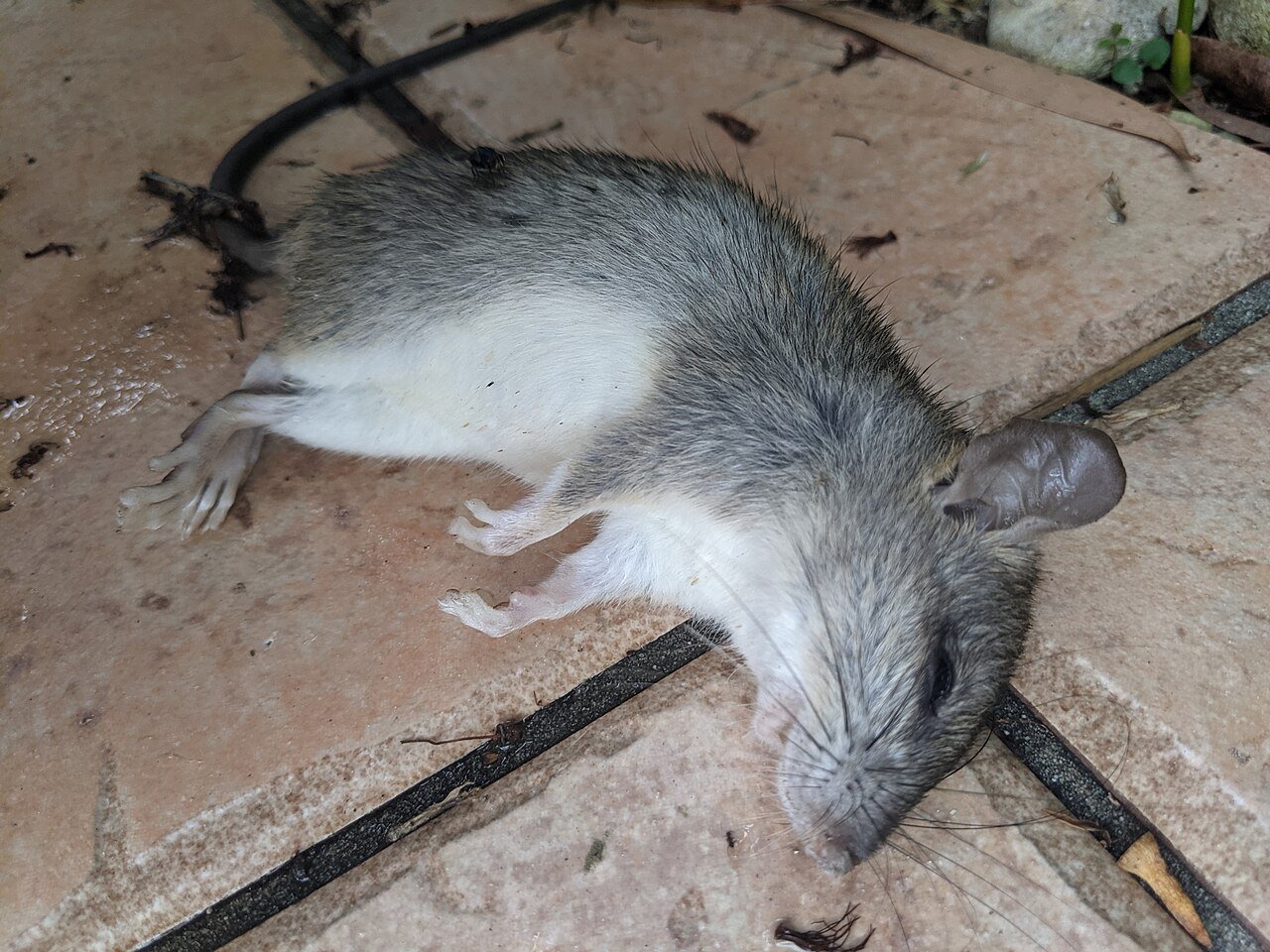
The lineup: what each animal actually is
In the Miami Valley, the practical choices are two. The house mouse (plus its woodland cousins, the deer and white-footed mice): body the size of a golf ball or small egg — two to four inches — with a thin, nearly naked tail as long as the body again, oversized ears, and a pointed, whiskery snout. Total weight, under an ounce: a creature that lives its whole life in the gap behind your stove. The Norway rat (brown rat, sewer rat — the only rat species established in structures here; Ohio has no meaningful roof rat presence): body seven to ten inches, the mass of a soda can or more, blunt snout, small ears for its head, and a thick, scaly tail noticeably shorter than head and body combined. Nobody who sees a Norway rat clearly mistakes it for a mouse — the identification problem is that clear sightings are rare, juveniles blur the line, and most evidence arrives secondhand: a dropping, a hole, a sound.

The droppings decoder (the most reliable evidence you have)
Mouse: rice-grain size — about a quarter inch — with pointed ends, scattered generously and casually along runways, behind appliances, in drawers; a single mouse leaves 50 to 75 pellets a day, everywhere it goes. Rat: raisin-to-olive size — half inch to three-quarters — blunt-ended and banana-curved, deposited in fewer, more concentrated groupings along established runs. The two are not close; put a dropping next to a grain of rice and the call makes itself. Two cautions from our call log: mouse droppings versus bat droppings fool people in attics (bat guano crushes to shiny insect fragments; mouse pellets stay hard), and old petrified droppings of either species read smaller than fresh — age the evidence by sheen and softness (fresh is dark, moist-looking, soft) before you size it.
Reading the rest of the evidence
Gnaw marks
Mice leave fine, almost decorative tooth marks — paired grooves about a millimeter wide — and their holes are neat dime-to-quarter circles with clean, clipped edges. Rats gnaw like power tools: grooves an eighth of an inch wide, ragged half-dollar-to-fist holes, and the signature nobody forgets — structural chewing through materials mice never attempt: plastic pipe, aluminum flashing, cinder-block mortar, live wiring conduit, and the corners of garage doors. A hole in a door corner you could pass a baseball through was not a mouse.
Sounds
Both animals are mostly nocturnal, so the 2 a.m. concert is normal either way. Mice produce light, fast scratching and skittering — a pencil eraser dragged in bursts — usually in walls and ceilings. Rats are heavier: deliberate gnawing you can feel in the drywall, distinct footfalls, and occasional thumps in crawl spaaces and basements. Location is a tell in our housing stock: ceiling and wall-void sounds skew mouse (and squirrel by day); under-floor, basement, and crawl-space sounds skew rat.
Runways, smudges, and burrows
Rats are creatures of fixed routes and leave a road system: greasy rub marks along baseboards and joists (their oily fur paints every regular path), packed-earth runways along foundations outside, and — the definitive rat sign — burrows: two-to-four-inch holes with fanned soil, under slabs, sheds, dumpsters, and compost, often with a polished entrance. Mice free-lance more, leave far fainter smudging, and never dig serious burrows; their nests are shredded-material pockets indoors (drawers, insulation, the glove box). Outdoors, a fresh burrow with a slick entry is a rat lease with an active tenant — and in older Dayton neighborhoods, check within sniffing distance of the sewer lateral: our Oakwood and downtown pages explain why cracked century-old laterals are the region’s quiet rat highway.
The juvenile-rat trap
The classic misidentification: a young Norway rat is mouse-sized for weeks, and “we have big mice” is how several of our rat jobs have been introduced. Three checks that never lie, at any age. Proportions: a juvenile rat has oversized feet and a chunky head it has not grown into — puppy proportions; a mouse is dainty and finished-looking. Tail: rat tails are thick at the base and shorter than head-plus-body; mouse tails are threadlike and as long as everything else. Ears: mouse ears are cartoonishly large for the head; rat ears are small and close-set. If the animal is gone before you could check any of that, fall back to droppings and gnaw width — the evidence sits still.
Why the answer changes the entire plan
This is not trivia — every operational decision forks on it. Entry points: a mouse passes through a gap the width of a pencil (quarter inch); a rat needs a half-dollar (half inch to an inch) but will make its own with those power-tool teeth — so mouse exclusion is a hunt for tiny gaps everywhere, while rat exclusion is armor on fewer, bigger targets plus fixing what invites the gnawing. Traps: rat traps are four times the size and snap force of mouse traps; a mouse trap merely educates a rat, and an educated rat is the industry’s hardest opponent. Behavior at the trap line: mice are curious and die on night one; Norway rats carry profound neophobia — suspicion of new objects — and will starve around an unset unfamiliar trap for a week, which is why professional rat work pre-baits unset traps until feeding is confident, then arms everything at once. Scale of concern: mice are an interior sanitation problem; rats add structural gnawing, burrow undermining of slabs and stoops, and the sewer-connection question. Guessing wrong costs weeks either direction — rat-scale hardware scattered for a mouse wastes money; mouse-scale response to a rat teaches it to win.
What to do next, either way
- Confirmed mouse: run the exclusion-first playbook — seal the quarter-inch gaps (garage corners, utility penetrations, door sweeps), snap traps along walls where droppings concentrate, no rodenticide in living spaces; full details in our mouse entry-point guide and rodent service page
- Confirmed rat: treat it as a property-system problem — find the burrows, fix the food source (trash lids, pet food, bird seed, compost), armor the entries with steel, pre-bait then trap, and investigate the sewer lateral if activity persists without an obvious surface source
- Still unsure: flour or baby-powder patch on the runway tonight — footprint size and tail-drag width answer by morning; or skip to the free option — photo of the droppings next to a coin, texted to (937) 569-3330
One honest scope note: significant rat pressure — multiple burrows, structural gnawing, sewer suspicion — is professional territory not because homeowners lack skill but because the job spans trapping, exclusion carpentry, sanitation forensics, and sometimes a plumber’s camera, sequenced correctly against an animal that punishes sequencing errors. That orchestration is precisely what our rodent service is, and rat work is guaranteed as quoted, with the full re-treatment guarantee available on our Protection Plan.
Can mice and rats coexist? (And what that means for your evidence)
Rarely, and the asymmetry is useful diagnosis: Norway rats kill and displace house mice where ranges overlap — muricide is documented rat behavior — so heavy rat presence usually means the mouse evidence you find is stale. Practically: if you are finding both dropping sizes fresh, you most likely have rats plus outdoor mice still working the garage or shed perimeter, or a transition in progress (rats recently arrived, mice on the way out). Either way, the rat evidence outranks the mouse evidence for planning — solve upward. The reverse error is the expensive one: dismissing early rat sign as “big mice” grants the colony the two quiet months it needs to establish burrows, and established Norway rats are an order of magnitude more work than intercepted ones.
The Ohio health-and-damage scorecard
Both animals contaminate — droppings, urine, and food-package gnawing carry the standard salmonella-class sanitation risks, and both can ferry mites and fleas indoors. The divergences: mice win the allergen category (mouse urinary proteins are a documented, measurable asthma trigger in heavily infested homes — one more reason “just a few mice” is not a steady state to accept), while rats win every damage category that costs real money — chewed wiring (a genuine fire-risk pattern), gnawed plumbing, undermined slabs and stoops from burrowing, and the flooded-basement surprise of a chewed washing-machine hose. Deer mice add their own hantavirus footnote, covered honestly in that guide. None of this is panic material; all of it is why the identification-then-action sequence on this page beats the wait-and-see instinct.
Mouse-or-rat questions we hear
I saw it in daylight — does that mean a huge infestation?
Not automatically. Daylight sightings mean pressure on the animal — a disturbed nest, competition at the food source, or simple boldness in a quiet room — and while heavy populations do push subordinate individuals into daytime foraging, a single daylight glimpse in an otherwise quiet house is a data point, not a verdict. Weight the physical evidence instead; it does not exaggerate.
Do sonic repellers settle it either way?
No — same verdict as every rodent page we write: habituation within days, documented across species. The plug-in changes nothing about identification or control; it only delays the week you start doing the things that work.
Which one is scratching in my ceiling?
Ceiling voids favor mice heavily in our housing stock — rats prefer the low road (basements, crawls, wall bases). But daytime ceiling noise belongs to a third suspect entirely: squirrels, especially in the slate-and-tree neighborhoods where roofline access is easy. Rule of thumb from our call log: dusk-and-dawn light skittering, mouse; midnight heavy gnawing low in the structure, rat; broad daylight thumping and rolling sounds overhead, squirrel — and we will tell you honestly which removal path each one needs, including the wildlife referral when it is not ours to sell.
The bottom line
Do not identify by glimpse; identify by evidence. Rice-grain scattered droppings, pencil-width entries, dainty proportions: mouse — run exclusion and snap traps this week. Raisin-curved droppings, greasy runway smudges, burrows, structural gnawing: rat — escalate to the systematic campaign, and respect the animal’s suspicion of your first move. Blurry middle ground: powder patch tonight or a photo to (937) 569-3330 now — free identification, honest scoping, same-week response when it turns out to be the bigger problem. Greater Dayton Pest & Rodent: it is in the company name for a reason.
A note on Dayton’s rat geography
Rat pressure in the Miami Valley is not evenly spread, and knowing your neighborhood’s baseline helps calibrate your response. The dense urban core — downtown’s alleys and aging infrastructure, the older commercial corridors, blocks near long-vacant properties or active demolition — carries a standing Norway rat population that surges locally whenever construction disturbs it; our downtown page covers that ecosystem in depth. The first-ring neighborhoods with century-old clay sewer laterals — South Park, the Salem Ave corridor, parts of Oakwood and old Kettering — see the sewer-sourced pattern: sporadic, house-specific appearances that track a cracked lateral rather than a surface food source. The outer suburbs see the least, and what they see usually traces to a specific generator: chickens, chronic bird feeding, an overloaded compost operation, or a neighbor’s neglected property. If you are in a low-baseline area and rats appear, look for the generator — and if you are in a high-baseline area, invest in the armor: sealed bins, steel exclusion, and the lateral inspection when evidence defies the surface story.
Prevention that covers both answers
The beauty of rodent-proofing is that the same afternoon of work handles either species at the entry level: steel mesh and sealant in every gap and penetration, brush-seal on the garage doors, tight lids on trash and recycling, bird seed and pet food in steel cans, compost closed, wood piles off the ground, and the foundation line visible all the way around. Mice are stopped by the quarter-inch discipline; rats are deterred by the food-security half and confronted by the steel when they test it. Every prevention list on this site converges on those fundamentals because twenty years of call logs converge on them — the houses that do the boring work simply stop calling, and we consider that the best possible outcome for everyone.
How many mice (or rats) do I actually have?
Estimate from evidence density, not sightings. Mice: droppings in one or two zones with light nightly accumulation suggests a family group of four to eight; droppings in every room, gnawed packages, and daytime activity suggests dozens and multiple nesting sites. Rats: a single active burrow with one polished entrance is typically two to eight animals; multiple burrows, heavy runway polish, and fearless feeding mean an established colony. Either way, the trapping itself becomes the census — a line that goes quiet after three catches told you the answer, and a line still producing on night ten is telling you to find the entry or the generator you missed. This is also exactly the kind of judgment call a photo and a five-minute conversation settles for free: (937) 569-3330.
Should I use poison to be safe either way?
We advise against leading with rodenticide in occupied homes for both species — and not out of squeamishness. Poisoned rodents die in voids (the odor problem is real and lasts weeks), bait placement mistakes endanger pets and owls, and — the professional’s reason — poison kills without teaching you anything: no carcass at a known location means no confirmation of species, count, or route. Snap traps answer questions while they work. Rodenticides have legitimate roles in professional exterior programs, locked stations, and heavy commercial pressure — contexts with monitoring and accountability around them. As a first move in a family kitchen, they are the wrong tool wearing a convenient label.
Whichever answer the evidence hands you, speed is the discount code: a first-week mouse family is an afternoon of sealing and three traps, and a first-week rat is an intercepted scout instead of a colony. The animals compound; so should your response. Free inspections, honest identification, and the Miami Valley’s fastest path from “something ran along the wall” to a quiet house again — that is the job, and we are minutes away.
Frequently asked questions
How do I tell if I have mice or rats?
Droppings decide fastest: rice-grain sized with pointed ends = mouse; raisin-sized and blunt = rat. Back it with gnaw marks (fine etching vs. rough quarter-inch grooves), rub marks (small smudges vs. heavy grease lines), and noise (light scratching vs. distinct thumping).
Does it matter whether it’s mice or rats?
Completely — trap sizes, trap spacing, bait amounts, exclusion gap standards (quarter-inch vs. half-dollar), and caution levels all differ. Running mouse protocol on rats catches nothing and educates the rats; the ID is the first decision of the campaign.
Can mice and rats live in the same house?
Rarely together — rats kill and displace mice, so an address usually hosts one or the other. Finding both kinds of droppings more often means old evidence from one era and fresh from another; the wet-vs-chalky freshness test sorts the timeline.
Are rats worse than mice?
Different grade of problem: rats gnaw structural materials harder (including wiring and pipes), need larger exclusion work, carry a heavier contamination profile, and are dramatically warier of new objects — which makes rat trapping a patience game mice never require.
What are the signs of rats specifically?
Burrow holes along foundations and under slabs (a rat signature mice lack), heavy grease trails on repeated runs, blunt half-inch droppings, thumping in walls or ceilings, and pets fixating hard on one zone. Roof rats add attic noise at night and trees-to-roofline travel.
Why are rat traps not catching anything?
Neophobia — rats avoid new objects for days, sometimes a week. The professional fix: pre-bait unset traps until feeding is confident, then set everything the same night. Impatient trap-checking and moving resets the clock every time.
Do rats and mice carry the same diseases?
Overlapping but not identical files — both contaminate via droppings and urine (salmonella-class risks); deer mice add the hantavirus flag; rats historically carry the heavier disease list. Cleanup protocol is the same: never dry-sweep, mist with bleach solution, glove everything.
What does it mean if I hear noise in the walls at night?
Timing and weight sort it: light scratching after dusk = mice; deliberate gnawing or thumping = rat-weight; daytime scampering overhead = squirrels (a different trade’s problem — we will tell you honestly). Recording the sound on your phone genuinely helps our phone triage.
What size hole can rats fit through?
A half-dollar — about the width of your thumb — against a mouse’s quarter-inch pinky gap. Rat exclusion is heavier work: quarter-inch hardware cloth, concrete patching on burrow routes, and door sweeps rated for gnawing pressure.
Who do I call for mice or rats in Dayton?
Us either way — both protocols are core service with the ID confirmed on inspection, evidence-based quotes, and warrantied exclusion: (937) 569-3330. Photograph any droppings before cleanup; that photo is the fastest triage we have.