
South Lebanon is Warren County’s transformation in one village: the old river settlement on the Little Miami’s east bank — one of the county’s earliest — now carrying some of its heaviest new growth as the corridor’s development wave rolls up the valley, big-box retail and phase construction stacking onto hillsides that watched flatboats. The pest file is the county’s two great chapters bound together: river-village old stock running the corridor-and-heritage playbook, and growth-ring construction running the boom file, with the valley itself refereeing both. Greater Dayton Pest & Rodent covers South Lebanon and its Union Township surrounds on the southern Warren loops — full service list, two-tier structure, no mileage lines, and the two-chapter literacy the village’s split personality requires.
River settlement, growth settlement
The old village — the settlement-era and Victorian survivors on the original river grid — runs the full heritage-corridor file: early foundations whose moisture history the valley keeps current, the basement guild prosperous in the river’s humidity, porch structures on their wasp calendars, flood-memory vigilance on the low blocks, and the reversible-craftsmanship exclusion the county’s oldest stock earns. The growth tier climbing the hills — the corridor wave’s phases and the retail serving them — runs the complete county growth file: builder gaps, displacement Octobers off the converting ground, young-landscape economies, and year-one baselines as the decade’s cheapest decision. Between them the Little Miami runs its standing corridor economy — the long mosquito seasons, the woodland pushes off the valley walls, the trail’s green-ribbon connectivity the Morrow page maps upstream. Old bank, new hills, one river: the era-read at the door decides everything, and South Lebanon’s doors span two centuries.
A South Lebanon seasonal calendar
- March–May: valley wet-season surges on the old grid; ants wake both tiers; termite swarms photograph same-day in the settlement stock; moles surge the new hillside sod
- June–August: corridor mosquito peak on the low blocks; deck and porch wasps scale both eras; the retail tier’s food service runs its surge season
- September–October: the two-chapter double — displacement pushes off the converting hills meeting valley pushes off the walls, invader flights on every sunny wall between; the September visit anchors the whole split village
- November–February: interior mouse season; heritage exclusion weather on the grid; the newest phases meet their first winters
The South Lebanon lineup, ranked
- Mice — two-source pressure: displacement off the converting hills, valley files on the old grid (rodent control)
- Mosquitoes — the corridor season on the low blocks; resting-site programs earn river-village keep (seasonal service)
- Ants — the supercolony species both tiers, valley wet-spring surges below, mulch-bed networks above
- Moles — the growth tier’s irrigated sod (trapping program)
- Wasps — settlement porches and phase decks on the same August (removal guide)
- The moisture guild — the river grid’s cellars keeping the valley’s honesty
- Termites — settlement sills demand annual vigilance; the hills’ former-farm phases deserve their baselines; WDI reports for a market moving at corridor speed
- Fall invaders — lady beetles on every sunny wall the remaining fields and the valley walls can see (the October file)
South Lebanon questions we hear
The village doubled around us — did the pest situation double too?
It transformed rather than doubled, and knowing the mechanics helps: construction waves displace the ground’s standing populations toward whatever holds still (the old grid’s houses absorbed several years of hillside evictions — if your century home’s mouse pressure rose with the earthmovers, that was real, not imagined), young landscapes install new economies (the mole and mulch-ant files arriving with every phase), and the retail tier added the commercial food-waste layer river villages never carried. The transformation also brought the counterweight: route density — the loops serve the corridor’s growth daily, response times improved as the village grew, and the defense doctrine (September, sealed structures, era-read craft) absorbs transformation the way it absorbs everything. The village that watched flatboats can watch subdivisions; the calendar holds either way.
Old-grid house, growth-tier prices — do we pay the boom’s rates?
Nobody pays “the boom’s rates” — the site-wide discipline prices jobs, not markets: the settlement house’s heritage exclusion quotes by its craftsmanship hours, the phase house’s baseline by its circuit, and neither reads the other’s appreciation curve. The cost guide’s ranges apply untouched from the river grid to the newest cul-de-sac, free firm quotes precede all work, and the corridor’s real-estate heat changes closing prices, not service prices. The village’s two eras share one honest rate card — ours.
Warren coverage: county hub · Maineville · Morrow · Lebanon · full service area.
The retail tier: corridor commerce at the village’s new front door
The growth wave brought South Lebanon a commercial tier the old river grid never imagined — the big-box and dining development serving the corridor’s new thousands — and the tier runs corridor-commerce files at full scale: documentation-grade food-service programs for the dining rows, dock-and-receiving discipline for the retail anchors (new commercial construction carries builder-gap files exactly like new houses, at loading-dock scale), the dumpster-line economics that decide every shopping center’s rodent baseline, and the commissioning-stage opportunity the Maineville institutional file describes — facilities young enough to start their pest architecture right rather than retrofit it. The tier’s managers get corporate-format reporting, multi-tenant coordination where centers share walls and waste lines, and the no-crisis-markup response their inspection calendars occasionally need. The village’s new front door deserves front-door standards; the programs deliver them at corridor pace.
What a South Lebanon first visit looks like
The era-read opens, as everywhere the county splits: river-grid addresses get the heritage-corridor hour — cellar first (the valley’s truth-teller), foundation lap with moisture-and-mortar attention, porch structures, flood-memory reading on the low blocks; growth-tier addresses get the boom circuit — builder-gap hunt, landscape audit, settle-stage assessment by phase age; and the commercial tier gets its category consultation. Findings photographed, homework separated from invoice, quotes written before scheduling, and the two-tier conversation matched to the property’s actual profile — corridor-and-heritage pressure argues plan-side on the grid, young phases often ride one-time-plus-baseline until their landscapes mature. Southern-loop scheduling books days ahead; photo-first booking arrives equipped. Two-era villages take two-era inspecting, and this one has earned inspectors fluent in both.
The bottom line for the settlement in the surge
South Lebanon carries the county’s whole story on one riverbank — earliest settlement to newest surge — and its coverage carries the site’s whole doctrine to match: corridor defense and heritage craft for the grid, growth homework and baselines for the hills, corridor-commerce programs for the new front door, and every standing promise (free quotes, free photo identification, no mileage lines, the two-tier guarantee) riding the southern loops at full strength. The river village that absorbed two centuries of change absorbs this one the same way — deliberately, structure by structure — and now does it with its file written and its number saved: (937) 569-3330, Monday–Friday 8–6, Saturdays by appointment. Greater Dayton Pest & Rodent, Ohio licensed — ODA Pesticide Business License #115079: the settlement covered, the surge covered, the seam between them read at every door.
One South Lebanon tip worth the page: the grid protects the hills, and vice versa
The two-era village’s special arithmetic: its halves defend each other when both hold their calendars. A sealed old grid gives the hills’ displaced populations no downhill refuge; baselined hills stop exporting evictions to the grid; and the village that runs both September programs simultaneously — heritage checks below, boom circuits above — cuts its total pressure deeper than either half could alone. Neighborhood coordination across the eras (the old grid’s garden club and the new HOAs talking to the same route calendar) is the move; the organize-the-street doctrine scales to organize-the-village here better than anywhere south of the seam towns. Two eras, one defense — the settlement’s next chapter, available on one shared loop day at a time.
Union Township and the valley’s working ground
The township around the village runs the county doctrine’s full rural chapter where the growth has not yet reached: campus farmsteads on whole-parcel reads, feed rooms hardened first, equipment on the storage protocol, and September kept against ground that still harvests — plus the holdout dynamics the Maineville file names, running here at the wave’s leading edge: parcels absorbing displaced pressure as neighbors convert, families weighing decades against offers, and maintained files serving both the working years and the someday-transaction. The valley walls’ wooded country adds its edge lineup to every lane it borders, and the corridor doctrine grades by distance exactly as the river demands. Township addresses ride the southern loops at village pricing; the wave will redraw the parcel map for years yet, and the doctrine is built to read every draft.
Family standard and the rental file, valley edition
The site-wide bedrock rides every visit — placed applications, tamper-resistant equipment, the placement-over-potions doctrine for a village filling with young households — and the rental file spans the eras like everything here: the grid’s subdivided older stock on the building-wide logic its shared cellars demand, the growth tier’s investor product on turnover inspections and phase-cycle intelligence, and the early-report culture keeping both eras’ landlord stories unit-sized. River villages have always housed their workers; the programs keep the housing’s pest chapter as quiet as the current.
The flatboat-to-phase timeline: two centuries of the same physics
A closing perspective the village’s split personality earns: South Lebanon’s pest history is continuous even where its housing is not. The settlement era fought the valley’s moisture with root cellars and lime; the canal-and-rail decades fought the same moisture with better drainage and worse infill; the quiet twentieth century let the grid’s foundations age into their current honesty; and the corridor era imports the boom’s patterns onto hills that spent two hundred years as the valley’s harvest view. Through every chapter the physics never changed — water seeks the low ground, displaced life seeks standing structures, sealed buildings outlast open ones — and the doctrine this site applies is just those constants written down with a license number attached. The village’s next two centuries will run the same rules on whatever gets built; the file is ready either way, and the September calendar has no expiration date. From flatboats to phases: same river, same physics, finally the same page.
DIY or call: the two-era fork, river edition
The honest split, valley-graded. Genuinely DIY: the grid’s hygrometer-and-dehumidifier discipline (the Morrow prescription applies bank-for-bank), the growth tier’s year-one caulk-and-sweep homework, standing-water patrol after valley rains, the twelve-doors Saturday on any settled street, and the reachable paper-wasp umbrella at dusk. Professional territory: settlement-fabric exclusion and its termite questions, the corridor’s established populations, void and ground yellowjackets per the never-plug doctrine, the commercial tier entirely, and the third-failure pattern wherever it appears. The photo line arbitrates daily across both eras — and the village’s newer residents, boom-arrived and river-curious, get the same patient teaching the whole map does. Two centuries of self-reliance built this bank; the free line just arms the tradition with better identification.
How fast can the loops actually reach us?
Southern-tier norms per the county hub’s honesty: next-loop booking inside three business days as the working standard, faster in season as the corridor’s density keeps thickening the schedule, and the priority lane jumping every queue for the situations that earn it — at the same no-markup price the whole map pays. The growth that transformed the village also transformed its logistics: more neighbors on the loops means faster loops, and South Lebanon’s response times improve with every phase that closes. The surge’s quietest benefit, delivered weekly.
The trail connection and the recreation file
The Little Miami’s trail threads South Lebanon into the corridor’s recreation economy — the cycling traffic rolling between Morrow’s confluence and the southern reaches — and the village’s share of the trail file follows the upstream pattern: trail-adjacent blocks inheriting the green ribbon’s connectivity, the refreshment stops that serve the riders running their patio-and-crumb seasons, and the canoe-and-camper storage rhythms of a riverbank village answering to the storage protocol every haul-out. The recreation layer is the valley’s gift and its schedule — and the sealed, September-anchored village enjoys the whole season from the dry side of its foundations, exactly as the doctrine intends. Rivers give; calendars keep.
The municipal building’s quiet lesson
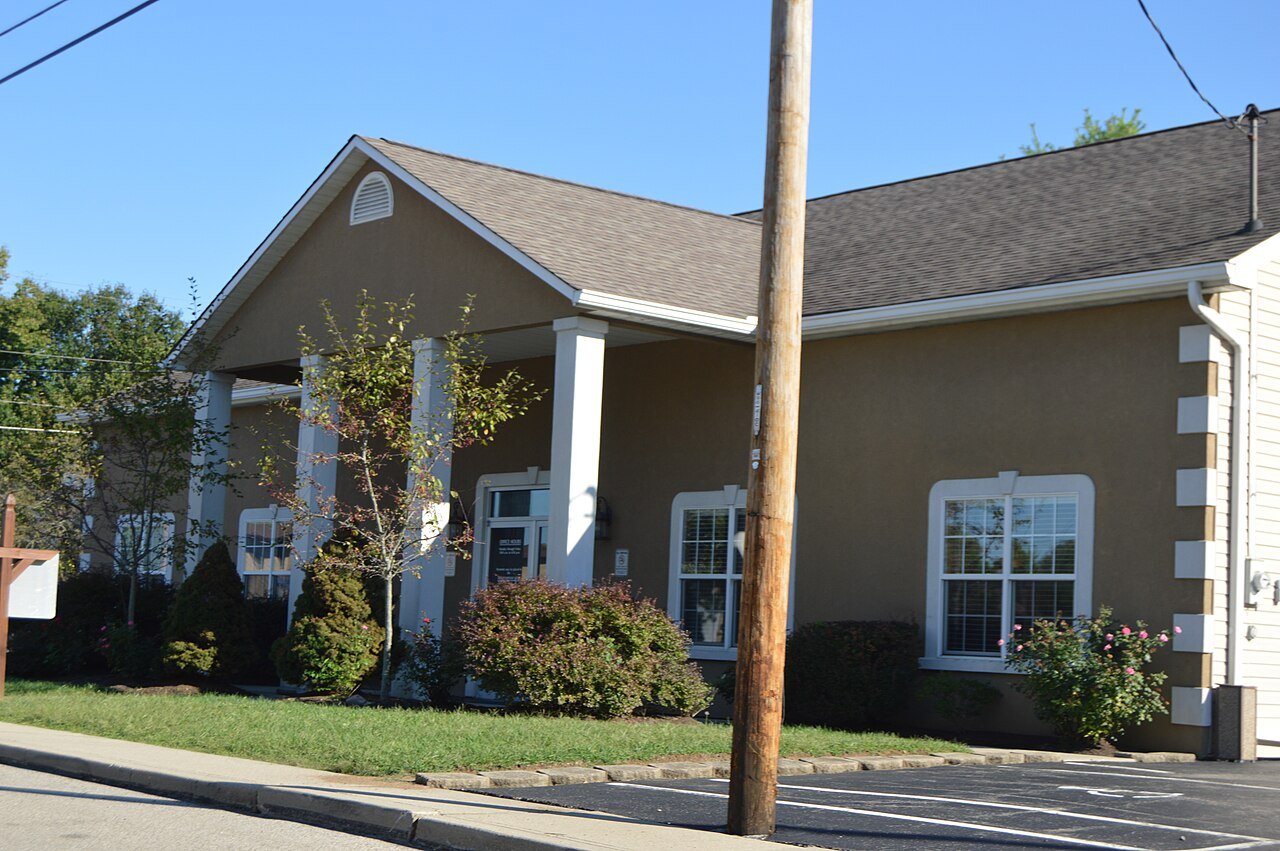
The village hall in the photograph holds this page’s closing argument the way civic buildings usually do — by standing there, maintained, through every era the village threw at it. Municipal stewardship is the settlement’s oldest continuous institution: the grid’s survivors exist because generations of owners kept their calendars, the hall exists because the village kept its own, and the growth tier’s long-term prospects depend on its new households learning the same habit their riverbank predecessors practiced by necessity. Pest doctrine is that habit’s smallest, steadiest chapter — the annual attentions that keep large repairs theoretical — and a village straddling two eras needs it written down more than most, because the old hands and the new arrivals inherit the tradition from different directions. This page is the written version; the loops are the practice; and the hall keeps watching, the way it has since the river was the highway. South Lebanon, both of you: covered, calendared, and on the map by name.
What does two-era village work cost?
The unchanged discipline, split-village edition: heritage hours price as craftsmanship, boom circuits price as circuits, the cost guide’s ranges hold across both eras, and the organize-the-village arithmetic above captures the roster’s best batch economics for whoever coordinates first. Free firm quotes before work, no mileage lines to the county’s southern reach, and one number spanning two centuries of housing: (937) 569-3330.
Licensed by the Ohio Department of Agriculture (Pesticide Business License #115079; applicator #170858 — categories 10A, 10B, and 12), insured, locally owned, and on the southern loops weekly — from the settlement grid to the surging hills, South Lebanon’s file is written, its eras are read, and its September is bookable now. The river village the growth found has found its coverage; welcome to the roster.
The wet-year appendix: reading the river’s big moods
One more valley-specific chapter, because the corridor teaches it every few springs: high-water years rewrite the village’s pest season in predictable ways worth knowing in advance. Sustained wet springs push the bottomland’s ground-dwellers upslope in waves (the weeks after high water are reliably the grid’s busiest for displaced-wildlife calls), saturate the flood-memory cellars past their dehumidifiers’ ordinary pace, extend the mosquito season on both ends, and soften the ground for the mole economy’s deepest years. The wet-year playbook mirrors the creek-village doctrine at river scale: post-event inspections while displaced problems are still singular, cellar humidity watched weekly rather than seasonally, sump-and-downspout infrastructure serviced before the season rather than during it, and the September visit run thorough in years the river ran high — the fall push follows the water’s generosity. The river’s big moods arrive on their own schedule; the village that reads them early spends them dry. Ours watches the gauges too — it is that kind of company, and this is that kind of valley.
Who actually turns up in South Lebanon: Greater Dayton Pest & Rodent is owned and operated by Bryan Camden, licensed by the Ohio Department of Agriculture — firm #115079, commercial applicator #170858, categories 10A, 10B and 12. When you call, you talk to the person who does the work. No call center, no rotating crews, and the same technician on every visit.
Frequently asked questions
Do you provide pest control in South Lebanon?
Yes — the river village and its rapidly-growing east side sit on the Warren route days; the old-village-meets-new-plat mix defines the local work.
What pests are most common in South Lebanon?
Split personality: the historic river-bottom village runs valley files (moisture basements, floodwater mosquitoes, foundation mice), while the new east-side plats run growth files (landscaping ants, sod wasps, first-frost garage mice) — two pest towns sharing one name.
How much is pest control in South Lebanon?
Standard formula across both halves: most homes $39–$55/month quarterly; one-time flat. Free: (937) 569-3330.
Does the Little Miami location affect the old village?
Substantially — river-bottom geography keeps the historic blocks’ basements humid (the moisture guild thrives) and delivers the floodwater mosquito waves; valley protocols (dehumidifier doctrine, barrier timing) lead there.
Why does my new east-side build have ants already?
The growth pattern — imported landscaping colonies plus disturbed-ground displacement; the first-year perimeter-and-seal package breaks the cycle before tradition sets. Same story as Maineville’s plats, same fix.
How fast can you reach South Lebanon?
Route days weekly or better — days typically, priority faster, no travel charges.
Do you serve South Lebanon businesses?
Yes — the village spots and the new corridor retail alike, matched programs and documentation included.
What about the outbuildings and river-edge sheds?
Deer-mouse protocol territory — river-and-woods adjacency makes the two-tone mice the default tenant; ventilate-then-enter, gloved storage handling, outbuilding-first inspections.
Is termite pressure different between the halves?
The old village stacks age-and-moisture conducive conditions (bait monitoring recommended); the new side runs the backfill-debris watch (annual inspections from year one). Both halves get the free look.
How do I start service in South Lebanon?
Instant quote, free photo ID, or (937) 569-3330 — free estimates, route-day scheduling, first visits typically within the week.