
Kettering’s termite risk doesn’t live in its houses — it lives in what its houses became. The original mid-century ranches went up fast and consistent: slab or shallow crawl, block foundation, one pour, one era. But almost nothing in this town is still the original floor plan. Seventy years of prosperity added sunrooms onto patios, family rooms onto garages, garages onto carports, bathrooms into breezeways — and every addition stitched new concrete to old, creating exactly the discontinuity subterranean termites exploit best. Termite control in Kettering is a study of those stitches. We call the phenomenon the addition seam, and once you learn to see it, you can walk any street in town and point to where the termites will try first.
Why Seams Beat Slabs
An intact slab is a genuine barrier — subterranean termites can’t chew concrete, and a monolithic pour with sound edges forces them to the visible perimeter, where inspection catches them. But two slabs poured decades apart never truly join. The cold joint between an original 1958 floor and a 1979 family-room addition is a permanent hairline highway from soil to sill, invisible under carpet and tile. Worse, additions concentrate the other classic entry points at the same seam: the new bathroom’s plumbing came up through a rough opening (the “bath trap”) that was never sealed; the old exterior wall became an interior wall, sometimes with its original sill plate — weathered, occasionally earth-close — now buried in the middle of the house; and the addition’s footer changed the drainage pattern, holding moisture against wood that stayed dry for its first twenty years. When we find active termites in a Kettering house, the discovery point maps to an addition seam more often than every other cause combined.
Reading Your Own House
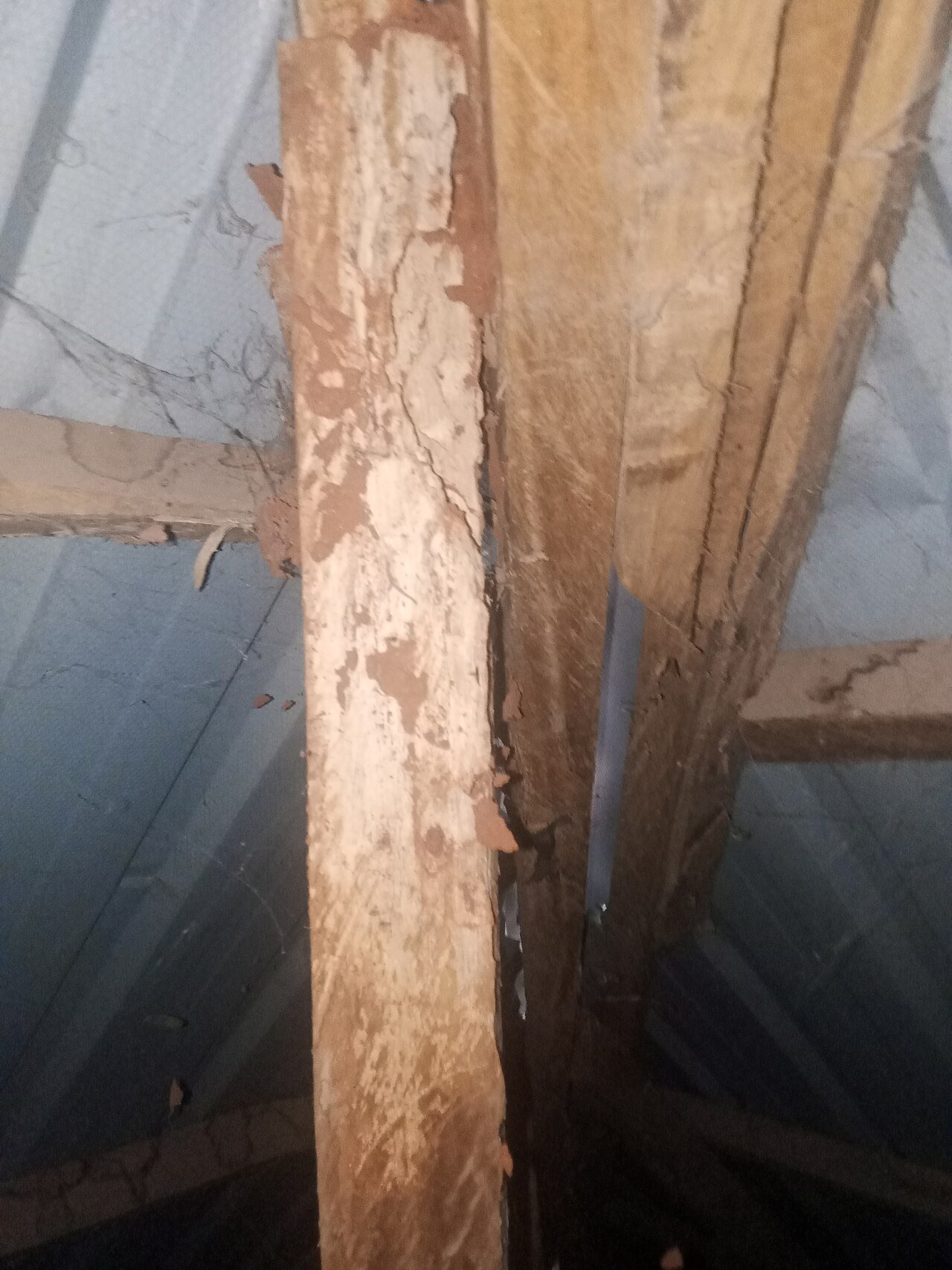
You can do the first pass yourself. Stand at the curb and read the rooflines and brick courses — the additions announce themselves in mismatched mortar, stepped foundations, and siding transitions. Every place new construction meets old is a seam worth a flashlight: inside, check the baseboards and carpet edges along that line for the blistered paint, hollow trim, or pinhole mud spotting that betrays activity behind; outside, check where the addition’s slab edge meets soil, especially if grade or mulch has crept up over the years. And the spring swarm rule applies doubled here: winged insects emerging from an interior wall in April — particularly a wall you now know was once exterior — are the seam announcing itself, and that’s a same-week call, not a someday one.
Protecting a Stitched-Together House
- Seam-mapped inspection: we date the construction eras first, then hunt the joints between them — the bath traps, buried sills, and cold joints a generic perimeter walk never sees
- Treatment matched to the map: liquid barrier work at accessible perimeters, targeted interior treatment at seam penetrations, monitored bait where additions block trenching
- Active vs. archaeology, stated plainly: plenty of Kettering seams carry scars from colonies past treatments already killed — we say which yours is, because the difference is thousands of dollars
- Moisture correction at the seam: the gutter, grade, and mulch discipline that keeps the addition’s drainage from re-issuing the invitation
The Kettering Ledger, Complete
This page closes Kettering’s set, and the eight files read together now: this is mid-century suburbia aging in place, and every service line traces the same architecture. The rodents ride the worn garage gaskets and crawl vents, the spiders run the crawl-space economy, the roaches inherit the estate appliances, the bed bugs arrive through the estate sales, the fleas bank in the deep original carpet, the wasps colonize the retrofit soffits, the ants work the settled foundations, and the termites probe the seams between building eras. Houses this age aren’t fragile — they’re documented, if your provider knows how to read the document. The full file lives on our Kettering service page.
Get Your Seams Mapped
One inspection dates your house’s construction eras, walks every joint between them, and hands you the honest verdict — active, historical, or clean — with protection matched to the map, not to a script.
Buying or selling in Kettering? What a lender, a VA file, or a listing agent asks for is not a treatment — it is a written report. That is a termite and WDI inspection in Kettering: $99 flat on the lender-ready NPMA-33, next business day, PDF the day we inspect. Treatment only enters the conversation if the report actually finds something.
Frequently asked questions
Why are additions the termite weak point in Kettering houses?
Because two slabs poured decades apart never truly join — the cold joint between original floor and addition is a permanent hairline route from soil to wood, invisible under flooring. Additions also bundle the other classic entries at the same line: unsealed bath traps, buried original sill plates, and changed drainage.
My house is all brick on a slab — can termites still get in?
Yes — they don’t need to breach the slab, just its discontinuities: expansion joints, plumbing penetrations, the seam where any addition meets the original pour, and the gap behind brick veneer. Slab houses show fewer warnings, not fewer termites.
What are the signs of termites along an interior wall?
Blistered or rippled paint, hollow-sounding trim, pinhole mud spotting at baseboards, and — the definitive one — winged swarmers emerging indoors in spring. On a wall that was once exterior before an addition enclosed it, take any of these seriously the same week.
I found old termite damage during a remodel — is it an emergency?
Only if it’s active. Kettering seams often carry archaeology: damage from colonies past treatments already killed. Fresh mud, live workers, or new wings mean active; dry, empty galleries usually mean history. The inspection says which plainly, because the difference is thousands of dollars.
Are the winged insects in my window termites or flying ants?
April–May produces both. Straight antennae, two equal wing pairs, thick waist = termite; elbowed antennae, unequal wings, pinched waist = ant. The photo ID is free and settles it in minutes — and the answer changes everything about the treatment.
Which is right for my house, liquid treatment or bait stations?
The construction map picks: liquid barriers where trenching can reach the perimeter, targeted interior work at seam penetrations, bait systems where patios and additions block the trench line. Anyone naming the method before dating your construction eras is selling, not inspecting.
Does a termite treatment from the 1990s still protect my house?
No — liquid barriers degrade over years, not decades, and any treatment older than its warranty is history rather than protection. If your only evidence of coverage is a previous owner’s memory, the honest status is “unprotected until inspected.”
What does termite control cost in Kettering?
Inspection quotes it from footage and construction: barrier and bait programs for typical ranches sit well below the cost of repairing one seam’s worth of hidden damage — which insurance, almost universally, does not cover.