
Every spider in an Ohio house gets accused of being a brown recluse, and almost none of them are. The state hosts hundreds of spider species; perhaps a dozen account for nearly every sighting in Miami Valley homes, and the overwhelming majority are harmless, beneficial, and badly misidentified. This is the field guide to the ones you will actually meet — the big fast one on the basement floor, the tiny fuzzy one watching you from the windowsill, the leggy one vibrating in the ceiling corner — with honest notes on the two genuinely medically significant exceptions (covered in depth in our venomous spiders guide), why your house has the spider population it has, and what actually reduces it when you have decided the rent is too high.
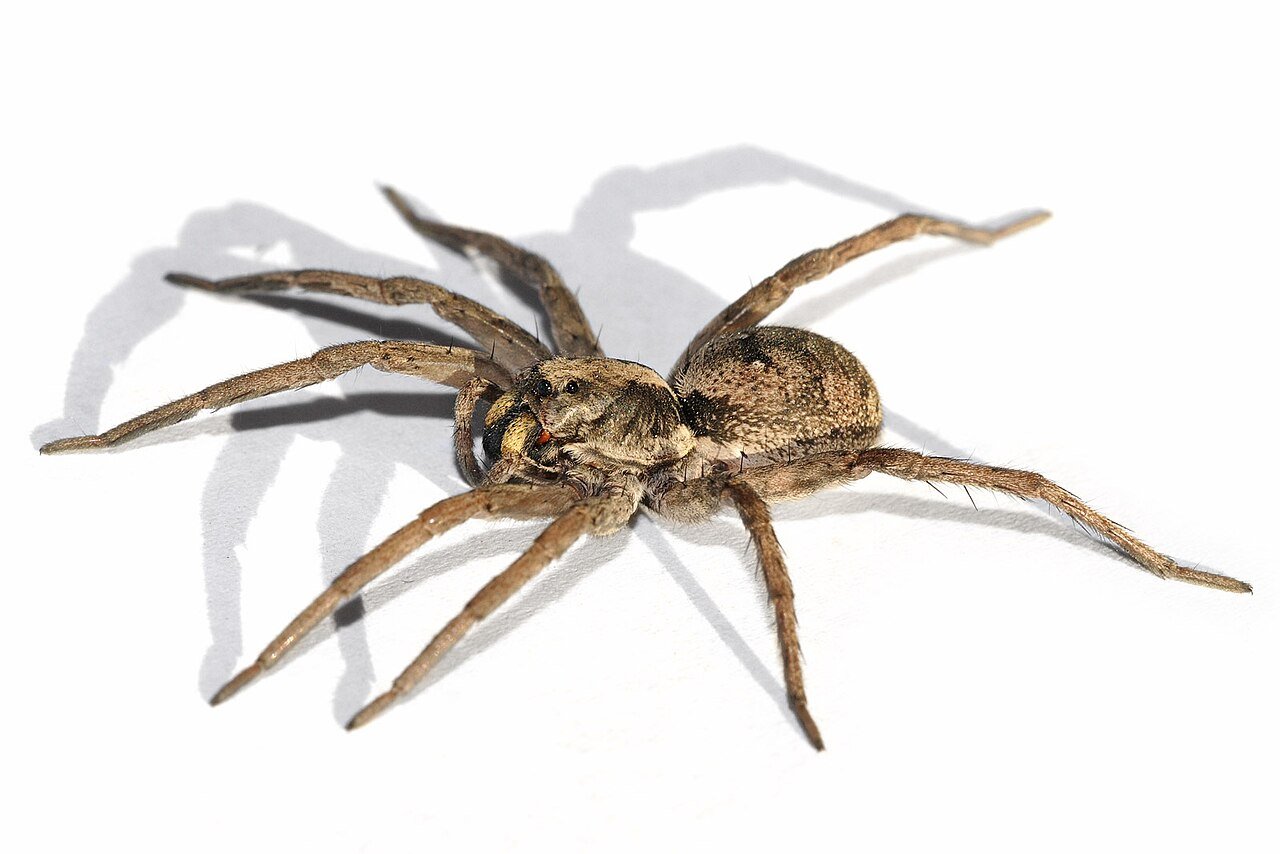
The big scary one: the wolf spider
Ohio’s most alarming encounter is almost always a wolf spider — up to two inches of leg span, robust, hairy, brown-on-brown patterning, and fast enough to cross a basement floor while you are still deciding to scream. The reassurances, in order: wolf spiders do not build webs in your house (they are roaming ground hunters — the one you saw is passing through, not homesteading), they bite only when trapped against skin (the bite is a bee-sting-grade event, medically minor), and they are prodigious hunters of the crickets, roaches, and basement guild they followed inside. Two identification notes worth owning: a wolf spider carrying what looks like a fuzzy backpack is a mother with spiderlings aboard (relocate that one gently outside — squashing scatters the babies, an experience nobody repeats), and eye-shine — wolf spider eyes reflect a flashlight at night like tiny green stars on the lawn, a party trick that converts arachnophobes into naturalists one August evening at a time. They enter under doors and garage corners in fall; the door sweep is the entire immigration policy.
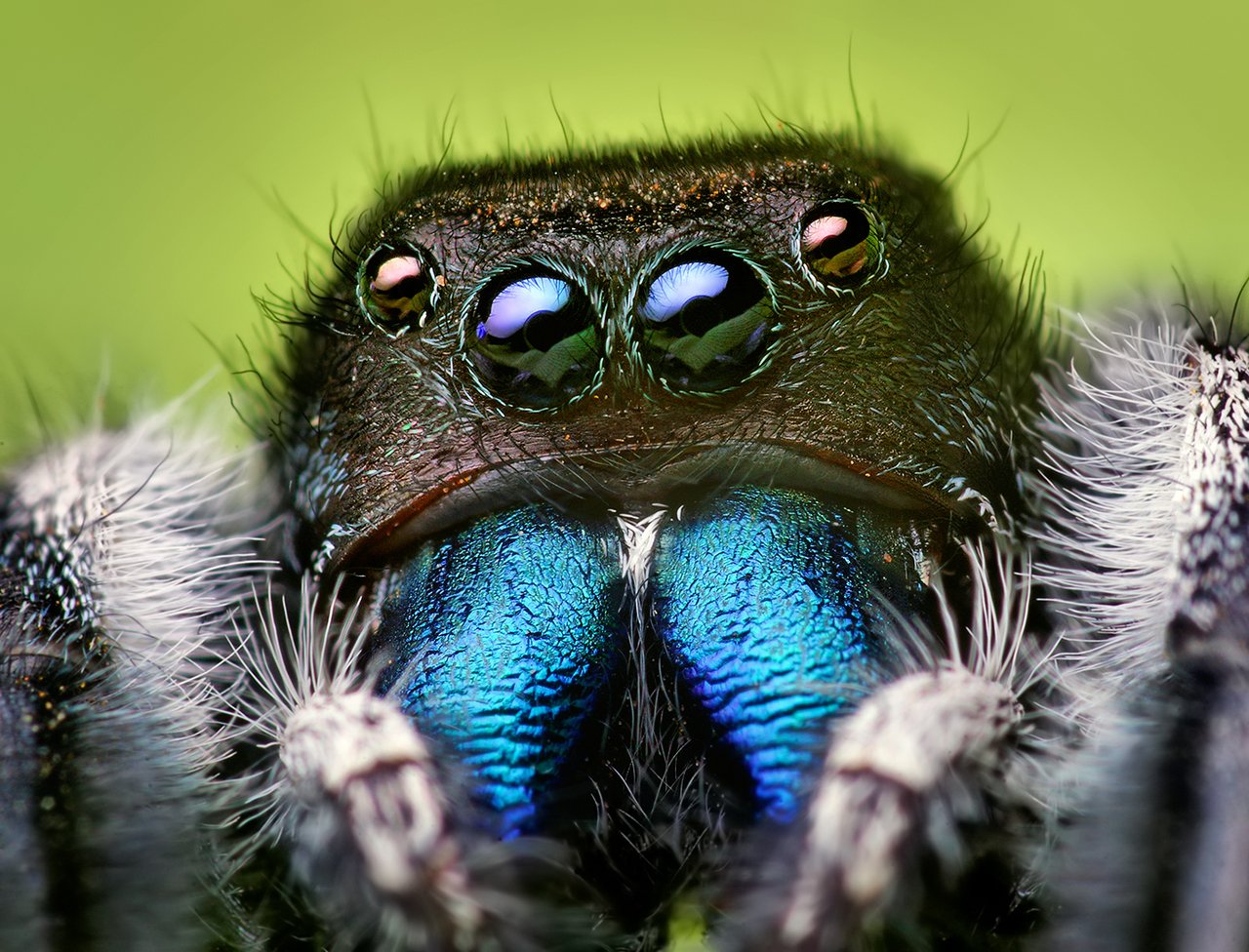
The charming one: the jumping spider
Small (under half an inch), compact, often fuzzy black with white or iridescent markings, moving in decisive hops along windowsills and sunny walls — and equipped with enormous forward-facing eyes that track you, because jumping spiders have the best vision in the spider world and genuine curiosity to aim it with. They build no webs (silk safety-lines only), hunt by daylight athletics, cannot meaningfully bite people, and have accumulated an internet fan club for reasons obvious to anyone who has been regarded thoughtfully by one. In the house they are unambiguous allies — daytime hunters of flies, gnats, and fabric pests — and the professional recommendation is to leave them entirely alone, a recommendation we make while fully aware nobody calls an exterminator about the cute one. Bold jumper on the sill: the house is working as intended.
The ceiling-corner residents: cellar spiders and house spiders
The leggy, delicate spider hanging inverted in a messy ceiling-corner web — the one that vibrates into a blur when disturbed — is the long-bodied cellar spider, incorrectly famous under the “daddy longlegs” name (which also gets applied to harvestmen, an entirely different non-spider arachnid with no venom or silk at all) and doubly incorrectly famous for the “deadliest venom, tiny fangs” legend, which is folklore top to bottom: cellar spider venom is trivial and the fangs work fine. They are basement-and-corner specialists, patient eaters of everything from gnats to other spiders (recluse included, where ranges overlap — a genuine argument for their tenancy), and the least dangerous roommate on this page. Their neighbor in similar spaces is the American house spider — small, brown, unremarkable, keeper of the classic tangled cobweb in window frames and behind furniture, mother of the little tan egg-sac spheres that alarm closet-cleaners every spring. Both species’ entire footprint on your life is the webbing itself; both are managed completely by vacuuming webs and sacs on a routine, which removes the residents, their nurseries, and the food-catching infrastructure in one pass.
The outdoor artists and the fall giants
September brings the calls: “overnight there is an enormous spider in a huge wheel web across my porch.” That is an orb weaver — usually a barn spider or the spectacular black-and-yellow garden spider — and fall is simply when a spring hatchling reaches photogenic size; she was there all summer, smaller. Orb weavers are placid, essentially blind to humans, medically irrelevant, and running the most effective flying-insect trap on your property; the management for a badly placed web is a broom and a relocation, not a treatment. Their ground-floor cousins, the funnel weavers and grass spiders, carpet lawns and shrubs with the horizontal sheet-webs-with-a-tunnel that dew reveals on August mornings — harmless, and the reason your yard is not ankle-deep in crickets. And along water — a Miami Valley specialty from the river corridors to backyard ponds — the fishing spiders: wolf-spider-sized and bigger, capable of walking on water, occasionally wandering into river-adjacent basements in corridor neighborhoods, and despite their genuinely impressive dimensions, harmless drama in a hairy suit. The pattern across all of them: outdoor spiders in Ohio are infrastructure, not threat — the goal is placement management, never eradication.
The two that earn caution — and the one that earns a footnote
Honesty requires the short serious list. The black widow (glossy black, red hourglass, reclusive webs in undisturbed outdoor clutter — meter boxes, woodpiles, garage corners) and the brown recluse (uniform tan-brown, violin mark, six eyes, established only patchily in southwest Ohio and dramatically over-reported) are the state’s two medically significant spiders, and both get full identification-and-response treatment in the venomous spiders guide — including the crucial point that the recluse accusation is wrong in the overwhelming majority of the photos we receive (wolf spiders and harmless funnel weavers take the fall daily). The footnote species is the yellow sac spider: pale yellowish-green, a night-active hunter that shelters in little silk tents where walls meet ceilings, and the probable author of a share of the minor “mystery bites” attributed to fiercer names — its bite stings and can raise a slow-healing sore, well short of dangerous but past “ignore.” Sac spiders indoors are a legitimate reason for the corner-vacuuming routine and, at density, for a perimeter treatment. Everything else on this page ranks below the family dog as a household hazard.
Why your house has spiders (the economics of eight legs)
Spiders are pure market followers: they settle where prey concentrates, and a spider-rich house is always announcing an insect-rich house — porch lights recruiting nightly moth traffic, a damp basement running the crustacean-and-cricket economy, gaps admitting the fall migration. This is why spider control that starts and ends with killing spiders disappoints: the vacancy re-lets within weeks. Effective reduction works the market — warm-temperature LED bulbs at entrances (measurably less insect traffic, thus less web traffic), the dehumidifier that evicts the basement prey base, door sweeps and sealed penetrations that close the commuter routes, outdoor clutter (woodpiles, stacked pots, tarps) held away from foundations, and web-and-sac vacuuming as routine maintenance. Do those and the spider census falls as a consequence; skip them and no spray schedule outruns the vacancy chain.
When professional spider control earns its place
We will happily tell a caller with one wolf spider to salute it and open a door — and there are situations where the professional visit is the right economics. Density: exterior webbing heavy enough that every light, eave, and shutter re-webs within days signals prey pressure worth attacking at the perimeter, where our treatments target the eave lines, entry gaps, and harborage edges spiders and their prey share (details on the spider control page). Location: confirmed widow habitat around kid-traffic areas — play sets, sandboxes, the garage bike corner — or a genuine recluse confirmation, both of which get specific, sober protocols rather than generic spraying. Tolerance: households where arachnophobia is a quality-of-life issue deserve zero judgment and a maintenance program that keeps encounters near zero — a real service we provide without requiring anyone to pretend it is about danger. And the rural seam: the estate-lot and edge neighborhoods whose spider pressure is structurally higher get the quarterly cadence that matches the geography. What we do not sell: recluse panic packages for wolf spider photos, or eradication fantasies — the honest goal indoors is few and incidental, and outdoors is balanced and out of the doorways.
Ohio spider questions we hear
I get “spider bites” every night but never see spiders. Likely?
Unlikely — nightly recurring bites point to systematic feeders (bed bugs, fleas, mites) or non-bite causes, not spiders, which bite defensively and rarely. The “spider bite” folk diagnosis delays a lot of correct answers; run the evidence-based workup in the mite guide and let inspection findings, not folklore, name the culprit. Free photo triage as always: (937) 569-3330.
Do spiders come up drains?
No — the bathtub spider fell in during a night hike and cannot climb the porcelain; the drain trap’s water seal blocks the plumbing route entirely. The tub is a pitfall trap, not a portal. Cup, cardboard, window; or the towel-draped-over-the-edge escape ladder for the humane-but-hands-off.
Are house spiders worse some years?
Yes, tracking their prey: wet springs that boom the insect base, mast years that boom the whole food chain, and warm falls that extend outdoor breeding all raise the autumn indoor census. A heavy spider year is a heavy bug year wearing its predator on the outside — and the same perimeter-and-exclusion response answers both layers at once.
The seasonal spider calendar for the Miami Valley
March–May: egg sacs hatch — the season of sudden spiderling dispersals (dozens of pinpoint spiders ballooning on silk threads from a hatched sac, alarming and over in a day) and the right window for the first web-and-sac vacuuming pass. June–August: the growth season — orb weavers scaling up in the gardens, funnel webs carpeting the morning lawn, wolf spiders hunting the mulch lines; outdoor abundance peaks while indoor sightings stay modest. September–October: the headline month — mature orb weavers at maximum drama, and the genuine indoor migration as males of many species (wolf spiders especially) wander in search of mates and warmth; nearly every “suddenly my house is full of spiders” call lands in these six weeks, and nearly every one is fall traffic through unsealed doors rather than an indoor population explosion. November–February: the settled season — whoever made it inside establishes in basements and quiet corners; winter sightings index your indoor prey economy (dust the moisture guild off the suspect list first). The practical rhythm: seal and treat the perimeter in late August before the migration, vacuum corners quarterly, and the year stays quiet at both ends.
The bottom line
Ohio’s household spiders are a dozen mostly-harmless regulars — the wolf on patrol, the jumper on the sill, the cellar spider running the corner concession, the September giants doing free pest control across the porch — plus two genuine exceptions with their own sober guide and one sac-spider footnote. Learn the cast, manage the economy (lights, moisture, gaps, clutter) instead of the individuals, keep the vacuum in the rotation, and reserve the professional call for density, confirmed danger, or a household’s peace of mind — all three of which we handle every week, guarantee attached. And the standing offer that resolves ninety percent of spider anxiety in one text: photograph it next to a coin and send it to (937) 569-3330. The answer is usually “harmless, and honestly kind of great” — and when it is not, we are already holding your address.
Related: Ohio’s venomous spiders · professional spider control · the basement prey economy · Ohio’s scariest-looking bugs.
Field marks in fifteen seconds: the cheat sheet
- Big, fast, on the floor, no web: wolf spider — harmless hunter; door sweep is the fix
- Small, fuzzy, hops, watches you: jumping spider — ally; no action
- Long legs, messy ceiling web, vibrates: cellar spider — harmless; vacuum the web if unwanted
- Small brown, tangled cobweb, tan egg spheres: American house spider — harmless; vacuum webs and sacs
- Huge wheel web outdoors, big striped builder: orb weaver — premier ally; relocate the web line if badly placed
- Sheet web with funnel in the grass or shrub: funnel weaver — harmless lawn infrastructure
- Very large, near water, walks on it: fishing spider — harmless corridor drama
- Pale yellow-green, silk tent at wall-ceiling joints, night walker: yellow sac spider — minor medical footnote; vacuum tents, consider perimeter work at density
- Glossy black, red hourglass, low web in outdoor clutter: black widow — real caution; the venomous guide, and gloves in the meter box
- Uniform brown, violin mark, six eyes, southwest-Ohio basement: possible recluse — photograph, do not handle, send it in
Print that list somewhere near the flashlight, and most household spider encounters resolve without a phone call — though the phone call stays free for the ones that do not.
A word for the arachnophobes (from a company that gets it)
Some readers made it this far white-knuckled, and this section is for you, written without condescension: spider fear is among the most common phobias humans carry, it does not respond to being told the wolf spider is friendly, and a pest control company that mocks it is a pest control company that has forgotten who calls pest control companies. Our approach for phobic households is practical accommodation, not conversion therapy — scheduled quarterly perimeter-and-corner service that keeps indoor encounters near zero, technicians briefed that this house takes webs seriously, the vacuuming and exclusion work done by us so nobody in the family has to approach a corner, and the emergency single-spider visit treated with a straight face when someone genuinely cannot re-enter a room (it happens; we come). The biology sections of this page are true, and your nervous system’s veto is also real; the service exists so both can be. Zero-judgment spider quiet, on a schedule: (937) 569-3330.
Should I relocate spiders outside or is that a myth too?
Species-dependent, pleasantly: the outdoor wanderers (wolf, fishing, orb weavers displaced from doorways) genuinely resume business outside and relocation is the right call; the true house specialists (cellar and house spiders) evolved for indoor climates and mostly do not survive winter eviction — for them the honest choices are tolerance or the vacuum, and pretending the cup-and-cardboard ride was a rescue is for your conscience rather than the spider. Either way the individual matters less than the economy: manage the lights, moisture, and gaps, and the census manages itself — humanely, automatically, and without anyone standing on a chair.
Two hundred million years of pest control experience walks your baseboards nightly, asks no fee, and mostly wants to be left alone with the gnats. Learn the ten field marks, save the two serious ones to your camera roll, and let the rest of the crew work — while we handle the parts of the ecosystem that actually bite back.
The Ohio spider identification chart, in words
For the chart-seekers: the spiders native to Ohio sort on four quick axes. Web architecture — symmetrical wheel = orb weaver (harmless, always); funnel-sheet in the lawn = grass spider; chaotic tangle low and dark = the cobweb clan, worth the gloss-and-hourglass check; no web at all = a hunter. Gait — floor-level sprint = wolf spider; stop-motion hop with a head-tilt = jumping spider. Venue — flower heads = crab spider; basement ceilings = cellar spider; window glass = zebra jumper. Gloss — shiny, hairless, jet black is the only finish that ever warrants careful handling. Every species indigenous to Ohio fits one row of that chart; the two rows with stakes get their own pages; and the photo line adjudicates every exception free.
Related: The funnel-web grass spiders people mistake for something worse.
Frequently asked questions
What are the most common spiders in Ohio houses?
The indoor five: cellar spiders (basement corners), American house spiders (cobwebs in room corners), wolf spiders (fall floor-sprinters), jumping spiders (sunny sills), and funnel-weaving grass spiders (September door-gap wanderers). All five: harmless, and mostly eating insects you want gone.
How many spiders in Ohio are actually dangerous?
Two of four-hundred-plus species: the black widow (uncommon) and brown recluse (rare here) — both storage-zone dwellers avoidable with one glove habit. Everything else on the state roster rates at or below a bee sting, most far below.
What is the spider with the huge round web in my garden?
An orb-weaver — the September showpieces (yellow garden spiders, banded argiopes, barn spiders) at peak size before frost ends them. Harmless architects doing free flying-insect control; relocate the web line if it crosses a path, otherwise enjoy the engineering.
What is the fast spider in my bathtub?
Usually a funnel weaver or house spider stranded at the water hole — winter-dry houses drive them to tub moisture, and the porcelain defeats their climbing. Not from the drain (the trap blocks it); cup, card, basement corner.
What are the spiders with the messy webs in my basement corners?
Cellar spiders — the long-legged “daddy longlegs” of indoor lore, running permanent fishing operations for fungus gnats and silverfish. The “deadliest venom” legend is pure myth; the free pest control is real.
Are daddy longlegs spiders?
Split the name: cellar spiders (web-dwelling, indoors) are true spiders; harvestmen (the one-piece-body lawn wanderers) are arachnids but not spiders at all — no venom, no silk, no fangs worth the name. Neither remotely threatens people; the shared folklore is wrong about both.
Why does my house have so many spiders?
Census logic — spider populations track prey populations, so a spider-rich house is announcing an insect-rich house: moisture feeding gnats, bright exterior lights feeding moths, foundation harborage feeding everything. Fix the food web and the spiders self-deport; the full program is on our spider guide.
What spider is mistaken for a brown recluse most?
Grass spiders overwhelmingly — similar size and brown coloring, but banded legs, visible spinnerets, and eight eyes acquit them instantly (recluses: uniform tan, six eyes). Wolf spiders and male house spiders round out the weekly false-alarm lineup.
When are spiders worst in Ohio?
September — mating-season males wander indoors, orb-weavers peak, and funnel webs carpet dewy lawns. It is a calendar event that self-resolves; the winter population you meet afterward is the permanent indoor staff, unchanged.
Which spider sightings warrant a call?
Suspected widows or recluses in storage zones (photo first — free ID, and most are false alarms), sighting counts climbing week over week (a prey-base diagnosis worth running), or web pressure beyond your clearing patience: (937) 569-3330. The rest of the roster earns the cup and the thank-you.
Three More Housemates Worth Knowing by Name
Reader photos keep surfacing the same three species this page hadn’t yet named, so here are their files:
The parson spider: the racing stripe in the laundry
Mid-sized, velvety gray-black with a white racing stripe down the abdomen ending in a small blaze — named for its resemblance to old clerical garb. A ground-hunting spider that wanders indoors in fall and turns up in laundry piles, bathtubs, and under boxes. It doesn’t build webs indoors, moves fast when uncovered, and its bite (rare, defensive, from being trapped in clothing) is unpleasant but medically minor. The fall wanderer pattern applies: seal the sweeps, shake out the floor laundry, escort with a cup.
The triangulate cobweb spider: the basement’s honest tenant
The small brown spider behind most Ohio basement cobwebs that aren’t the American house spider’s: look for a chevron/triangle pattern down a globular abdomen. It’s a cobweb-family cousin of the widows with none of the medical significance — and it actively hunts other spiders, including having a documented taste for brown recluses in the regions that have them. A triangulate in the corner is quiet pest control; the management play is a vacuum pass on the webs you can’t abide, not a treatment.
The cat-faced spider: the porch-light orb weaver of autumn
A chunky orb weaver whose abdomen bumps read as cat ears (the “jewel spider” of some regions), famous for building big wheel webs at porch lights and eaves each fall. Same verdict as the whole orb family: harmless, temporary, and gone at frost — September’s web across the porch light is a free insect trap positioned exactly where the bugs are, and it takes its architecture down for good within weeks.
Not sure what you’re looking at? Start at the Ohio Bug Identification Library — every ID file on this site, indexed on one page.