
Every summer, Ohio produces a handful of insects that look like they escaped from a monster movie — and every summer, our identification line fills with photos of them attached to messages in all caps. So here it is: the official Greater Dayton Pest & Rodent ranking of the scariest-looking bugs in Ohio, scored honestly on two axes — how terrifying they look, and how much they can actually hurt you — because the gap between those two numbers is the whole story. Spoiler for the anxious: the correlation is nearly inverted. Ohio’s most nightmarish-looking arthropods are almost uniformly harmless (several are actively beneficial), while the genuinely dangerous residents are small, plain, and covered elsewhere in this library under their own unglamorous names. Ten contestants follow, each with its scare score, its real-harm audit, and what to do when one shows up — plus the free photo line that has talked more people off more ladders than any page we’ve ever written: (937) 569-3330.
#1: The eastern dobsonfly — Ohio’s reigning nightmare champion
Nothing else comes close. The male eastern dobsonfly is a hand-sized insect — wingspans pushing five inches — with gray shrouded wings and, on the males, a pair of enormous curved sickle mandibles a quarter the length of its body, the kind of hardware that makes a porch light gathering scatter. It emerges from the region’s cleaner rivers and streams in early summer (the larvae — “hellgrammites,” themselves fearsome-looking and prized as fish bait — develop underwater for years), lives about a week as an adult, and blunders to lights near the water: riverside porches in Miamisburg, Englewood’s Stillwater corridor, and every campground on a Miami Valley stream. The harm audit dismantles the terror: those saber mandibles are mating equipment — so oversized the male cannot generate meaningful bite force with them (they’re for jousting rivals and grasping females); the females and hellgrammites can deliver a real pinch if hand-grabbed, drawing a bead of blood at worst; no venom, no aggression, no interest in you whatsoever. Scare score: 10/10. Harm score: 1/10. Verdict: turn off the porch light, take the photo of a lifetime, and know its presence is a compliment — dobsonflies require clean water, so the monster on your screen is an environmental report card with wings. (The full dobsonfly-and-hellgrammite file — the three-year river life, the bait-shop economy, the storm-predicting walkouts — now has its own page.)
The frightening-looking ones are mostly harmless and the genuinely troublesome ones are dull to look at. Sorting that out is pest control in Dayton.
#2: The house centipede — the sprinting nightmare in your basement
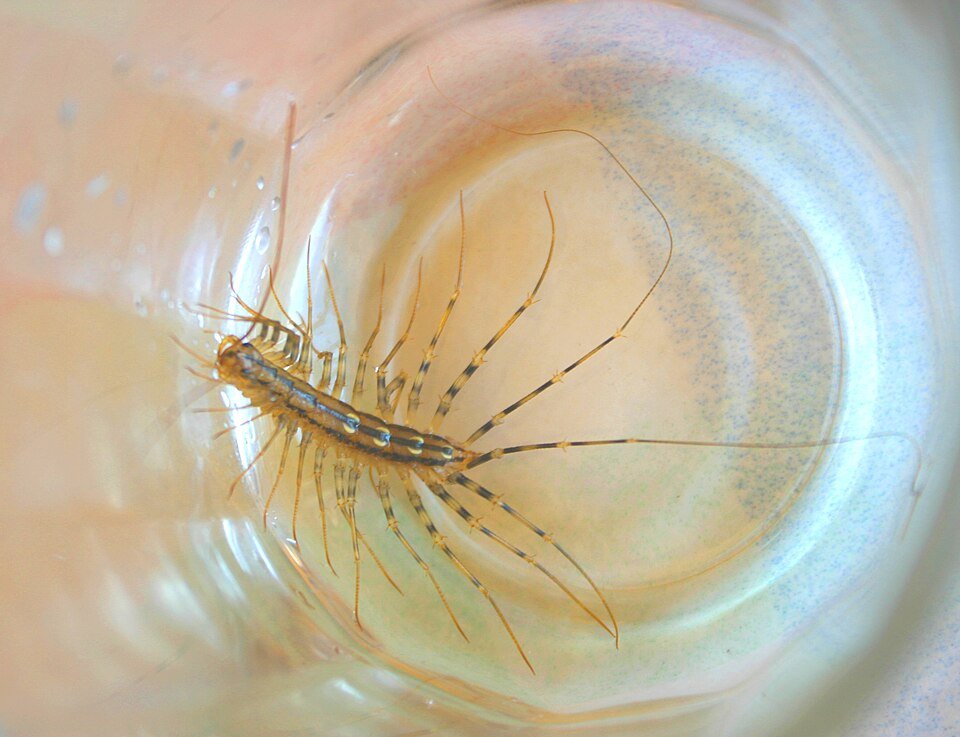
If the dobsonfly rules the porch, the house centipede rules the 11 PM basement scream. Fifteen pairs of impossibly long banded legs, a body that seems to flow rather than run, speeds that outpace any startled human’s slipper, and a habit of appearing in bathtubs and racing along baseboards — it’s the arthropod most likely to make a grown adult leave a room. The audit: house centipedes are predators on your side — they hunt roaches, silverfish, carpet beetle larvae, and spiders through your basement all year, they’re physically capable of a defensive nip (rare, minor, requires hand-capture), and their real message is environmental: a robust house centipede population means a humid space with a prey base, the same moisture-and-food-chain reading our spider page teaches. Scare score: 9/10. Harm: 1/10. Response: a dehumidifier under fifty percent and the prey-reduction program shrink the population by starving it — no chemical campaign needed, though the perimeter services that cut their food supply do double duty. Or make peace with the night shift: every centipede you tolerate is running free pest control at speeds you couldn’t buy.
#3–#5: The two-inch club — cicada killer, European hornet, giant water bug
#3, the cicada killer wasp: two inches of black-and-yellow, sand-throwing burrows, cicadas airlifted across the lawn — and, as its full section in our cicada guide details, a near-total bluff: patrol males have no stinger, burrow females almost never use theirs. Scare 8, harm 2, and the harm requires barefoot-on-wasp misfortune. #4, the European hornet: Ohio’s largest true social wasp — an inch-plus of brown-and-gold that flies at night, thumping against windows like a moth with a gym membership, and fueling every “murder hornet” panic our bee guide debunks annually (the northern giant hornet has never been found in Ohio). This one earns respect: it’s a colonial wasp with a real sting and a nest to defend — typically in hollow trees, occasionally in wall voids, where it becomes a genuine professional job. Scare 8, harm 5 — the list’s first contestant whose danger is more than folklore, though unprovoked attacks remain rare. #5, the giant water bug: the “toe-biter” — two-plus inches of flattened aquatic ambush predator with raptorial forearms, famous for the most painful insect bite in North America (a genuine venom injection it uses on fish and frogs) and for flying to parking-lot lights on summer nights, earning its other nickname, “electric light bug.” Scare 9, harm 4 — but only if handled; on the pavement under a gas-station light it’s a stranded fish predator, not a threat. Slide it onto cardboard, release it toward water, and keep your toes hypothetical.
#6–#8: The household frights — wolf spider, camel cricket, earwig
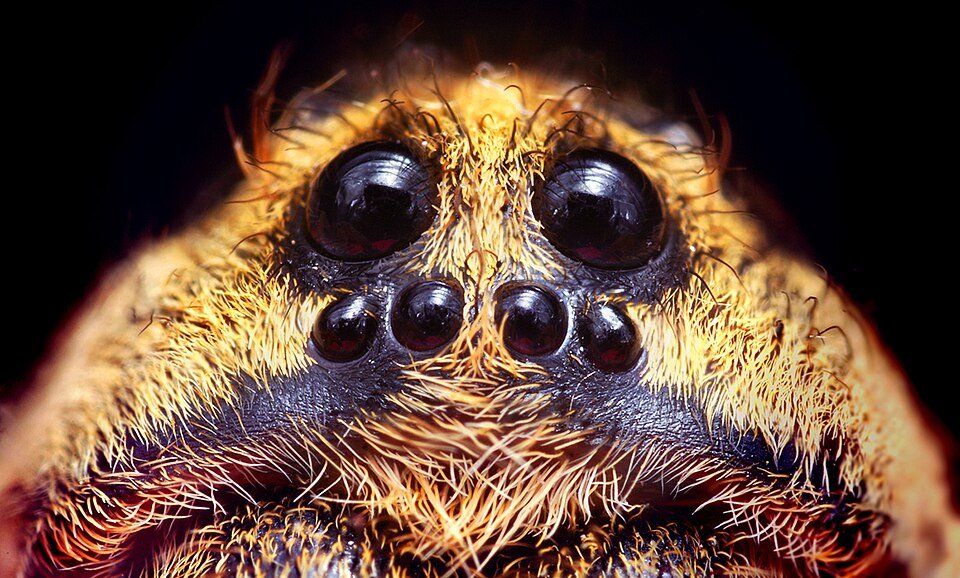
#6, the wolf spider: October’s big, fast, hairy floor-crosser — the single most screamed-about arthropod in Ohio homes and the star false alarm of our venomous spider guide: no web, no aggression, a mild venom reserved for crickets, and a mother who carries her spiderlings on her back (the “exploding spider” of legend when swatted — one more argument for cup-and-card). Scare 8, harm 1. #7, the camel cricket: the humpbacked basement “sprickets” that jump — crucially, toward whatever startles them, a blind panic reflex that reads as attack and has ended more basement laundry sessions than any actual pest. No bite, no venom, no interest; a moisture-and-prey indicator that shrinks under the same dehumidifier as the centipede. Scare 7, harm 0 — the only perfect zero on the list. #8, the earwig: those rear pincers (cerci) look surgical and medieval folklore did the rest — the ear-crawling myth is pure fiction, the pincers manage a token pinch at worst, and the species is a damp-mulch dweller that wanders indoors and dies. Scare 6, harm 1 — and a fuller treatment of its household habits is coming in this library’s next wave. The pattern by now is explicit: the household frights are moisture messengers, not menaces, and the perimeter-and-humidity playbook answers all three at once.
#9–#10: The armored and the enormous — stag beetle, Luna moth’s giant kin
#9, the stag beetle: Ohio’s tank — up to two inches of glossy armor with antler-jaws on the males, blundering to porch lights in early summer and hissing faintly when picked up (which you may, freely: the antlers are wrestling gear for rival males, capable of a firm pinch and nothing more — the females’ smaller jaws pinch harder, a detail nobody expects). Larvae spend years in rotting stumps doing decomposition’s honest work. Scare 7, harm 1. #10, the giant silk moths: cecropia, polyphemus, and imperial moths — palm-sized, bat-mistaken at dusk, and the source of a steady trickle of “giant THING on my siding” photos. They are the gentlest entry ever to make a scary list: adult silk moths have no functional mouthparts — they cannot bite, sting, or even eat, living a single week on larval reserves to mate and die. Scare 6, harm 0. Their startling caterpillars (the horned hickory horned devil, the spiky cecropia larva) score the same: dramatic, harmless, and increasingly uncommon — every one you spare is a small win for a declining group. The list’s bottom half, in other words, is a wildlife appreciation section wearing a Halloween costume — which was the ranking’s thesis all along.
The inversion: where Ohio’s real danger actually lives
Now flip the ranking, because the safety lesson is in the mirror image. Ohio’s genuinely consequential arthropods are, almost without exception, small, plain, and unphotogenic: the yellowjacket — half the size of anything on this list — sends more Ohioans to emergency care than every scary-looking species combined, via wall-void and ground colonies defended in coordinated waves; the brown recluse is a modest tan spider whose entire menace hides in a violin marking most people can’t find; the blacklegged tick is a sesame seed with Lyme disease; the mosquito — history’s deadliest animal — weighs two milligrams; and the bed bug, this library’s most expensive resident, is an apple seed that hides from you. Evolution explains the inversion neatly: genuinely dangerous animals rarely need to advertise, while the harmless ones benefit from looking like monsters — the dobsonfly’s sabers, the hornet-mimic costumes, the centipede’s theatrical sprint are all defense budgets spent on appearance precisely because nothing real backs them. So the practical household rule inverts too: react to evidence and behavior, not to appearance — steady traffic into one wall gap outranks any porch-light monster, ankle bites outrank a bathtub centipede, and the ten scariest bugs in Ohio deserve, collectively, about one-tenth the concern of a single line of ants to the dog bowl. That recalibration is this page’s entire payload, delivered by ranking.
The scary-bug protocol: what to actually do with a monster
- Photograph first — beside a coin if it’s stationary; every entry on this list is a free same-hour ID at (937) 569-3330, and half the value is the story you keep
- Cup-and-card the indoor ones — a glass and a stiff card evict everything on this list safely; the centipede requires ambition, the dobsonfly requires a bigger cup
- Kill the porch light — the dobsonfly, hornet, water bug, stag beetle, and silk moths are all light-trapped travelers; warm-spectrum bulbs (the same lighting advice as ever) cut the parade at the source
- Dry the basement — centipede, camel cricket, and earwig populations are humidity readings with legs; the dehumidifier is the whole campaign
- Respect exactly two: the European hornet’s nest (a professional call if it’s in a wall or traffic area) and anything matching the recluse/widow profiles — the list’s only entries where the next step is our truck rather than your camera
- Skip the revenge spraying — a one-time monster is not an infestation, and perimeter chemistry aimed at a stranded water bug is theater; save treatment for evidence-backed problems, which is the standing policy of every page here
The full scoreboard
- #1 Eastern dobsonfly — scare 10 / harm 1 — clean-water compliment; photograph and release
- #2 House centipede — scare 9 / harm 1 — free basement pest control; dehumidify to evict
- #3 Cicada killer — scare 8 / harm 2 — stingless males, reluctant females; tolerate or treat burrow zones for comfort
- #4 European hornet — scare 8 / harm 5 — real wasp, real nest defense; wall-void colonies are a professional job
- #5 Giant water bug — scare 9 / harm 4 — legendary bite, handling-only; cardboard-assist back toward water
- #6 Wolf spider — scare 8 / harm 1 — October wanderer; cup, card, compliment
- #7 Camel cricket — scare 7 / harm 0 — the list’s only perfect zero; jumps toward you out of blindness, not malice
- #8 Earwig — scare 6 / harm 1 — the ear myth is fiction; damp-mulch wanderer
- #9 Stag beetle — scare 7 / harm 1 — antlers are for wrestling; hisses for show
- #10 Giant silk moths — scare 6 / harm 0 — no mouthparts, one week to live; pure spectacle
- Meanwhile, the real list: yellowjackets, recluses, ticks, mosquitoes, bed bugs — small, plain, and covered under their own pages, which is where the actual vigilance belongs
Ten monsters, two worth caution, zero worth panic — and a phone line that’s heard every scream on the list and answered each one the same way: send the photo, keep the story, and save the treatment budget for the bugs too boring to make the ranking: (937) 569-3330.
Honorable mentions: the regional bench
Every ranking leaves contenders in the parking lot, and Ohio’s bench deserves its roll call. The wheel bug — the armored assassin with the cog crest — would have made the top five if our kissing bug guide hadn’t already crowned it the state’s most productive false alarm; its defensive stab outranks most entries here, its garden services outrank its risk. The fishing spider — a wolf spider’s bigger cousin that hunts across pond surfaces and occasionally overwinters in river-adjacent basements — is the “biggest spider I’ve ever seen” call from every waterfront street in Englewood and Miamisburg: palm-sized, harmless, unforgettable. The mydas fly and robber flies — huge, wasp-costumed aerial predators — panic picnics while eating the insects that deserve it. Hellgrammites — the dobsonfly’s aquatic larvae — technically scored under their adult form but would rank independently if more people flipped streamside rocks. And the toe-curling sight of a cicada mid-emergence — pale, hunched, alien — sends a photo to our line every July from someone certain they’ve discovered something unprecedented; the cicada guide awaits them warmly. The bench confirms the ranking’s law without exception: in Ohio, the more unforgettable the monster, the more certainly it’s innocent — and the identification line remains undefeated against all of them: (937) 569-3330.
Why a pest company celebrates its monsters
A closing note on why this page reads more like a nature guide than a service pitch — because that’s the honest shape of the subject, and because the celebration is strategic in a way worth admitting. Fear of dramatic-looking insects drives two costly behaviors we spend all year correcting: the panic purchase (treatments aimed at harmless one-time visitors) and the panic swat (which, for reflex-bleeding lady beetles, brood-carrying wolf spiders, and scent-gland stink bugs, always makes things worse). A household that can name its dobsonfly doesn’t buy either mistake — it takes the photo, keeps the story, and saves its vigilance for the small plain evidence that actually matters: the fecal dots on a mattress seam, the mud tube on a foundation, the steady traffic into one gap. Teaching that recalibration free of charge is the best marketing this company does, because the household that trusts us to say “harmless, enjoy it” ten times believes us completely the one time we say “this one’s real — here’s the plan.” Ohio’s monsters, it turns out, are the library’s best teachers: unforgettable, innocent, and living proof that in pest control, as everywhere, the scary thing and the dangerous thing are almost never the same thing. Frame the dobsonfly photo. Call us about the yellowjackets: (937) 569-3330.
(Parents: this page doubles as the best bug-anxiety antidote we know for kids — the ranking format turns fear into collecting, and a child who can score a camel cricket “seven and zero” has learned the entire risk-literacy lesson adults pay therapists for. Print the scoreboard, issue a magnifying glass, and let Ohio’s monster bench do the teaching all summer. First one to photograph a dobsonfly wins the Miami Valley.)
Frequently asked questions
What is the scariest bug in Ohio?
By reader vote across our call log: the house centipede (speed plus legs), the cicada killer (sheer size), the wolf spider (hairy sprint), the wheel bug (armored menace), and the European hornet (inch-plus at the porch light). The punchline this page exists for: every one of them is essentially harmless — Ohio’s scariest-looking roster and its most dangerous roster barely overlap.
What Ohio bugs are actually dangerous?
The short honest list: yellowjackets and their kin (sting volume plus allergy risk — the genuine ER-filler), black widows (uncommon), brown recluses (rare), ticks (disease transmission — arguably the state’s most dangerous arthropod), and mosquitoes (West Nile). Note the pattern: mostly small, plain, and unphotogenic.
Is the giant wasp digging in my yard dangerous?
The cicada killer — two inches of pure intimidation, functionally zero sting risk: females ignore people, patrol males cannot sting at all. It tops every “scariest” list and belongs on none of the dangerous ones; the full acquittal has its own page.
What is the huge spider that sprints across the floor?
Wolf spider or giant house spider — the speed and bulk trigger every instinct, and the bite file (rare, bee-sting grade, flee-first temperament) supports none of it. Cup, card, and the respect owed a fellow pest-control professional.
What is the armored gray bug with the cog on its back?
The wheel bug — Ohio’s largest assassin bug and its most medieval-looking insect, with the one asterisk on this page: handled carelessly, its defensive stab genuinely hurts (worse than most stings). Unhandled, it is a beneficial predator clearing caterpillars off your trees. Look, admire, don’t grab.
Are earwigs as creepy as they look?
The pincers write checks the insect cannot cash — a startled soft pinch at worst, no ear interest whatsoever (the folklore is medieval), and a garden ledger that is half beneficial. Fully acquitted on its own page.
What about the bug that looks like a walking dust bunny?
The masked hunter nymph — an assassin bug that camouflages in lint and hunts bed bugs and other insects; its adult form delivers a sharp defensive poke if handled. One of the strangest sights in Ohio homes and, unhandled, one more unpaid staff member.
Why do harmless bugs look so scary?
Because looking dangerous IS their defense — the whole gallery (spines, pincers, size, speed, warning colors) evolved to make predators and primates flinch. The bluff works; the venom and aggression budgets went unfunded. Danger and drama are separate evolutionary purchases.
Which scary-looking bug should I actually respect?
The ranking that matters: any yellowjacket ground nest (the vibration-triggered swarm is the region’s real injury generator), the tick you never felt attach, and the two careful spiders in undisturbed storage. Respect the quiet ones; wave at the theatrical ones.
Who do I send my scary bug photo to?
(937) 569-3330 — the acquittal desk is always open, the ID is free, and the answer arrives with its danger grade attached. Fair warning from experience: nine times out of ten the verdict is “magnificent, harmless, please leave it be” — and the tenth time, we handle it.
Not sure what you’re looking at? Start at the Ohio Bug Identification Library — every ID file on this site, indexed on one page.
Related identification guides: black widows in Ohio, red wasps, and the great black wasp.