
Grass spiders own one morning a year: the first cool September dawn when dew silvers the lawn and reveals dozens of flat silk sheets, each narrowing into a funnel, each holding a striped sprinter that has been there — unnoticed — all summer. The reveal triggers the season’s predictable searches: what are they, are they dangerous, is that a hobo or a recluse in there, and why is one suddenly in my bathtub. This page is the species’ complete file: the racing-stripe identification, the funnel-web engineering that carpets Ohio turf, the acquittals it collects weekly (recluse and hobo both — grass spiders are the most-accused innocent in the state), the one-season biology that ends every colony at frost, and the honest management verdict for the lawns that host hundreds.
Identification: stripes, bands, and spinnerets
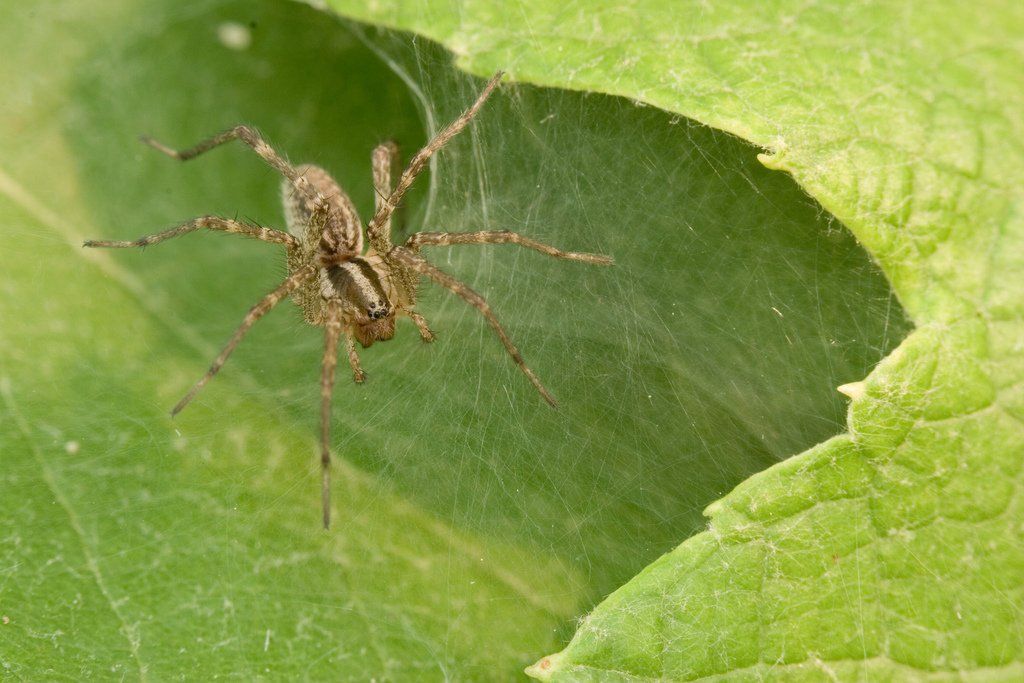
Agelenopsis wears three marks that close every case: two bold dark racing stripes running the length of the tan-brown carapace (the head-plate — the field mark visible from standing height), banded legs annulated in light and dark rings, and — the tiebreaker at close range — prominent paired spinnerets extending from the abdomen tip like a small twin tail, longer than any look-alike carries. Size runs half-to-three-quarters of an inch in body, palm-covering with legs at autumn peak; the silhouette is the funnel-weaver family’s athletic build — long-legged, flat-bodied, engineered for the sprint across the sheet. Behavior confirms what anatomy starts: a grass spider OWNS its web — found on or beside the funnel, retreating INTO it at disturbance at genuinely startling speed (the family’s hallmark sprint, clocked among the fastest spider movements measured) — and a striped, banded, twin-tailed sprinter on a funnel sheet is a grass spider with the confidence of a signature.
Grass spiders belong in the lawn and rarely come in. When they do, and keep doing it, that is spider control in Dayton.
The web: a catching floor with a panic room
The funnel web is not sticky — the engineering is better than glue. The flat sheet is a TRIP FLOOR: non-adhesive silk laid dense over grass, shrub tops, groundcover, and foundation corners, connected upward to knockdown threads that tumble low-flying insects onto the platform; the spider, waiting in the funnel’s throat, reads the impact through the silk and covers the distance in a tenth-of-a-second sprint, taking the prey before it rights itself. The funnel proper is the panic room — a silk tube retreating into thatch, stone gap, or siding corner, sheltering the owner from birds, weather, and lawn mowers between strikes. One lawn can float dozens of operations (the September dew-reveal’s whole spectacle), each clearing its patch of leafhoppers, crickets, moths, and mosquitoes nightly — the turf’s own air-defense grid, invisible eleven months of the year and never once interested in the humans mowing over it.
The most-accused innocent: recluse and hobo charges, dismissed
Grass spiders collect more false identifications than any Ohio species, and both charges dismiss on the marks above. The recluse charge: similar size, similar brown — but the recluse wears NO stripes, NO leg bands, and no prominent spinnerets (uniform tan, slender plain legs, six eyes), never builds or occupies funnel webs, and remains rare in Ohio besides; a striped, banded funnel-owner is acquitted before the eye-count starts. The hobo charge: closer kin (same family) and the internet’s favorite — but hobos wear PLAIN legs and no bold stripes, and per the hobo page’s full file, do not live in Ohio at all; the photo-matching that convicts your grass spider is comparing it to mislabeled photos of other grass spiders. The bite record, for completeness: a handled grass spider can nip — brief, minor, bee-sting-or-less — and unhandled ones sprint away from humans at the family’s famous speed; no medically significant grass spider bite exists in the literature. The species’ entire criminal file is mistaken identity, and the stripes were the alibi all along.
One season, banked eggs, and the bathtub finale
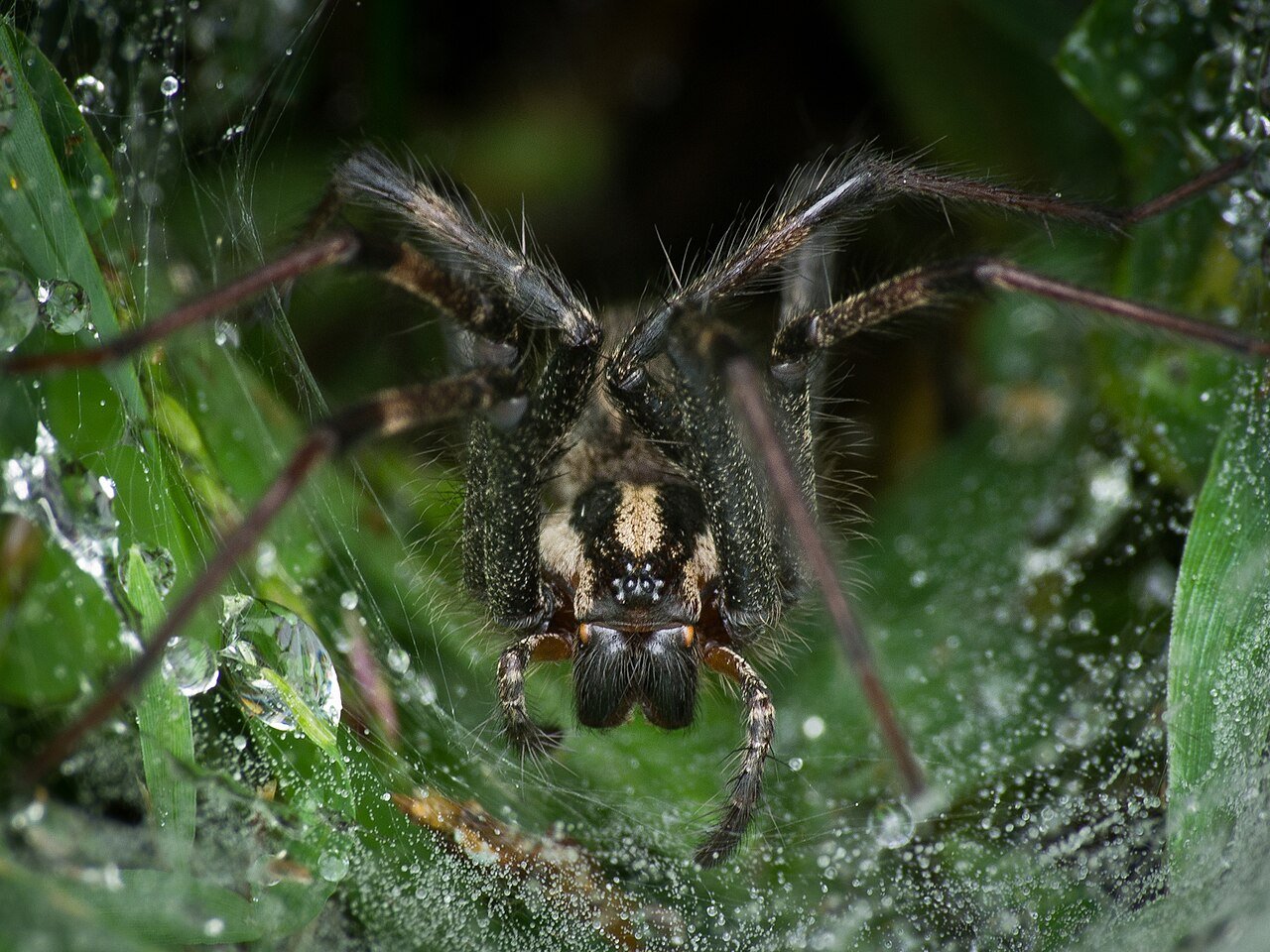
The biology runs the annual calendar the winter-spiders page maps: eggs hatch in spring, spiderlings build thumbnail sheets by June, the webs and their owners scale up all summer (unnoticed until the dew), and September delivers the double peak — maximum web size AND the mating wander, when males abandon their funnels to search for females and become the season’s door-gap walk-ins. The indoor appearances resolve accordingly: the September grass spider crossing the family room is a wandering male on his one errand (cup-and-card; he neither wants nor survives indoor residence), and the bathtub stranding runs the standard porcelain-trap physics. Frost ends every adult; the species overwinters entirely as egg sacs — disc-shaped, tucked into siding gaps, stone crevices, and thatch — and the winter sac-sweep on porch-adjacent surfaces cancels spring hatchlings by the dozen per minute of work. No colony persists, no web is rebuilt, and next September’s grid rises entirely from this year’s banked sacs — the annual-species arithmetic that makes grass spider “control” mostly a matter of waiting six weeks or sweeping one porch ceiling.
Management: the verdict for a lawn full of funnels
The formal ruling matches the family’s: no treatment for grass spiders as such, ever — the September grid is seasonal, beneficial, and self-terminating, and every funnel is clearing pests from its patch at no charge. The honest management list handles the collisions instead: door sweeps and thresholds retire the September male walk-ins (the same ground-level sealing as the wolf-spider program — one pass serves both); the winter sac-sweep on porch ceilings, shutters, and siding gaps trims next year’s foundation-adjacent density; web placement grievances (the funnel across the doorframe, the sheet on the grill cover) resolve with a broom and a day — the owner relocates rather than rebuilds contested ground; and the prey-base read applies as everywhere — an extraordinary funnel year reflects an extraordinary insect year, worth the lighting-and-moisture audit more than any spider response. Broadcast lawn treatment for grass spiders remains the wing’s standing anti-recommendation: it fires the air-defense grid to solve a six-week aesthetic. The September dew-reveal is the lawn showing its work — photograph it, walk the kids through it, and let the frost file the paperwork: (937) 569-3330 for the identifications that resist the stripes.
Frequently asked questions
Are grass spiders dangerous?
No — handled ones can nip at bee-sting-or-less grade, unhandled ones sprint away at family-record speed, and no medically significant grass spider bite exists in the literature. Their entire reputation problem is mistaken identity, dismissed by the stripes.
What is the spider with the funnel web in my lawn?
A grass spider (Agelenopsis) — tan-brown with two bold carapace stripes, banded legs, and prominent twin spinnerets, waiting in the funnel’s throat of a flat silk sheet. The September dew-morning reveal of dozens of webs is the species’ annual signature.
Is a grass spider a brown recluse?
No — the weekly false alarm dismisses in one glance: grass spiders wear bold stripes, banded legs, and twin spinnerets and live ON funnel webs; recluses are uniform tan, plain-legged, six-eyed, webless wanderers of storage zones — and rare in Ohio besides.
Is a grass spider a hobo spider?
Same family, different continent-half: hobos have plain legs and no bold stripes — and do not live in Ohio at all, per their full acquittal page. The striped, banded funnel-owner in your yard is the local cousin the internet keeps mislabeling.
Why are there so many funnel webs in my grass in September?
Peak season — the annual species reaches maximum web size exactly as cool dew makes silk visible, revealing a grid that operated unseen all summer. It is the lawn’s air-defense system showing its work, six weeks from frost’s free cleanup.
Do grass spiders come inside houses?
September males do — the mating wander sends them through door gaps on their one errand; they neither want nor survive indoor residence, and the cup-and-card (or a door sweep, preventively) closes the file. Bathtub strandings run the standard porcelain-trap physics.
What do grass spiders eat?
The lawn’s low-flying and hopping traffic — leafhoppers, crickets, moths, mosquitoes, flies — tripped by the sheet and taken in the tenth-of-a-second sprint. A funnel-rich September lawn has been running free pest control since June.
Do grass spider webs mean an infestation?
They mean a healthy annual population doing seasonal work — self-terminating at frost, rebuilt from egg sacs each spring. “Infestation” framing fits neither the biology nor the response; the honest verbs are tolerate, sweep the doorway webs, and wait six weeks.
How do I get rid of grass spiders?
Mostly: don’t — but for the collisions: door sweeps end the fall walk-ins, a broom relocates doorway webs permanently, and the winter egg-sac sweep on porch surfaces trims next year’s density. Broadcast lawn treatment fires the pest-control grid to solve a six-week aesthetic — the wing’s standing anti-recommendation.
When do grass spiders go away?
At first hard frost — every adult ends with the season, webs weather away, and the species winters entirely as banked egg sacs. The September grid is always six weeks from free, total cleanup; patience remains the cheapest product in the file.
The funnel-weaver family tree, Ohio branch
The grass spider anchors a local dynasty worth one orienting paragraph, since the family supplies half the spider wing’s caseload. Agelenopsis holds the OUTDOOR franchise — the lawn-and-shrub grid this page documents, annual and sun-loving; the giant house spider (Eratigena atrica) runs the INDOOR branch — multi-year basement residency, the bathtub legends, the hobo-accusation lightning rod; the barn funnel weaver (Tegenaria domestica) fills the intermediate niche — sheds, cellars, garages, the modest crevice-sheets nobody photographs; and the absent relative — the actual hobo — stays west per its page. Family traits run throughout: the non-sticky sheet-and-retreat architecture, the record sprint, the flee-first temperament, the harmless bite, and the chronic misidentification that keeps all three local members on the photo line weekly. Sort them by venue and tenure — annual lawn grid, perennial basement resident, modest outbuilding middle child — and the family’s entire Ohio operation resolves into three files, all acquitted, all working, and all better photographed than sprayed. The dynasty’s September dew-portrait remains the best free nature show a lawn produces; the family earned it.
The eight-county funnel report
The grid’s local weights: the big-turf counties show it best — Warren and Greene’s newer lawns and Miami and Preble’s farmstead yards float the densest September reveals, with fencerow and foundation lines carrying the heaviest sheets; the mature suburbs run strong shrub-top populations (the boxwood-sheet morning is a Kettering and Centerville classic); and the urban cores contribute the September male walk-in files that the door-sweep program retires annually. County-wide constants: the dew-morning photo submissions each September (our favorite seasonal traffic), the recluse false alarms the stripes dismiss, and the frost date that files the whole grid’s paperwork on the same mornings the mosquito page’s almanac records. One species, eight counties, six weeks — and a lawn-care note that travels: the yards that skip broadcast insecticide keep the grid, and the grid keeps the leafhoppers; the September dew shows exactly who is holding up that end of the bargain.
Stripes read, funnels credited, charges dismissed — the September architect returns to its sheet with the record cleared and the lawn’s air defense back on duty. Six weeks to frost, dozens of patches cleared nightly in the meantime, and the whole grid gone by Thanksgiving with the paperwork banked in silk discs for spring. The dew-morning was never a warning; it was an annual report — and now you can read it from the porch, coffee in hand, knowing exactly which innocent runs every funnel on the page.
The family’s other branches — the basement giant, the hobo that never was, the winter biology behind the whole calendar — wait one link away across the spider wing; the lawn’s chapter closes here, at dew height, fully credited. Sweep the doorway, keep the grid, and let September sign its own work.
Case dismissed, funnels funded, frost pending — the lawn’s best tenant keeps its lease.
See you at the next dew-morning — stripes and all.
Coffee recommended; binoculars optional.
Grid appreciated.