A big rust-red wasp is patrolling the porch ceiling, there’s a honeycomb-looking nest growing behind the shutter, and the internet has informed you — correctly, for once — that red wasps have one of the more memorable stings in the yard. Here’s the full file: what red wasps are, how to tell them from everything else reddish that flies, what that open-comb nest means for August, why they keep choosing your porch specifically, and the honest decision tree for when a nest is a leave-it, a knock-it-down-at-dusk, or a call-us situation.
What a Red Wasp Is
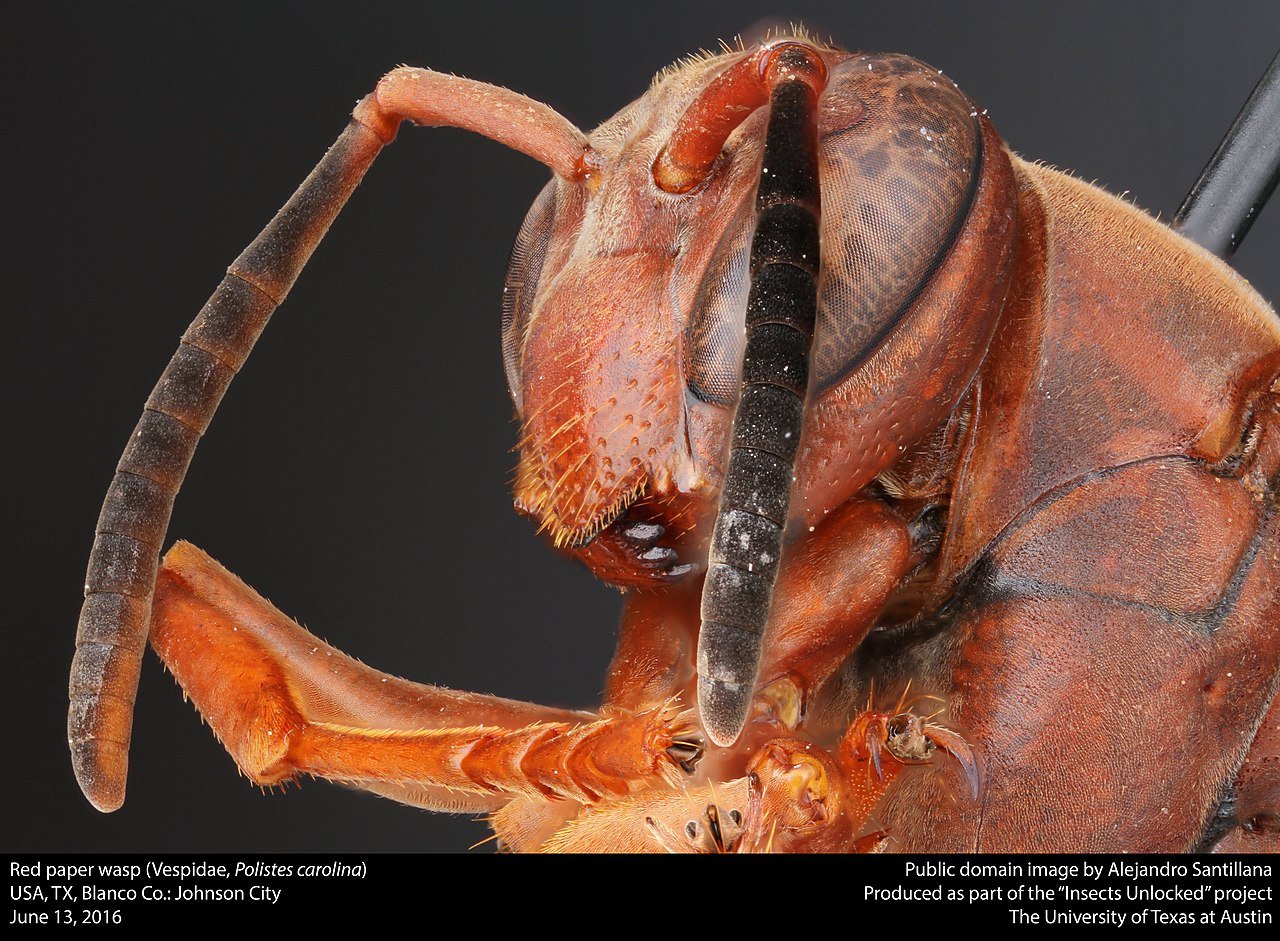
“Red wasp” almost always means one of two closely related paper wasps — Polistes carolina or its near-twin Polistes perplexus — rust-red from head to abdomen, with smoky dark wings and legs that dangle in flight like landing gear nobody retracted. At close to an inch long they read bigger than the brown paper wasps most Ohioans know, and the solid red coloring makes people assume something exotic. They’re not: they’re classic paper wasps in a red suit, with paper wasp architecture, paper wasp temperament, and the paper wasp calendar. Their heartland is the American South, but they range solidly into Ohio — the Miami Valley sits near the top of their comfortable range, and southern-facing porches around here host them every summer.
An open comb under a soffit is reachable and defended, which is the combination that sends most people to wasp and hornet removal in Dayton.
Like all paper wasps, red wasps are semi-social: a mated queen starts a nest alone in spring, raises a first shift of workers, and the colony builds through summer to a few dozen wasps — not the thousands a bald-faced hornet globe or a yellow jacket ground nest can hold. They’re predators doing genuinely useful work: caterpillars, flies, and garden pests get chewed into paste and fed to larvae all season. A red wasp nest in a tree at the property line is free pest control. The problem is purely locational — they love the same covered, sun-warmed spots you do.
The Nest: One Open Comb, No Cover
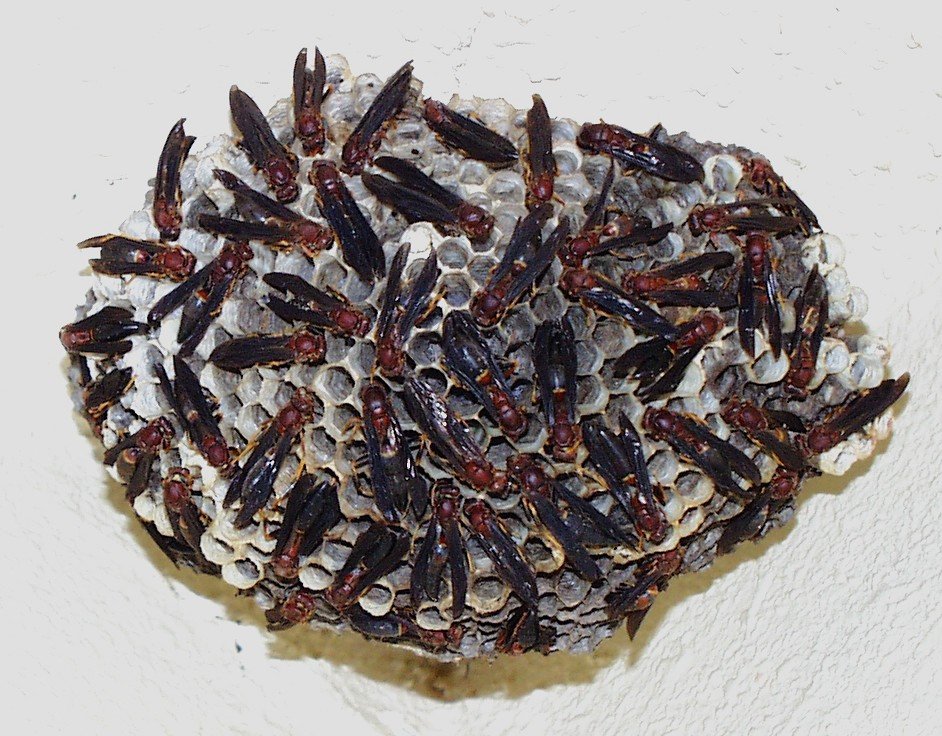
Red wasp nests are the signature paper wasp build: a single umbrella of hexagonal cells hanging face-down from a short stalk, cells exposed to view, no papery shell around anything. If you can see open comb — larvae capped in some cells, adults standing sentry on the face — you have a paper wasp of some species; if the nest is a closed gray football or globe, you’re in hornet territory and the risk math changes completely. Red wasps favor protected overhead spots with a warm exposure: porch ceilings, eave corners, behind shutters, inside grill lids and mailbox flags, deck rail undersides, shed rafters, and — the one that causes the most trouble — attic spaces reached through gable vents, where a colony can work all summer unseen.
Size tracks the calendar. A golf-ball comb with one queen in May is trivially manageable. The same nest in mid-August is a palm-sized-or-better comb with thirty to fifty defenders and a short fuse. Every step of the decision tree below gets easier the earlier in the season you walk it — which is the single most actionable sentence on this page.
The Sting: Respect, Not Panic
Red wasps sting harder than their brown cousins — consistently described as among the more painful common stings in the eastern U.S., a hot, sharp hit that settles into hours of throb and swelling. Unlike a honey bee, a red wasp keeps its stinger and can hit repeatedly, and nestmates defend the comb as a team when it’s disturbed. Two pieces of context keep this honest: away from the nest, a foraging red wasp on your flowers or your soda can is genuinely uninterested in you and stings only when grabbed or swatted; and a single sting, for the roughly 97% of people without venom allergy, is a painful afternoon and nothing more. Cold compress, an antihistamine, elevation if a limb swells, and it’s over. The emergency signs are the systemic ones — hives away from the sting site, swelling of the face or throat, trouble breathing, dizziness — and they mean epinephrine and 911, not a wait-and-see. Our wasp prevention guide covers keeping them from nesting near doors in the first place.
Red Wasp or Something Else Reddish? The Lineup
- Red wasp (red paper wasp): solid rust-red, dark wings, open-comb nest, dangling-leg flight. The subject of this page.
- Common paper wasps: brown with yellow or reddish markings, same architecture and habits, milder sting. Same playbook applies — see nest identification.
- Yellow jackets: bright yellow-and-black, compact and quick, nests hidden in the ground or wall voids rather than open combs. The late-summer picnic menace — and the more dangerous removal.
- European hornet: big, brown-and-reddish with yellow, active even after dark around porch lights; a true hornet with a covered nest in a hollow. See hornets in Ohio.
- Cicada killer: huge, black-and-yellow, burrows in bare soil, dramatic and harmless — the gentle giant that terrifies everyone in July.
- Mud dauber: slender thread-waist, builds mud tubes not paper combs, virtually never stings — full acquittal on the mud dauber page.
- Velvet ant (“cow killer”): fuzzy red-and-black and wingless, walking on the ground — actually a wasp, and the one red insect on this list with a sting worse than the red wasp’s. Meet it on the cow killer page.
The Decision Tree: Leave It, DIY It, or Call
Leave it when the nest is small and nowhere — a shed corner you visit twice a summer, a tree at the fence line, anywhere the colony’s flight path and yours don’t cross. Red wasps on caterpillar patrol are working for you, and the whole colony dies at first hard frost regardless; only new queens overwinter, and they won’t reuse the old comb.
DIY is defensible for a small early-season comb (golf ball to tennis ball, May or June) on an open, reachable exterior spot: full dusk or full dark, when the whole colony is home and sluggish; a wasp-labeled aerosol with distance range, used per label; soak the comb thoroughly; leave, don’t stand admiring; knock the dead comb down the next day so returning stragglers find nothing. No ladders — the injury data on DIY wasp work is a falls story far more than a sting story — and no improvising with gasoline, fire, or a garden hose, all of which appear in emergency-room anecdotes more often than you’d hope.
Call us for the August comb with dozens of defenders, anything requiring a ladder, nests over doorways and play areas, wasps working in and out of a gable vent or soffit gap (that colony is in the attic, and sealing the hole without killing the colony first drives them into the house), any nest near someone with a sting allergy — and any closed-globe or in-ground nest, which isn’t a red wasp problem at all but a hornet or yellow jacket one with different stakes. Our wasp and hornet service handles all of it with the gear and the exit plan, and the full wasp guide covers the season-long strategy.
Keeping Them Off the Porch Next Spring
Red wasp prevention is a March-and-April project: queens scout nest sites in the first warm weeks, and a porch that gets a hard look then stays empty all summer. Knock down last year’s combs (they aren’t reused, but their presence advertises good real estate), caulk the shutter gaps and soffit seams queens tuck into, screen gable vents from the outside, and give porch ceilings and eave corners a quick soapy wipe-down — scout queens re-inspect weekly in early spring, and a spot that keeps getting disturbed gets crossed off the list. Ten minutes of spring diligence beats an August standoff every single year. The prevention guide has the full checklist, and our Protection Plan builds the early-season eave sweep into every spring visit.
Red wasps setting up over your door — or already in the attic? Get a quote and we’ll handle it. Serving Dayton and all of Montgomery, Greene, Miami, Clark, Warren, Butler, Preble, and Darke counties.
A Season in the Life of a Red Wasp Colony
Understanding the calendar explains almost every red wasp encounter you’ll have. April–May: overwintered queens emerge from under bark and siding, scout nest sites, and found combs alone — this is the golf-ball-nest window, when removal is trivial and prevention actually works. June–July: the first workers take over construction and caterpillar-hunting while the queen settles into full-time egg laying; the comb grows steadily and defense begins in earnest. August–September: peak population and peak attitude — the colony raises next year’s queens and males now, resources tighten, and defensive range extends; this is when porch standoffs, grill-lid ambushes, and attic-vent discoveries all cluster. October: new queens mate and disappear into hibernation; the old queen, the workers, and the males all die with the frosts, and the comb goes permanently silent. Every nest you see is a single-season project — which is why timing, more than technique, decides how hard your particular red wasp story is.
One Ohio-specific note on that calendar: our warm-exposure microclimates — brick south walls, dark shutters, attic spaces over black shingles — run weeks ahead of the yard at large. The nest behind the south-facing shutter is always the biggest one on the property by August. When we do spring preventive sweeps, those hot spots get checked first, every time.
And a scale note for calibration: a mature red wasp colony tops out around thirty to fifty adults — noisy, but knowable. A bald-faced hornet globe can run several hundred; a late-season yellow jacket ground nest, several thousand. When people describe a “huge wasp problem,” the species matters more than the adjective, and it’s the first thing our inspection pins down.
Frequently Asked Questions
What is a red wasp?
A red paper wasp — Polistes carolina or its near-twin P. perplexus — rust-red with dark wings, close to an inch long, building the classic open-comb paper wasp nest. A southern-leaning species that ranges solidly into Ohio, especially on warm southern exposures.
Are red wasps in Ohio?
Yes. Their heartland is the South, but the Miami Valley sits comfortably inside their range, and sun-warmed porches, eaves, and attic vents around Dayton host colonies every summer.
How bad is a red wasp sting?
Among the more painful common stings in the eastern U.S. — a hot, sharp hit with hours of throb and swelling — and one wasp can sting repeatedly. For anyone without venom allergy it’s a rough afternoon, managed with cold compress and an antihistamine. Systemic symptoms (hives elsewhere, facial or throat swelling, trouble breathing) are the 911 signs.
Are red wasps aggressive?
Away from the nest, no — foragers ignore people. At the nest they defend as a team, and the fuse shortens as the colony grows through summer. An August comb near a doorway is a genuine hazard; the same comb in May was ten minutes of easy work.
What does a red wasp nest look like?
A single open umbrella of hexagonal cells on a stalk — no papery cover. Favorite spots: porch ceilings, eave corners, behind shutters, grill lids, shed rafters, and attics entered through gable vents. A closed gray globe is a hornet nest, not a red wasp nest.
Do red wasps do anything good?
Genuinely, yes — they’re caterpillar and fly predators that feed garden pests to their larvae all season. A nest away from human traffic is free pest control, and the whole colony dies at first hard frost anyway.
Can I knock down a red wasp nest myself?
A small early-season comb on a reachable exterior spot, at dusk, with a wasp-labeled aerosol — defensibly, yes. Skip DIY for big late-summer combs, anything on a ladder, nests over doors, and wasps entering vents or soffits (that colony is inside the structure). Falls injure more DIY wasp fighters than stings do.
Why do red wasps keep coming back to my porch?
Warm covered overhead spots are exactly what scouting queens hunt each spring. Remove old combs, caulk shutter and soffit gaps, screen gable vents, and disturb favorite ceilings in March and April — a porch that fails the queen’s inspection stays waspless all summer.
Do red wasps come back to the same nest every year?
No — combs are never reused, and only new queens survive winter, hibernating under bark and siding. But last year’s comb marks the site as proven real estate, so knocking it down (and disrupting the spot in spring) matters.