Once or twice a summer, a eight-county backyard produces the sighting that earns its own phone call: a large “ant” in blazing scarlet-and-black velvet, marching alone across the sunniest patch of lawn with the unhurried confidence of something that has never needed to run from anything. The internet identifies it instantly and alarmingly: the cow killer — reputedly able to kill livestock, reputedly among the most painful stings in North America, reputedly unkillable. This page delivers the full trial, and the verdict splits precisely: the sting reputation is real — the eastern velvet ant’s sting sits in the top tier of the famous pain indexes, a genuinely unforgettable experience — while everything else in the legend dissolves on inspection: no cow has ever been killed (the name is pure hyperbole about the pain), no nest or colony exists to defend (she’s solitary — the solitary-equals-safe theorem’s most heavily armed member), stings essentially require picking her up barefoot-or-barehanded, and the animal is not an ant at all but a wingless female wasp running one of the insect world’s most remarkable survival portfolios. The file: what velvet ants actually are and do, the armor-and-arsenal biology that made them a scientific celebrity, the sting truth and its honest care, the look-alike sorting (including the harmless males, who fly, and can’t sting — this library’s favorite recurring twist), and why the correct response to the yard’s most dramatic pedestrian is a respectful photograph. Greater Dayton Pest & Rodent: (937) 569-3330.
Not an ant: the wingless wasp’s actual biography
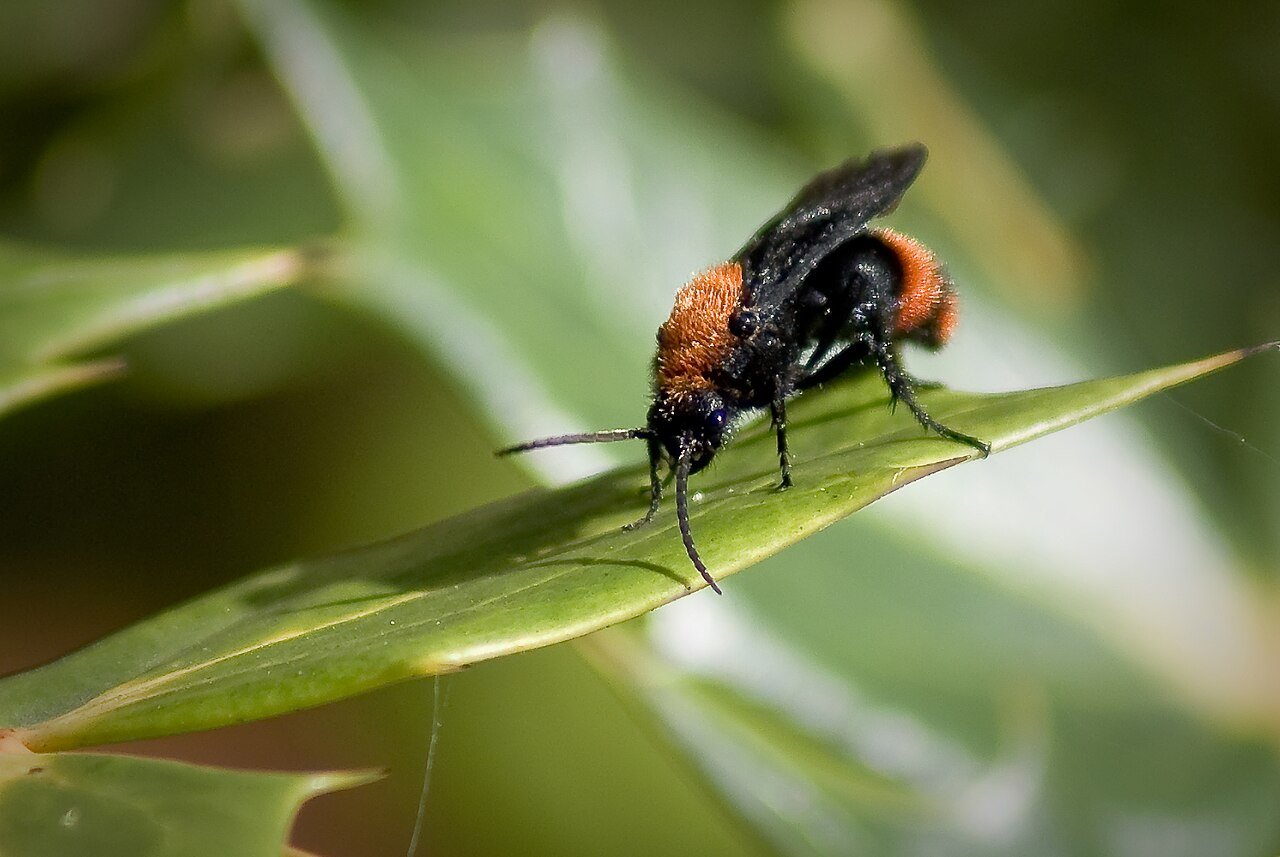
Velvet ants (family Mutillidae — several thousand species worldwide, a handful in Ohio, the inch-long scarlet “cow killer” Dasymutilla occidentalis the showpiece) are wasps whose females traded flight for armor and errand-running. The biography explains every encounter: the wingless female spends her weeks walking sunny, sandy, open ground — lawns, trail edges, the cicada killer’s exact real estate, and not coincidentally — hunting the burrows of ground-nesting bees and wasps: she slips into a host’s nest, lays an egg on the dormant larva-pupa, and her offspring consumes it — a parasitoid of the ground-nesting guild, which makes the velvet ant, in this library’s terms, a regulator of the ground-bee-and-wasp economy rather than any threat to yours. The males live the opposite life: winged, nectar-sipping, stingless — fliers over the same open ground, mistaken for the females’ predators-in-pursuit and unable to harm anything (the sex-segregated arsenal, fourth appearance in this library, streak intact). No colony, no nest of her own, no aggregation — every velvet ant is a solo operation, which is the single most important fact in the file: there is nothing to defend, so there is no defensive behavior — no swarm, no pursuit, no territorial strike; the entire sting scenario is one human hand (or bare foot) making sustained contact with one profoundly unwilling insect.
The indestructibility portfolio (why science keeps writing about her)
The velvet ant’s research celebrity rests on a documented defensive portfolio unmatched in the insect world, worth itemizing because it explains the swagger in that lawn-crossing walk: the exoskeleton — famously among the hardest ever measured in insects; the entomological literature is full of bent pins and failed mounting attempts, and predator studies record lizards and birds simply unable to crack one; the sting — the longest relative to body size of nearly any stinging insect, curved, maneuverable, and deployable at almost any angle a grip allows; the warning system — the scarlet aposematic velvet, an audible squeak (stridulation) when grabbed, and a chemical alarm note, three channels all broadcasting the same honest advertisement; the mimicry economy — dozens of velvet ant species across the continent converge on the same red-and-black uniforms in one of North America’s largest documented Müllerian mimicry rings (shared warning branding, honestly backed by every member); and the running speed that makes her hard to even redirect. Predation studies’ conclusion, roughly: essentially nothing eats an adult velvet ant on purpose twice. For the household, the portfolio’s practical translation is cheerful: an animal this well-defended has no need for a hair trigger — she wants distance, advertises honestly, and escalates only under actual grip — and the “unkillable” folklore resolves into the correct management insight: you were never supposed to be managing her at all.
The sting file: honest pain, honest odds, honest care
The pain reports are not folklore: the eastern velvet ant’s sting scores at the top of the Starr sting-pain scale and features in Schmidt-index lore with descriptions like “explosive and long-lasting” — thirty-plus minutes of genuinely severe burning is the standard account, and this library won’t soften it: it is, by consensus, among the worst stings the region can deliver. Now the rest of the file, which softens everything else: medical significance stays low — the venom is pain-optimized rather than tissue-toxic (low toxicity per the comparative literature; the agony is the strategy, damage isn’t), local swelling and hours of misery resolve without intervention in nearly all cases, and the standard escalation tier (systemic allergic signs — the anaphylaxis protocol) applies as it does to every sting at vanishing rarity. The odds file: stings require grip-contact — the barefoot step, the child’s grab, the gardener’s blind reach into the border — and Ohio case volume is accordingly tiny; our eight counties’ velvet ant file contains sightings by the dozen and stings nearly never. Care, when the odds miss: cold compress, elevation, the standard protocol, and the honest counsel that the first half hour is the sentence — it commutes on schedule. Prevention, complete: shoes on the summer lawn where one’s been sighted, the look-before-grab garden habit the widow page already installed, and the children’s briefing — “the red velvet one is look-don’t-touch” — which children, shown the animal’s warning uniform, reliably honor better than adults.
The sorting file: what the red walker might be instead
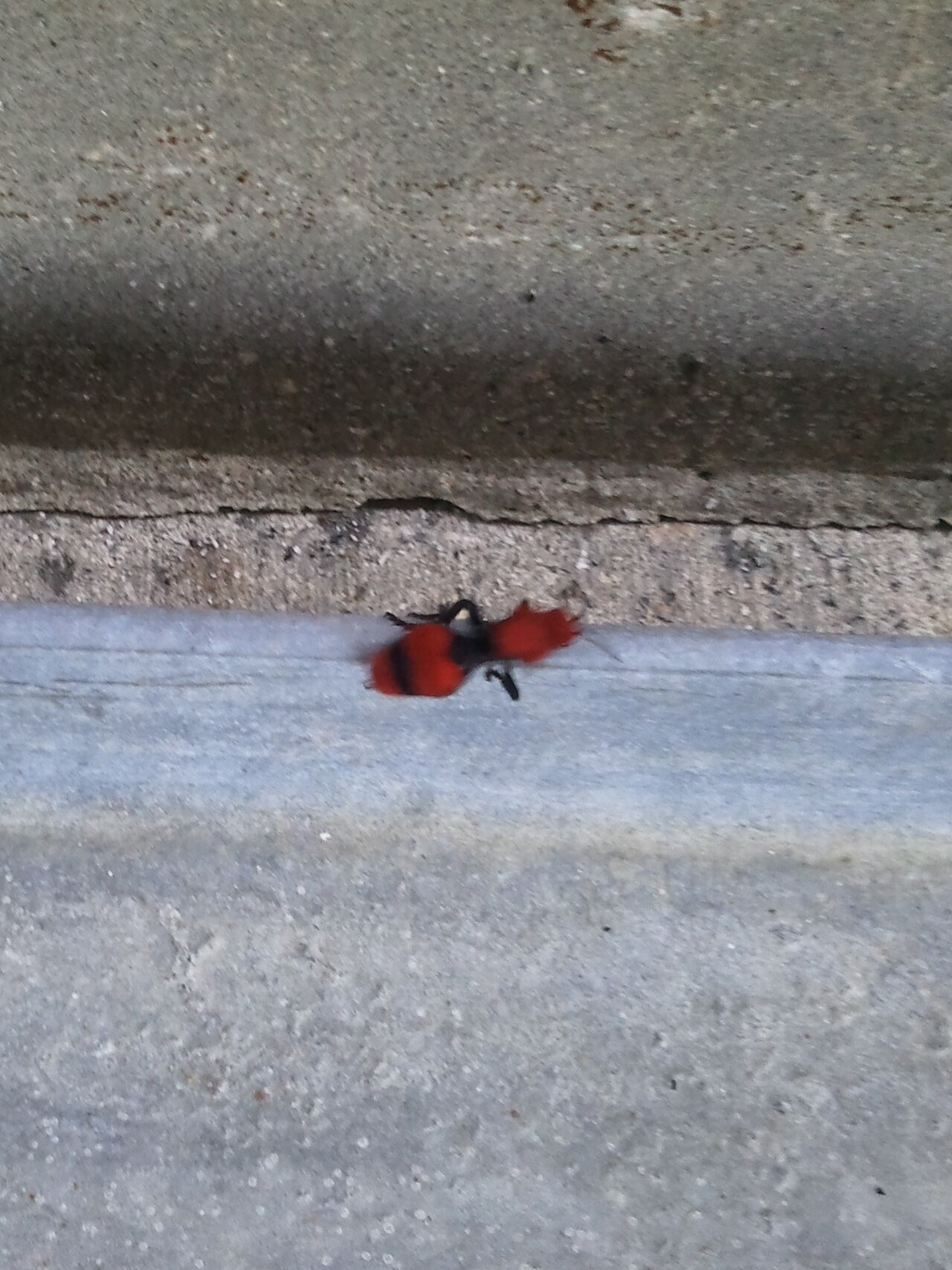
The velvet ant’s look-alike docket, since the scarlet-pedestrian report covers several animals: the winged red-and-black flier over the same lawn is most often the velvet ant’s own male — stingless, harmless, and frequently misreported as a “flying cow killer” (technically true, functionally toothless); smaller red-and-black walkers include Ohio’s several lesser velvet ant species (same rules, smaller package, milder sting) and the red velvet mite of the tiny-red-bugs page — the plush harmless wanderer a tenth the size; fast red ants in numbers route to the fire-ant sorting page (velvet ants are always alone — two together is already a different story); and the ant-mimicking spiders occasionally complete the docket for the macro-photography crowd. The two-second sort: alone, inch-scale, densely furred, walking with total confidence in open sun = velvet ant, apply the look-don’t-touch protocol and enjoy the region’s most dramatic insect sighting; anything social, smooth, or web-adjacent = a different page of this library, all of them linked from the identification bench. And the photo line’s standing offer covers the ties, with a note from the grading desk: velvet ant submissions are among our favorites all year — the animal photographs like a jewel and the news is always good.
Velvet ant questions, answered
Should I kill it? It’s near the kids’ swing set.
Relocation beats execution and takes thirty seconds: a jar or large cup herded over her (she cannot jump, fly, or climb slick plastic), cardboard underneath, and a release at the yard’s far margin — the errand she was running continues elsewhere, and the swing set’s barefoot zone returns to standard rules. Killing one is both difficult (the armor is real) and pointless (another may wander through next month regardless); the jar is faster than the shoe and teaches the household’s watchers the better lesson.
Does a velvet ant sighting mean an infestation is coming?
The opposite of an infestation is possible: velvet ants parasitize ground-nesting bees and wasps, so her presence suggests host burrows nearby — occasionally including the yellowjacket and ground-bee populations whose management pages exist for better reasons. One velvet ant is one wandering parasitoid, never a colony scout; there is no velvet ant “infestation” anywhere in the literature or our files, and the singular sighting is the complete event.
Did one really never kill a cow?
Never — no documented livestock death exists anywhere in the record; the name is nineteenth-century pain hyperbole that stuck because the sting earns vivid language. The venom’s dose and chemistry are built to teach a lesson, not end a grazer; the cows of the Miami Valley remain, as ever, entirely safe from the lawn’s scarlet pedestrian.
The verdict in velvet
The cow killer closes this library’s stinging files as its most honest member: an animal whose warning label is accurate, whose arsenal is real, and whose entire threat model requires the human to initiate — the anti-yellowjacket, armored instead of aggressive, advertised instead of ambushing. Learn the uniform, brief the barefoot season, herd the rare swing-set visitor into a jar, and award the sighting the wonder it deserves: a wingless wasp in scarlet plate, walking your lawn on parasitoid business, carrying the region’s most theatrical sting and no intention whatsoever of using it on anyone who leaves her be. For the ties, the sightings worth bragging about, and everything else red and remarkable: (937) 569-3330, Greater Dayton Pest & Rodent, Dayton and all eight counties — where the legend gets fact-checked, the sting gets respected, and the velvet gets photographed, in that order.
The mimicry ring: the region’s largest honest-advertising cooperative
The velvet ant’s scientific headline deserves its fuller telling, because it’s one of evolution’s best documented cases of cooperative branding. Across North America, researchers have mapped hundreds of velvet ant species into a handful of regional Müllerian mimicry rings — groups of genuinely defended species converging on shared warning uniforms, so that every predator’s painful lesson protects every member of the ring: the eastern red-and-black ring our cow killer anchors runs dozens of species deep, one of the largest such complexes known in any animal group. The logic is insurance economics written in exoskeleton — a shared brand spreads the cost of predator education across the membership — and it’s the honest inverse of the mimicry this library usually documents: where the hover flies and clearwing moths wear stinging uniforms they can’t back (Batesian freeloaders on the bees’ brand), every member of the velvet ring pays full freight. The household relevance is the takeaway this library keeps circling: warning coloration in the yard is information, not aggression — the animals that advertise loudest are, almost uniformly, the ones with the least interest in spending their defenses, because honest advertising exists precisely to avoid the encounter. The lawn’s scarlet pedestrian is the principle’s most vivid local instructor; the correct tuition is a photograph and a respectful step aside — the same fee this entire library has charged for every lesson worth keeping.
A eight-county sighting diary
The local velvet ant year, from the photo line’s archive: sightings run June through September, peaking in the July-August heat that suits both the wandering females and the ground-nesting hosts they hunt; the reports map to sunny, sandy, open ground — the river-terrace lawns of the Great Miami corridor (the same glacial outwash that hosts the cicada killer aggregations — parasitoid and host sharing an address, as ecology likes it), the trail edges and campground margins of the Little Miami valley, the farm-lane shoulders, and the sun-baked play-yard sand that generates the swing-set calls. Volume stays low — single-digit confirmations most summers, each one photographed like a celebrity — and the sting file stays effectively empty, which is the whole legend’s local epitaph: the region’s most feared “ant” produces annually more wonder than welts, by a margin of roughly everything to nothing. Watch the sunny margins in high summer, keep the barefoot rule where one’s been seen, and send the photo — the grading desk’s favorite subject walks only a few times a year, and every appearance improves the archive.
The pain scales, visited honestly (the section the curious came for)
Since the cow killer’s celebrity runs through the famous sting indexes, the honest tour: the Schmidt pain index — entomologist Justin Schmidt’s four-point scale, built from personal experience across hundreds of species and written with a wine-critic’s vocabulary — anchors the genre; the Starr scale runs the parallel rankings where the eastern velvet ant takes its top-tier placement. The regional leaderboard, for context: the velvet ant’s “explosive, long-lasting” burn out-scores the bald-faced hornet and yellowjacket tier, which in turn out-scores the honeybee benchmark, with the daubers and sweat bees rounding the bottom — and the crucial inversion this page exists to install: the leaderboard runs backward from actual risk. The region’s most painful sting belongs to its least likely stinger (solitary, honest, contact-only), while the medically consequential events belong to the modest mid-table (the colony defenders whose alarm pheromones multiply one sting into dozens, and whose anaphylaxis file is the region’s one genuine emergency tier). Pain and danger, once again, refuse to correlate — the library’s oldest lesson, here at its most quotable: fear the average yellowjacket more than the legendary velvet, and handle neither, and the whole leaderboard stays trivia. Which is where it belongs: recited at the barbecue, respected on the lawn, and experienced — ideally — by Schmidt alone, who did it so nobody else has to.
The scarlet postscript
One closing scene, because the velvet ant earns the library’s best sendoff: somewhere in the eight counties this week, on a sun-struck strip of lawn between the sidewalk and the sprinkler’s reach, an inch of scarlet armor is crossing open ground at her own unbothered pace — carrying the region’s most theatrical sting, the insect world’s hardest shell, a warning uniform honored by every predator that ever tested it, and an errand list that concerns only the burrows of other wasps. She will not chase anyone. She cannot fly. She has no nest, no colony, no grievance, and no interest in the household watching from the porch — and if left exactly alone, she will finish her crossing, complete her strange solitary work, and exit the yard’s story having contributed one spectacular sighting and zero incidents, which has been her species’ complete record here for as long as anyone’s been keeping one. The cow killer never killed a cow; the legend never survived a fact-check; and the lawn’s most dramatic pedestrian remains what she’s always been — the best free show in August, in velvet, at walking pace. Look, don’t touch, photograph, brag: the complete protocol, and the last word in scarlet.
Armored, honest, alone, and thoroughly done being slandered: the velvet verdict stands — top of the pain charts, bottom of the risk table, and first on the summer’s must-photograph list. Case closed in scarlet, with the jar-and-cardboard option standing by for swing-set diplomacy.
Three pages remain in the library’s current wing: the boxelder bugs, the phorid flies, and the tiger-striped mosquito — the season’s last three files, opening now.
Frequently asked questions
What is a cow killer ant?
Not an ant at all — the red velvet ant is a wingless female wasp in dense scarlet-and-black fur, famous for one of the most painful stings in North America. The “kills cows” name is pure folklore; the sting is agony-grade, not livestock-lethal.
How bad is a cow killer sting really?
Top-tier on every pain index — a burning, throbbing half hour that earns the legend honestly — but medically modest: low venom volume, minimal systemic risk for non-allergic people. It is pain theater backed by little actual danger, delivered only when handled or stepped on.
Will cow killer ants infest my house or yard?
Neither — velvet ants are solitary parasites of ground-bee and wasp burrows, wandering through rather than residing. Seeing one means walking on; seeing several across a summer means your soil hosts the ground-nesting bees they parasitize.
What should I do if I see one?
Look, enjoy, and leave it — the scarlet fur is a legitimate wildlife sighting. Keep bare feet and curious kids from grabbing it (the entire injury file is handling), and skip any treatment: there is no colony to treat.
Why is it called an ant if it’s a wasp?
The females are wingless and ant-like at a glance — the “velvet ant” misnomer stuck centuries ago. Males fly, look waspish, and cannot sting; females walk, look ant-ish, and absolutely can.
Can cow killers sting through shoes?
No — and that is the practical protection: footwear in barefoot-risk areas during late-summer wanderings. The stinger is long for an insect but no match for a sole.
Do cow killer ants come in groups?
Never — strictly solitary. Multiple sightings mean good parasite habitat (sandy soil, ground-bee aggregations), not a nest. There is no velvet ant infestation anywhere, ever — the concept does not apply to the species.
What do velvet ants eat?
Adults sip nectar; larvae parasitize the pupae of ground-nesting bees and wasps — the female digs into host burrows to lay. Their presence is downstream of the mining-bee populations our ground-bee page acquits.
Are they dangerous to pets?
A pawing dog can take the legendary sting — a dramatic yelp-and-limp event that resolves like a bad bee sting. Vet attention for the rare allergic reaction; otherwise cold compress duty and a lesson the dog remembers.
Do you treat for cow killer ants?
No treatment exists or is needed — but we happily ID your photo (the scarlet fur makes it the easiest call of the week) and check whether the “ants” that worried you are actually a treatable file wearing a costume: (937) 569-3330.