
The centipede page promised its slow cousin a fuller hearing, and the search volume agrees: millipedes in the house — the coiling brown cylinders on the garage floor after rain, the wet-spring carpets of them at the walkout door, the “are millipedes poisonous / do they bite” questions that ride every discovery — earn the complete file this page delivers. The verdicts, front-loaded per house style: millipedes cannot bite (no biting mouthparts exist anywhere in the class — they’re detritus-grazers to the last segment), “poisonous” mis-frames their one real chemistry (defensive secretions that can irritate skin and absolutely offend taste — the wash-hands-after rule, not a venom file), indoor millipedes are already dying (the moisture leash the basement wing perfected — they desiccate indoors in days, and the “infestation” is a doorstep event, never an establishment), and the mass migrations are weather — the astonishing wet-season surges with their own section below, alarming by census and self-resolving by physics. Plus the counts the searches love (how many legs, really), the centipede fork restated from the slow side, and the door-line program that converts every future migration into a sweeping job. Greater Dayton Pest & Rodent: (937) 569-3330.
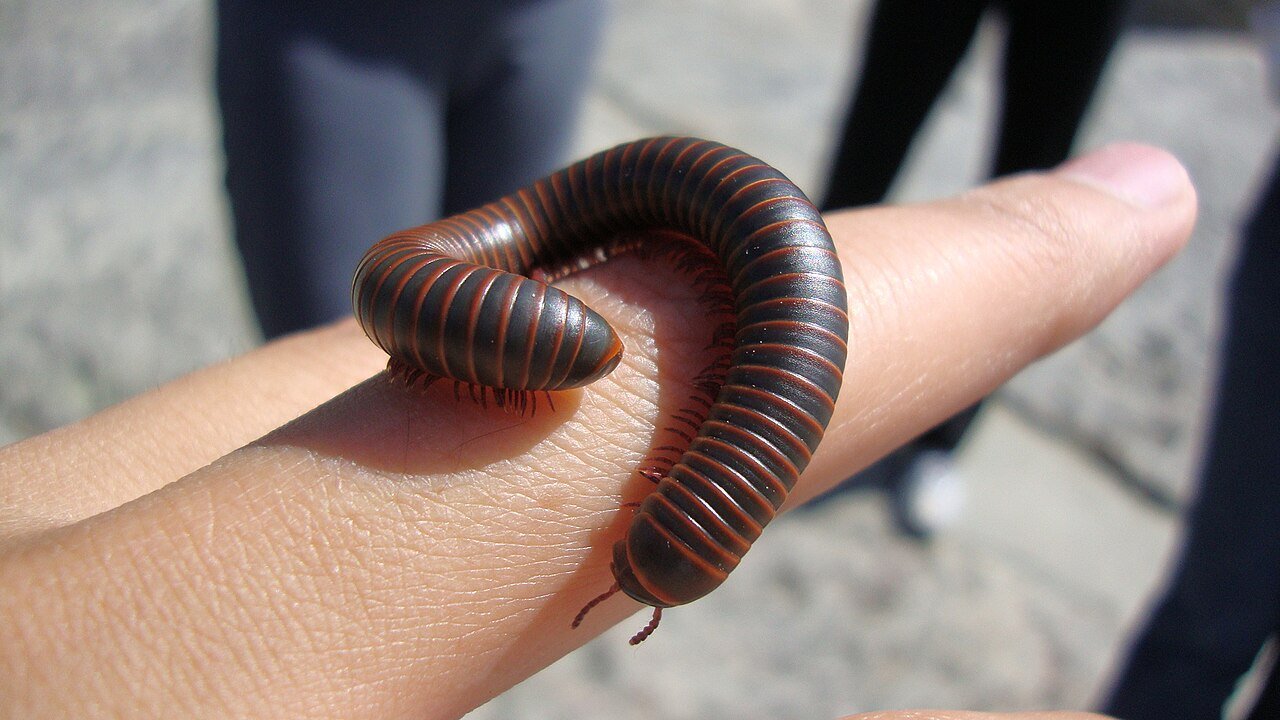
Meet the class: legs, coils, and Ohio’s roster
Millipedes (Diplopoda — “double feet,” for the two leg-pairs per segment that separate them from every centipede’s one) are the soil economy’s armored composters: cylindrical, slow, hard-shelled grazers of leaf litter and decaying wood, running the isopod guild’s job description at greater length. The leg arithmetic the searches request, honestly: no common species reaches a thousand (the world record — a rare Australian deep-soil species — finally cracked it in 2021 at 1,306, a genuine scientific event); Ohio’s residents run 30-to-400 legs by species and age (they add segments and legs at each molt — the household’s specimens are all works in progress). The local roster: the ubiquitous garden millipedes (inch-long, brown, the migration-event crowd), the greenhouse millipede (the flatter-backed import massing in mulch and pots — the flowerpot stowaway of the quarantine doctrine’s files), and the showpiece: the American giant millipede — four inches of glossy maroon-banded armor, the woodland walker whose fingertip portraits anchor this page’s photography and whose docile bulk makes it the class’s best ambassador (handled gently and hands washed after, per the chemistry section — the trail-walker’s classic encounter from Caesar Creek to the covered-bridge woods). The fork from the fast cousin, restated once: coil-and-slow = millipede (this page’s gentle file); sprint-and-flat = centipede (the predator’s page); and the two share only the basement wing’s moisture leash — which writes, as ever, the whole management story.
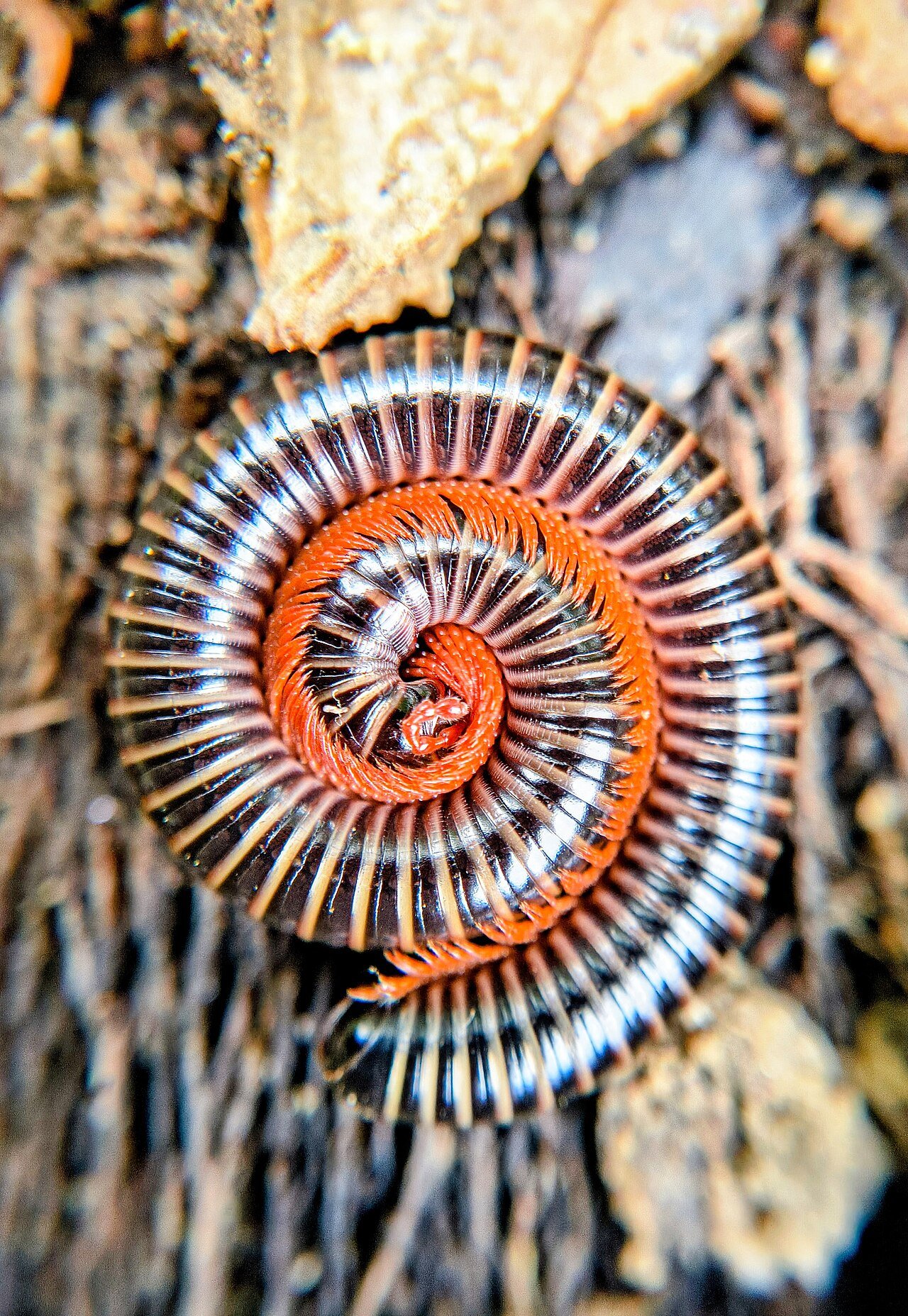
The chemistry file: “poisonous” sorted honestly
The class’s one genuine defense earns precise handling, because “are millipedes poisonous” conflates three claims. Venom: none — nothing in the class injects anything; the bite question closes at the mouthparts (grazing surfaces, incapable of piercing skin). Contact chemistry: real and modest — many species’ flank glands secrete defensive compounds (benzoquinones and, in some lineages, trace hydrogen-cyanide precursors — the almond note naturalists report from handled specimens is genuine chemistry, not folklore), which at Ohio-species concentrations can stain and mildly irritate skin, genuinely irritate eyes, and reliably teach dogs the one-taste lesson the boxelder’s drooling-regret face made famous. The protocol: handle gently or not at all, wash hands after, keep fingers from eyes, and rinse a curious pet’s mouth — the complete medical file, tropical giants excepted (the pet-trade’s large African species run stronger secretions; standard exotic-husbandry rules apply). Ingestion: self-limiting — the taste enforces its own rarity. The frame that files it correctly: millipede chemistry is a predator-education budget, spent on shrews and beetles and the occasional Labrador, never an offensive capability — the honest-advertising economy’s humblest member, defending four hundred million years of composting with a bad flavor and a coil. Wash the hands; skip the worry; the class’s entire threat model just fit in a paragraph.
The migration events (when the yard walks)
The page’s dramatic section, because the events genuinely astonish: under the right wet-season conditions — saturated soils after sustained rain, or paradoxically the drought-flight when baked ground expels its populations — regional millipede populations mobilize simultaneously, and the household experiences the census: hundreds-to-thousands crossing patios, carpeting garage floors, massing at walkout doors and window wells overnight, occasionally making regional news when the numbers reach the swept-with-shovels tier (the historical literature’s train-stopping migrations — rails greased by the crossing — are documented fact, and the family’s favorite party citation). The mechanics defuse the alarm: migrations are displacement, not invasion — the population was always there, processing the yard’s leaf-fall invisibly at soil level, and the weather simply surfaced it in motion; the travelers seek shelter and moisture, sample the doorstep, and either move on or desiccate where they wandered in (the curled gray commas along the baseline — the isopod page’s landing-party ending, at greater length); and the event exhausts itself with the weather that launched it, days-to-two-weeks by the case files. The response scales accordingly: sweep, don’t spray (the standing verdict — treating a weather event chemically is the library’s definition of billing the rain), shop-vac the volume cases, mind the crush-stain rule on light flooring (the secretions mark — the broom beats the boot), and bank the event’s real payload: a migration is the yard’s loudest possible announcement of the door-line gaps the next section closes.
The door-line program (the whole fix, one Saturday)
Millipede management is the basement wing’s program aimed at grade level, and it converts every future migration into a non-event. The sweep-and-seal tier: door sweeps on every ground-level entry (the walkout, the garage’s person-door and the main door’s corner gaps — the $12 fix’s fourth constituency), the garage-door bottom seal renewed (the class’s widest entrance in most homes), thresholds caulked at their corner failures, and the window wells covered or cleared of the wet leaf-pack that stages them. The moat tier: the foundation’s vegetation-free gravel band — now serving its fifth constituency — with the mulch economics stated plainly for the class that lives in it: mulch IS millipede habitat (moist, organic, decaying — their exact job site), so the six-inch pullback from the foundation line converts the bed from on-ramp to neighborhood; deep-mulch renovations (the volcano beds) trade drama for drainage everywhere the wing has audited. The moisture tier: downspouts and grading moving storm water off the foundation (migration pressure tracks soil saturation — the drainage fix is literally migration prevention), and the below-grade humidity program standing per the wing’s constitution for the walkout-basement cases. The interior tier: nothing — the honest entry, one more time: indoor millipedes are dying of dryness on arrival, interior treatment addresses a corpse-in-progress, and the vacuum concludes what the desert already decided. One Saturday, five constituencies served, and the next wet September’s thousand-leg census happens on the far side of a swept threshold — visible, harmless, and outside.
Millipede questions, answered
Hundreds appeared in the garage overnight. Emergency?
Weather event — the migration file above: sweep or shop-vac the arrivals (outside, per the bag-emptying rule), note the entry lines for Saturday’s seal work, and expect the event to exhaust with the weather inside two weeks. The census is a gift disguised as a mess: no cheaper entry-audit exists than a thousand slow surveyors marking every gap in chalk-line formation.
Do millipedes damage plants, foundations, or anything at all?
The garden’s file mirrors the isopod verdict: decay first, always — with the same wet-spring seedling asterisk (soft sprouts and strawberry undersides in heavy years, answered by the same collars, straw and board traps, never chemistry). Foundations, wood, fabric, stored goods: untouched — the class eats what’s already decomposing, and sound structure holds no menu. The yard’s ledger runs positive by pounds of processed leaf-fall; the house’s runs neutral minus one sweeping.
Millipede or wireworm/cutworm in my garden soil?
The turn test: millipedes coil at disturbance; wireworms (click-beetle larvae, the amber jointed cylinders) flex stiffly; cutworms (the bench’s seedling-clippers) curl soft and C-shaped. Legs settle ties — the millipede’s fringe versus the larvae’s six-or-none — and the verdict routes the response: coilers get relocated to the compost with thanks; the larvae get the bench’s protocols.
My kid wants to keep the big one. House rules?
The jar-keeper doctrine’s gentlest case: the American giant is a beginner-friendly terrarium resident (damp substrate, leaf litter, cucumber slices, years of tenure), with the wash-hands rule as the entire safety briefing and the native-release option always open. Between the hisser, the jumper and the giant, the library has quietly assembled a starter zoo — the conversion-to-curiosity business model, shelf by shelf.
The verdict at the threshold
Millipedes in the house, completely filed: a biteless, ancient composting class whose indoor appearances are weather-driven, self-terminating doorstep events; whose one chemistry earns a hand-wash and nothing more; whose migrations are the yard’s soil census surfacing in motion; and whose management is a door sweep, a gravel band, a downspout and a broom — the basement wing’s program at grade, serving its fifth constituency for the same Saturday it always cost. Sweep the events, seal the lines, mind the mulch, and let the coilers keep the leaf-fall economy they’ve run since before the first forest finished falling. For the migration-scale events, the entry audits and the coil-or-sprint photos: (937) 569-3330, Greater Dayton Pest & Rodent, Dayton and all eight counties — where the slow cousin gets the same fair reading as the fast one, and the threshold, at last, gets its sweep.
The oldest walker (a science panel for the class that invented land legs)
The millipede’s deep résumé outranks even the wing’s other ancients, and the panel writes itself: the fossil record’s first known land animal is a millipede — Pneumodesmus, from Scotland’s Silurian rocks, the earliest direct evidence of air-breathing life on land — making the class the literal pioneer of every terrestrial story this library tells; its Carboniferous cousin Arthropleura ran the pioneer franchise to its limit at over two meters (the griffinfly-era oxygen economy’s ground division, and the honest owner of the “giant prehistoric bug” legends the roach bracket re-assigned); and the modern class’s quieter records round the panel — the 1,306-leg Australian champion, the bioluminescent Sierra species that glow warning instead of tasting it, and the cyanide-chemistry lemur spa: Madagascar’s black lemurs deliberately agitate millipedes and anoint themselves with the secretions as insect repellent, primatology’s favorite example of animal self-medication and the single best cocktail-party return this page’s subject will ever pay. The household translation of four hundred million years: the coiling cylinder on the garage floor is the land’s original resident running the land’s original job — decay into soil, forest into future — and the doorstep misunderstanding is, at geological scale, a rounding error in the longest tenancy on Earth. Sweep with respect; the pioneer earned it.
The wet-season calendar (when the marches run)
- March–April: the thaw-and-rain surges — saturated soils surface the winter’s population; garage floors and window wells collect the first landing parties; the Saturday seal work, done now, pre-empts the whole year.
- May–June: garden season’s seedling asterisk in wet years (collars and straw per the isopod playbook); the greenhouse millipede’s flowerpot imports peak with planting — quarantine the flats.
- July–August: the drought-flight exception — baked soils expel populations toward irrigated beds and foundation shade; the moat and mulch-pullback earn their summer keep.
- September–October: the classic migration window — peak populations meet fall rains, and the year’s biggest marches run exactly as the fall-invader season opens (one more constituency for the same caulk line, same fortnight, same Saturday).
- November–February: the class winters deep in soil and leaf-pack; indoor sightings drop to the stray heated-space wanderer; the file sleeps with the yard.
- Always: sweep-don’t-spray, wash-after-handling, and the migration-as-audit rule — every march maps the gaps, free of charge, in slow motion.
One calendar, five seasons, zero emergencies — the marching class’s whole year, scheduled around a broom and a caulk gun. The rain runs the events; the threshold decides the venue; and the household that sealed in March watches September’s census from the dry side, counting legs for sport.
An eight-county march report
The local files: migration events cluster in the walkout-basement suburbs (the patio-door threshold is the county’s premier march venue — Beavercreek and Centerville’s wet-September case files lead), the mulch-generous garden districts (the volcano beds’ drama, renovated one consultation at a time), and the river-and-woods addresses whose leaf-fall economies run the region’s deepest populations — the levee towns’ flood-year surges and the farm belt’s barn-apron carpets both filed under weather, swept accordingly; the giant-millipede sightings pepper the trail systems’ photo submissions each summer, graded with the fingertip-portrait enthusiasm they deserve. The resolution ledger completes the wing’s pattern: sweep-and-seal closes the files, the drainage finds pay the occasional real dividend, and the spray-request conversions — households talked out of treating rain — run as this page’s standing service. The marches keep their calendar; the thresholds keep their sweeps; and the land’s first walker keeps walking, mostly outside, exactly as four hundred million years of practice suggests it will.
Two legs per segment, one coil per threat, four hundred million years per tenancy — the slow cousin’s file closes beside the fast one’s, and the many-legged wing stands complete: centipede acquitted as predator-staff, millipede acquitted as pioneer-composter, and both managed by the same threshold Saturday the whole basement corps co-signed. The marches will run again with the September rains; the door sweep will hold; and the garage floor’s next coiled comma will read, at last, as what it always was — a slow surveyor from the oldest firm on Earth, marking one more gap for the caulk gun, then curling politely around its own conclusion. Sweep, seal, respect: the whole file, three verbs, filed.
The many-legs master key (both cousins, one card)
- Fast, flat, legs held wide, sprints from light: house centipede — the basement’s predator-staff; census what it hunts, dry the theater, thank the hunter.
- Slow, round, legs tucked under, coils at a touch: millipede — this page’s composter; sweep the event, seal the line, wash after handling.
- Many small ones after rain, dying along the baseboard: the migration’s landing party — weather, broom, Saturday’s gap list.
- In the flowerpot: greenhouse millipede via nursery import — the two-week quarantine’s constituency; dry the pot per the gnat protocol.
- Four inches, maroon-banded, on a trail: the American giant — photograph, admire, optionally adopt per the jar-keeper doctrine.
- Anything jointed, amber and stiff in garden soil: not this family — the wireworm-and-larvae differential routes to the garden bench.
- Every tie: the coin-scale macro to the line — coil-or-sprint grades in seconds, free as always.
One card, two ancient cousins, seven verdicts — the many-legged question, permanently sorted at a glance, and the library’s leggiest wing closed with every appendage accounted for.
Coil filed, sprint filed, thresholds swept: the land’s first walker rests its case.
Millipedes in Ohio: the species and the season
Ohio millipedes are almost entirely a nuisance of timing rather than of damage. The common ones here are the American giant millipede, Narceus americanus, which is the thick brown-black cylinder several inches long that turns up on patios, and a range of smaller greenhouse and woodland millipedes an inch or less in length that are the ones people actually find indoors by the dozen. All of them are detritivores, feeding on decaying leaf litter and damp wood, and none of them bite, sting, or damage a structure.
The Ohio calendar is what makes them memorable. Millipedes migrate in numbers twice a year, and both migrations are moisture events rather than temperature events. The autumn movement, typically September into October, is the big one: as leaf litter dries and nights cool, populations that spent the summer in mulch and lawn thatch move en masse, and anything in their path with a gap at ground level receives some of them. The spring movement in April and May is smaller and happens when saturated soil after heavy rain drives them upward and outward.
The other reliably Ohio detail is that millipedes die indoors, quickly. Your basement is far too dry for an animal built for saturated leaf litter, so the ones that get in have a lifespan measured in a day or two, and the classic experience is not a live infestation but a line of curled dead millipedes along a basement wall or in a window well every autumn. That is a sealing and grading problem, not a pest population, and it is why spraying the inside of the house accomplishes so little.
What attracts millipedes, and what to do about it
Moisture, decaying plant matter, and a gap. That is the whole list, and it is the same list every year. Millipedes are drawn to the damp organic layer directly against a foundation, which in most Miami Valley yards means the mulch bed, and then they follow that damp band along the wall until they find a way through. They are not attracted to your house, to light in the way moths are, or to anything inside; they are attracted to the conditions along the outside of it and then they blunder in.
The fixes are all outdoors and all mechanical. Pull mulch back to leave a few inches of bare, dry soil against the foundation, and keep the mulch layer to two or three inches rather than the six that has accumulated over several seasons. Rake leaf litter away from the wall in autumn before the migration rather than after. Get downspouts discharging well away from the foundation. Clear window wells and consider covers. Move firewood, landscape timbers, and stored lumber off the ground and away from the house. Cut back groundcover that holds a permanently damp mat against the siding.
Then close the gaps, which is the step that actually stops them entering: door sweeps on every exterior and garage door, weatherstripping on thresholds, sealant around utility penetrations, sill plate gaps, and basement window frames. A millipede cannot chew, so a genuinely sealed opening is a permanent solution rather than a seasonal one. Our fall invaders guide covers the same exclusion work for the other autumn arrivals, and doing it once handles all of them.
Interior sprays are near the bottom of the list for a reason. The animals coming in are already dying of desiccation, so a residual barrier inside the basement changes the outcome very little and treats a symptom that resolves itself. If treatment has a role here it is an exterior perimeter application timed to the autumn migration, applied alongside the sealing rather than instead of it.
Frequently asked questions
Why are millipedes in my house?
Weather refugees — millipedes live in outdoor leaf litter and mulch, and heavy rains (flooding them out) or droughts (drying them out) push migrations under doors and through foundation gaps. Indoor millipedes are dying tourists: interiors are too dry for them to survive more than days.
Are millipedes harmful?
No bites, no stings, no damage — their entire defense is curling into a coil and, in some species, secreting a mildly irritating fluid that can stain and warrants hand-washing after handling. The response they earn is a dustpan, not a treatment.
What is the difference between millipedes and centipedes?
Build and speed: millipedes are slow, rounded, coil-when-touched detritus-eaters with two leg pairs per segment; centipedes are fast, flattened predators with one. Slow-and-coiling = harmless composter; fast-and-flat = harmless hunter. Neither file is dangerous.
Why do I find dead curled-up millipedes everywhere?
Desiccation — the migration that entered during last week’s weather died of dryness within days, leaving the coiled shells along baseboards. Vacuum and note the entry side of the house; the bodies map your door gaps.
How do I stop millipede invasions?
Seal the grade-level routes (sweeps, thresholds, foundation seams) and thin the outdoor habitat: mulch pulled back to a dry band, leaf litter cleared from the foundation line, downspout swamps drained. The moat strategy again — millipedes cannot cross dry exposed ground in numbers.
What attracts millipedes to a house?
Moist organic matter against the structure — deep mulch, compost edges, leaf drifts, dense groundcover — plus damp basements offering brief indoor refuge. The wetter the foundation line, the bigger the standing population waiting on the next weather trigger.
Do millipedes breed indoors?
Essentially never — they need soil moisture and organic matter interiors lack. Every indoor millipede arrived recently from outside, which is why exclusion plus habitat management is the entire program and indoor spraying is pointless.
Why do millipede invasions happen in fall?
The season stacks triggers: rain cycles, cooling nights, and litter-fall all mobilize the population while doors leak warm air advertising shelter. September–October millipede waves are the terrestrial version of the fall-invader flights — and the same August sealing prevents both.
Are millipedes good for anything?
Genuinely — they are the recycling crew, converting dead leaves to soil at compost-accelerating rates. In the yard they are wanted; the management question is only the fifty feet nearest your doors.
When do millipedes warrant professional help?
Recurring mass invasions — some properties’ grading and habitat produce thousands-strong migrations — respond to the perimeter band treatment plus the drainage-and-mulch consult: (937) 569-3330. A dozen stragglers after a storm just need the dustpan and the door sweep.