Two spider searches arrive from Ohio window sills all summer, and they’re usually the same animal: “jumping spider ohio” and “black and white spider ohio” — both pointing, in the great majority of cases, at the bold jumping spider, the fuzzy black-and-white charmer with iridescent green fangs that watches you back, tilts its head, and has single-handedly converted more arachnophobes than every nature documentary combined. This page is the jumping spider family’s complete Ohio file: the bold jumper and its local relatives, the vision-and-leap biology that makes them the internet’s favorite arthropods (eyesight rivaling a cat’s, jumps planned like chess moves, and documented curiosity about humans that borders on rude), the bite question answered at the family’s usual stakes (essentially none), and the adjacent searches this page adopts on the way: the white spiders of Ohio flower heads (a different family with a color-changing trick), the “are spiders cold-blooded” classroom question (yes, with a fascinating asterisk), and the “tarantulas in Ohio” rumor (no — with one furry look-alike responsible for the annual reports). The spider wing’s architecture triage closed the fear files; this page closes the wing with its friendliest resident. Greater Dayton Pest & Rodent, photo verdicts free and — for this species — frequently accompanied by congratulations: (937) 569-3330.
Meet the bold jumper (and the family’s Ohio roster)
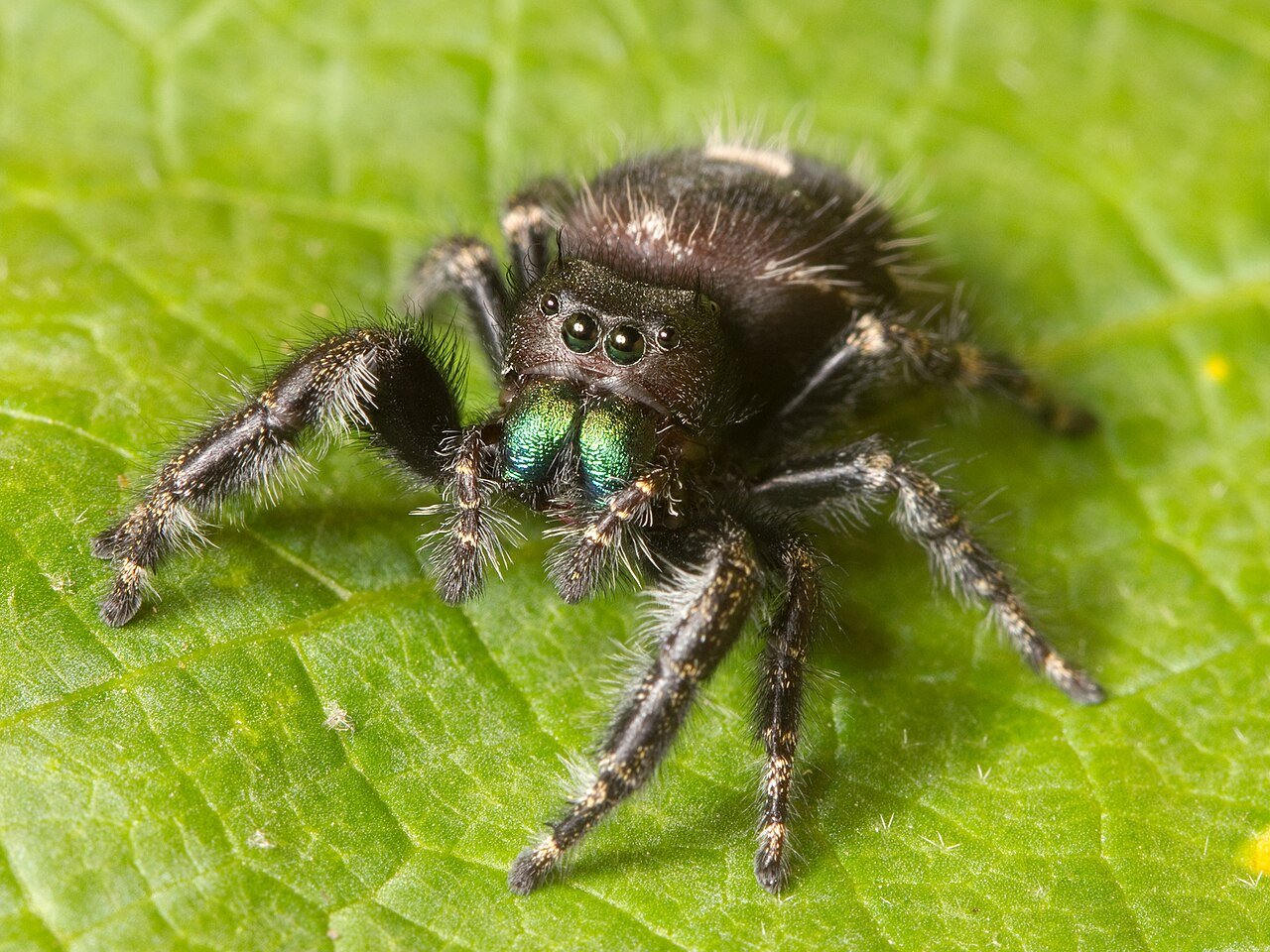
The bold jumping spider (Phidippus audax — the species name means exactly what it looks like) is a half-inch of dense black fuzz with a signature white triangle-and-dots pattern on the abdomen, white-banded legs, and the detail every close look rewards: iridescent metallic-green chelicerae — the fang bases — flashing like jewelry under any light. It’s the “black and white spider” of nearly every Ohio windowsill search, found on fences, siding, garden stakes and sunny interior sills statewide, and it anchors a local family roster worth knowing: the tan jumping spider (the bark-colored one on tree trunks and porch posts, master of the sideways shuffle), the zebra jumper (the tiny black-and-white-striped window specialist — the “little striped spider watching me do dishes”), the emerald jumper of grassy margins, and Phidippus cousins in various red-marked editions that occasionally trigger widow double-takes (fuzz settles it instantly — widows are glossy, jumpers are teddy-bears). Family field marks, universal: the compact, boxy build; the stop-motion gait — short runs, dead stops, quizzical pivots; no webs beyond a silk sleeping bag in a corner; and above all the face — two enormous forward headlight eyes in a flat-fronted head that produces the family’s celebrity: eye contact. A spider that visibly notices you, turns to track your movement, and occasionally leaps onto the phone photographing it is a jumping spider, full stop — nothing else in Ohio behaves remotely like it.
The biology that earned the fan club
The jumping spider’s internet stardom rests on measurable superlatives. The eyes: the family’s eight-eye array centers on two enormous anterior median tubes working like telephoto cameras — among the sharpest vision per body size in the animal kingdom, resolving detail at distances hundreds of body-lengths out, with recent research adding color vision via retinal filters and the ability to track moving objects (laser-pointer studies with jumping spiders are a genuine laboratory genre, and exactly as charming as they sound). The jump: no spring-loaded legs — jumpers launch hydraulically, pressurizing leg fluid for takeoffs of ten-to-forty body lengths, always anchored by a silk dragline paid out mid-flight (the bungee that lets a missed leap become a rappel — watch one jump off a fence post and climb its own line back up, and the day improves). The planning: the family’s celebrated cognition studies — detour experiments where jumpers survey a route, lose sight of the target, and navigate multi-step paths from memory — put their problem-solving in conversation with animals thousands of times their size; the word researchers keep reaching for is “curiosity,” and the windowsill behavior matches: the head-tilt at your phone is the animal genuinely investigating. The lifestyle: daylight ambush hunters of flies, mosquitoes, aphids and garden pests, working the sunny surfaces other predators skip — the day-shift complement to the wolf spiders’ night patrol, at zero cost and considerable entertainment value.
The adopted searches: white spiders, cold blood, and the tarantula rumor
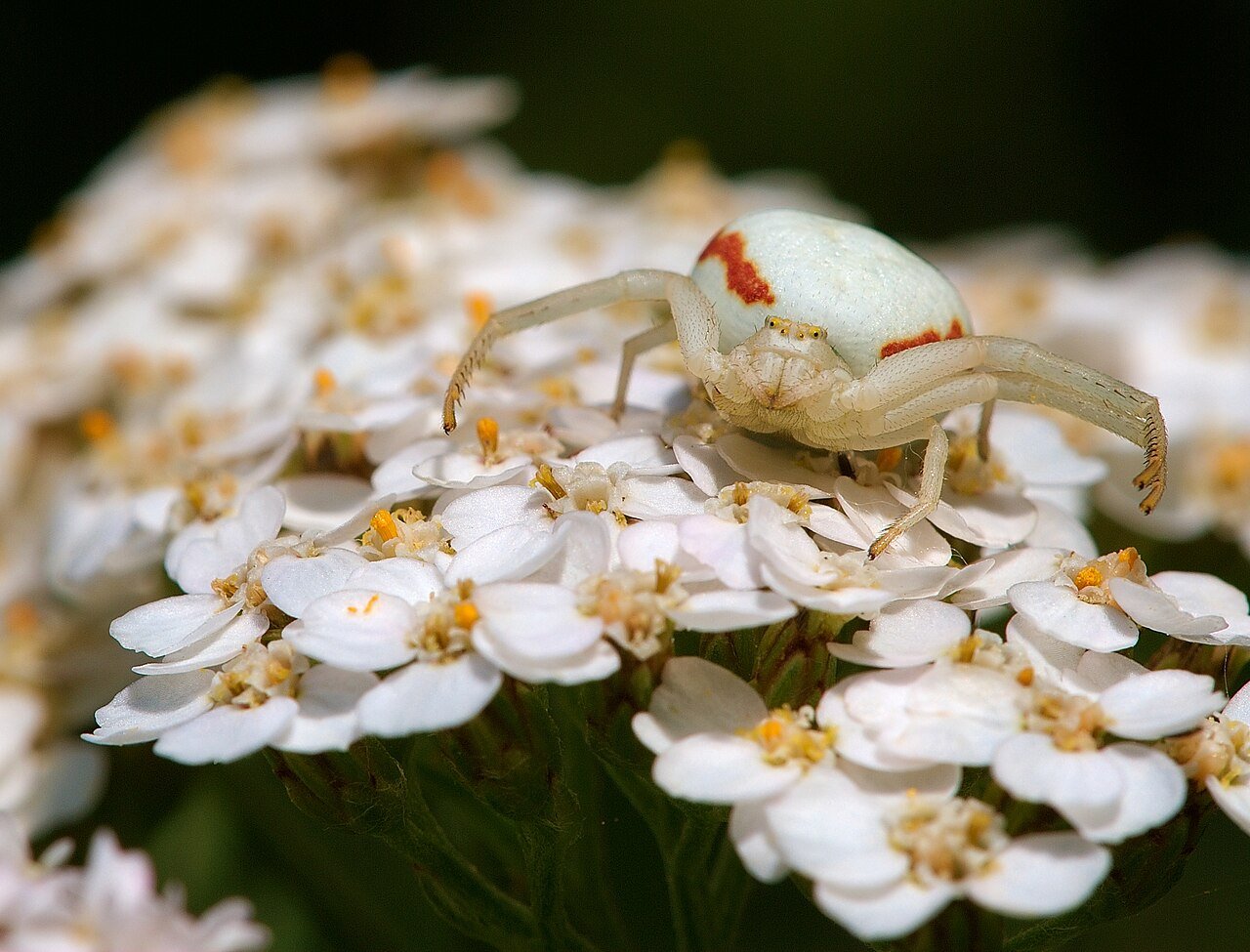
The white spider of Ohio: the search this page adopts most often points at the goldenrod crab spider — the flower-head ambusher that holds its front legs crab-wise and performs the party trick the family is famous for: changing color between white and yellow over days to match its flower, the better to ambush the pollinators it hunts. Harmless to people, stationed on daisies, goldenrod and garden blooms all summer, and the answer to nearly every “white spider on my flowers” photo; the pale sac spiders indoors cover most of the rest (a genuinely mild-mannered cohort covered in the common spiders guide). Are spiders cold-blooded? Yes — ectothermic, running on ambient temperature like all arachnids — with the asterisk that makes it interesting: they behaviorally thermoregulate, which is why the jumpers own the sunny sills (solar-powered hunting), why September’s wanderers seek warm slabs, and why winter drives the whole cast to the strategies their pages describe — eggs, dormancy, or your basement’s stable chill. Tarantulas in Ohio? None native, none established — the state’s furriest big spiders are the wolf spiders and fishing spiders already acquitted, and the annual “tarantula” reports resolve to big female wolf spiders (or escaped pets, rarely, which get rehomed, not treated). The rumor’s persistence is the size-perception file’s spider chapter; the correction is the usual coin photo; and the genuinely tarantula-adjacent Ohio fact — that our fishing spiders can span a coffee mug — comes with the family’s standard verdict attached: impressive, harmless, and better admired than feared.
The bite file (shortest in the wing) and the management file (shorter)
The bite paragraph, complete: bold jumpers can bite if grabbed and pinned — the family’s standard clause — and essentially never do otherwise; documented bites run below bee-sting grade with brief local soreness, no medical significance, and a rarity that reflects the animal’s actual preference when cornered: jumping away, which it does better than anything its size on Earth. Children hand-walk bold jumpers daily across the internet without incident; the species’ entire defensive posture toward humans is the retreat-and-observe cycle the windowsill demonstrates. And the management file runs even shorter: there isn’t one. Jumping spiders don’t infest (no webs, no aggregations, no indoor breeding populations — the sill visitor is a solo hunter working your fly traffic), they self-regulate with the seasons, and the correct response to one indoors is the cup-and-card relocation or — the option this page formally endorses — nothing at all: a resident zebra jumper on a kitchen window is a fly-control subscription with a personality, and households that name them (they do, constantly — our line has met a Kevin, two Steves and a Barbara) report zero regrets. The one connection to the working library: heavy jumper traffic on a wall or sill maps the insect traffic feeding it, so a sudden jumper convention joins the predator-census principle — read what they’re hunting, fix that if it needs fixing, and thank the census-takers on their way out.
Jumping spider questions, answered
It jumped toward my hand. Attack?
Investigation — and possibly a landing miscalculation on a moving perch. Jumpers assess large objects visually and occasionally board them; the boarding party wants a vantage point, not a meal (you register as terrain with weather). Hold still and it patrols your sleeve, tilts at your face, and leaps off trailing silk — the closest thing to a wildlife encounter a kitchen offers, and the family’s entire threat profile is contained in how this paragraph ends: it left.
Black and white spider with red marks — jumper or widow?
Fuzz first: dense fur plus the boxy build plus daylight boldness = jumper (several Phidippus wear red or orange dorsal marks); glossy hairless black plus a tangle web in a dark corner = the widow workup. The two species’ venues barely overlap — sunlit surfaces versus dark clutter — and the photo line splits the rare ties same-day. (Submission stats: red-marked “widow” photos from windowsills grade out jumper at overwhelming rates — the sunny venue almost decides it alone.)
Can I keep one as a pet?
Yes — jumping spiders are the arachnid hobby’s gateway species: a ventilated enclosure, a weekly fly or two, a mister, and a spider that genuinely interacts through the glass. Bold jumpers live a year-plus in care; the hobby’s captive-bred regal jumpers (the bold’s bigger southern cousin) run the deluxe version. As with the hisser question: sourced responsibly and lidded properly, it’s a superb first invertebrate — and the household’s resident arachnophobe, given a month of watching Kevin hunt through glass, converts at rates no pamphlet touches.
Do they ever damage anything — plants, screens, anything?
Nothing, ever — no webs on the architecture, no chewing (fangs, not mandibles), no plant interest beyond the prey on it, and droppings too small to notice. The family’s total household cost across our entire service history: zero dollars, several delighted phone calls, and one memorable dispatch interrupted because the customer’s zebra jumper was “handling it.” The library’s books balance rarely this cleanly.
The friendliest verdict
The jumping spider closes the spider wing as its unambiguous ambassador: the best eyes in the arthropod world, a leap with a safety line, laboratory-certified curiosity, a bite file shorter than this sentence, and a windowsill presence that converts fear to fandom faster than any page this library can write — though this one has now formally tried. Learn the fuzz-and-face ID, adopt the white-flower crab spider and the cold-blooded asterisk as bonus knowledge, retire the tarantula rumor, and let the sill’s black-and-white resident keep its post: the flies never voted for it, and the household always does. For the rare tie, the red-marked double-take, and the photo that’s really just showing off your new roommate: (937) 569-3330, Greater Dayton Pest & Rodent, Dayton and all eight counties — where the grading desk answers jumper photos with species, congratulations, and occasionally name suggestions. The wing closes; Kevin abides.
The salticid science shelf (for the reader who wants the deep cuts)
The family rewards the curious with a genuine research literature, and the highlights travel well to dinner tables: the detour studies — Portia, the family’s celebrated spider-hunting genus, plans routes through three-dimensional mazes toward prey it can no longer see, holding the goal in something functionally like working memory for durations that embarrass the “insects are automata” era; the vision engineering — the principal eyes’ boomerang-shaped retinas sweep behind fixed lenses like scanning sensors, and the layered-retina depth-perception trick (image sharpness compared across retinal layers) was novel enough that camera engineers cited it; the color courtship — male jumpers’ famous dances (the paddle-waving, abdomen-drumming performances of a billion views) pair with ultraviolet and iridescent signals their filtered retinas read and ours need lab equipment to see; the numeracy experiments — jumpers tracking how many prey items disappeared behind an occluder and reacting when the count comes up wrong; and the audience effect — documented behavioral shifts when a jumper knows it’s being watched, which every windowsill owner independently discovers. None of it changes the household verdict — harmless, beneficial, cup-and-card at most — but all of it upgrades the sill encounter: the half-inch of fuzz tilting its head at your coffee is running some of the most sophisticated sensory and cognitive machinery the invertebrate world ever built, and it thinks you’re the interesting one. The library files no better trade all year.
The eight-county jumper map and season
Local viewing notes: jumpers work every zip code — the family’s sunny-surface niche runs from Oakwood porch rails to Preble barn walls without preference — but the venues sort predictably: bold jumpers own the garden stakes, fence lines and siding of every sunny yard; zebra jumpers run the window-glass franchise (south-facing kitchen windows are the classic beat — the glass concentrates both warmth and fly traffic, the species’ complete job description); tan jumpers hold the tree trunks and cedar posts, matching bark well enough that most sightings start with the movement; and the crab spiders’ white-and-yellow flower patrol peaks with the goldenrod economy the bee calendar already mapped. The season runs April’s first warm sills through October’s last sunny afternoons, peaking in high summer when the fly traffic funds maximum activity; winter drives the cohort to sheltered silk retreats (the little white sleeping bags in fence-post crevices and shed corners — leave them; that’s next spring’s Kevin), with the occasional heated-home individual working the winter windowsill on the year’s sunniest days. Viewing protocol, complete: approach slowly, let it notice you (it will), offer a finger at sill level if you’re feeling social, and keep the phone in portrait — the family photographs like it’s sponsored, and the macro shots recruit the household’s next generation of spider-tolerators better than every acquittal this wing has published. Two hundred pages of library, and the best ambassador turns out to be half an inch tall with green fangs: the Miami Valley’s friendliest predator, at a window near you, all season long.
The complete Ohio spider wing, indexed
With the jumpers filed, the spider wing stands complete, and its index deserves one card: the common spiders overview for the full roster; the venomous guide and its widow deep-file for the two species with stakes; the wolf spiders for the September floor-crossers; the orb weavers for the garden’s architecture (and the wing’s master triage: read the web before the animal); this page for the windowsill’s watchers and the flower heads’ white ambushers; and the woodlouse hunter cameo for the red-fanged specialist under the flowerpots. One wing-wide scorecard, worth stating plainly at its close: of Ohio’s several hundred spider species, the medical-significance list holds two, the those-two-encounter rate rounds toward zero with one flashlight hour a year, and everything else on the roster — every walker, weaver, watcher and jumper this wing has profiled — works your address’s pest control nightly for free. The wing’s standing advice compresses accordingly: read the architecture, check the gloss, glove the woodpile, and otherwise let the staff work — with the photo line adjudicating ties, the cup-and-card handling relocations, and the shoe, from this page forward, reserved for actual shoes.
Eight eyes, one head-tilt, green fangs and a fan club: the wing’s last resident takes the sill, the flies take their chances, and the library’s spider chapter ends the only way it ever could — with the scariest word in the index attached, at last, to its friendliest face. Wave at Kevin on your way past the kitchen window; he’s been watching the whole time, and by every measure the laboratory owns, he’s been taking notes.
Frequently asked questions
Are jumping spiders dangerous?
Not remotely — tiny fangs, milder-than-bee venom, and a personality that has made them the internet’s favorite arachnid. The bold jumping spider watching you from the windowsill is curious, harmless, and arguably the best pest-control-per-gram in the house.
What is the little black spider with white spots that jumps?
The bold jumping spider (Phidippus audax) — Ohio’s charismatic flagship: half-inch, fuzzy black with white abdominal spots and iridescent green chelicerae, moving in precise hops with visible head-turns to watch you back.
Why do jumping spiders look at me?
Genuine vision — their oversized principal eyes resolve detail better than almost any arthropod, and they visually track large moving objects including humans. The head-tilt inspection is real observation, not menace; they are deciding whether you are scenery or threat.
Do jumping spiders bite?
Essentially never unhandled — and even a provoked bite from the boldest species is a brief pinprick below bee-sting grade. They would rather hop away, and their vision means they see you coming in time to do exactly that.
Why is a jumping spider in my house?
Hunting the sunlit windows — they are daytime visual predators drawn to the fly-and-gnat traffic where light concentrates it. A windowsill jumper is running a one-spider patrol of exactly the insects you did not want; most households quietly keep them.
Do jumping spiders make webs?
No snare webs — silk serves as draglines (rappelling anchors for the leaps), molting retreats, and egg sacs. The hunt is all optics and pounce: stalk, range-find, jump — accurate to several body lengths.
How do jumping spiders jump so far?
Hydraulics — they extend their legs by blood-pressure surges rather than big muscles, launching twenty-plus body lengths with a dragline safety rope paid out behind. Pound for pound, among the best jumps in the animal kingdom.
What do jumping spiders eat?
Flies, gnats, mosquitoes, moths, and anything else stalk-able up to their own size — a windowsill resident meaningfully thins the winged traffic. Their diet is the whole argument for the catch-and-relocate-at-most policy.
How long do jumping spiders live?
A year or so typically — overwintering as juveniles in silk retreats under bark and siding laps, active on sunny sills even in winter warm spells. The one you keep seeing is likely the same individual working a good territory.
Should jumping spiders ever be treated?
No — they are on this site’s protected-in-practice list alongside the mud daubers and dragonflies: harmless, beneficial, and honestly good company. If spider volume overall is the concern, the prey-base program on our spider guide addresses causes: (937) 569-3330 for that conversation.
The Regal Jumping Spider: the Pet-Trade Celebrity
The regal jumping spider (Phidippus regius) — the big, fuzzy, iridescent-fanged star of every jumping-spider video — is a southeastern species, Florida especially, and its Ohio appearances are almost exclusively as escaped or kept pets rather than wild residents. Our local equivalent is the bold jumper covered above: same charisma, same head-tilting curiosity, slightly smaller package. If you found a large jumping spider in Ohio and wondered if it’s a regal: probably a bold jumper — and either way, you’ve met the most personable spider family on the continent.