
You flip on the basement light and something silver flows — not runs, flows, like a drop of mercury with legs — behind the water heater. Silverfish have that effect on people out of all proportion to their actual menace: they don’t bite, don’t sting, and carry nothing, but they eat books, photographs, wallpaper paste, linens and the occasional wool sweater, they live for years (genuinely — up to eight), and their presence delivers a message about your house that is worth hearing: somewhere, you have a humidity problem, and the silverfish found it first. This guide covers the whole story for Miami Valley homes: what silverfish are and why Ohio’s muggy summers and damp stone basements suit them perfectly, the firebrat cousin that runs the hot side of the same racket, what they’re actually eating (some of it is irreplaceable — wedding albums rank high on the casualty list), why a dehumidifier is the single most effective silverfish weapon ever sold, and the full elimination playbook from tonight’s traps to the permanent fix. From Greater Dayton Pest & Rodent — free photo ID and straight answers at (937) 569-3330.
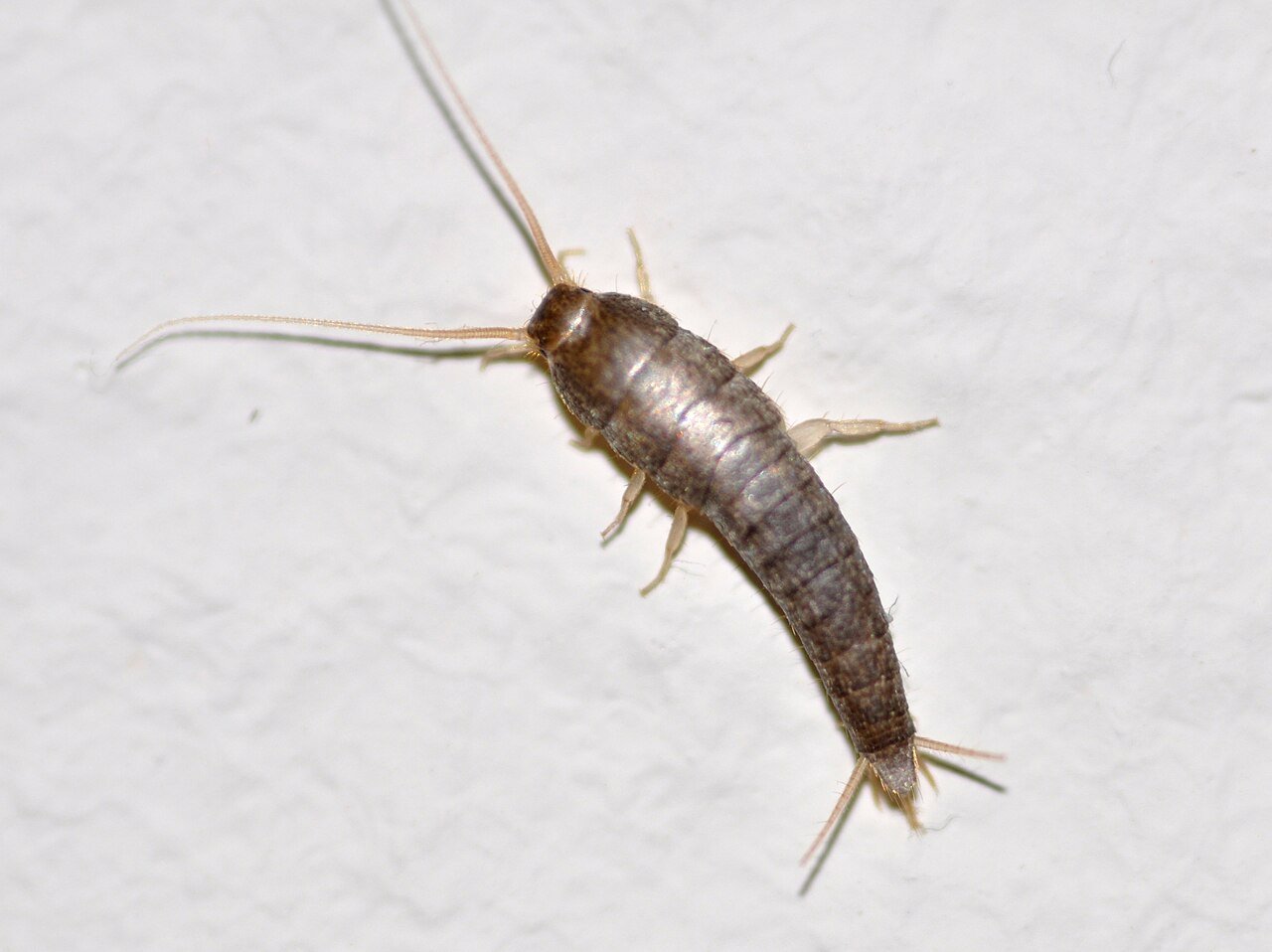
An insect older than the dinosaurs, living behind your water heater
Silverfish (Lepisma saccharinum) belong to one of the most ancient insect lineages on Earth — wingless then, wingless now, essentially unchanged for hundreds of millions of years, which tells you how well the design works. The body is a half-inch teardrop in gunmetal scales that shed under a predator’s grip (or a tissue’s), with two long antennae up front and three bristled tails behind — the field mark that separates them from every look-alike. The name’s second half comes from the movement: a side-to-side fish-wriggle sprint that outruns most spiders over short carpet. They are nocturnal, photophobic, and champions of the narrow gap — behind baseboards, under floor edges, inside book spines — emerging at night to forage. Two biological facts drive the whole control strategy. First, they are moisture hostages: silverfish need roughly 75 percent-plus relative humidity to thrive; below 50 percent they dehydrate, stop reproducing and die out. Second, they are patient: a years-long lifespan, molting continuously as adults (rare among insects), able to survive months without food but only days without moisture. Read those two facts together and the dehumidifier headline writes itself.
What they’re eating: the polysaccharide tour of your keepsakes
Silverfish run on starches, sugars and cellulose — polysaccharides wherever they hide, which turns out to be everywhere humans store memories. The menu, in rough order of heartbreak: paper and paste — book bindings (the old animal-glue spines of pre-1960 volumes are dessert), wallpaper paste grazed from behind seams, cardboard boxes and the documents inside them; photographs — the gelatin emulsion layer is animal protein and starch, and a silverfish grazing a photo’s surface leaves irregular etched scrape marks across faces that no restoration fully fixes; textiles — cotton, linen, rayon and silk, especially anything starched (they eat the starch and take the fiber with it), plus wool’s occasional damage that gets blamed on carpet beetles and moths; and pantry starches — flour, oats, cereal dust in undisturbed corners. The signature evidence: irregular scraped patches and notched edges (not the clean holes of moth larvae), yellowish stains on fabric, pepper-grain droppings in drawers, and the shed scales that dust a heavy harborage. A single silverfish eats little; a five-year-old established population in a box-filled basement eats your grandmother’s postcards. That’s the stake on the table.
Why Ohio houses grow silverfish
The Miami Valley is practically silverfish habitat by design. Summers run humid — July dew points regularly push basements past the 75 percent threshold without any plumbing failure at all — and the housing stock cooperates: the stone-foundation century homes of Oakwood and Dayton’s historic districts wick ground moisture through masonry all year (the same damp-basement physics that drives their spider and camel-cricket populations), while newer builds contribute finished basements whose carpet, drywall and stored cardboard sit directly on cool slabs — a condensation sandwich with a snack bar. Add the way we store things — paper in cardboard, in the dampest room of the house, undisturbed for years — and an Ohio basement is a silverfish retirement plan. The geography of sightings inside a house maps the humidity: basements and crawlspaces first, ground-floor bathrooms second (the overnight shower-steam economy), laundry rooms, kitchens’ under-sink cabinets, and attics with roof leaks or poor ventilation — a surprisingly common silverfish stronghold that announces itself when they start dropping through ceiling fixtures. If you’re seeing them on an upper floor with no obvious moisture, that’s diagnostic: either a hidden leak or an attic population, and both are worth finding for reasons bigger than insects.
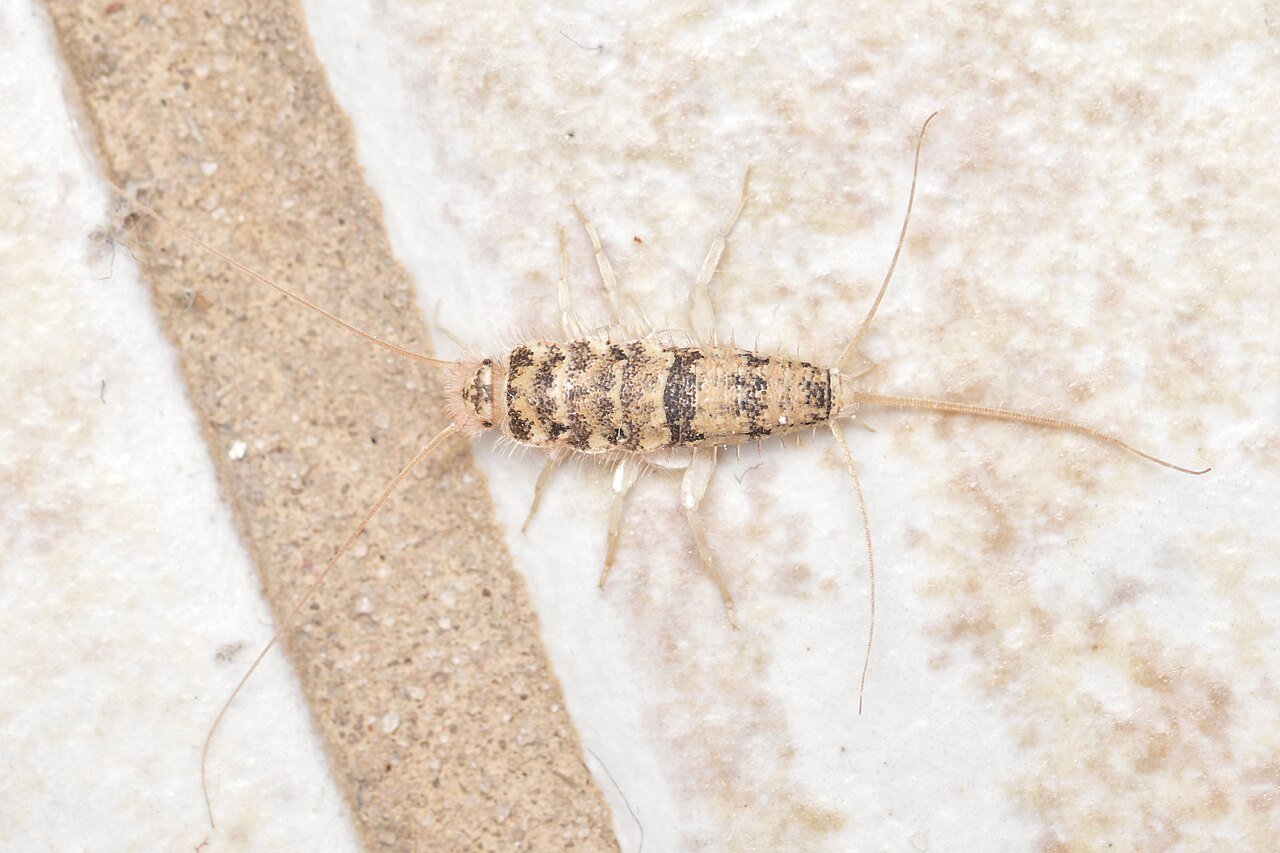
The firebrat: the cousin who likes it hot
If your “silverfish” sightings cluster around the furnace, water heater or boiler room rather than the damp corners, meet the firebrat (Thermobia domestica) — same ancient body plan in a mottled tan-and-gray finish, same diet, opposite thermostat. Firebrats thrive in the 90-to-100-degree microclimates that ring heat sources, breeding fastest exactly where basements are warmest. The distinction is worth thirty seconds because it aims the moisture work: silverfish point at damp, firebrats point at the heat-plus-humidity pocket around your mechanicals (that pipe-wrapped corner where the water heater keeps a permanent tropical closet). Control is identical in method — dry the air, starve the harborage, treat the cracks — just aimed at a different corner of the building. Either way, the three-tailed silhouette in your photo gets the same free ID from us, and mistaking one for the other costs nothing. Mistaking either for a roach nymph, however, sends people down an entirely wrong treatment road — see our baby cockroach guide for that fork: roach nymphs are darker, rounder, and sprint straight rather than wriggle, and the difference in what happens next is the difference between a dehumidifier and a kitchen protocol.
The dehumidifier: why one appliance beats every spray
Here is the section the keyword data says Ohio actually searches for, and the answer deserves its popularity: dehumidification is the closest thing to a silver bullet in all of structural pest control. The logic is airtight. Silverfish cannot drink; they absorb moisture from air and food, which makes ambient humidity their oxygen. Drop a basement from 78 percent RH to 45–50 percent and you have not inconvenienced the population — you have shut off its life support: eggs fail to hatch (they need high humidity throughout development), nymphs desiccate, adults stop breeding and die over weeks, and the space becomes permanently uninhabitable to the next generation, which no insecticide ever accomplishes. Practical spec for a Miami Valley basement: a 35-to-50-pint Energy Star unit for typical footprints, set to 45–50 percent, drained by hose to the floor drain or sump so it never depends on anyone emptying a bucket, filter cleaned seasonally, and a five-dollar hygrometer across the room to verify the number honestly (the unit’s own sensor reads its own exhaust). Run it April through October at minimum; damp stone foundations often justify year-round. Cost: roughly $250 up front and a few dollars a month of electricity — less than one professional treatment, and unlike a treatment it also suppresses the camel crickets, house centipedes, millipedes and mold that ride the same damp. When our technician tells you a $250 appliance will outperform our own chemical visit for this particular insect, believe both halves: it’s true, and we’d rather earn the trust than the invoice.
The full elimination playbook
- Tonight — census with traps: sticky traps flat against baseboards in suspect rooms (silverfish travel wall edges), or the classic free version — a glass jar wrapped in masking tape with a spoonful of flour inside; they climb the tape, can’t climb glass out. Trap counts tell you where the harborage actually is, which is never quite where the sightings are.
- This week — dry the air: the dehumidifier per the spec above; bathroom exhaust fans actually run for twenty minutes post-shower; dryer vented fully outdoors; crawlspace vapor barrier if the underside of your floor is bare earth (a common Preble and Miami County farmhouse finding).
- This week — break up the buffet: books and papers out of damp zones or into sealed totes (the $8 gasket bin is the archivist’s pest control); photographs into archival boxes upstairs, never the basement floor; pantry corners vacuumed; cardboard — their food and their home in one material — replaced with plastic wherever storage lives in humid rooms.
- This month — close the harborage: caulk baseboard gaps, crack lines in basement walls, and the penetrations around pipes; the same crack-and-crevice discipline that runs the rest of the library. Boric acid or diatomaceous earth puffed into inaccessible voids works on silverfish (they groom, they’re wingless, they walk through dust) — used per our DE safety guide, thin and dry, never broadcast.
- Verify at six weeks: fresh trap line. Dropping counts = the drying is working (population momentum takes weeks to reverse; adults are stubborn, eggs are not). Flat counts = missed moisture, and that’s inspection territory.
When to call, honestly
Silverfish are one of the pests where DIY genuinely wins most residential cases — the fix is environmental, and you own the environment. The professional call earns its fee in four situations: attic populations (treating blown-in insulation harborage is equipment-and-experience work); heritage collections at stake — when the basement holds an estate’s books, a photo archive or textile heirlooms, the stakes justify professional crack-and-crevice treatment plus a storage consult rather than a learning curve; persistent populations after honest drying — which usually means a moisture source you haven’t found (roof leak, wall void condensation, a slab crack wicking), and finding it matters more than the insects; and multi-unit buildings, where your dehumidifier can’t dry the neighbor’s half of the party wall. Our approach on any silverfish visit: confirm the ID, map the humidity with a meter room by room, treat the cracks and voids that matter, and leave you with the environmental fix specified — because the treatment knocks down this generation, but the humidity number decides whether there’s a next one. Protection Plan members get it folded into the quarterly rhythm with the re-treatment guarantee behind it.
Silverfish questions, answered
Do silverfish bite people or pets?
No — their jaws scrape surfaces; they physically can’t break skin. The scary-fast wriggle is a getaway, not an attack. Cats find them entertaining; the feeling is not mutual.
Does seeing one silverfish mean an infestation?
One silverfish in five years means nothing; they hitchhike in cardboard constantly. One a week in the same room means an established local population — and since each female lays continuously for years, “a few sightings” understates the census roughly the way an iceberg’s tip does. Run the trap census and let counts, not glimpses, make the call.
Why do I find them in the bathtub?
They fell in hunting the moisture and can’t climb porcelain — the tub is a passive trap, not a drain problem. They’re not coming up the pipes (the P-trap’s water seal blocks that route); they came over the rim. A tub sighting is a free data point about bathroom humidity.
Will they go away on their own in winter?
Indoor populations, no — your furnace keeps their world comfortable, and an Ohio basement’s winter humidity often stays high enough. What winter does provide is the year’s best drying leverage: cold outside air holds little moisture, so ventilation plus the dehumidifier can crash basement humidity faster in January than July. Winter is silverfish elimination season, if you use it.
A silver flash behind the water heater is a two-hundred-million-year-old survivor telling you your basement is running humid — fix the number and you fix the insect, permanently. For the ID, the attic case, or the moisture hunt that’s outrun the hygrometer: Greater Dayton Pest & Rodent, (937) 569-3330, serving Dayton and all eight counties with source-first answers on every call.
The archivist’s corner: protecting what can’t be replaced
Because the casualty list is so often irreplaceable, the storage doctrine deserves its own section — this is the advice we give estate executors and the keepers of family archives across our eight counties, and it costs almost nothing to follow. Elevation: nothing organic stores directly on a basement floor, ever — wire shelving’s bottom shelf six inches up turns a flood-and-silverfish double risk into a non-event. Enclosure: gasketed polypropylene totes for anything with paper, fabric or photographs in any below-grade or attic space; the bin is a humidity envelope and a wall in one, and it’s the entire reason “we stored it in plastic” families keep their postcards while “we used good boxes” families don’t. Placement: the truly precious — the wedding album, the letters, the christening gown — lives upstairs in conditioned space, full stop; closet shelf beats basement shelf by forty humidity points. Paper hygiene: newspapers and cardboard leave the basement (they’re bait), and any box that arrives from someone else’s attic gets opened and inspected in the garage first — hitchhiking silverfish are how established populations commute between houses at estate-cleanout time. Ten minutes of storage discipline protects what no treatment can restore — scraped emulsion never grows back. It’s the cheapest insurance this site will ever recommend.
A route note from the eight counties
Where silverfish calls come from tells the whole humidity story in miniature. The historic cores — Oakwood, the Troy and Lebanon square districts, Germantown’s stone-foundation stock — produce the classic basement pattern, and the fix is almost always dehumidification plus storage discipline. The newer suburbs — Beavercreek, Springboro, Mason — skew toward finished-basement carpet edges and attic populations over builder-grade ventilation. And the farm properties out the Preble and Miami grids add the crawlspace variable — bare-earth crawls under farmhouse additions run tropical all summer, and a vapor barrier down there fixes more pest problems per dollar than any product in this library. Same insect everywhere; the building decides the battlefield. Knowing which house you’re in is most of the plan — and if you’d like the room-by-room humidity map done with a meter instead of a guess, that’s literally our Tuesday.
One last reframe worth keeping: of all the insects in this library, the silverfish is the most honest messenger. It can’t hurt you, it doesn’t want your kitchen, and it will never surprise you at the dinner table — it simply moves in wherever a building holds its breath too wet, and eats whatever memories were stored in the damp. Listen to the messenger, dry the room, save the postcards. And when the message needs translating — a photo ID, a humidity map, an attic verdict — the phone number on every page of this site answers for silverfish too.
Two hundred million years of practice, beaten by forty-five percent relative humidity. Some fights you win with an appliance.
What attracts silverfish, in one list
The attraction file, compressed for the searchers: humidity above 75 percent (the headline — nothing else matters if this is fixed), starch and cellulose food (paper, cardboard, wallpaper paste, fabric sizing, pantry dust), undisturbed dark storage (the boxes nobody opens), and entry routes at grade (the gaps the twelve-doors audit closes). Remove the first and the rest become irrelevant; remove all four and the species has no case — the whole page above, in four bullets, for the reader who needed only the list.
Frequently asked questions
What are silverfish and are they harmful?
Wingless, teardrop-shaped, silver-scaled insects that wriggle fish-like when they run — harmless to people (no bites, no disease) and hard on possessions: starch and cellulose eaters that graze book bindings, paper, photos, wallpaper paste, and starched fabric.
What attracts silverfish to a house?
Humidity above 75% plus starch supply: damp basements with cardboard storage are the perfect resort. They can live months without food but not without moisture — which is why the dehumidifier out-treats every spray.
How do I get rid of silverfish permanently?
The moisture-first program: dehumidify below 50%, fix seeps and condensation, swap cardboard for plastic bins (removing food and housing in one move), vacuum the harborage cracks, and add sticky monitors to grade progress. Boric acid or DE in dry voids assists; dryness decides.
What damage do silverfish actually do?
Grazing damage with a signature: irregular surface scraping, notched edges, and yellowish stains on paper goods — the photo albums, book spines, and stored documents in humid storage take the losses. Damage compounds slowly; discovery usually means months of quiet residence.
Do silverfish mean my house is damp?
Reliably — they are a walking hygrometer reading, thriving only in sustained high humidity. A silverfish population is worth treating as a moisture diagnosis first: find the source (seepage, ventilation, condensation) and both problems resolve.
Why do I see silverfish in the bathtub?
The tub-trap physics again — they climb in following moisture and cannot exit the slick walls. Regular tub strandings mark an established bathroom-adjacent population working the humidity.
What eats silverfish?
House centipedes and spiders keep genuine pressure on them — another entry in the leave-the-predators ledger. No predator overcomes a wet basement full of cardboard, though; habitat always outvotes the food chain.
Are silverfish and firebrats the same?
Cousins with opposite thermostats: silverfish want cool-damp (basements), firebrats want hot (furnace rooms, water heater closets, attics in summer). Same program either way — moisture and harborage control, targeted to their zone.
How do I protect books and photos from silverfish?
Climate first: valuable paper belongs above 50%-RH floors in sealed plastic bins, never cardboard in basements. Add a monitor trap inside storage areas as a tripwire; a single catch beats discovering the grazing after a decade.
When should silverfish involve professionals?
When populations persist past a genuine dry-out (hidden moisture is the usual culprit — we find it), when storage-area damage appears, or when the basement project needs the full moisture-and-pest audit: (937) 569-3330.