
“Roof rats” is one of the rodent wing’s most-searched terms and the Miami Valley’s most misapplied one — so the local answer leads: the roof rat is not established in Ohio; the state’s rat is the Norway rat, and the “rat in the attic” that launches most local roof-rat searches is, on inspection, a deer mouse, a red squirrel’s cousin (whose file this library’s droppings guide reads without treating), or a Norway rat proving that “prefers not to climb” never meant “can’t.” But the page earns its full length anyway, on three honest grounds: the ID stakes (roof-versus-Norway is consequential everywhere both live, the tells transfer to every attic mystery here, and southern transplants arrive carrying the vocabulary); the range question (the roof rat’s river-city and warming-climate story parallels the fire-ant file, port detections and all, and the early-report protocol applies); and the attic playbook — because whatever species your ceiling hosts, the aerial-rodent response (the vertical audit, the roofline exclusion, the species-sorting evidence read) runs the same equipment this page assembles. Greater Dayton Pest & Rodent, attic verdicts free by photo and dropping: (937) 569-3330.
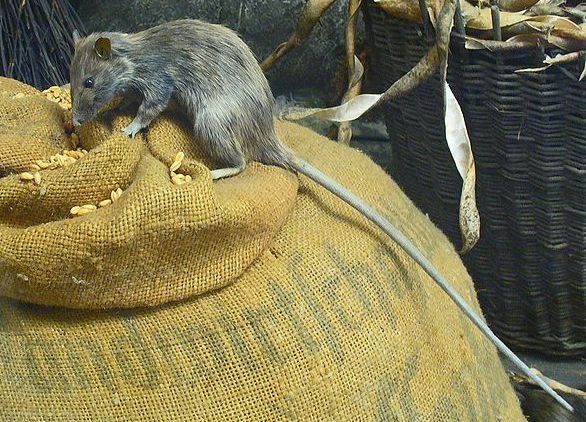
Meet the aerialist (and the sorting table that matters)
The roof rat (Rattus rattus — black rat, ship rat, the plague-history celebrity) is the rat family’s arboreal specialist: slender where the Norway is stocky (200-plus grams versus the Norway’s 300-500), big-eared and big-eyed, pointed-muzzled, and carrying the field mark that settles most photographs — a tail longer than its body, versus the Norway’s shorter-than-body tail. The lifestyle divergence writes the diagnostic table: roof rats live up — trees, vines, rooflines, attics, riding utility lines as commuter rail — while Norways live down: burrows, foundations, sewers, ground floors (the sorting page’s baseline). Evidence diverges accordingly: roof rat droppings run spindle-shaped with pointed ends (Norway’s are blunt capsules, per the field guide), their grease-mark highways trace rafters and wire runs rather than baseboards, and their food caches — hollowed citrus and nut middens in the southern literature — sit at height. Where both species share a city, the vertical split is near-absolute: the same building can host Norways in the basement and roof rats in the attic, running separate economies on separate floors — a stacked arrangement the Gulf-and-Pacific pest trade manages daily and Ohio, for now, reads about.
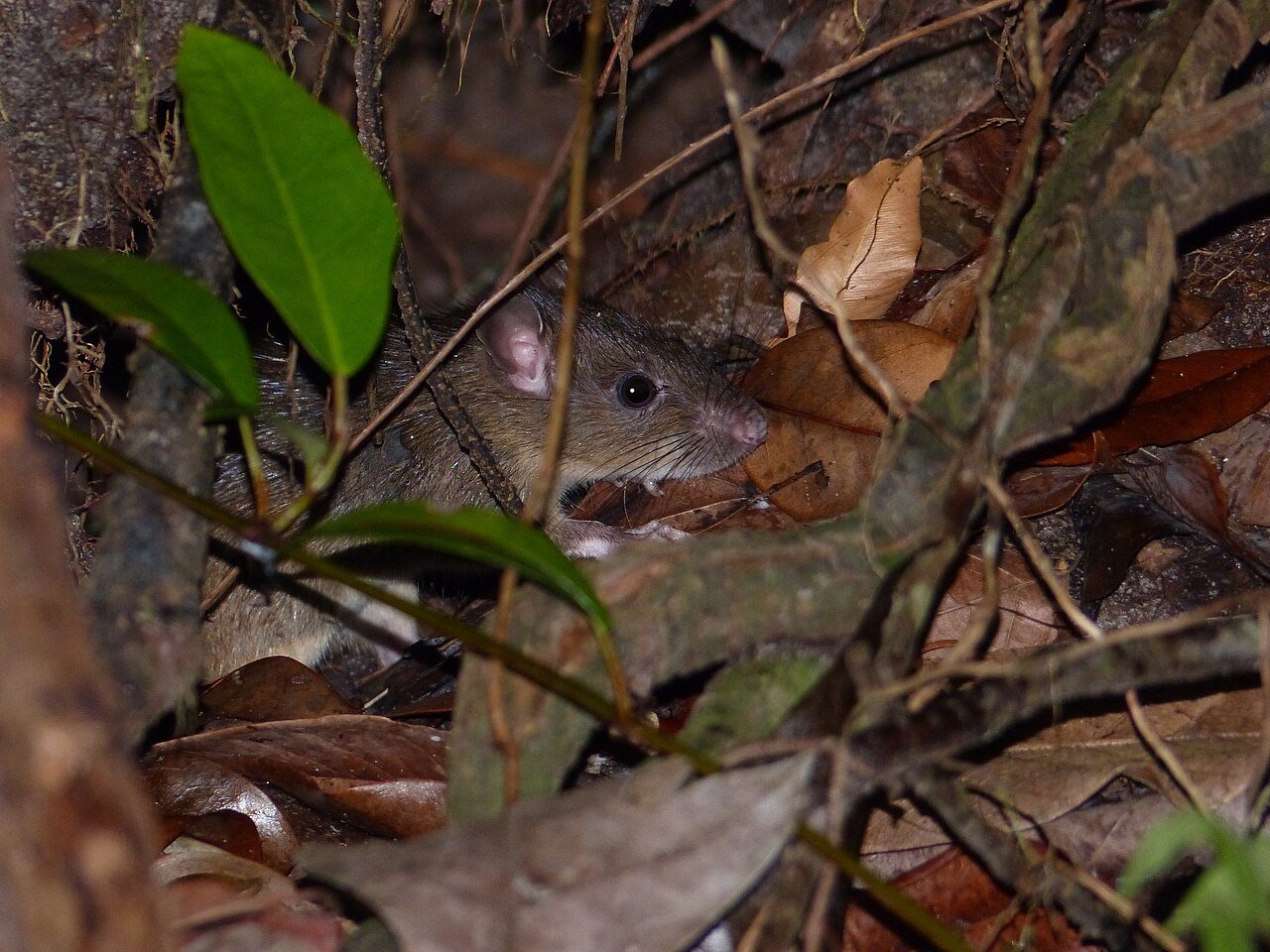
The range file: why Ohio (mostly) sits this one out
The roof rat’s American map is a warmth-and-water story: dominant across the Gulf states, Florida, coastal California and the Pacific Northwest’s port cities, thinning fast inland and northward — the species is tropical-and-subtropical by heritage, burrow-averse by lifestyle (no deep refuge from real winters), and its continental range has historically stopped well south of the Ohio Valley’s freeze line. The asterisks that keep the file honest: river-and-rail detections — roof rats travel cargo as fluently as their shipboard ancestors, and Ohio’s port-adjacent cities log occasional specimens (Cincinnati’s riverfront literature includes historical records) that winter has so far declined to convert into populations; the warming trend — the same range-edge modeling the fire-ant and tick files track runs here too, with the species’ northern margin creeping in the multi-decade projections; and the heated-structure loophole — a cargo-arrived roof rat in a warehouse, grain elevator or big-box distribution center meets no winter at all, which is why the occasional inland detection clusters at exactly those addresses and why our commercial accounts’ rooftop-and-rafter monitoring quietly includes the species. The protocol mirrors the fire-ant page’s: a genuinely suspected roof rat — the long-tail photo, the spindle droppings at height, the rafter grease-lines — earns same-day grading and, on a credible find, the reporting escalation, because early detection at a range edge is the entire difference between an anecdote and an establishment. The odds say deer mouse; the protocol stands for the year they don’t.
The attic playbook (species-agnostic, and overdue at most addresses)
Whatever the ceiling hosts, the response runs one sequence — and it’s the vertical audit operationalized. Read before treating: the attic evidence census — droppings sized and shaped (the field guide’s attic chapter: rice-pointed = mouse, capsule = Norway, spindle = the photo-line call, rounded-tan = squirrel-referral, crumble-and-sparkle pile = bat protocol), gnaw gauge (wire insulation stripped bright is rodent-of-size; the fire-risk line every attic page owes its readers — rodent-chewed wiring features in a measurable share of attic fires, and active gnawing on romex upgrades any timeline), soundtrack timing (dawn-dusk scamper = squirrel; night = mice/rats; silence + evidence = the read continues), and entry mapping from the roofline tier — the fascia gaps, vent screens, and limb-bridges the climbing page itemized. Then the sequence: seal-all-but-one at the dime-to-quarter standard (species-scaled), clearance trapping at the evidence concentrations (snap-scale matched to the occupant — and the no-loose-bait verdict applies doubly in attics, where the wall-void sequel becomes the ceiling-stain sequel), the final closure on verified quiet, and the insulation-and-sanitation pass where tenure ran long (urine-marked insulation is both odor reservoir and re-invitation — the remediation conversation our rodent program scopes honestly). The attic was always the building’s least-inspected room and its best rodent habitat — undisturbed, insulated, highway-served; the playbook just makes it inspected, which was most of the problem.
Roof rat questions, answered
I hear running in my ceiling at night. Isn’t that literally a roof rat?
In Ohio, the night-shift ceiling roster runs: house mice (the majority verdict), deer mice (rural-and-wooded addresses), Norway rats proving the exception (heavier, slower footfall — a genuinely weighty ceiling run warrants the evidence census promptly), and flying squirrels — the region’s secret attic tenant, nocturnal unlike their gray cousins, colony-living, and the actual author of many “rats in the ceiling” files (their evidence: clustered latrines, high-pitched chirps, and the wildlife referral they route to). The dawn-and-dusk version is gray squirrels. Roof rat sits last on the local list — but the census that sorts them is one flashlight visit, and every candidate on the roster ends at the same sealed roofline.
I just moved from Florida/Texas where roof rats were constant. What transfers?
Your habits transfer perfectly — the limb-trimming, the wire-run awareness, the citrus-and-birdseed discipline, the roofline vigilance — they just get re-aimed at the local cast (squirrels and deer mice run the same routes here). What retires: the fruit-tree stripping calendar and the palm-skirt inspections. What upgrades: your attic-checking reflex puts you years ahead of the native-born household, whose ceilings mostly go unaudited until the scratching starts. Keep the reflex; enjoy the lighter roster.
Are roof rats the plague rat? Should the history worry anyone?
They’re history’s famous carrier — the medieval pandemics rode Rattus rattus’ fleas — and the modern file is calmer: plague persists only in western-US wild-rodent reservoirs (a handful of human cases annually, none from Ohio, none from roof rats in cities), and the species’ contemporary disease ledger (leptospirosis, salmonella, rat-bite fever) mirrors the Norway’s — managed by the same sanitation-and-exclusion doctrine, not dread. The history makes the best trivia in the rodent wing; the local risk table doesn’t change by a line.
What would confirm a genuine Ohio roof rat, and what happens then?
The convergence: tail-longer-than-body on a slender 6–8-inch rat, spindle-pointed droppings at height, rafter-line grease trails, and ideally the specimen or clear photos — graded same-day on our line. A credible find escalates: reported to the county health district and ODNR channels (the early-detection protocol), the source traced (cargo, warehouse, transport corridor), and the exclusion-and-trapping response run at the aerial standard regardless — because whatever the species verdict, the playbook above was already the answer. Zero confirmations in our files to date; the streak reports gladly.
The verdict at the roofline
The roof rat closes the rodent wing’s new construction as its best-traveled absentee: the world’s aerialist rat, master of wires and rafters and cargo holds, held off the local map by winters the trend lines are slowly renegotiating — and useful here mainly as the sharpest lens the attic question owns. Learn the tail-and-dropping tells for the year the range edge tests them, run the species-agnostic playbook on whatever the ceiling actually hosts, treat the roofline as the front door it’s always been, and let the vertical-audit doctrine — seal, clear, verify, at altitude — keep the building’s least-visited room its least-inhabited one. For the ceiling soundtracks, the spindle-or-capsule verdicts, and the roofline work that ends the whole roster’s options: (937) 569-3330, Greater Dayton Pest & Rodent, Dayton and all eight counties — where the attic gets audited before the legend gets blamed.
The ship rat’s biography (history’s best-traveled rodent)
The species’ back-story earns its section, because no animal in this library has shaped more human history. The roof rat domesticated itself to shipping before shipping had a name — South Asian in origin, aboard Bronze Age hulls by the archaeological record, and distributed to every port on Earth by the age of sail: the “ship rat” ran the world’s merchant fleets as standing crew, its climbing kit purpose-matched to rigging and mooring lines (the dockside rat guards — those metal discs on hawser lines — are the smooth-surface doctrine’s oldest deployment, still standard maritime equipment). Its flea cargo carried the Justinian and medieval plagues; its island landfalls wrote extinction chapters seabird conservation still repairs (the island-eradication programs of New Zealand and the Pacific are, at heart, roof rat removals at archipelago scale); and its eventual continental displacement by the burlier Norway rat — the eighteenth century’s quiet rodent regime change across temperate Europe and North America — is why Ohio’s rat is the Norway at all: the newcomer out-competed the aerialist everywhere winters favored burrows over rafters, squeezing Rattus rattus back to the warm coasts and the tropics it still rules. The modern range map is thus a fossil of that war, redrawn annually at the margins by climate and cargo — the two forces the range file above watches — and the attic listener’s takeaway is pleasingly literary: the scratching overhead connects, however distantly, to the oldest transportation story animals and humans share. It’s still, almost certainly, a deer mouse. But the lineage it borrowed the search term from has earned the footnote.
The attic census, step by step (the visit that settles every ceiling)
- Gear: headlamp, N95 (the droppings protocol’s attic rule — rural attics assume deer mice until proven otherwise), gloves, phone camera, and a coin for the scale shots.
- The entry read: before stepping in — smell (musk = rodent tenure; ammonia = heavy; sweetish decay = the retrieval file), listen two minutes with the light off, and note temperature (heated attics run winter populations; ambient ones concentrate at the warm chases).
- The floor survey: droppings photographed where they lie — scatter versus latrine versus pile placement is species testimony; insulation tunnels and compressed runways mapped; cached food noted (nuts = squirrel referral; pet food = the pantry’s upstairs branch).
- The structure survey: gnaw marks gauged (pencil-line = mouse; substantial = rat-scale; wiring damage photographed and flagged for the electrician same-week); grease trails traced along their runs (the runs point at the entries).
- The perimeter from inside: daylight check — every light-leak at the roofline is a candidate door, matched against the exterior audit’s list.
- The verdict routing: mouse-scale = the standard program; rat-scale = the call (attic rat work is ladder-and-experience territory); squirrel/bat/flying-squirrel evidence = the wildlife referral; ambiguous = the photos, to the line, same day.
One visit, one census, one routed verdict — the ceiling mystery’s entire solution, run in an hour and mostly with a flashlight. The attic kept its secrets on darkness alone; the census was always going to be this easy.
The eight-county ceiling report
What the region’s attics actually host, from the census files: the rural-and-wooded belt runs deer mouse country — the farm campuses and wooded-lot addresses of every county, with the hantavirus-aware protocol standing and the fall intrusion writing the calendar; the mature suburbs’ ceilings split between house mice (riding the chases up from ground entries per the climbing page) and the gray-squirrel day shift wherever the maple limbs run close; the historic districts add the flying-squirrel colonies their deep eaves and old-growth street trees host (the night-shift chirpers of Oakwood’s census surprises); the river-corridor commercial stock keeps the Norway-rat-at-altitude exceptions and the port-cargo watchlist; and the roof rat itself remains the report’s standing zero — watched for, graded against, and so far absent from every spindle-dropping submission the line has fielded. The report’s through-line is the page’s: the ceiling roster is knowable, the census is an hour, the roofline is the front door, and the species that named the search was never the species in the search — which, by now, is this library’s most familiar plot, resolved the most familiar way: evidence first, playbook second, legend last.
The rodent wing, assembled (a milestone index)
With the roof rat filed, the rodent wing this library’s owner set as its strategic center stands at full strength, and the index earns printing: the humane program for the doctrine; the twelve doors and the vertical audit for the building; the poison file for the aisle; the droppings decoder for the evidence; mouse-or-rat and this page for the species table; the deer mouse for the countryside; the repellent myths for the folklore; the courier rumor for the crossover; moles-versus-voles for the yard’s tunnels; and the program page binding it to the trucks. One wing, one doctrine restated at its completion: rodents lose to buildings, never to products — seal at the dime, trap at the evidence, verify by monitor, and reserve the chemistry for the stationed, licensed margins. Every page above is that sentence at a different address; every quiet ceiling in the eight counties is its receipt; and the wing closes — for now — with its namesake absentee watching from the warm side of the range line, guards on the hawsers, exactly where the story’s always kept it.
Tail longer than body, history longer than either — the aerialist that rode the age of sail ends this chapter as the rodent wing’s horizon-watcher: not here, worth knowing, and out-planned in advance by the same roofline doctrine that already answers everything the ceiling actually hosts. Audit up, seal at altitude, grade the spindle-or-capsule question by photo, and let the attic’s hour-long census retire another legend the way this library retires them all — with a flashlight, a coin for scale, and a species that turns out, once again, to be exactly as manageable as the evidence said. The ship rat keeps the sea; the deer mouse keeps the countryside; and the ceiling, sealed and censused, keeps nothing at all.
Spindle or capsule, dawn or midnight, rafter or baseboard: three questions, one census hour, and every ceiling in the eight counties readable by morning. The roofline is the front door; treat it accordingly.
Case closed at the range line — and the wing’s watchtower manned.
Frequently asked questions
What are the signs of roof rats?
Night noise overhead (attic scampering and gnawing after dusk), half-inch blunt droppings along attic runs, grease trails on rafters and entry gaps, gnawed wiring or stored boxes up high, and citrus or garden produce hollowed from trees. Ground-level evidence often stays clean — that inversion is the tell.
Are roof rats in Ohio?
Less common than Norway rats but present and locally rising — our calls cluster around older neighborhoods with mature trees and dense utility lines. Any attic rat evidence deserves the species check, because the protocols differ meaningfully.
How do roof rats get into the attic?
From above: tree limbs overhanging the roof, utility and cable lines ridden like bridges, then gable vents, fascia gaps, roofline transitions, and chimney chases. They can climb brick and downspouts directly — six feet of branch clearance plus screened vents closes the highway.
What is the difference between roof rats and Norway rats?
Roof rats: sleeker, longer-tailed-than-body, aerial travelers, attic and tree nesters. Norway rats: heavier, blunt-faced, burrowers under slabs and foundations. Address and altitude usually identify them before anatomy does — attic vs. burrow is the practical split.
What do roof rats eat?
Fruit, nuts, birdseed, pet food, and garden produce first — the vegetarian-leaning menu behind hollowed backyard fruit and raided feeders. Unsecured attic-adjacent food (garage bins, holiday candy boxes) holds them; metal-bin discipline starves them.
How do you get rid of roof rats?
The rat-grade campaign, run high: pre-baited snap traps on attic runs (patience for neophobia), the aerial-route exclusion (branches, lines, vents, fascia), food lockdown, and verification before the seal completes. Poison in attics trades a rat problem for a die-in-the-insulation problem.
Are roof rats dangerous?
Same contamination file as other rats — droppings, urine, gnawed wiring’s genuine fire risk — concentrated in the attic where insulation and stored belongings absorb it. The wiring damage alone justifies prompt treatment.
Do roof rats come down into living spaces?
When food or population pressure warrants — wall voids connect attic to kitchen fluently. Early attic-only evidence is the cheap window; ceiling-noise-plus-pantry-evidence means the colony has commuted.
How fast do roof rats reproduce?
Rat-standard: five-plus litters yearly, six to eight pups each, maturity inside three months — slower than mice, still compounding. The same early-action arithmetic applies, with attic insulation as the nursery.
Who handles roof rats in Dayton?
We do — species ID, attic campaign, and the aerial exclusion audit most ground-focused companies skip: (937) 569-3330. Record the overhead noise on your phone before calling; timing and weight genuinely aid triage.