
It happens on a warm, humid morning after rain, usually April or May in the Miami Valley, often the first genuinely spring-feeling day: a cloud of winged insects pours from a crack in the porch, a gap in the basement sill, a seam in the garage slab — hundreds of them, dark-bodied, trailing long silvery wings, spiraling toward the windows. An hour later the flyers are gone and the windowsills are littered with shed wings like tiny fish scales. If that’s your morning, this page is your next thirty minutes, and it leads with the honest stakes: termites with wings — swarmers — are the reproductive graduation ceremony of a mature colony, and a swarm from inside your structure is the single most significant termite evidence a homeowner can witness. Not a reason to panic (the swarmers themselves eat nothing and die by nightfall), but a reason to act this week: colonies don’t produce swarmers until they’re several years old and tens of thousands strong, so the ceremony announces an establishment, not an arrival. What follows: the two-second wings-and-waist ID against the flying ants that cause most false alarms (the full side-by-side lives at our termites vs. flying ants page — this page is what to do when the answer comes back termite), what a swarm from each location means, the evidence hunt that follows, and the response timeline with real prices. Greater Dayton Pest & Rodent — licensed termite treatment and WDI inspection (10B and Category 12), free swarm-photo verdicts at (937) 569-3330.
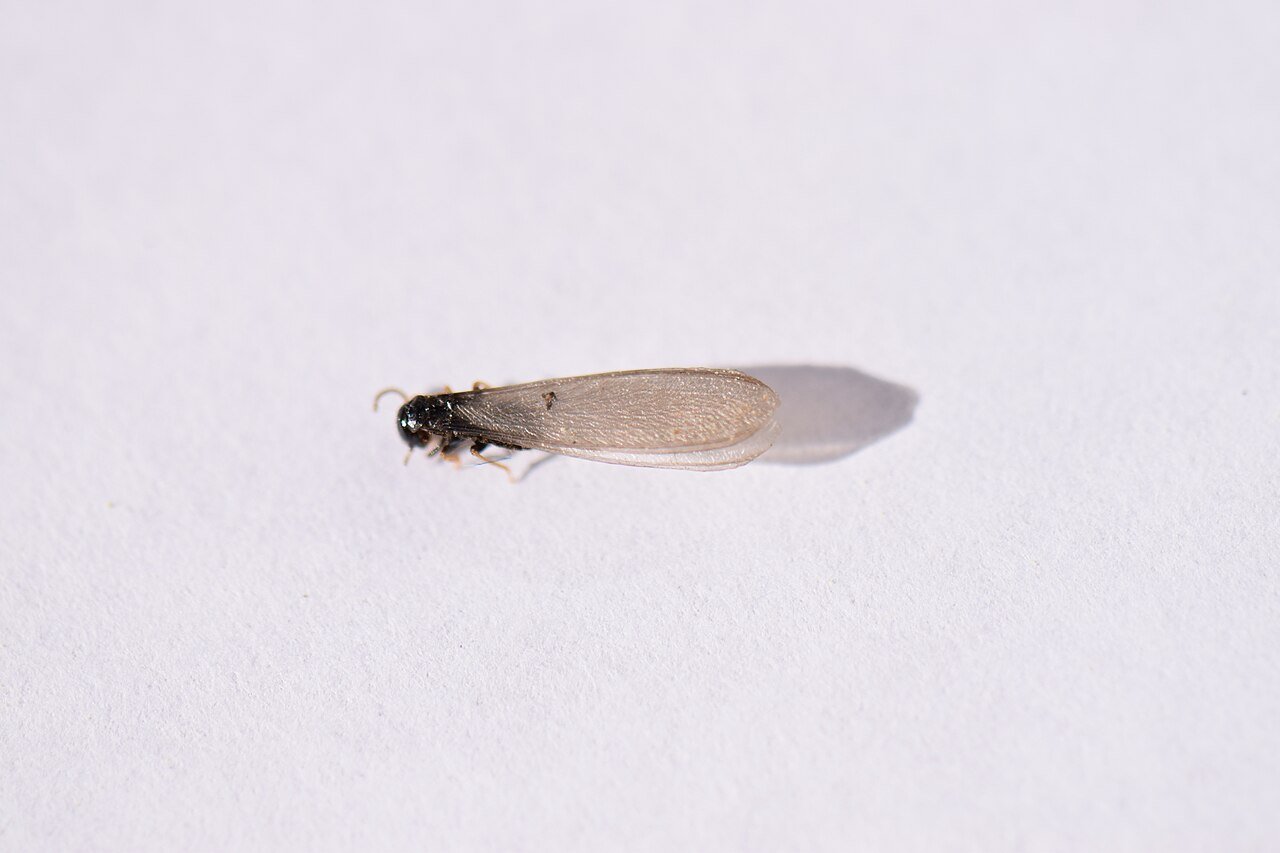
The three-point check, at windowsill speed
You’re holding (or photographing) a dark quarter-inch insect with wings — the entire diagnosis rides on three features any phone macro captures. Wings: termite swarmers carry four equal-length wings, milky-translucent, extending well past the body — ant alates carry mismatched pairs, front longer than back, usually clear. Waist: termites are straight-sided, a seed with legs; ants pinch at the waist like the picture next to “insect” in every dictionary. Antennae: termite antennae are straight strings of beads; ant antennae bend at a sharp elbow. Two supporting tells seal most cases: the shed wings themselves — termites drop their wings within hours of landing (the discarded-wing drifts on sills and in spiderwebs are diagnostic all by themselves; ants keep theirs), and the body — Ohio’s eastern subterranean swarmers run uniformly dark brown-black at about three-eighths of an inch with wings; carpenter ant queens are noticeably bigger and clearly waisted. Score all three points termite and the rest of this page is live; score them ant, exhale and visit the carpenter ant fork, which has its own (slower, cheaper) to-do list. Genuinely torn: the photo line answers swarm-season IDs within the hour, free, because this particular fork is worth getting right the same day.
What a swarm actually is (and why it’s a census document)
Demystifying the cloud pays calibration dividends, so: an eastern subterranean colony spends its first three-to-five years invisible — a queen, her workers, an expanding underground foraging network — and only upon reaching maturity (colonies of 60,000 to a million-plus workers) does it budget for reproduction: raising alates, the winged males and females, and holding them until the right spring trigger — warm temperature, high humidity, rain within a day, usually mid-morning — then releasing them en masse through purpose-built exit tunnels. The synchronized timing floods predators and coordinates with neighboring colonies’ releases for cross-mating; the flyers are feeble (most travel under a hundred yards), the birds and house predators take the majority within hours, the survivors drop their wings, pair, and attempt new colonies at a failure rate above 99 percent. Read as evidence, then: the swarm tells you the source colony’s age (mature), size (large), and — by its exit point — address. That last one is the entire diagnostic fork, next section. What the swarm does NOT mean: that damage began today (the colony predates the ceremony by years — whatever eating is happening has been happening), that the house is falling down (subterranean termites work slowly; weeks matter, hours don’t), or that the flyers themselves threaten anything (they can’t bite, sting, or chew — vacuum them without ceremony). The swarm is a census document that flew. File it accordingly, and this week, not this quarter.
The address fork: where they came out decides everything
Swarm from inside the structure — pouring from a basement crack, a porch column, the garage slab seam, a window frame, the furnace-room wall: the serious read. Interior exit points mean the colony’s foraging network reaches your structure — the swarmers used tunnels that run through or under your building envelope, and the response is the full inspection-to-treatment arc below, initiated this week. Swarm outside, near the house — boiling out of the mulch bed, a stump, the woodpile, the fence line: the intermediate read. Ohio soil simply contains termite colonies (essentially every wooded or established-neighborhood lot hosts them — they’re the ecosystem’s recyclers), and an exterior swarm confirms a mature colony within striking distance but not structural contact; the response is a professional perimeter inspection and a hard look at conducive conditions — grade lines, mulch depth, wood-to-soil contacts, the moisture file. Swarmers on windowsills with no visible source: the ambiguous read — a handful of wings inside can be outdoor swarmers that slipped through screens toward light, or the fringe of an interior event you didn’t witness; count and placement grade it (three strays on one sill after a neighborhood swarm day reads outdoor; dozens plus wing drifts at one repeated location reads interior source until proven otherwise). All three roads converge on the same next step at different urgencies: eyes on the structure — and this is precisely what the inspection exists for, free when you suspect activity, licensed (Category 12) when a transaction needs the official NPMA-33 answer.
The evidence hunt: thirty minutes with a flashlight and a screwdriver
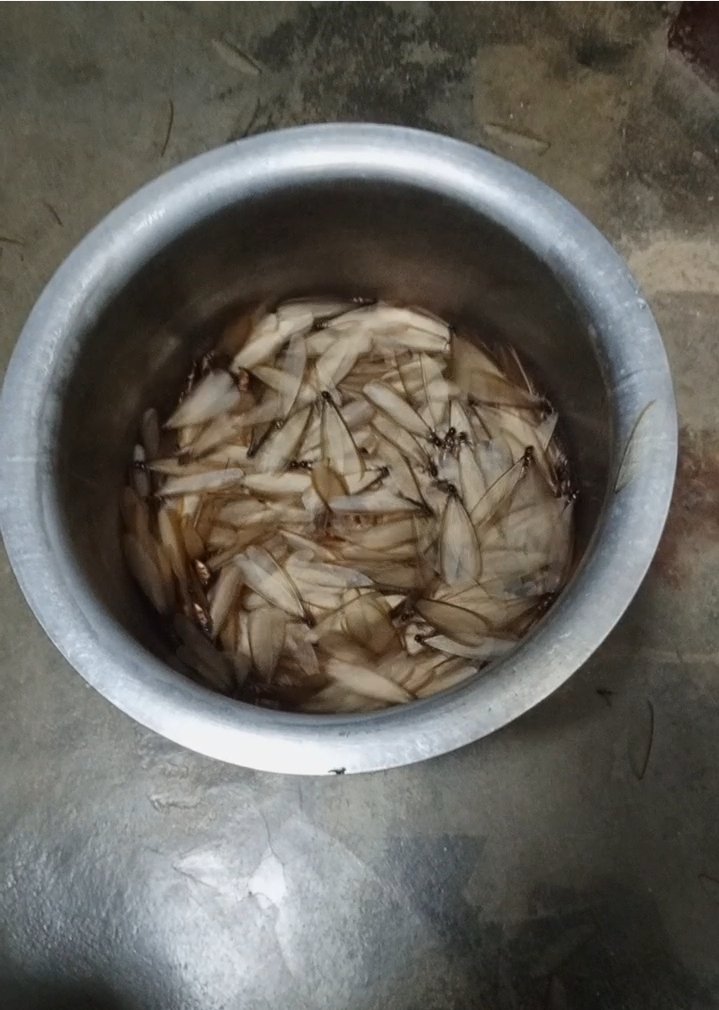
While you wait for the professional eyes (or to inform the call), the homeowner’s sweep — the same circuit our inspectors run, minus the training: mud tubes — the signature evidence; pencil-wide earthen tunnels climbing foundation walls, piers, and plumbing penetrations, bridging soil to wood; check the basement walls, crawlspace piers, garage slab edges, exterior foundation line behind shrubs, and under porch skirts; break a small section of any tube found — workers repairing it within days confirms active use. The screwdriver test — probe sill plates, rim joists, porch posts and any soft-suspect wood: termite-worked timber sounds hollow and gives easily, and breached galleries show the signature mud-packed tunnels running with the grain, filled with soil (carpenter ant galleries, by contrast, are clean-swept — the sawdust-vs-mud distinction from the fork page). Paint that lies — bubbled or rippled paint over thin wood skin, the “water damage” that isn’t near any water. The wing census — bag a teaspoon of shed wings and note every location found; exit-point geography is treatment intelligence. What NOT to do during the hunt, from hard experience: don’t spray the swarm exit (killing the visible flyers does nothing to the colony and can scatter evidence the inspector needs), don’t caulk the exit crack yet (same reason — it’s a diagnostic landmark), and don’t haul the firewood or demo the porch before photos. Evidence first; the fixes have a better sequence and it starts with a map.
The response arc, honestly priced
Confirmed activity — swarm plus tubes, galleries, or a positive inspection — runs a well-marked road at this company, and the prices are published like everything else. The inspection: free for suspected activity; the formal WDI/NPMA-33 report for real-estate transactions at its flat fee. The treatment: our program leads with bait systems — in-ground stations ringing the structure at ~10-foot intervals, delivering a growth-inhibitor the foragers carry home, eliminating the colony over weeks-to-months and then standing guard against successors; install runs $675–$915 for most Dayton-area homes (large perimeters $935–$1,265), with monitoring from $24–29 monthly — the continuous-protection economics, and no drilling through your century home’s stone foundation. Liquid soil barriers remain the market alternative for active-infestation knockdown; the cost guide compares both honestly. The timeline truth that keeps swarm week sane: subterranean colonies consume wood slowly — the urgency is measured in weeks (get the inspection scheduled now, treatment inside the month), not in the panicked hours the door-knocking “swarm chasers” who materialize in freshly swarmed neighborhoods want you to feel. Any company pressing same-day contracts on swarm-day fear has told you what you need to know; the red-flags section of our cost guide names the whole repertoire.
Swarmer questions, answered
The swarm happened once and I’ve seen nothing since. Maybe it’s over?
The ceremony is over; the colony isn’t. Swarming is an annual event lasting hours — the tens of thousands of workers who staged it went straight back to work in the dark, where they’ve been for years. Silence after a swarm is the normal state that preceded it. The inspection appointment survives the quiet; keep it.
Termites swarmed from a stump way out by the fence. Do I care?
Mildly and productively: you’ve confirmed a mature colony on the property, which upgrades the value of conducive-condition hygiene (grade lines, mulch depth, wood-to-soil contact, the downspout file) and makes the case for monitoring stations if the structure has other risk factors. What it doesn’t warrant: treating the stump (colonies span areas, not objects) or structural panic. The perimeter look is cheap; take it.
It’s September and something just swarmed. I thought this was a spring thing?
Spring owns the eastern subterranean’s big ceremony, but smaller secondary flights happen through summer and early fall, and a September swarm reads exactly like an April one: check the three points, note the address, make the call. (One autumn nuance: late-season winged ants are extremely common — the fall false-alarm rate runs higher, which the three-point check absorbs without breaking stride.)
We bought the house two years ago with a clean WDI report. How is a mature colony possible?
Three honest ways: the colony was foraging nearby but hadn’t contacted the structure at inspection time (reports certify visible evidence on inspection day, not the soil’s future); evidence existed in genuinely inaccessible areas (finished basements hide sill plates — every inspector’s stated limitation); or contact began after closing — two years is ample for an established neighborhood colony to extend a foraging tube. It’s why the industry’s honest position — ours included — is that in termite country, and Ohio is termite country, protection is a standing arrangement, not a closing document. The annual-inspection habit costs less than any sentence in a repair estimate.
Swarm day, handled
So: the cloud came out of the porch crack, the sills are scaled with wings, and you now know exactly what happened — a mature colony filed its annual census through your building envelope, the flyers are already finished, and the week ahead has a checklist: three-point ID (or the free photo verdict), the flashlight-and-screwdriver sweep, no spraying or caulking the evidence, and the inspection booked — free, licensed, local. From there the road is mapped and priced in the open: inspection to bait-system treatment to standing monitoring, the same arc our cost guide walks in dollars. Ten thousand Miami Valley colonies will swarm next spring the same way; the difference between the households that shrug it off and the ones that fund a contractor’s boat is almost entirely which week they made the phone call. Make it the first one: (937) 569-3330, Greater Dayton Pest & Rodent — Bryan’s 10B and Category 12 licenses on every termite truck, eight counties, straight answers on the season’s scariest morning.
The swarm-chaser file: a consumer warning with a calendar
Every April, a predictable second swarm follows the insects’ by about 48 hours: the door-knockers. Freshly swarmed neighborhoods — and swarm days cluster block-by-block, since neighboring colonies launch on the same weather trigger — draw a circuit of high-pressure operators running the same play: “we were just treating a house up the street,” a free “inspection” that always finds catastrophe, a same-day-only price, and a contract on the hood of the truck. The tells, so the play never works on you: legitimate inspectors photograph and show you evidence in place (tubes you can touch, galleries you can probe) rather than narrating horrors from the crawlspace you didn’t enter; legitimate quotes itemize method, linear footage and warranty terms in writing and survive a week of thinking (the honest urgency is weeks — anyone pricing by the hour is selling adrenaline); and Ohio applicators carry state licensing you can verify in minutes (ask for the number; watch the reaction). The strongest consumer position on swarm day is the one this page just built: you know what the ceremony was, you’ve bagged your evidence, and your inspection is booked with a company whose prices were published before your porch ever swarmed. Fear is the industry’s oldest upsell; a homeowner with a flashlight, a screwdriver and a calendar is remarkably hard to frighten. Be that homeowner — and lend this page to the neighbor whose porch blew the same morning, because the circuit will reach their door too.
The eight-county swarm map
Local pattern recognition for the season: swarm pressure tracks housing age and soil moisture, so the historic cores lead the call log — Dayton’s pre-war neighborhoods, Oakwood, the square districts of Troy, Lebanon, Eaton and Franklin — where century-old sill plates meet century-old soil contact and buried grade lines. The riverside blocks follow — the levee-town moisture gradient that runs the Miami and Montgomery county river corridors keeps foundation soils termite-friendly deep into summer. The mature suburbs (1960s–80s Kettering, Centerville, Fairborn) swarm off established neighborhood colonies plus the era’s slab porches and attached garages; and the farm campuses of Preble and western Miami counties add outbuilding wood-to-soil contact and the barn-first swarm that warns the farmhouse. New-build subdivisions swarm least and inspect worst (finished basements, buried evidence) — the combination that writes the “clean report, surprise swarm” stories above. Wherever your address falls on that map, the arithmetic holds: the region’s colonies swarm every spring regardless; the houses that mind are the ones without eyes on their perimeter. Ours are licensed, local, and a phone call away — and from April through June, that phone hears more wings than words, which is exactly how swarm season should end: identified, inspected, and handled before July.
One warm morning, one cloud of wings, one week of well-ordered response — and the season’s most alarming insect event resolves the way everything in this library eventually does: into evidence read correctly, a call made early, and a house that knows exactly where it stands. The wings on the sill were the colony’s announcement; the inspection on the calendar is yours.
Equal wings, straight waist, beaded antennae — three points, thirty seconds, and swarm day never owns you again.
Frequently asked questions
What are termites with wings?
Alates — the reproductive caste: future kings and queens launched from mature colonies (typically 3–5+ years old) to found new ones. Dark-bodied with four equal milky wings, weak fluttering flight, and an urgent message when they emerge indoors: the parent colony is in or under your structure.
Are winged termites worse than regular termites?
They are the same colony announcing itself — the workers you never see do the eating; the alates just prove maturity and location. An indoor emergence is diagnostic gold: colonies old enough to swarm have been feeding somewhere for years.
What do I do if winged termites are in my house?
Collect specimens (tape or a jar), note the emergence point exactly, vacuum the rest, and book the inspection this week — not this hour; swarms are seasonal alarms, not fires. What you should NOT do: spray the point and hide the evidence our boundary-mapping needs.
Can winged termites start a new colony in my house?
Indoors, essentially never — founding requires soil moisture and a successful pairing; your carpet is a desert to them and indoor swarmers die within hours. The threat is never the swarmers; it is the parent colony that produced them.
Why are the wings longer than the body?
Alate design — oversized equal wings for the one dispersal flight of their lives, shed immediately after landing (the source of the windowsill wing piles). The disproportion is itself a field mark: ant wings run closer to body length.
Do winged termites bite or sting?
Neither — alates are harmless couriers with no soldier weaponry. Their entire menace is informational.
When do termites swarm in Ohio?
March through May, triggered by the first warm humid days after rain — often several colonies on the same afternoon, which is why swarm-day photo traffic is our busiest ID season. Indoor heated emergences occasionally run early, even midwinter.
What is the difference between swarmers from the yard versus the house?
Everything: yard swarms are the region’s normal background (colonies every few dozen feet in Ohio soil); emergence FROM the structure — baseboards, window frames, the garage slab seam — is the in-or-under diagnosis that books inspections. Watch where they rise, not where they land.
How serious is an indoor termite swarm really?
Serious-and-slow: it confirms an established colony worth treating this season — and termite feeding damages over years, not weekends, so the response window is honest weeks. The panic version costs people money; the calibrated version books the free inspection and reads our cost page first.
Who inspects after a swarm in the Dayton area?
We do — free, all eight counties, with boundary mapping and openly-priced options if the colony is confirmed (bait systems for most cases): (937) 569-3330. Bring the taped specimens; they start the visit a step ahead.