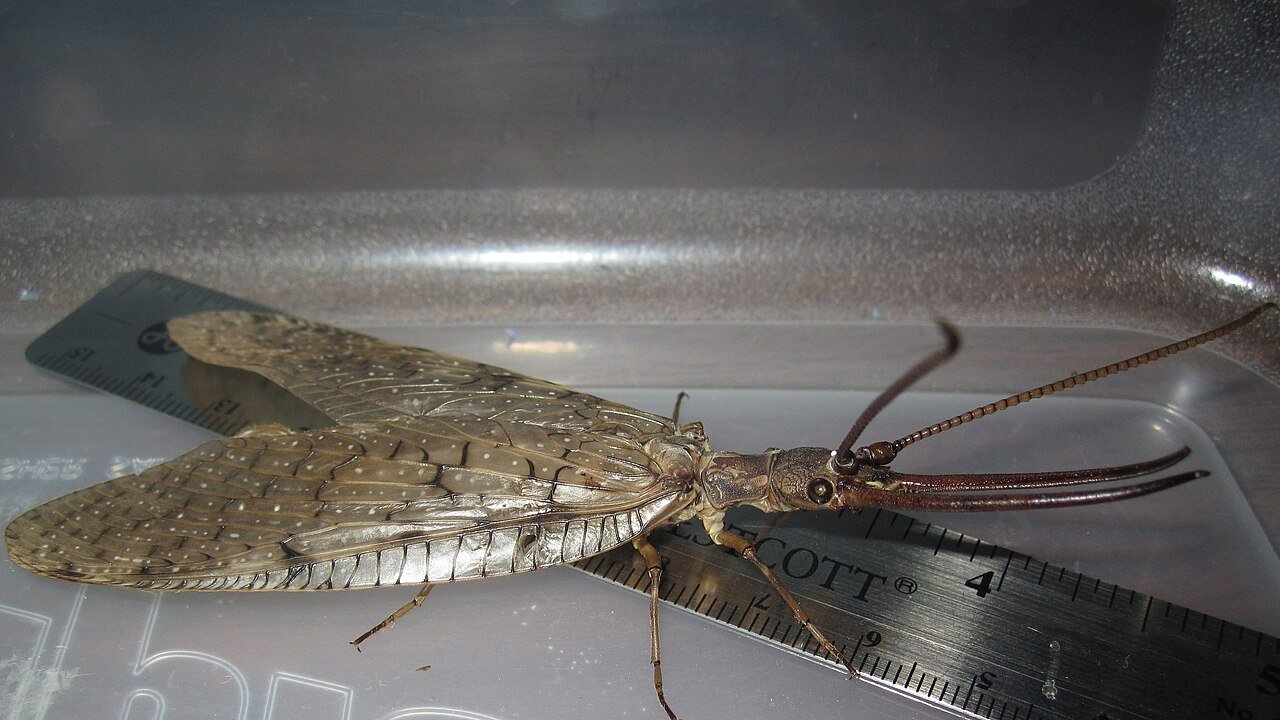
Every June and July, somewhere along an Ohio river, a porch light summons the most alarming insect in the state: five inches of gray wings, a heavy writhing body, and — on the males — a pair of curved inch-long tusks that look engineered for a horror franchise. Phones come out, group chats detonate, and the search bar receives another round of “giant flying bug with pincers Ohio.” Meet the eastern dobsonfly — and its equally storied larva, the hellgrammite, which anglers have prized as premium bass bait for two centuries. This is the complete file on Ohio’s reigning nightmare-looking insect: what those tusks actually are (and why the scary sex can’t hurt you), the remarkable underwater double life, what a dobsonfly at your light says about your river — it’s a compliment — and the short honest section on whether any of this ever needs pest control (almost never, and knowing why is the fun part).
The Tusks Are a Bluff: Dobsonfly Anatomy, Honestly
The eastern dobsonfly (Corydalus cornutus) is among North America’s largest flying insects — wingspans to five inches-plus — and its most famous feature is its least dangerous. The males’ spectacular sickle mandibles are pure mating equipment: display hardware for impressing females and sparring with rivals, so long and leverage-poor that the males physically cannot deliver a meaningful bite to a human. Nature loaded the actual deterrent onto the modest-looking sex: females carry short, powerful cutting jaws and can draw blood if handled — a sharp pinch, no venom, no medical consequence, released the moment you stop squeezing. Both sexes live only about a week as adults, many barely feeding at all; the entire adult program is moonlit mate-finding along the river, with your porch light as an unfortunate navigation error. Handle neither, fear neither, and photograph both — the male’s portrait in particular, because that’s the one that wins the group chat.
A dobsonfly means your river is clean. For the insects that are genuinely a problem indoors, there is pest control in Dayton.
The Hellgrammite: Three Years of Underwater Monster, One Week of Moth-ish Adult
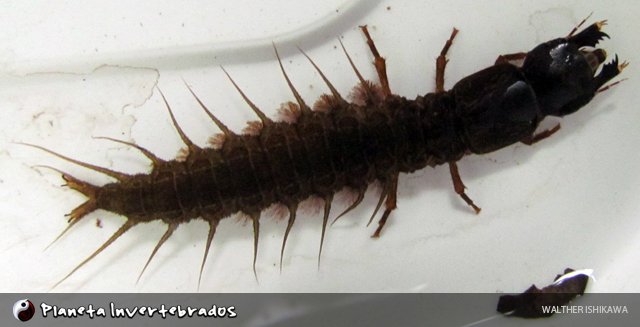
The dobsonfly’s real life happens underwater. Its larva — the hellgrammite — is a dark, armored, centipede-looking predator up to three inches long that spends two to three years hunting under riffle stones in clean, fast, well-oxygenated streams, breathing through lateral filaments and eating whatever aquatic insects it can ambush. Anglers have known it forever: the hellgrammite is legendary smallmouth bass bait — tough on the hook, irresistible in the drift — sold in bait shops and hunted by generations of kids flipping river rocks (mind the pinch; the larva bites with enthusiasm the adult male can only advertise). When mature, the hellgrammite hauls out — sometimes dozens of yards from water, famously often just before summer thunderstorms — digs a chamber under a log or stone, pupates, and emerges weeks later as the giant at your porch light, closing a three-year story with a one-week finale.
A Dobsonfly at Your Light Is a Compliment to Your River
Here’s the part that reframes the scare: hellgrammites are certified clean-water bioindicators. Stream scientists literally score river health by finding them — they tolerate neither serious pollution nor low oxygen, so a breeding population means the water upstream of you is in genuinely good shape. Dayton’s dobsonflies map precisely onto our healthiest water: the Stillwater and Mad River corridors, the Great Miami’s recovering riffles, Caesar Creek’s tailwaters, Twin Creek. When one lands on your screen door in Miamisburg or Troy, the accurate reading isn’t “infestation” — it’s “the river two blocks away passed its physical.” The same logic applies to their frequent porch-light companions, the stoneflies — smaller, flatter river insects whose larvae are even stricter about water quality. River-town porch lights in early summer are, in effect, a live water-quality readout, and the scarier the audience, the better the grade.
Dobsonfly, Fishfly, Stonefly, or Mayfly? The Riverside Porch-Light Lineup
- Dobsonfly: the giant — 4.5–5.5” wingspan, gray mottled wings folded long over the body, males with the display tusks. June–July, always near rivers. Harmless (female pinch excepted).
- Fishfly: the dobsonfly’s smaller cousin — 2–3”, often with feathery antennae and reddish head, same clean-stream story at a lower terror setting.
- Stonefly:
- Mayfly: upright sail wings, two or three long tail filaments, the famous one-day adult — swarms by the lake and river billboards each June (their full story is in our library). Zero mouthparts, zero harm.
- The impostor to rule out: a “giant flying roach” at a river-town light in summer is occasionally exactly that — an American cockroach strayed from a sewer line — and THAT one earns a call. Wing posture sorts it: roaches carry wings flat and run when lit; the river insects sit dazed and let you photograph them.
Does a Dobsonfly Ever Need Pest Control? (The Honest Section)
Almost never, and here’s the complete decision logic. Dobsonflies cannot breed at your house — larvae need years in flowing stream water, so there is no such thing as a dobsonfly infestation of a structure. Adults live a week, don’t feed meaningfully, don’t damage anything, and arrive only because your lights out-competed the moon. The entire management toolkit is lighting: swap porch bulbs to warm/yellow LEDs, aim fixtures down, put riverside floods on motion sensors for the June–July emergence window, and keep screens tight so the occasional navigator doesn’t end up indoors (if one does: cup, cardboard, back to the night — the female-jaws warning applies to bare hands only). When we DO get a legitimate call from a riverside property in dobsonfly season, the real subject is usually the whole porch-light menagerie — and the honest fix is the lighting audit plus sealing, not a spray against a river’s worth of healthy insects. We’ll say exactly that on the phone, for free.
The exception that proves the rule: riverside restaurants and patios where any large insect traffic is a business problem. There the commercial program earns its keep — lighting redesign, entrance air management, and monitoring — engineered around the insects without pretending we can (or should) treat a healthy river.
Giant winged thing on the porch you’d like identified — or a riverside patio that needs engineering instead of panic? Send the photo; the ID is free and usually good news. Serving Dayton and all of Montgomery, Greene, Miami, Clark, Warren, Butler, Preble, and Darke counties.
The Hellgrammite Economy: Two Centuries of Bait-Shop Royalty
No Ohio insect has a longer commercial résumé. Hellgrammites appear in American angling literature back to the 1800s, sold streamside for prices that routinely beat nightcrawlers several-fold — because nothing else on a hook survives the current, stays lively, and reads as native food to a smallmouth quite like one. Generations learned the harvest ritual: a seine net downstream, a partner flipping riffle rocks upstream, and a coffee can of furious black armor by lunch (plus the traditional first pinch, a rite of passage). Bait shops along the Great Miami and Stillwater still stock them seasonally, and tournament smallmouth anglers still guard their hellgrammite water like family secrets. There’s a genuine conservation kicker, too: that entire cottage economy depends on rivers clean enough to grow them — making the bait can, like the porch light, another instrument that quietly measures water quality. The fish, the anglers, the bait shops, and the scientists all vote the same way on hellgrammites; the only demographic that panics is the porch, one week a year, when the survivors graduate.
From Riffle to Porch Light: the Full Three-Year Timeline
The life cycle, start to finish, because it explains every encounter: eggs are laid in summer as chalky white patches on leaves and bridge girders overhanging water — thousands of eggs per patch, positioned so hatchlings drop straight into the current. Larvae spend one to three years (typically two or three in Ohio’s climate) hunting under riffle stones, molting a dozen times, riding out floods anchored in the substrate. Come early summer of their final year, mature hellgrammites stage the great walkout — hauling from the water, often ahead of thunderstorm fronts, sometimes crossing yards and roads in numbers that generate their own alarmed reports — to dig pupal chambers under logs, rocks, and riverside debris. A few weeks later the adults emerge into their single week: males joust with their tusks, females choose, eggs go onto the overhanging leaves, and the river inherits the next class. Total program: up to three years of quiet aquatic predation funding seven days of terrifying-looking romance. The porch light catches only the finale — which is why the correct response has always been a photograph, not a shoe.
Why This Page Lives on a Pest Control Site
Fair question, since we’ve now spent two thousand words defending an insect. The answer is the same one behind our whole acquittal library, from cicada killers to fishing spiders: identification is the treatment decision, and the scariest-looking finds are reliably the wrongest targets. Every June, river-town households spend money and adrenaline on the week the dobsonflies fly — sprays purchased, porches abandoned, occasionally a whole-house treatment demanded — against an insect that cannot infest, cannot meaningfully bite, and announces good news about the neighborhood’s water. Meanwhile the genuinely expensive insects — the termite swarmers, the quiet carpenter ant traffic — pass unphotographed because they don’t look like monsters. A company that will tell you the five-inch tusked giant is free and the small brown ant is the emergency has told you something about every other verdict it renders. That’s the business case for the dobsonfly’s defense — that, and the fact that Ohio’s reigning nightmare insect genuinely deserved a better publicist. (For the full tour of the state’s alarming-but-innocent, our scariest bugs in Ohio countdown ranks the dobsonfly against its competition — spoiler: it wins.)
One last piece of hellgrammite folklore worth preserving: riverside old-timers held that the great walkouts predicted thunderstorms — and modern observation backs them, with mass hellgrammite emergences repeatedly documented in the hours before storm fronts, likely triggered by the falling barometric pressure. Ohio’s scariest insect is, among everything else, a barometer. The natural world keeps writing better material than the horror franchises ever managed — it just files it under rocks, in rivers, two counties from wherever you left your porch light on.
(Vocabulary corner, since the names are half the fun: “dobsonfly” has defeated etymologists — no one knows who Dobson was — while “hellgrammite” is American folk invention at its finest, joined regionally by go-devils, grampus, crawlerbottoms, and conniption bugs. Any insect that accumulates five folk names in two centuries was never actually unpopular; it was famous.)
Frequently Asked Questions
What is the giant flying bug with pincers in Ohio?
The eastern dobsonfly — wingspans to five inches, found near rivers in June–July. The dramatic inch-long “pincers” belong to males and are mating display equipment too leverage-poor to hurt anyone; females carry short jaws that can pinch hard if handled. No venom, no danger, one-week adult lifespan.
Can a dobsonfly hurt you?
The tusked males physically cannot bite meaningfully. Females can deliver a sharp, blood-drawing defensive pinch if squeezed — no venom, no medical consequence. Don’t hand-wrestle either sex and the answer is no.
What is a hellgrammite?
The dobsonfly’s larva: a dark, armored aquatic predator up to three inches long that lives two to three years under riffle stones in clean streams. Legendary smallmouth bass bait, enthusiastic pincher, and a certified clean-water indicator species.
Why are dobsonflies at my porch light?
Adults navigate by moonlight along rivers, and bright lights hijack the system during the June–July emergence. They live about a week and can’t breed at your house — the fix is lighting (warm bulbs, motion sensors, aimed fixtures), never treatment.
Are dobsonflies a sign of anything?
Yes — good news: hellgrammites only survive in clean, oxygen-rich flowing water, so scientists literally use them to certify stream health. A dobsonfly at a Dayton-area light means the nearby Stillwater, Mad, or Great Miami stretch is healthy.
Do I need pest control for dobsonflies?
No — there’s no such thing as a dobsonfly infestation (larvae need years in a river). Lighting adjustments and tight screens handle the week of adult season. The one legitimate service case is commercial riverside patios, where the fix is lighting engineering, not spraying.
What’s the difference between a dobsonfly and a stonefly?
Size and drama: dobsonflies are the five-inch giants with (on males) tusks; stoneflies are smaller, flat, roll their wings tight over the back, and emerge from the same clean riffles. Both harmless, both compliments to the river, both porch-light regulars in river towns.
When is dobsonfly season in Ohio?
Adults fly mainly June through July, with emergence spiking on humid nights — hellgrammites famously crawl out to pupate ahead of summer storm fronts, which old-timers used as fishing-weather lore. By August the year’s adults are gone.