
An enormous jet-black wasp — an inch and a half of gleaming black with wings that flash smoky blue — just cruised low across your yard, and every instinct says emergency. Here’s the file, and it’s mostly an acquittal: the great black wasp is one of Ohio’s largest wasps and one of its least dangerous, a solitary katydid-hunter and legitimately important pollinator that has essentially no interest in you, your kids, or your cookout. This page covers the ID, the strange and wonderful way it makes its living, the short list of situations where it’s actually a problem, and how to tell it from the black-and-white lookalike that genuinely deserves your caution.
ID: An Inch and a Half of Blue-Black
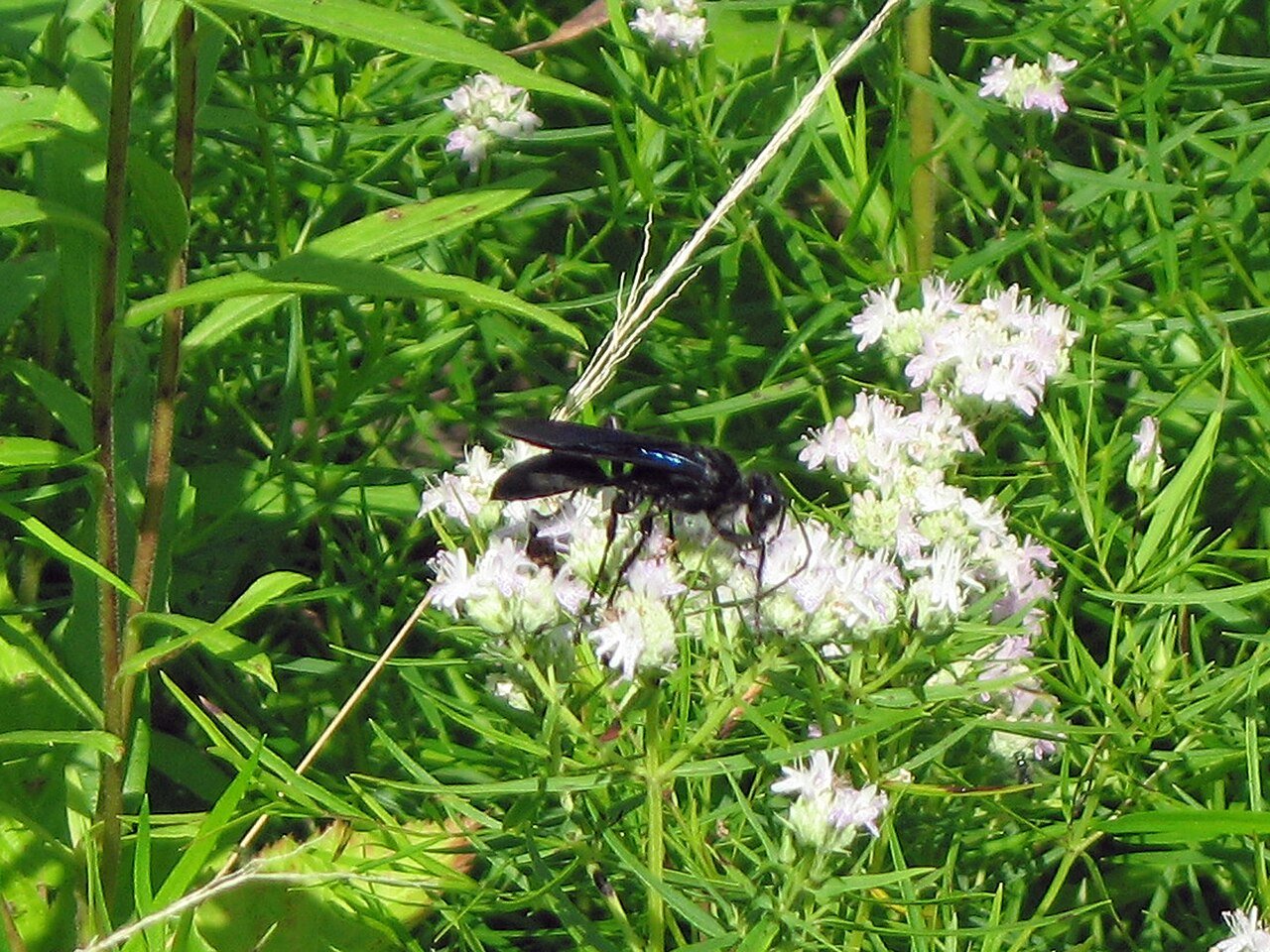
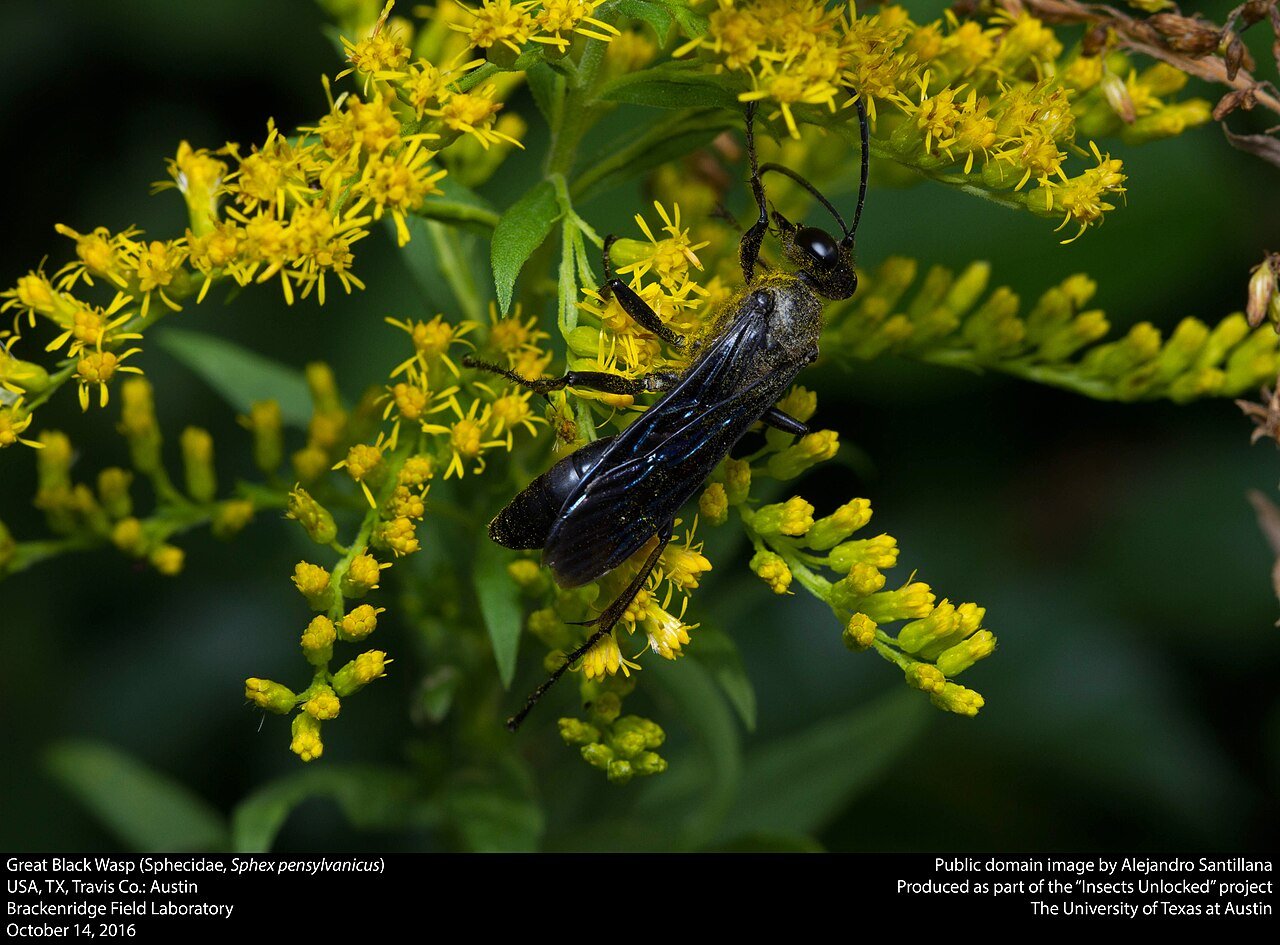
The great black wasp (Sphex pensylvanicus) is hard to mistake once you know the field marks: entirely black — no yellow, no white, no red anywhere — with a satin sheen, smoky wings that catch blue-violet iridescence in sunlight, a slender waist between thorax and abdomen, and serious size: females run to an inch and a half, among the biggest wasps an Ohioan will ever see. Flight style is a tell too: purposeful, low, and heavy, often trailing long legs, patrolling flowers and open ground rather than circling your food. You’ll see them from July into September, singly — never in numbers around a nest entrance, because there is no shared nest to defend, which turns out to be the whole story of why they’re safe.
Great black wasps are solitary and worth leaving alone. The social nests people actually need gone are a different job — wasp and hornet removal in Dayton.
It belongs to the digger wasp family (Sphecidae), cousin to the mud daubers on your porch and the cicada killers in your sandy bank, and it shares their defining temperament: solitary wasps don’t defend territory, don’t swarm, and treat stinging a human as a catastrophic last resort rather than a job duty.
How It Makes a Living (This Part Is Genuinely Wild)
The great black wasp is a katydid specialist. A female hunts katydids and large grasshoppers — insects frequently bigger than she is — stings them into permanent paralysis with surgical precision, then flies or drags the cargo back to a burrow she’s dug in soft soil. Underground, she stocks each chamber with two or three paralyzed katydids, lays a single egg on one, seals the cell, and repeats — a dozen cells across a summer, each provisioned like a pantry. The larva hatches into a living larder, develops through fall, overwinters underground, and emerges as next July’s adult. The adults themselves drink nectar, which makes them surprisingly significant pollinators of milkweed and other summer natives — you’ll see them dusted in pollen far more often than you’ll see them anywhere near people.
Two consequences follow. First, every great black wasp in your yard is quietly deleting katydids and grasshoppers — garden herbivores — at an industrial rate. Second, because each female works alone and invests everything in her own burrow, she has nothing to gain from conflict: no colony, no shared brood, no defense instinct. The evolutionary math that makes a yellow jacket ornery simply doesn’t apply to her.
The Sting Question, Answered Honestly
Can a great black wasp sting? Females can — the sting is katydid-paralyzing equipment, and if you grab one barehanded or trap one against skin, you’ll get a genuinely painful lesson (males, as with all wasps, cannot sting at all). Will one sting you unprovoked? Functionally never. There is no nest-defense trigger, no swarm response, and no interest in humans or human food — they don’t raid picnics, don’t hover at soda cans, and don’t come to your burger. Decades of entomology-extension literature on this species repeats the same line: stings occur when the wasp is handled or stepped on barefoot, and essentially not otherwise. Standard sting first aid applies on the rare occasion, and the systemic-allergy warning signs are the same as for any sting — but this species sits at the very bottom of Ohio’s realistic sting-risk table, several tiers below the yellow jackets and bald-faced hornets that cause nearly all actual incidents.
Great Black Wasp vs. the Lookalikes
- Bald-faced hornet: the one that earns caution — black but with bold white face and tail markings, social, hundreds strong in a closed gray globe, and genuinely defensive. Black-with-white and coming from a paper nest changes everything; see hornets in Ohio.
- Cicada killer: comparable size but black-and-yellow banded, burrowing in bare sandy soil, hovering territorially (all bluff — the males can’t sting). The other gentle giant.
- Blue-black spider wasps: smaller, twitchy, wing-flicking wasps hunting spiders along walls and soil; also solitary and uninterested in you.
- Mud daubers: slender thread-waisted relatives, some metallic blue-black, building mud tubes on your porch; virtually sting-proof in practice.
- Carpenter bees: big and black-bodied but chunky, fuzzy-legged, hovering at wood, drilling perfect holes — a wood problem rather than a sting problem; see carpenter bee removal.
The one-line sort: solid black + blue wing-flash + working flowers alone = great black wasp, stand down. Black with white markings + numbers + a papery globe = bald-faced hornet, keep distance and call. Nothing else that big and dark flies in Ohio.
When a Great Black Wasp Is Actually a Problem
The honest list is short. Burrows where bare feet go: a female may dig in the soft soil of a garden bed, sandbox edge, or volleyball court — the wasp is docile, but a barefoot child standing directly on one is the single realistic sting scenario, so a burrow in a play zone is worth addressing. Sting allergy in the household: when anaphylaxis is on the table, even a bottom-tier-risk species justifies removal, no argument from us. Repeated indoor visits: a great black wasp indoors is lost, not invading — open a window and it leaves — but repeat visits mean a door or screen gap worth fixing. Sheer unmanageable fear: real, and we don’t lecture about it. If an inch-and-a-half wasp patrolling the patio means nobody uses the patio, that’s a quality-of-life call we’ll honor.
What we won’t do is spray your flower beds “for black wasps” on sight — that trades a beneficial katydid-hunter and pollinator for nothing, and it’s the kind of upsell this site exists to talk you out of. When treatment is warranted it’s surgical: the specific burrow, the specific play area, done. The same judgment-first approach runs through our whole wasp and hornet service.
If You’d Rather Not Host Them Next Summer
Discouragement is mostly landscaping. Females want soft, workable, sun-warmed soil: heavily mulched open beds, sandy patches, thin lawn with exposed ground. Keep turf dense, top open soil with a coarser mulch layer, and water play-area sand regularly (damp sand loses its appeal). Since adults commute to nectar, yards stacked with midsummer bloom right at patio edges will host more fly-through traffic; moving pollinator plantings a bit farther from seating moves the wasps with them — a placement fix, not a chemical one. And leave the population-scale worrying to us: this species is never numerous, one female per burrow, a handful per yard at most, gone by October with the year’s katydids to show for it.
Big black wasp you’d like a second opinion on — or a burrow exactly where the kids play? Send us a photo and we’ll name it and handle only what needs handling. Serving Dayton and all of Montgomery, Greene, Miami, Clark, Warren, Butler, Preble, and Darke counties.
The Katydid Connection: Why August Is Great Black Wasp Season
If it seems like the giant black wasps appear at exactly the moment the evening katydid chorus peaks, that’s because they do — the wasp’s adult season is timed to its prey’s. Katydid populations crest in mid-to-late summer, and a hunting female great black wasp works that abundance hard: a single provisioning season can put dozens of katydids underground, one paralyzed insect at a time, each flown or hauled home along fencerows and garden edges. Homeowners occasionally witness the astonishing part — a wasp airlifting a green katydid bigger than herself, flying in labored hops from perch to perch — and call us convinced they’ve seen something tropical. You haven’t; you’ve seen one of Ohio’s better wildlife moments, free, over your own tomatoes.
It’s also why the species self-limits: no katydids, no wasps. Populations track prey, never exceed a handful of females per yard, and can’t “infest” anything — there is no colony to grow. Compare that with the social wasps’ late-summer trajectory — a yellow jacket nest is at several thousand and climbing in the same weeks — and you see why the two demand completely different responses. Species first, adjectives second: it’s the sorting rule behind every wasp call we run, and the reason a photo texted to us before anyone reaches for a spray can is always the right first move.
A Word for the Pollinator Ledger
One more entry for the acquittal file: entomologists consistently list the great black wasp among the more valuable native pollinators of common milkweed — the same plant the monarch recovery effort depends on. A yard hosting a great black wasp is a yard whose milkweed sets more seed. If you’ve planted for monarchs, the big black wasp isn’t the intruder in that project; she’s staff. It’s a fitting note to end on, because it’s the theme of this whole corner of our site, from mud daubers to cicada killers: the scariest-looking insects in an Ohio yard are, with impressive consistency, the ones doing the most good — and the modest-looking ones in the wall void are the ones that need us.
For calibration on size, since “huge” does a lot of work in wasp reports: the great black wasp’s inch-and-a-half ties it with the cicada killer and the European hornet for the biggest wasps Ohioans encounter, a full half-inch beyond any yellow jacket or paper wasp. Size and danger simply don’t correlate in this lineup — the two biggest entries are the two safest, and the most dangerous common stinger in any Ohio yard remains the modest half-inch yellow jacket in the ground nest nobody noticed until the mower found it. If a wasp’s size is what alarmed you, the odds are genuinely good that you just met one of the gentle giants.
Frequently Asked Questions
What is the big black wasp in my yard?
Almost certainly the great black wasp (Sphex pensylvanicus) — up to an inch and a half, entirely jet black with smoky blue-iridescent wings, seen alone at flowers or cruising low from July into September. A solitary katydid-hunter and pollinator, not a threat.
Do great black wasps sting?
Females can, but functionally only if grabbed or stepped on barefoot — there’s no nest defense, no swarming, and no interest in people or food. Males can’t sting at all. This species sits at the bottom of Ohio’s realistic sting-risk table.
Are great black wasps aggressive?
No — solitary wasps have nothing to defend and everything to lose in a fight. They don’t raid picnics or hover at drinks; you’ll find them dusted in milkweed pollen, not circling your plate.
What do great black wasps eat?
Adults drink nectar and pollinate summer natives, milkweed especially. Females hunt katydids and large grasshoppers — often bigger than themselves — paralyze them, and stock them in underground burrow-chambers as living pantries for their larvae.
Great black wasp or bald-faced hornet — how do I tell?
Solid black with a blue wing-flash, working alone at flowers: great black wasp, harmless. Black with bold white face and tail markings, in numbers, around a closed gray paper globe: bald-faced hornet — keep your distance and call. Ohio has nothing else that big and dark.
Should I kill a great black wasp?
We’d rather you didn’t — each one is deleting garden katydids and pollinating on the side, works alone, and disappears by October. The exceptions worth acting on: a burrow in a barefoot play zone, or a sting allergy in the household. Those we treat surgically, not with a yard-wide spray.
Why is there a great black wasp in my house?
It’s lost — they have zero indoor agenda. Open a window and it will find its way out. Repeat indoor visits usually mean a torn screen or a door gap worth fixing, not an infestation; there’s no such thing as a great black wasp nest in a wall.
Where do great black wasps nest?
In burrows dug in soft, sunny soil — garden beds, sandy spots, thin lawn. One female per burrow, no colony, and the burrow is abandoned once provisioned. Dense turf, coarse mulch, and damp play-sand make a yard unappealing without any chemistry.