
The short answer: no — cicadas are not harmful to people or pets in any meaningful way. They don’t bite (they physically can’t — their mouthpart is a plant-sap straw), they don’t sting (no stinger exists on the insect), they carry no diseases, they don’t infest houses, and the only genuine damage they do in a lifetime is cosmetic injury to young trees during egg-laying — a real but narrow problem this guide covers with real solutions. Everything else about the cicada experience is theater: the astonishing volume, the crunchy abundance, the dog that won’t stop snacking on them, and — every seventeen years in southwest Ohio — the emergence events that put millions of red-eyed singers in every tree at once. This is the complete Ohio cicada file from Greater Dayton Pest & Rodent: annual versus periodical species, the honest harm assessment for kids, pets, gardens, and trees, the cicada-killer wasp that terrifies more people than the cicadas ever could, and why this is the rare insect page on our site with almost nothing to sell you — which is exactly why you can trust the rest of it: (937) 569-3330, free photo ID as always.
Ohio’s two cicada calendars: every summer, and every seventeen years
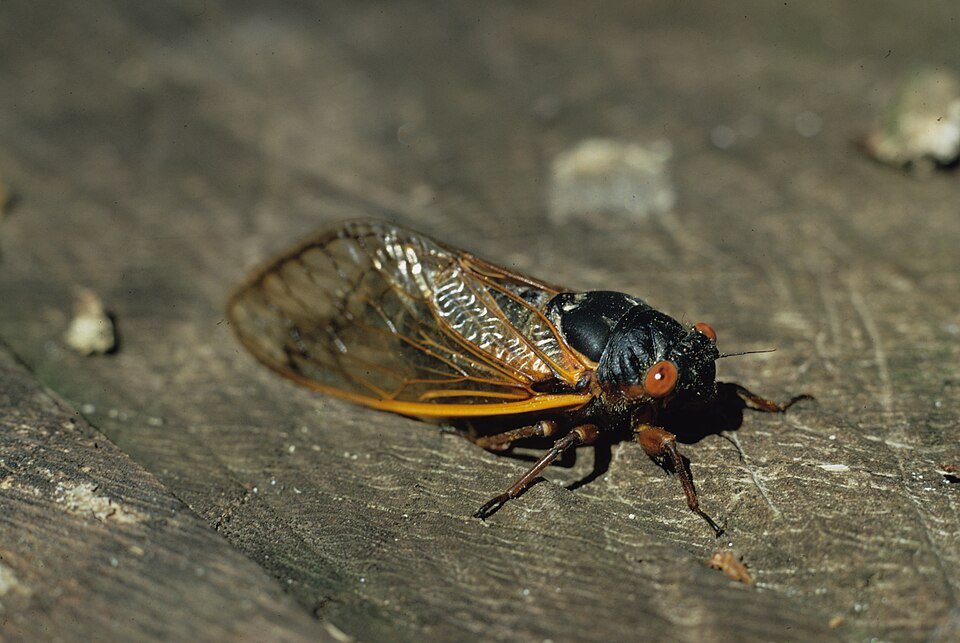
Two different phenomena share the name, and knowing which you’re hearing sets every expectation. Annual (dog-day) cicadas arrive every July and August without fail: big green-and-black singers whose buzzing crescendos define an Ohio heat wave, emerging by the thousands per county from multi-year underground development staggered so some mature each summer. They’re the source of the shed shells on tree bark, the occasional startled scream when one blunders onto a porch, and the summer soundtrack — and their densities never reach damaging levels. Periodical cicadas are the world-famous ones: smaller, black-bodied, orange-veined, red-eyed, and locked to seventeen-year clocks (thirteen in the South) that produce the biblical mass emergences. Southwest Ohio sits in the territory of Brood X — the great 2021 emergence Miami Valley residents remember, with its millions-per-acre densities, roaring chorus, and month of crunching sidewalks — and lesser broods clip our region’s edges in other years. The mass strategy is the point: predator satiation, overwhelming every bird, raccoon, and enthusiastic dog by sheer arithmetic so enough survive to breed. The next Brood X return is 2038 — a date worth knowing mostly for one audience, the future tree-planters this page addresses below.
Cicadas are harmless, which is more than can be said for some of what people mistake them for. If you are not sure what you have, that is what pest control in Dayton is for.
The harm audit: kids, pets, gardens, houses
Run the fears in order. Bites and stings: anatomically impossible — cicadas have neither jaws for biting nor a stinger; a hand-held cicada may buzz alarmingly and, very rarely, probe skin with its drinking straw in confused thirst (a pinprick, not an attack). Children can handle them freely; catching cicadas is, honestly, one of the great starter experiences of Ohio nature. Pets: the dog eating cicadas is the number-one emergence-season question, and the veterinary consensus is reassuring — cicadas are non-toxic protein and a few are a crunchy treat; the only issue is volume, since a dog gorging on dozens during a mass emergence can earn an upset stomach or vomiting from the indigestible wings and shells. Moderate the buffet during peak weeks; no other action needed. Houses: cicadas neither enter, nest in, nor damage structures — the ones on your screens are resting between flights, and the shells on the siding brush off. Gardens and mature trees: adult cicadas barely feed and do no meaningful foliage damage — they are not locusts, despite the borrowed nickname (locusts are swarming grasshoppers that actually defoliate; the confusion dates to colonial America and refuses to die). The single real exception is next.
The one real problem: young trees and the flagging cut
Female cicadas lay eggs by slitting pencil-thin twigs with a saw-like ovipositor and depositing eggs inside — and at mass-emergence densities, thousands of slits per tree cause flagging: twig tips wilting brown and dangling across the canopy. On a mature oak this is free pruning, shrugged off in a season. On a newly planted or young tree — anything with a trunk under about two inches, or planted within the last couple of years — heavy flagging can prune away a meaningful share of the branch structure and set the tree back badly. The protections, honestly ranked: netting wins — quarter-inch mesh wrapped over young trees before a periodical emergence and secured at the trunk excludes egg-layers completely, and it’s the only method university programs endorse without reservation; timing beats treatment — the smartest move of all is simply not planting vulnerable young trees the spring of a mapped emergence year (nurseries and extension offices publicize brood years well in advance; 2038 is southwest Ohio’s next big appointment); and insecticides disappoint — spraying canopies against millions of arriving insects is expensive, environmentally indiscriminate, and poorly effective, which is why we don’t sell it and neither should anyone. Annual-cicada years need none of this: densities never reach flagging thresholds, and the summer soundtrack comes damage-free.
The cicada killer: the scariest harmless thing in your yard
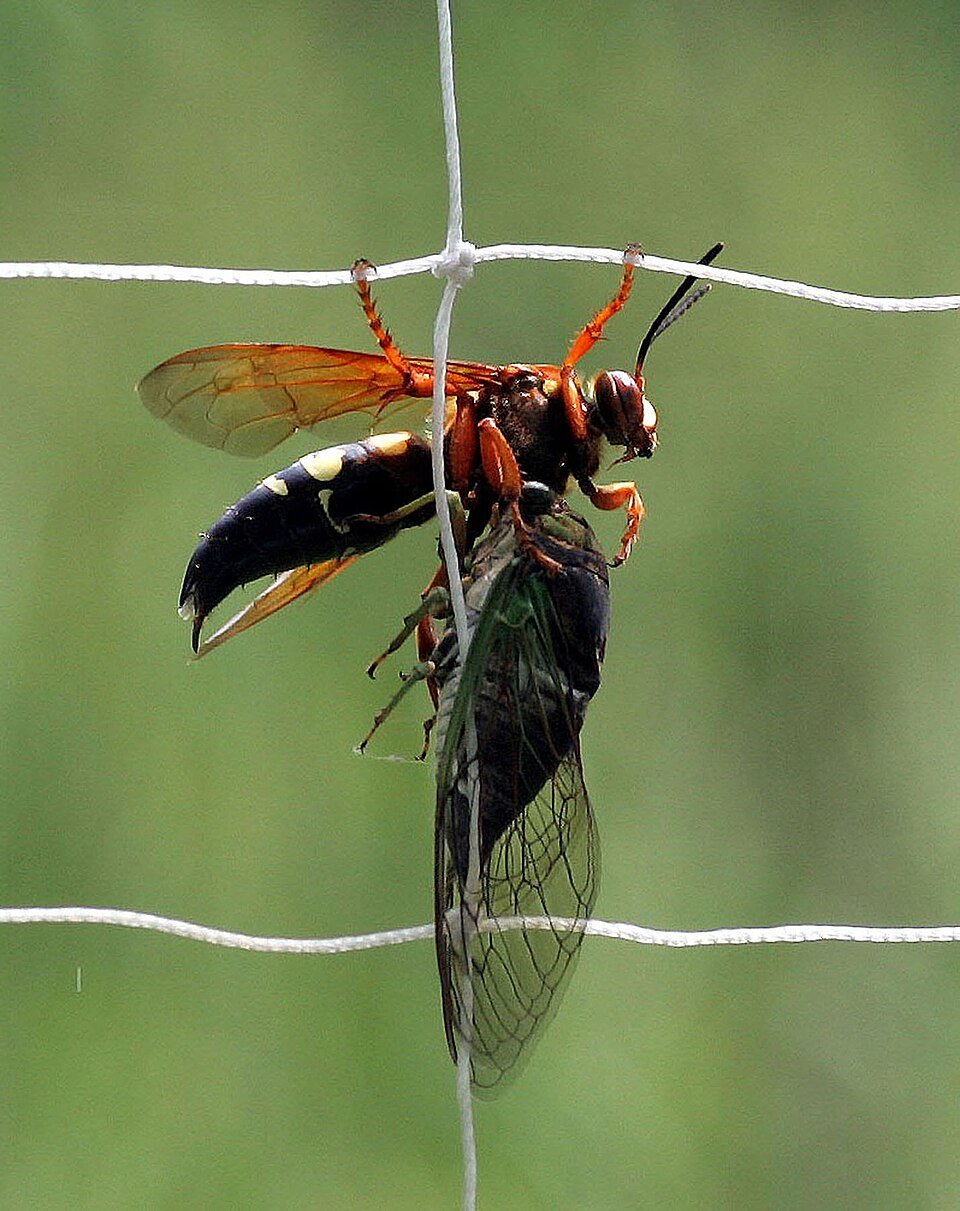
Every July, as annual cicadas tune up, their nemesis emerges — and generates more panicked calls than the cicadas ever could. The eastern cicada killer is Ohio’s largest wasp: up to two inches of black-and-yellow intimidation, cruising lawns at ankle height, excavating burrows that throw sand across patios, and carrying paralyzed cicadas twice its weight through the air like cargo helicopters. The fear is entirely understandable and almost entirely misplaced. Males — the aggressive-looking patrol flyers that hover and dart at anything entering their territory, humans included — cannot sting at all (no stinger, pure bluff, the same theater as the carpenter bee’s). Females can sting but essentially never do — they’re solitary, unaggressive, and interested exclusively in cicadas; documented stings involve grabbing one barehanded or stepping on one barefoot. There is no colony to defend, which removes the entire mechanism that makes yellowjackets genuinely dangerous. Our honest guidance: tolerate them if you can (each female removes dozens of cicadas and aerates your lawn), and where burrow densities in play areas or sandy patios cross a family’s comfort line, targeted burrow treatment is a modest job we’ll do while explaining cheerfully that the wasps were mostly innocent. What we won’t do is treat them as an emergency — that word belongs to the wall-void yellowjackets a few pages over.
Cicada questions, answered
A cicada landed on my child and buzzed — is any reaction possible?
The buzz is a startle defense, not an attack, and no venom, toxin, or bite exists in the equation. The only medical footnote in the cicada file: people with severe shellfish allergies are advised against eating cicadas (they’re biologically arthropod cousins — and yes, emergence-year cicada cuisine is a real thing), which says everything about how safe casual contact is.
Why are there holes all over my lawn?
Emergence tunnels — nymphs surfacing after their years underground leave dime-sized exit holes, sometimes with mud turrets in wet springs. They’re temporary, harmless, and actually beneficial aeration. No treatment exists or is needed; the lawn closes them within weeks. (Bigger, sand-thrown burrows in July are the cicada killer’s — see above; golf-ball holes with runways are the vole conversation.)
Do cicadas mean my trees have a pest problem?
No — cicada presence tracks tree presence generally, not tree distress, and the nymphs’ root-feeding over their long development causes no measurable harm to established trees. Shells on the bark and singing overhead are signs of a normal Ohio ecosystem doing its loudest annual work.
Emergence-year survival guide: the practical month
- Pets: moderate the cicada buffet — a few are fine, a gorge earns vomiting; keep leashed walks moving during peak crunch weeks, and know the wings-and-shells stomach upset resolves on its own (persistent vomiting or lethargy is the vet-call line)
- Young trees: net anything under two-inch trunk diameter before emergence begins; quarter-inch mesh, sealed at the trunk, removed after egg-laying ends (~6 weeks)
- Planting plans: defer spring tree planting in a mapped brood year to fall — the cheapest protection ever invented
- Pools: skim daily and keep the pump baskets clear — cicada loads are a filtration nuisance, not a chemistry problem
- Outdoor events: schedule around the peak-chorus fortnight if a quiet backyard wedding matters; no spray changes the calendar, and vendors selling emergence-proofing are selling weather control
- The noise: up to ~100 decibels in peak chorus — real, temporary, and coming from males’ abdominal drums (tymbals); it ends when mating does
- Cleanup: carcass accumulations under big trees can smell for a week — rake, compost, and know the protein bonanza is feeding every bird, fish, and garden bed in the county
Why a pest company published a do-nothing page
This page sells almost nothing on purpose, and that’s worth a closing word. Cicadas sit at the exact intersection where pest-control marketing does its worst work: dramatic, loud, abundant, alarming to newcomers — and harmless, which makes them the perfect fear-vehicle for companies selling emergence-year “protection packages” that protect nothing. Every mass emergence, somewhere in the Miami Valley, households get sold canopy sprays, perimeter treatments, and lawn applications against an insect that doesn’t bite, sting, infest, or destroy — money extracted from awe. Our position is the one this whole site runs on: the identification is free, the honest answer is the product, and the trust earned by saying “keep your money, enjoy the spectacle” is what brings the same household to us when the problem is real — the wall-void yellowjackets, the bed bugs, the October mice. Seventeen-year cicadas are one of North America’s genuine natural wonders, Ohio sits in the heart of their range, and the correct professional advice fits in a sentence: net the saplings, pace the dog, and go watch. For everything on this site that actually bites back: (937) 569-3330.
The seventeen-year clock, briefly marveled at
Since the fear is dispatched, spare a paragraph for what’s actually overhead. Periodical cicadas run the longest synchronized life cycle of any insect on Earth: seventeen years underground as nymphs, sipping root sap through more than four thousand Ohio nights, counting the years — the leading hypothesis says by tracking the trees’ seasonal sap pulses — and then emerging within the same few weeks across entire states, triggered by soil hitting 64 degrees. The prime-numbered cycles (13 and 17) likely evolved to dodge predator populations that boom on shorter rhythms; the mass synchrony overwhelms everything that eats them; and the broods are old enough that the ones singing over Dayton in 2021 descended from cicadas that sang over the Wright brothers’ bicycle shop and, further back, over unbroken forest. Emergence years re-fertilize whole ecosystems — a once-per-generation nitrogen pulse of carcasses that measurably boosts tree growth rings — and the crunching month that unsettles newcomers is, ecologically, southwest Ohio at its most abundant. Mark 2038 on the long calendar: net the young trees, brief the new neighbors, and give the kids a mesh net and a jar. Some insect events on this site are problems to solve; this one is an inheritance to watch, and the region’s honest pest company is glad to be the one telling you so.
The look-alike lineup: what the cicada gets blamed for (and vice versa)
Cicada season generates its share of misdirected identifications, so here’s the sorting guide. “A giant fly attacked me” — usually a blundering annual cicada (they’re clumsy fliers that treat humans as landing strips), occasionally a horse fly, which actually does bite; the cicada is bigger, louder, and innocent. “Locusts are eating my garden” — actual defoliation is grasshoppers, Japanese beetles, or caterpillars; cicadas take the blame by nickname while barely feeding as adults. “A murder hornet is digging in my lawn” — the cicada killer again, subject of its section above and of annual false alarms our bee guide also fields; no northern giant hornet has ever been found in Ohio. “Something huge is stuck in my window screen buzzing” — cicada, nine times out of ten; cup, card, and release restores the peace. The shells on the tree — shed nymphal skins (exuviae), not dead insects and not eggs; they’re the emergence’s harmless souvenirs and, for what it’s worth, excellent nightmare fuel glued to a sibling’s pillow. As with every identification on this site, the photo line settles the rest free — and cicada season photos are among our favorites to answer, because “completely harmless, enjoy it” is the best verdict in the business: (937) 569-3330.
The one-screen answer
- Are cicadas harmful? No — no bite (anatomically impossible), no sting (no stinger), no disease, no home infestation, no garden damage
- Pets: a few eaten cicadas are a treat; a gorge means a day of stomach upset from wings and shells — moderate during mass emergences, call the vet only for persistent symptoms
- The one real risk: egg-laying “flagging” on young trees during periodical emergences — net anything under 2” trunk with quarter-inch mesh, or defer planting in brood years; sprays disappoint and we don’t sell them
- Two calendars: annual dog-day cicadas every July–August (never damaging); Brood X periodical emergence next due in southwest Ohio in 2038
- The scary sidekick: cicada killer wasps — two inches of bluff; males can’t sting, females almost never do, burrow treatment available for comfort, never urgency
- Lawn holes, shells, noise: emergence tunnels aerate, exuviae brush off, the chorus ends with mating — all temporary, all free
- The number that’s mostly for other bugs: (937) 569-3330 — free photo ID, and “enjoy the spectacle” delivered with pleasure
Net the saplings, pace the dog, and look up — Ohio’s loudest insect is also one of its most innocent, and now you have the audit to prove it.
A Miami Valley postscript: Brood X, 2021, remembered
For the record and for the newcomers: southwest Ohio’s last great emergence, Brood X in May and June of 2021, remains the reference experience locals compare everything to — the ground boiling with nymphs on warm evenings, shells stacked on every fence post from Oakwood’s oaks to Bellbrook’s woods, a chorus loud enough to drown mowers, dogs waddling home smug and slightly ill, and — five weeks later — silence, flagged twig-tips on the maples, and a forest floor quietly fertilized for the next generation of everything. Households that netted their new trees came through untouched; households that panic-bought treatments came through equally untouched, minus the treatment money; and the seventeen-year larval clock started again beneath every lawn in the region, ticking toward 2038 as you read this. When that spring arrives, this page will still be here saying exactly what it says now — because the honest answer to “are cicadas harmful” hasn’t changed in the four hundred years since colonists first mistook them for locusts, and it isn’t changing on our watch: no, mostly no, net the saplings, and enjoy the show.
Frequently asked questions
Are cicadas harmful to humans?
Harmless to a degree almost unmatched in the insect world: no bites, no stings, no venom, no disease, no interest in you whatsoever. The 17-year emergence is a natural spectacle with a sound-system problem — the risk file is genuinely empty.
Do cicadas bite or sting?
Cannot — their mouthpart is a tree-sap straw, and they carry no stinger. A cicada that lands on you is lost, not hostile; the worst documented outcome is being startled off a ladder.
Are cicadas harmful to dogs that eat them?
In snack quantities, no — crunchy protein, safely processed. In gorging quantities (emergence years turn some dogs into vacuum cleaners), the exoskeleton load causes vomiting and GI upset worth a vet call. Moderation enforcement is the entire pet protocol.
Do cicadas damage trees?
The one real file: egg-laying slits on pencil-thin branch tips cause “flagging” — browned twig ends on mature trees (cosmetic, self-pruning) but genuine risk to NEWLY-PLANTED young trees during emergence years. Netting (quarter-inch mesh) on saplings during the six-week window is the whole defense; sprays are useless and pollinator-harmful.
Will cicadas damage my garden, house, or lawn?
No — they eat nothing as adults beyond sap sips, dig nothing structural (the emergence holes aerate and close), and touch no vegetable or flower. The post-emergence shell litter composts; the lawn recovers by August unbothered.
What is the difference between annual and periodical cicadas?
Annual (“dog-day”) cicadas emerge every summer in modest numbers — the July soundtrack; periodical broods (17-year in Ohio) emerge en masse on their calendar — the once-a-generation spectacle. Both are equally harmless; only the volume differs.
Do cicadas attract other pests?
The honest chain: emergences feed everything — birds, raccoons, and notably CICADA KILLER wasps, whose burrow counts rise in the years after big annual cicada seasons. The killers get their own acquittal page; the chain is ecology, not infestation.
Why are cicadas so loud and when does it stop?
Males’ tymbal organs courting at up to 100 decibels — lawnmower volume from the trees — peaking in afternoon heat and ending as the six-week adult window closes. There is no abatement product; there is patience and the knowledge that it IS six weeks.
Should I spray for cicadas?
Never — sprays cannot dent an emergence measured in millions per acre, and the collateral (pollinators, songbirds eating treated insects) is real. The entire management toolkit: sapling netting, pool skimming, dog discipline, and earplugs for the sensitive.
Who do I call with cicada concerns near Dayton?
Us, for the reassurance and the sapling-netting spec — and for the one actionable follow-on: the cicada killer wasps and scavenger pressure that trail emergences: (937) 569-3330. Cicada calls are our favorite acquittals; the defendant is always innocent.