Vandalia sits at a crossroads twice over — the historic National Road east-west, the airport and I-75 logistics corridor north-south — and its rodent pressure reads exactly like the map. Freight moves through this town at a scale few suburbs see: warehouse and distribution docks, airport-adjacent operations, truck traffic, and pallet flow, all of it the rodent world’s transit system. Ring that with the open ground that feeds field populations — airport buffer land, the Taylorsville and Great Miami floodplain edge, and the farm parcels still threaded between developments — and wrap it around a housing stock that runs from National Road-era homes to postwar ranches, and you get Vandalia’s two distinct rodent stories: the commercial dock problem and the October house problem. We run programs for both, and they share one calendar.
The Field-to-Furnace Pipeline
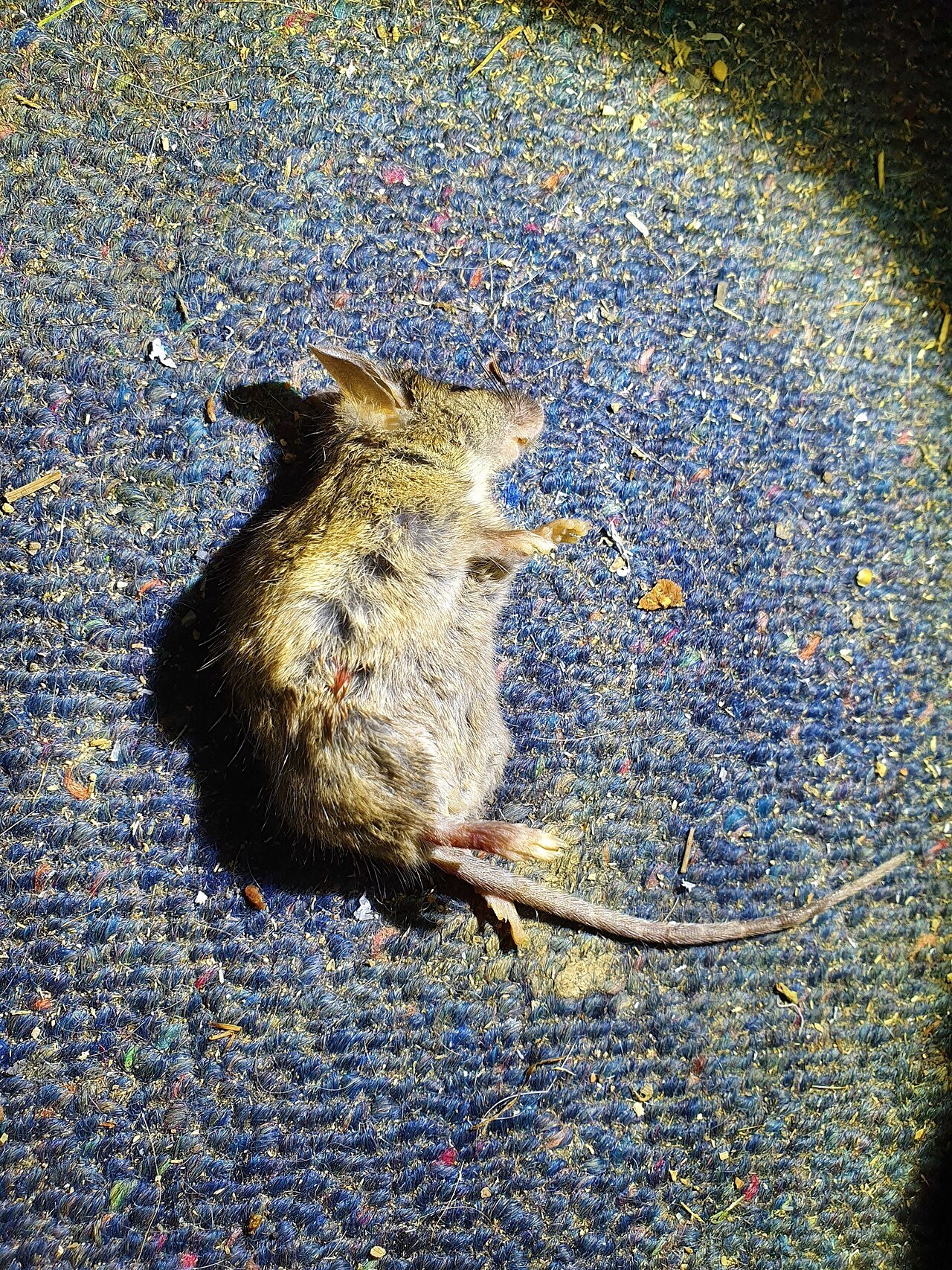
Residential Vandalia’s mouse year is written by its open edges. All summer, house mice and their two-toned country cousins — deer mice, common near the buffer lands and floodplain — live outdoors in field margins, fence rows, and equipment areas, breeding through the warm months at full speed. The first hard October frosts flip the switch: populations move toward heat, and the houses nearest the open ground — the streets backing the airport buffers, the park edge, the remaining ag parcels — take the front of the wave through garage doors, utility penetrations, and the dime-width foundation gaps every house accumulates. The postwar ranches funnel entries through garage weatherstripping and slab-level utility runs; the older National Road-era homes add stone-foundation sill gaps and porch junctions. By December the wave is indoors — walls, attics, garages — and by February it’s been breeding there for two generations, which is the arithmetic (run it here) behind our standing Vandalia advice: the September exclusion audit beats the January emergency call by every measure that matters.

The Residential Program
- Evidence first: droppings mapped (rice-grain versus anything larger — the species call changes the hardware), runways read, and the deer-mouse question answered early, because their presence upgrades cleanup protocol: wet-method droppings removal, gloves, ventilation, never dry sweeping (the full forensics here).
- Trapping on the commute: snap traps perpendicular to baseboards and sills along the actual routes — garage walls, utility rooms, attic wall-plates — checked and cleared on schedule. No poison inside structures: a bait-killed mouse in a wall void trades a scratching noise for a three-week odor (the whole case).
- Exclusion to the dime standard: copper mesh and sealant at utility penetrations, sill gaps, and porch junctions; fresh sweeps on garage doors — the airlock most Vandalia mice actually use; and the attic’s gable-vent screening where the noise has gone overhead.
- Exterior stations where the edge pressure is chronic: locked bait stations along the field-facing fence lines — rodenticide’s one correct role, far from interiors, pets, and the owls working those same edges.
- Verification before victory: flour patches, silent nights, and a clean follow-up pass — then the quarterly Protection Plan holds the perimeter against next October’s wave.
The Commercial Side: Docks, Pallets, and Paper Trails
Vandalia’s warehouse and logistics operations run rodent exposure most towns never think about: every inbound pallet is a potential introduction, every dock door a standing invitation, and every audit — customer, insurer, or regulator — a reason the monitoring paperwork matters as much as the catch count. Our commercial rodent work here follows the industry standard playbook: perimeter station grids on a documented service schedule, interior monitoring at the dock-and-storage transition zones, door-sweep and dock-seal exclusion surveys, and the logbooks that satisfy an auditor before the question finishes being asked. Food-adjacent and pharma-adjacent operations get the tighter protocol their certifications specify. The full program — and the vertical-specific details — live on our warehouse pest control and commercial services pages; the Vandalia-specific note is simply pressure: a logistics corridor between an airport and a floodplain runs a baseline no downtown office park ever sees, and the operations that treat rodent control as infrastructure — not incident response — are the ones whose audits stay boring.
The Vandalia Calendar, Both Fronts
September: the exclusion month — residential audits before frost, commercial door-and-dock surveys before the freight season peaks. October–February: the indoor season — trapping campaigns, wall-and-attic work, and the year’s heaviest call volume, led by the field-edge streets. March–May: cleanup and verification — droppings remediation (deer-mouse protocol where the ID says so), insulation spot repairs, and the post-winter station audit. Summer: the outdoor reservoir rebuilds in the margins — the season for brush-line management, fence-row cleanup, and the habitat moves that shrink October’s wave before it forms. One flat price on the residential side, documented service agreements on the commercial side, and the same standard behind both: trap and seal first, poison only in locked stations at the edge, and verification before anyone declares victory. Everything else we handle in town is on the Vandalia pest control page; the service itself at rodent control.
Field-Edge House or Freight-Dock Operation?
Two rodent stories, one local crew — trap-and-seal residential programs and audit-ready commercial grids, flat-priced and guaranteed across Vandalia.
Frequently asked questions
Why do Vandalia houses near the airport get so many mice?
The buffer lands and remaining farm parcels sustain large outdoor field populations all summer, and October’s first frosts push the wave toward the nearest heated structures — the field-edge streets take the front of it annually until exclusion closes the routes.
What is the two-toned mouse in my Vandalia garage?
Likely a deer or white-footed mouse — the field-edge specialist, brown above with a crisp white belly. The ID matters: deer mice carry hantavirus risk, which means wet-method droppings cleanup with gloves and ventilation, never dry sweeping or shop-vacs.
When should I mouse-proof my house in Vandalia?
September — before the frost migration, while the population is still outdoors. The same audit in January is damage control; in September it’s prevention, and it’s the single highest-value hour of the rodent year here.
Do you use poison for mice in Vandalia homes?
Not inside — poisoned mice die in walls and attics, trading a noise for weeks of odor. We trap on the runways and reserve rodenticide for locked exterior stations along chronic field-edge pressure lines, away from pets and the owls working those same edges.
Do you service warehouses and logistics operations in Vandalia?
Yes — documented station grids, dock-transition monitoring, exclusion surveys, and audit-ready logbooks are our standard commercial program, tuned for the corridor’s freight-driven pressure. Food- and pharma-adjacent operations get their certification-specific protocols.
How do mice keep getting into a warehouse?
Freight and doors: inbound pallets carry introductions, and dock doors and worn seals stand open to the field populations outside. Dock-seal exclusion plus a maintained perimeter grid turns a chronic problem into a logged non-event.
How many mice does one fall sighting mean?
Assume a family — by the time one shows, the colony is usually established and breeding on a six-week generation clock. Trap counts and droppings maps give the real census; two silent weeks with clean flour patches is the finish line.
What does rodent control cost in Vandalia?
Residential runs one flat price — inspection, trapping, sealing, verification — with the Protection Plan holding the perimeter after. Commercial operations get scoped service agreements sized to the facility and its audit requirements.
Vandalia’s full service picture continues with termite control in Vandalia, cockroach control in Vandalia, and bed bug treatment in Vandalia.