
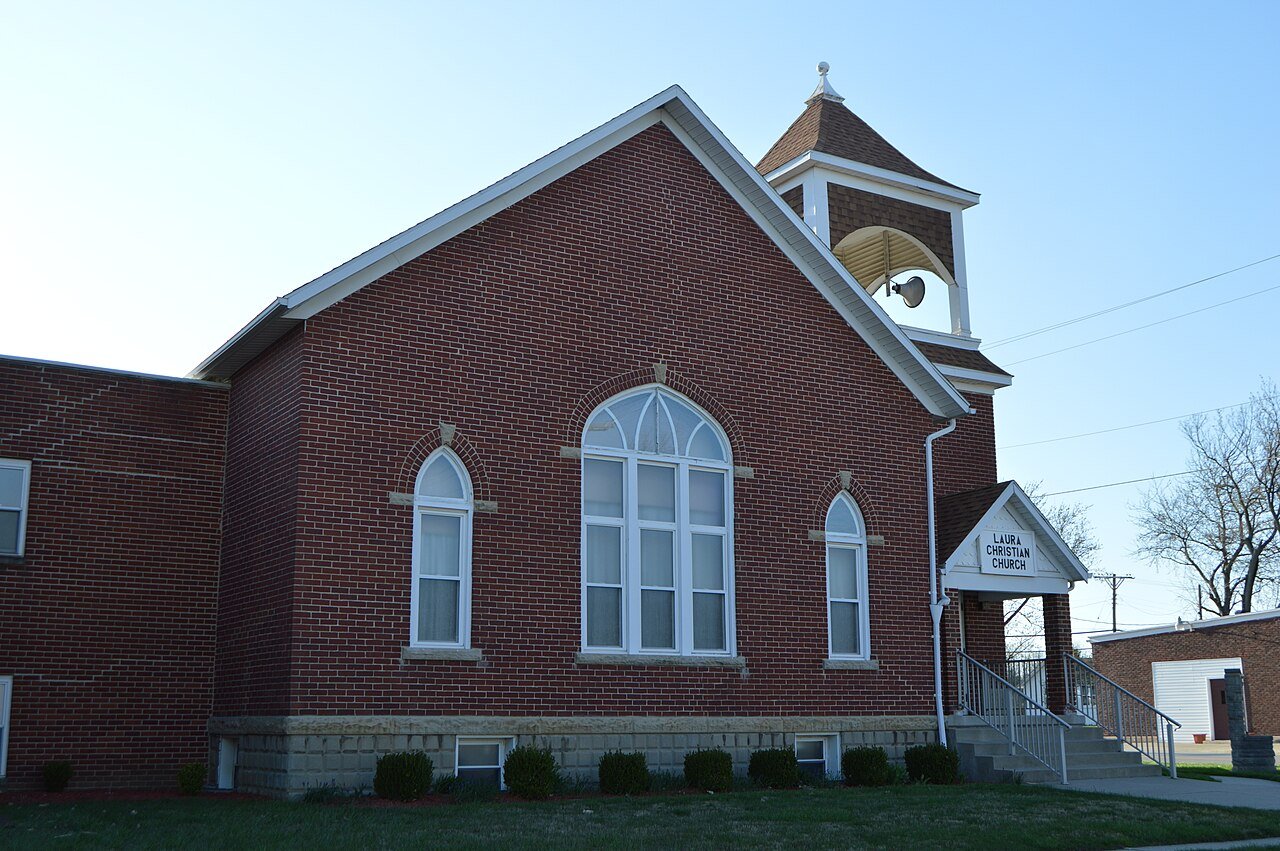
Laura is the quiet heart of the county’s southwest — a village of about 450 in Union Township’s rolling grain, its water tower the tallest thing between the Stillwater’s wooded valley and the Darke County line, its Christian Church and municipal building holding the corner the way they have since the 1890s. The kids ride to Milton-Union with West Milton’s; the farms run to every horizon; the neighbor hamlets — Potsdam two miles north, Ludlow Falls down the creek road — share the loop, the schools and the seasons. Greater Dayton Pest & Rodent covers all of it: ants, mice and rats, wasps, termites, mosquitoes, spiders, roaches and bed bugs, on the west-county loops. (937) 569-3330, or book online.
Searching Laura exterminator and searching Laura pest control turn up the same thing here. One is the old name for the other.
The upland hamlet: doctrine on the plateau
Laura sits on the upland between watersheds — no river frontage, no interchange, just the plateau’s grain and the village grid — and that plainness is its pest profile: the purest two-campaign year on the west side. The autumn campaign is everything here. Union Township’s sections empty at harvest, the migration files toward the village’s hundred-odd heated foundations, and the September exclusion pass decides the entire winter — the hamlet arithmetic at its cleanest. The summer campaign is the eaves-and-outbuildings patrol: frame porches, garden sheds and the garages every village lot carries, each one prospected by wasp queens every May, each one clearable at starter size in a single spring pass. Between campaigns the upland coasts — drier basements than the river towns, moderate mosquito pressure (ditch-fed, not river-fed), and the honest word that a well-sealed Laura house is one of the lowest-maintenance addresses on our whole eight-county map. Plainness, properly defended, is a luxury — the plateau’s houses just need the defending done once and checked annually.
Union Township’s working land: campuses, tree farms and the five-acre class
The township around Laura works its land in more registers than most: serious grain campuses, century farmsteads, a Christmas tree farm whose rows change the winter ecology of their corner (conifer stands hold overwintering insects and shelter rodent runs the open grid doesn’t — adjacent households get that read in their inspection), and the growing five-acre pole-barn class filling the section roads. The farm-campus doctrine covers the span: house, barn, machine shed and feed room quoted as one system, feed room hardened first, cat-respecting bait geometry, the farmhouse sealed the same visit, everything re-read after harvest. Tree-farm and orchard operations add the seasonal-crowd line — cut-your-own season brings November foot traffic and its snack economy just as the migration peaks, a small festival-doctrine cameo — and the mini-campus class gets the scaled rules with a straight face: the coop is the feed room, the pole barn is the barn, and the rules hold at every acreage. No mileage lines; the loops already run these roads.

The water tower’s view: reading the southwest quarter
From the tower’s height the southwest quarter reads as one system: West Milton’s river valley east, Potsdam’s crossroads north, Ludlow Falls’ wooded gorge southeast, and Laura’s plateau holding the dry middle. That’s the service map too: the west-county loops thread all four on standing schedule, which gives every hamlet city-grade response without a city address — next-day norms, genuine same-day capability most loop days, the priority lane at no markup county-wide. The quarter’s pest gradients follow its water: the creek and river corridors run the moisture profile (mosquitoes, wildlife traffic, damp basements), the plateau runs dry-grid calm, and a mile of township road can move a house from one profile to the other — which is why the inspection reads the address, not the town name, and why two Laura-adjacent farmsteads can carry honestly different plans.
Frame houses, dry cellars: the plateau’s era-read
Laura’s housing runs the west county’s familiar catalog at hamlet scale — 1890s frame survivors near the church corner, foursquares and bungalows filling the grid, postwar ranches at the edges, farmsteads immediately beyond — and the plateau setting gives the whole catalog its best-case version: dry cellars, honest grade lines, less of the moisture pressure that complicates the river towns’ old stock. The twelve-doors inspection still earns its keep (weather-worked frame seams are mouse doors on any plateau, and a century of porch repairs leaves its usual gaps), but the plan that follows is usually the lean one: seal once with reversible materials, September perimeter annually, monitoring where the ambient pressure warrants, and the honest word that more would be theater. The termite file runs the same lean logic — the dry upland keeps baseline pressure moderate, the local multipliers (mulch over sills, downspouts at foundations, wood-to-soil contact) do the recruiting, and monitoring-first protection with Bryan’s 10A/10B/Category 12 licensing behind it covers both the vigilance and the WDI paperwork when a farm or village property changes hands.
The Laura pest calendar
February–March: winter mice audible in frame walls; exclusion weather. April–May: ant files wake; queen patrols clear porches, sheds and the garden outbuildings; swarm watch where wood meets soil. June: ditch-country mosquito season opens modestly; the plateau coasts while the creek roads gear up. July–August: high summer’s steady defense; fair month pulls the township to Troy; wasp colonies build toward their peak. September: the anchor — perimeter at yellowjacket maximum, exclusion ahead of the harvest migration; the plateau’s whole winter decided in one visit. October–November: seal-and-check, post-harvest campus audits, tree-farm season’s small crowd cameo. December–January: interior follow-ups and next year’s plan, priced in the quiet the plateau does best.
Why Laura calls us
- The plateau is on the map: no density minimums — Laura rides the west-county loops at the county’s full standard and published prices.
- Lean-plan honesty: dry-plateau houses get the lean plan and the plain word that more would be theater — the inspection reads the address, the quote follows the read.
- Campus fluency: grain campuses, tree farms and five-acre mini-campuses quoted as the systems they are.
- Two honest tiers: one-time jobs at posted prices; the Protection Plan’s re-treatment guarantee when the year should be owned.
- Photo-first triage: text the evidence to (937) 569-3330 — free identification always, honey bees to beekeepers free, every time.
Laura questions, answered straight
Our place is the dry-basement exception’s exception — it floods at the corner every thaw. Why?
Plateau drainage is good on average and specific at every address: a downspout line, a driveway grade or a filled-in swale can hold thaw water against one corner of an otherwise dry foundation, and that one corner then runs the river-town profile in miniature — camel crickets, spring millipedes, termite interest at the damp seam. The fix is half plumbing, half pest work: re-route the water, then seal and monitor the seam it fed. We diagnose both halves in one inspection and only bill for ours.
The tree farm’s our neighbor — does that actually change anything?
Modestly and predictably: conifer rows hold overwintering insects (the fall ladybug-and-stink-bug sun-side gathering runs heavier near evergreen stands) and shelter rodent runs the open grid doesn’t, so adjacent households get slightly warmer baselines and a fall-exclusion emphasis. It’s a gradient, not a grievance — the rows also hold the songbirds and the school-trip season — and a sealed foundation retires most of the difference. The inspection names it; the plan answers it; nobody panics over Christmas trees.
One truck for Laura, Potsdam and Ludlow Falls — do we wait longer for it?
The opposite: shared loops are why the hamlets never wait. The truck that serves the quarter is scheduled through it weekly regardless of any one address, so your call slots into a standing route instead of justifying a special trip — next-day norms hold, same-day works most loop days, and the priority lane reaches the plateau at the same no-markup policy as Troy’s corridor. Small places wait longest with companies that route from call centers; ours routes from the map.
Do it yourself, or call?
The plateau split, plainly drawn. Reasonable DIY: the reachable paper-wasp umbrella, a rain-week ant file, one mouse in a tight garage, the fall spider sweep of a genuinely dry cellar — the guides cover it all free. The call list: anything inside a wall or soffit void, termite evidence at any wood-soil seam, campus-scale rodent pressure, bed bugs anywhere, bats always, October lawn nests, and any problem outlasting its third store-bought remedy — recurrence means a condition, conditions need diagnosis, and the photo line runs diagnosis free. On a plateau this dry, most calls end with the lean answer and a short bill; the ones that don’t are exactly the ones worth catching early.
Landlords and the quarter’s scattered doors
Rental doors across the southwest quarter — village frame houses, farmhouse leases, the occasional double — get the landlord program from door one: per-door pricing, direct-tenant scheduling, per-unit documentation, and the farmhouse-lease clause covering the campus pressure a tenant can’t manage. The grain-country ledger closes the pitch as always: one September pass per unit beats one February emergency, every year, at every address on the loop.
The plateau, kept plain
Laura’s whole pitch is the county’s quietest: a dry grid, a lean plan, a loop that never misses, and a September that does the year’s heavy lifting in an afternoon. From the church corner to the tree farm’s rows to the last section road toward the Darke line, the southwest’s calm middle is read, quoted and covered — with Potsdam, Ludlow Falls and West Milton on the same trucks and the county page holding the roster. Text a photo to (937) 569-3330, take the free identification and the lean, honest quote, and let the water tower keep watch over one more quiet winter.
The lean-plan philosophy: why less is a promise, not a shortcut
Laura’s page is the right place to write down something the whole eight-county roster runs on: the lean plan is a discipline, not a discount. Pest-control economics reward over-selling — every franchise script upgrades a dry plateau ranch to the full river-corridor program because the customer can’t audit the difference — and the industry’s reputation pays the interest on that habit. Our counter-discipline is the address-level read with the price attached: if your fifty feet run dry-grid calm, the quote says so and stays small; if they run corridor-wet, the quote says that instead and explains why; and the inspection that sorts you is free either way, so the sorting itself can’t be a sales lever. What makes the discipline durable is the guarantee structure — the workmanship guarantee on sealed entries and the Protection Plan’s re-treatment promise mean we eat the cost of under-calling a risk, which aligns the read with reality better than any mission statement could. A hamlet audits its tradespeople over decades, not transactions; the lean plan is how a route company passes that audit, and the plateau’s quiet houses are the ledger it’s written in.
That’s Laura: the calm middle of the map, served without drama at prices that respect the calm. The west-county loop climbs past the water tower weekly; one photo to the triage line puts your address on it, and the plateau does the rest.
Milton-Union mornings: the school-run township
Laura’s children bus east to the Milton-Union campus, and the shared district knits the southwest quarter into one family-life system — game nights in West Milton, practices and pickups threading the township roads, the school calendar setting the rhythm every household schedules around. Our family standard rides the same rhythm: tamper-resistant everything, treatments placed where children and pets aren’t, appointment windows that respect the school run, and the plain-spoken triage that tells a parent when the pantry moths are a five-dollar fix and when the wall noise is a real job. The Protection Plan fits the commuting-family life best — the year owned at a flat rhythm, the September anchor doing its quiet work while everyone’s at practice — and one-time problems get one-time prices, posted, because a school district is also a referral network and we plan to keep earning ours.
The pollinator line, plateau edition
Garden country rules hold on the plateau: honey bee swarms and colonies are never treated — beekeeper referral, free, every time, ten-second photo test; solitary ground bees in the spring lawn get “leave them working” unless allergy changes the math; bloom-adjacent treatments get timed around the foraging day; and the yellowjacket-versus-bee call is what the free photo line exists for. The township’s gardens, orchard rows and the tree farm’s understory all run on wings; the pest program defends the kitchen without taxing them, by policy and on purpose.
Wasps, sheds and the outbuilding census
If the plateau has a signature summer pest, it’s the outbuilding wasp economy: every village lot and farmstead carries its shed count — garden sheds, detached garages, well houses, the pole barns of the five-acre class — and every structure is a wasp queen’s spring shortlist. Sheds run warmer than eaves (still air, sun-heated roofs, undisturbed corners), which is why the township’s July nests are so often discovered at full softball size behind a door nobody opens twice a month. The spring queen patrol is the counter: one pass in May walks the whole outbuilding census, clears starter nests at golf-ball size, treats the favored corners, and retires the July surprise for the season. Paired with the September anchor it makes the plateau’s two-campaign year complete — and it’s the cheapest line on the whole wasp file, priced as the quick preventive sweep it is rather than the emergency it prevents. Ladder heights, wall voids and anything defending its nest hard belong on the call list, not the weekend list; the one-time rates post the removal prices by nest type and height, no drama included.
One last plateau note, because the quarter’s households compare notes: the Laura–Potsdam–Ludlow Falls loop day makes neighbor referrals genuinely efficient — a new address on an existing loop adds minutes, so there’s no surcharge, no waitlist and no minimum, and the “my neighbor uses you” call is the easiest booking in the company. Hamlets defend best together (every sealed foundation shrinks the winter carrying capacity for the grid), and the loop’s economics reward exactly that — the more of the plateau on the schedule, the sharper the schedule gets. The water tower has watched the village keep itself plain and solvent for a century; the pest ledger should read the same way, and on this loop it does.
Laura, the file is open and the loop runs weekly — one photo, one lean quote, and the calm middle of the county stays exactly that.
From the church corner’s Sunday quiet to the tower’s long view over the grain, the plateau asks little and deserves it done right: the twelve doors sealed once, the May patrol walked, the September anchor kept, the prices posted. That’s the whole covenant, it fits on a fridge magnet, and the west-county loop has honored it at every hamlet on the map. Welcome to the roster, Laura.
Quiet grid, kept promises — the plateau’s way, and ours.
Who actually turns up in Laura: Greater Dayton Pest & Rodent is owned and operated by Bryan Camden, licensed by the Ohio Department of Agriculture — firm #115079, commercial applicator #170858, categories 10A, 10B and 12. When you call, you talk to the person who does the work. No call center, no rotating crews, and the same technician on every visit.
Frequently asked questions
Do you provide pest control in Laura?
Yes — the small Union Township village rides the Miami County rotation with West Milton and Potsdam; every address, full program.
What pests are most common in Laura?
Farm-belt village standards: harvest rodent surges, older-home foundation mice, farmstead wasps, stink bug flights off the surrounding fields, and stored-grain pests on the ag properties.
How much is pest control in Laura?
County formula, village scale irrelevant: most homes $39–$55/month quarterly; campuses walked; free: (937) 569-3330.
Why do small villages get the same fall surge as farms?
Because the village IS the shelter — a cluster of heated structures amid working acreage catches the displacement wave whole; September sealing carries every address in town.
Do you treat Union Township farms?
Campus model — systems quotes, harvest calendars, deer-mouse protocols; the township lanes are standing route work.
How fast can you reach Laura?
Weekly rotation — days typically, no travel charges.
Is service in a village this small really practical?
The route-day model makes it exactly as practical as Troy — and the dedicated page you are reading is the proof of intent: every community on the map gets known-by-name service.
What about barn wasps and fencerow globes?
The farmstead file applies: eave-line combs on patrol schedules, globes triaged honestly (frost verdicts for the remote, protocol for the traffic).
Is the Protection Plan right here?
Farm-adjacent and older homes, yes — standing exposure warrants quarterly; the first-call triage stays honest for the rest.
How do I start service in Laura?
Instant quote, free photo ID, or (937) 569-3330 — free estimates, route days weekly.