Harveysburg holds its hilltop above Caesar Creek like it has since the 1820s — a Quaker-founded village whose 1831 schoolhouse was Ohio’s first free school for Black children, whose autumn hosts the Renaissance Festival’s armored crowds on the ridge east of town, and whose pest file is the county’s purest lake-country edition: state-park forest and water on three sides, a compact historic grid absorbing the wild edge’s full attention, and a festival-season pulse no village this size ordinarily meets. Greater Dayton Pest & Rodent covers Harveysburg and the Massie Township lanes on the southern Warren loops — full service list, two-tier structure, no mileage lines, and the edge-village literacy the hilltop’s geography demands.
Some of our Harveysburg customers found us searching for an exterminator near me. The honest answer to that search is somebody local enough to come back for free when something returns.
The lake-country village file
Caesar Creek’s thousands of forested, watered acres wrap Harveysburg closer than any park wraps any village on the county roster, and the concentrated-pressure arithmetic runs here at maximum: the park’s woodland deer mice choosing among a few dozen structures each fall, carpenter ant parent colonies in unbroken mature timber within trunk-trail reach of every roofline, tick margins wherever the grid’s yards trade edges with park brush, the lake’s insect column feeding spider economies at every porch light, and the seasonal camping-and-marina traffic keeping the park’s human edge busy all summer. The village’s historic stock — Quaker-era survivors and their successors on cellar-era foundations — meets that pressure with the heritage vulnerabilities the county’s oldest grids share, which makes the full edge doctrine non-negotiable here: sealed structures to the twelve-doors standard, September barriers as village religion, wood lines managed at every yard’s boundary, and the wild side respected as the permanent neighbor it is. Three sides of park means three sides of pressure — and one calendar holding all of it.
Festival season: the fortnights that triple the village
Every autumn weekend for two months, the Renaissance Festival’s grounds east of the village host crowds that dwarf Harveysburg’s population many times over — turkey legs, ale, and all the concentrated food traffic a period fair generates — and the county festival doctrine meets its most dramatic local case. The mechanics run as they do everywhere calories mass in autumn: scavenger yellowjackets peaking exactly on the festival calendar (October ground colonies at their year’s maximum meeting the year’s maximum outdoor dining), post-weekend food-waste pulses testing every dumpster line and residential can within range, and the traffic-and-parking spillover pressing the village’s edges each Saturday. The festival grounds run their own operations; the village’s share of the season — the businesses catching festival traffic, the homes along the routes, the rental stock serving the vendors and cast who summer here — runs ours: pre-season wasp patrols in September, tight-lid discipline through the run, and the post-festival inspection that reads what two months of crowds seeded. Fair season is the hilltop’s economic harvest; the calendar keeps it from becoming anything else’s.
A Harveysburg seasonal calendar
- March–May: the park wakes — ants into the village kitchens, termite swarms photographing same-day in the Quaker-era stock, tick season opening on every edge
- June–August: lake-country peak — camping traffic, marina season, spiders prospering at every light, wasps scaling toward their festival-season maximum
- September–October: the hilltop’s crescendo — the woodland push off three sides of park, invader flights on the sunny grid, and festival weekends layering their pulse over all of it; the September visit is the village’s whole strategic calendar in one appointment
- November–February: the quiet — interior mouse season in the old stock, exclusion weather, and the grid’s finite gaps getting their steel while the park sleeps
The Harveysburg lineup, ranked
- Mice — the park’s fall push at maximum concentration against a compact historic grid (rodent control)
- Wasps & yellowjackets — festival-season scavenger surges layered on lake-country baselines (removal guide)
- Ticks — three sides of park brush meeting village yards; margin discipline as standing policy
- Carpenter ants — unbroken mature timber within reach of every roofline (their file)
- Spiders — the lake’s insect column at every porch light (the census)
- Fall invaders — lady beetles and cluster flies on the hilltop’s sunny walls (the October file)
- Termites — Quaker-era sills on annual vigilance; WDI reports for the village’s transactions
- Mosquitoes — the lake country’s season, graded by the hilltop’s drainage (seasonal service)
Harveysburg questions we hear
Does living against a state park mean the pest fight is unwinnable?
It means the fight is permanent and the winning is structural — the distinction every edge page on this site draws, at this village’s maximum dose. The park’s populations cannot be reduced and should not be (they are the point of the park); the village’s structures can be sealed completely and stay that way; and the households running the full doctrine — steel in the finite gaps, September kept, margins managed — live comfortably against habitat that would overrun an undefended house in two seasons. Harveysburg’s compact grid makes it the county’s best candidate for the seal-the-whole-village play: a few dozen structures, coordinated Septembers, and the park’s entire annual push meeting a hilltop with no openings. The wild side never negotiates; the sealed side never needs to.
The festival brings us seasonal renters and vendor traffic — anything special there?
The turnover file, festival edition: seasonal rentals cycling cast and vendors run the same introduction risks as any high-turnover housing — inspect between tenancies, hot-dry the linens, keep the evidence literacy handy — and the properties storing festival gear across the off-season (trailers, costume stock, vendor equipment) run the storage protocol at theatrical scale. Landlords serving the season get turnover inspections timed to the run’s calendar; the village’s festival economy deserves programs that know its rhythm, and ours has marked these weekends for years.
Warren coverage: county hub · Waynesville · Corwin · Morrow · full service area.
The schoolhouse standard: stewarding a village that made history
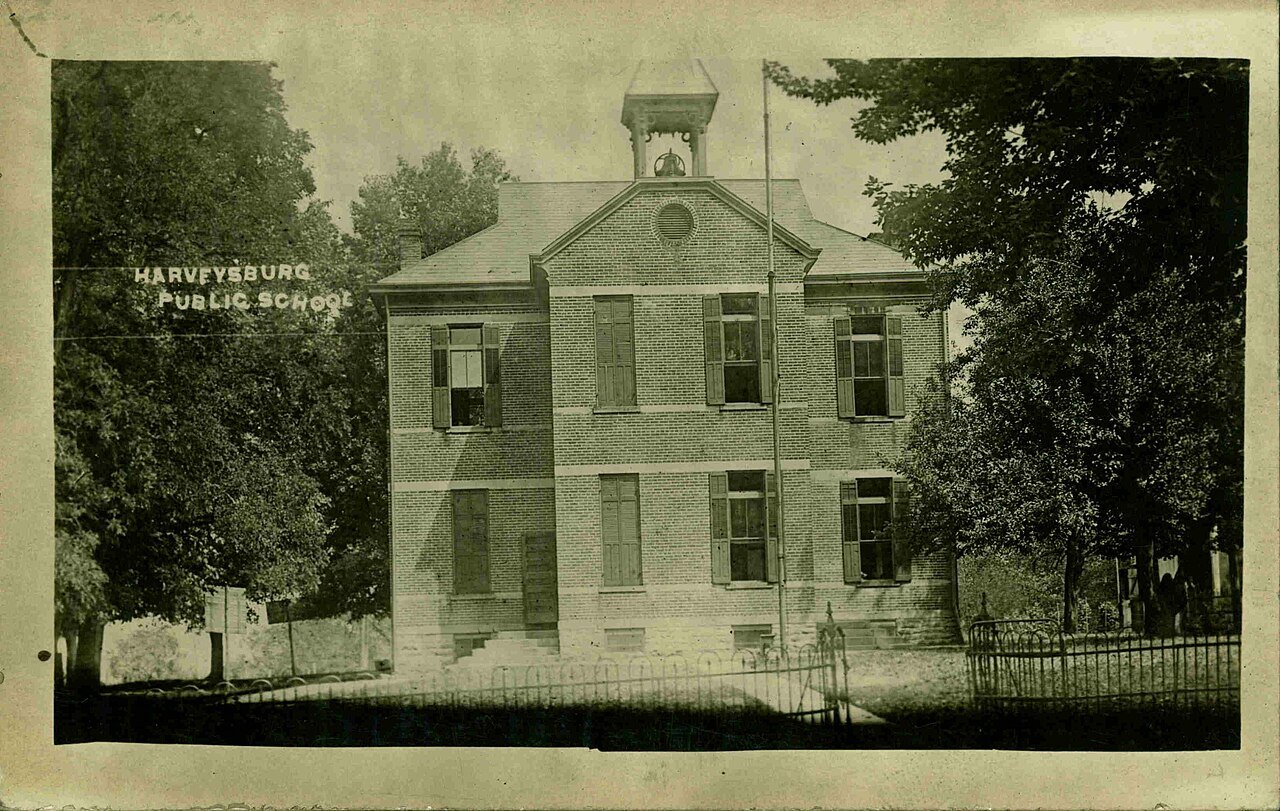
The 1831 schoolhouse in the photograph is Harveysburg’s argument for taking building stewardship personally: Ohio’s first free school for Black children still stands because generations of this village decided it would, through eras when standing was not guaranteed, and the preservation ethic that kept it is the same one this site’s heritage doctrine serves — reversible materials, era-appropriate craft, moisture managed before damage, and the annual attentions that keep irreplaceable fabric merely old instead of gone. The village’s Quaker-era survivors get that standard on every visit (mortar-and-mesh exclusion, old-timber termite vigilance, void treatments through existing access), and the schoolhouse itself stands as the local proof that maintenance is a form of memory: buildings hold their histories exactly as long as someone holds their calendars. Harveysburg has been holding calendars since 1831; our September just joins the tradition, steel in hand, on a hilltop that has always known what keeping things means.
What a Harveysburg first visit looks like
The edge-village hour at full attention: the complete perimeter lap with the park-side boundaries walked as seriously as the foundation (staging habitat, margin conditions, the wood line’s reach toward the roofline), the heritage read on the old stock’s cellars and sills, outbuildings included as the campus doctrine demands, and the tick-margin audit every three-sided-park property earns. Findings photographed, homework separated from invoice, quote before scheduling — and the two-tier read here lands plan-side more often than anywhere in the county, because maximum permanent pressure is precisely the Protection Plan’s design case: the park never rests, so the calendar should not either. One-time work remains honestly available; the geography just states its preference plainly, and we relay it the same way.
Massie Township and the park’s working perimeter
The township lanes around the hilltop run the county’s campus doctrine against the park’s working perimeter — farmsteads and acreage places whose whole-parcel reads weight the edge variables to their maximum: feed rooms hardened against the woodland economy’s standing interest, barns triaged with the park’s carpenter-ant pressure in mind, equipment on the storage protocol in country where every unvisited structure is habitat-adjacent, and the September calendar kept with lake-country seriousness. The park’s recreation infrastructure adds its working accounts — the marina-and-campground service economy, the trail-margin businesses, the seasonal structures on seasonal programs — and the whole perimeter shares the hilltop’s arithmetic: pressure at maximum, defense by calendar, and the wild side’s magnificence enjoyed from behind honest steel. Township addresses ride the southern loops at village pricing; the park’s perimeter has been working ground since before the lake existed, and the doctrine reads it lane by lane.
One Harveysburg tip worth the page: the margin walk
The three-sided village’s highest-return habit costs one hour each September: walk your property’s park-facing margins with a critical eye — brush touching the fence, wood stacked against anything, leaf litter drifted to the foundation, limbs reaching the roofline, tall grass holding the tick file at your yard’s edge — and correct what the walk finds before the fall push tests it. The margin is where the park’s pressure meets your defense, every item on the list is free to fix, and the households that walk it annually hand the September visit a property already half-defended. The wild side sends its census every October; the margin walk is how the hilltop answers before the question arrives: (937) 569-3330 for everything the walk cannot reach.
Family standard and the village’s working stock
The site-wide bedrock rides every hilltop visit — placed applications, tamper-resistant equipment, stand-off buffers for the gardens and dog runs, the placement-over-potions doctrine entire — with the edge-village addendum that outdoor-loving households here get the tick-and-margin briefing as part of every plan: the park’s gifts include its parasites, the yard-edge disciplines that manage them, and the honest calibration (Ohio’s tick risks are real and manageable, not Lyme-belt catastrophic) that keeps families hiking instead of hiding. The village’s modest rental stock runs the small-portfolio playbook at hilltop scale, festival-season turnover included per the file above. Villages this size raise their children half-outdoors by design; the standard keeps the design working.
DIY or call: the hilltop fork
The maximum-edge split: genuinely DIY — the margin walk above, the compact grid’s twelve-doors Saturday, storage-protocol discipline on the gear and trailers, and the reachable paper-wasp umbrella at dusk; professional territory — the heritage fabric’s exclusion and termite files, the park-pressure populations that out-scale counter methods by definition here, void and ground yellowjackets per the never-plug doctrine (festival season makes the ground-colony file genuinely serious each fall), and every third-failure pattern. The photo line arbitrates free, the hilltop’s households know their own ground better than most, and the fork’s honest answer at maximum edge pressure tilts professional more often than the county average — which this page says plainly rather than letting the aisle teach it expensively.
The bottom line for the hilltop
Harveysburg’s file is the county doctrine at its purest concentration: maximum edge pressure against minimum village footprint, heritage fabric worth museum-grade care, and a festival season that borrows a city’s crowds for a village’s autumn — answered by the doctrine at full strength on the southern loops: complete-seal candidacy for the grid, September as religion, margin discipline at every boundary, festival-calendar readiness, and every site-wide promise (free quotes, free photo identification, no mileage lines, the two-tier guarantee) honored to the park’s edge. (937) 569-3330, Monday–Friday 8–6, Saturdays by appointment: the hilltop covered, the calendar kept, the wild side respected from behind good steel. Greater Dayton Pest & Rodent, Ohio licensed — ODA Pesticide Business License #115079 — the village that made history in 1831 gets its file made in full.
What does hilltop work cost?
The unchanged answer at the county’s wildest edge: job-priced, never geography-priced, the cost guide’s ranges intact, and the seal-the-village coordination economics at their absolute best on a grid this size — a few dozen structures could batch the county’s most efficient September on record, and the neighbors who organize it will hear our routing gratitude in the number. Free firm quotes before work, one number for the hilltop and its township: (937) 569-3330.
The lake’s long story: what Caesar Creek’s making meant for the hilltop
One more chapter the village’s elders remember firsthand: Caesar Creek Lake is younger than much of Harveysburg’s housing — the Army Corps closed the dam in the 1970s, the valley communities below made way for the water, and the hilltop watched its landscape transform from farm valley to lake country inside a generation. The pest-file translation matters: the park’s forest is largely regrowth still maturing (its carpenter-ant and woodland economies deepening as the timber does — edge pressure here trends upward by design), the lake’s recreation infrastructure imported the seasonal-traffic files a farm valley never carried, and the drowned valley’s displaced ecology resettled the margins the village now borders. Harveysburg’s edge pressure is not ancient equilibrium; it is a fifty-year-old arrangement still finding its level, which is one more reason the hilltop’s calendar discipline earns its keep — the wild side is still growing into its role, and the village’s defense should assume the neighbor keeps getting stronger. It will; the doctrine is built for exactly that; and the hilltop that adapted to a lake can certainly adapt to a schedule.
Festival vendors and the traveling-structure file
A closing specialty the Renaissance grounds make locally relevant: the festival’s vendor economy runs on traveling structures — booths, trailers, stage sets, and costume stock that winter in barns and lots across the township between seasons — and traveling structures run the storage file at its most colorful: fabric inventories reading as carpet-beetle habitat, trailer cushions and prop chests as deer-mouse real estate, and the spring reopening ritual deserving the wet-method respect every long-closed structure earns. Vendors and the properties hosting their off-season get the protocol consultation free with any visit: haul-in inspections, storage hardening for the hosting barns, and the pre-season checks that keep opening weekend about turkey legs instead of tenants. The fair’s magic runs on its logistics; the logistics winter in our township; and the file was going to exist either way — better written down, like everything else on this hilltop.
Licensed by the Ohio Department of Agriculture (Pesticide Business License #115079; applicator #170858 — categories 10A, 10B, and 12), insured, locally owned, and on the southern loops each week — from the 1831 schoolhouse to the newest lane against the park, the hilltop rides the schedule now. Three sides of wild, one side of calendar, and the calendar holds: Harveysburg, covered by name. Free quotes and photo identification every business day; the village that kept its history keeps its houses too.
And the county’s quickest referral: which neighbors share our loop?
The southern lake-country day typically threads Waynesville, Corwin, the hilltop, and Morrow’s valley in one sweep — which means Harveysburg bookings ride the antiques capital’s density, and a hilltop household coordinating with a Waynesville cousin’s appointment gets the county’s tightest scheduling for free. The lake country books as a country; the loop was drawn that way on purpose.
Hilltop, park, and calendar — the arrangement holds.
Who actually turns up in Harveysburg: Greater Dayton Pest & Rodent is owned and operated by Bryan Camden, licensed by the Ohio Department of Agriculture — firm #115079, commercial applicator #170858, categories 10A, 10B and 12. When you call, you talk to the person who does the work. No call center, no rotating crews, and the same technician on every visit.
Frequently asked questions
Do you provide pest control in Harveysburg?
Yes — the hilltop village above Caesar Creek sits on the Warren rotation; small community, full service, dedicated page.
What pests are most common in Harveysburg?
Lake-and-woods adjacency writes it: woodline wasps and bald-faced globes, deer-mouse pressure in outbuildings, fall rodent surges off the surrounding fields, and the festival-grounds seasonal patterns the Renaissance crowds bring each autumn.
How much is pest control in Harveysburg?
Village addresses pay the same formula as everywhere — no small-town premium, no distance charge: most homes $39–$55/month quarterly, one-time flat. Free: (937) 569-3330.
Does Caesar Creek proximity mean more pests?
More edge pressure of the manageable kind — the woods-and-water adjacency raises wasp, deer-mouse, and mosquito baselines; the edge-lot program (exclusion emphasis, sentries, seasonal barrier) fits the village exactly.
How fast can you reach Harveysburg?
Route days reach the village weekly — days typically, priority arranged faster, no travel charges.
Do you serve the village’s small businesses?
Yes — the local spots and the festival-season vendors’ needs both, with the same programs any Main Street gets.
What is the deer mouse protocol for village outbuildings?
Standing assumption — sheds and barns near the woods carry the two-tone mice, so the ventilate-then-enter habit and bleach-mist cleanup protocol apply, and outbuilding inspections lead every village visit.
Do the fencerow hornet globes need removal?
The honest triage: high and remote earns the free wait-for-frost verdict; over lanes and lots gets the professional protocol. The village grows impressive globes; most earn the acquittal.
Is the Protection Plan practical for a village home?
Edge-adjacent properties, clearly — the standing woods-and-field pressure never sleeps; the quarterly rhythm matches it. Interior village blocks can run leaner, and we say so on the first call.
How do I start service in Harveysburg?
Instant quote, free photo ID, or (937) 569-3330 — free estimates, route-day scheduling, first visits typically within the week.