The little sand volcanoes between the patio bricks, the brown ants filing out of the driveway’s expansion joint, the occasional startling battlefield of thousands writhing on an April sidewalk — and, some springs, the trail that finds the kitchen: pavement ants are the Miami Valley’s most-seen ant, the species living literally underfoot at every address with a slab, and the subject of the search this page answers completely (along with its aliases — the “cement ants” and “concrete ants” of regional vocabulary are the same insect, and the “biting ants” searches mostly land here too, at the mildest possible verdict). The file: the crack-dwelling biology that makes slabs their perfect landlord, the famous sidewalk wars explained (spring’s territorial battles — alarming, harmless, and genuinely worth watching), the honest threat assessment (structural: none; kitchen: seasonal and baitable; sting: technically present, practically irrelevant), the bait-first playbook tuned to this species’ specific appetites, the patio-and-paver management that’s really a sand-economics problem, and the one confusion with stakes — the termite-swarm lookalike moment every slab-dwelling species eventually produces. Greater Dayton Pest & Rodent, ant verdicts free by photo: (937) 569-3330.
The tenant underfoot: biology of a slab specialist
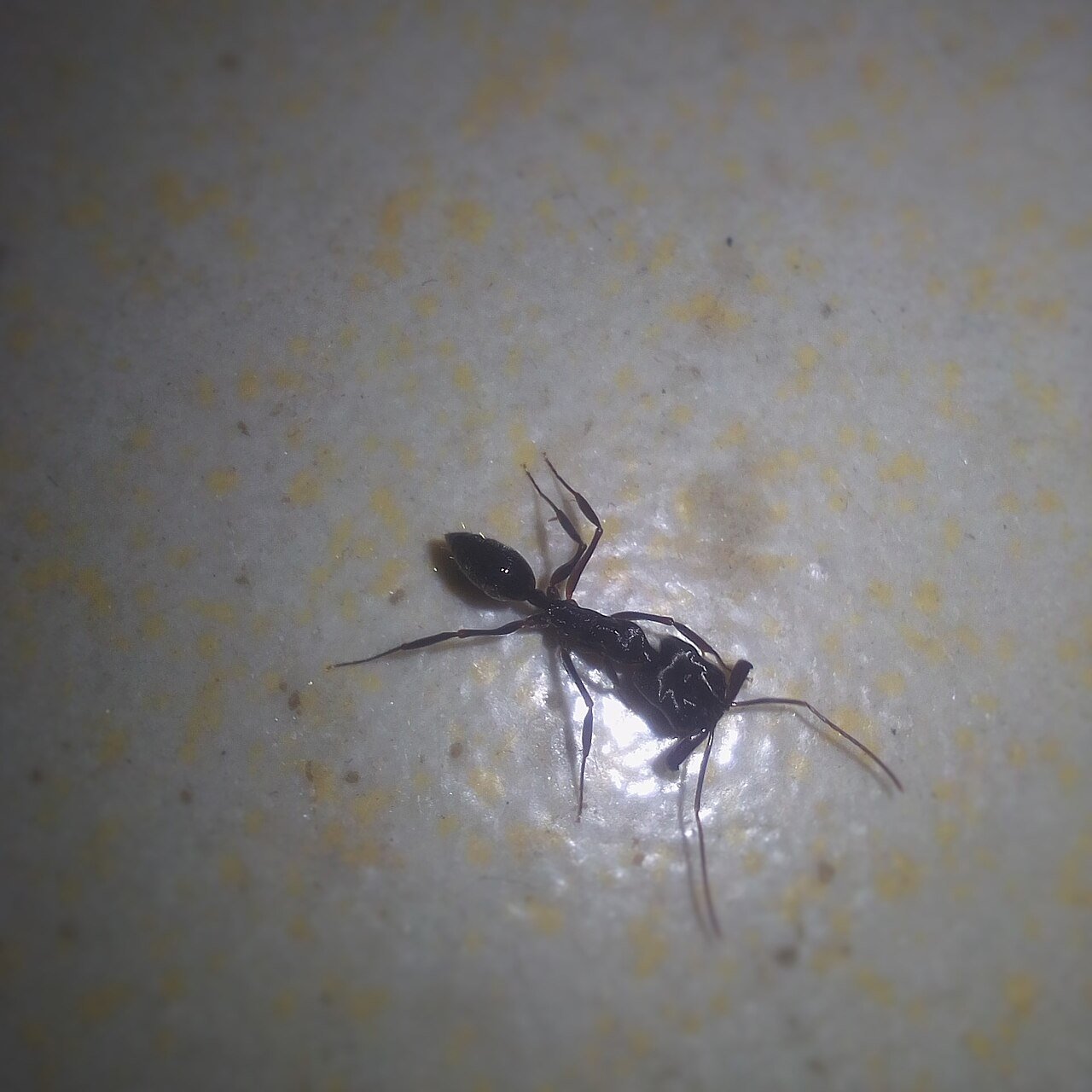
The pavement ant (Tetramorium immigrans — a European import so long established that American sidewalks feel like native habitat) is a small (eighth-inch), dark-brown ant whose field marks reward one phone-macro look: parallel grooves etched down the head and thorax (the sculpted look no other common local ant wears), a two-segment waist, and a pair of small spines on the thorax’s rear corners. The lifestyle explains the name and the neighborhood: colonies of several thousand nest in soil under and beside stones, slabs, and pavement — the concrete works as roof, heat-sink and moisture regulator all at once, warming the brood chambers on spring days weeks before open soil wakes — and the excavated sand volcanoes at crack lines are the spoil piles of continuous renovation (the patio’s “dirt piles” are subtraction from under your pavers, an accounting the paver section below settles). The diet is omnivorous with a sweet lead — honeydew from the aphid herds they farm on foundation plantings, plus grease, seeds, and whatever the picnic drops — making them textbook customers for the sugar-bait doctrine with a protein-cycle asterisk the playbook handles. And the temperament: mild to a fault — the sting the “biting ants” searches ask about exists (they’re distant fire-ant relatives, subfamily-wise) but barely functions on human skin, delivering at most a faint pinch under sustained provocation; the species saves its aggression entirely for other pavement ant colonies, which is the sidewalk-war story the next section tells.
The sidewalk wars (spring’s free spectacle, explained)
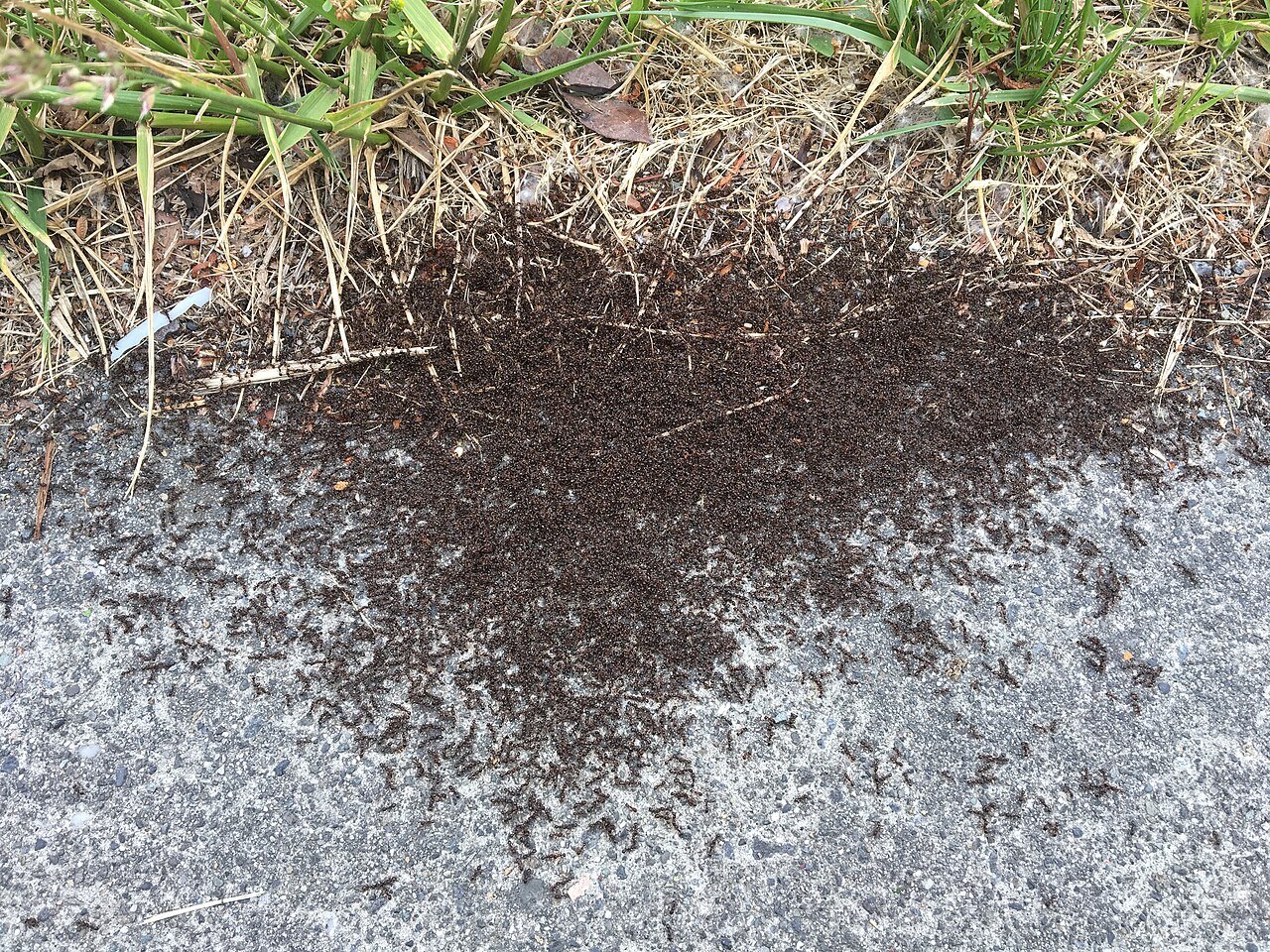
Every April and May, some Miami Valley sidewalk hosts the sight that generates the season’s most alarmed ant photos: a seething brown mat of thousands of ants locked in combat, spread across a square yard of concrete, bodies accumulating at the edges. This is the pavement ant border war — the species’ signature behavior, and one of urban nature’s great unwatched spectacles. The mechanics: neighboring colonies’ spring expansion brings foraging territories into contact, and disputes get settled by massed ritual-and-real combat at the boundary — workers grappling mandible-to-mandible in a battle that can run days, redrawing the property lines beneath your property lines. The household translations: it’s harmless to everything but the combatants — no swarm risk, no aggression spillover, no treatment warranted (spraying a border war kills the participants and changes nothing beneath — both colonies’ queens are home in their slabs); it’s diagnostic — a war marks the meeting point of two healthy colonies, useful intelligence for where baits will find traffic; and it’s temporary — the front settles, the bodies get scavenged, and the sidewalk clears within days. The companion spring spectacle needs its own line: pavement ants also stage mating swarms — winged reproductives boiling out of crack lines in early summer, occasionally indoors from slab gaps — and here the stakes arrive, because winged dark ants from a slab crack are the exact scenario the termite swarm page exists to arbitrate: run the three-point check (waist, wings, antennae) on every indoor swarm before filing it as ants; the pavement ant’s pinched waist and elbowed antennae clear the alarm in thirty seconds, and the one household in fifty whose check comes back straight-waisted just caught something worth catching early.
The playbook: bait the sweet tooth, starve the slab
Pavement ant control runs the bait doctrine at its most favorable matchup — this is the species the doctrine was practically written for. The kitchen-invasion case (spring’s slab-gap trail to the pantry): sweet gel baits or the borax recipe placed ON the active trail, spray-nothing discipline held (the recruitment highway is the delivery system), and the protein-cycle asterisk honored — pavement colonies shift appetites seasonally, so a snubbed sugar bait gets a parallel grease-or-protein offering (a dab of peanut butter beside the gel lets the colony vote), with the winner carried to the queen on the ants’ own logistics. Expect the day-two surge and day-seven crash; expect full resolution in two weeks; and seal the entry seam afterward (the slab-to-sill gap, the sliding-door track, the plumbing penetration — the usual suspects at floor level). The perimeter-pressure case (heavy crack-line populations ringing the foundation): exterior bait stations at the traffic lines beat any barrier spray — and where populations run dense, the perimeter program’s granular baiting and targeted crack treatments run the professional version on the quarterly rhythm. What earns the standing no: broadcast-spraying the patio (kills foragers, leaves queens, breeds the repeat-customer cycle), pouring anything into the volcanoes (the boiling-water folk remedy damages pavers and misses the queen’s chambers, which sit deeper and lateral), and treating the sidewalk wars (see above — spectate, don’t spray). The species’ slab fortress looks impregnable and is actually the opposite: the same central-queen economics that borax exploits everywhere runs underneath every volcano, and the trail that raids your pantry is the supply line that delivers the ending.
The paver-and-patio file: sand economics
The pavement ant’s one genuine property offense is subtraction: the sand volcanoes on the patio are joint sand and bedding material excavated from under and between your pavers, and years of dense colonization can measurably unsettle a paver surface — the wobbly brick, the sunken corner, the joint lines gone gap-toothed. The management is masonry-plus-bait, in order: bait down the population first (stations at the active volcanoes — re-sanding an active colony is paying to refill their spoil pile), then re-sand with polymeric joint sand — the binder-hardened product that sets against excavation and weeds alike, the single best material upgrade a paver patio can buy against this species (ordinary play sand is an invitation; polymeric is a lease termination), then hold the perimeter with the seasonal bait rhythm where pressure history warrants. The adjacent files get their cross-references: slab-adjacent volcano lines plus indoor moisture readings occasionally flag the drainage conversations worth having anyway; dense foundation-line colonies farming aphids on the shrubs connect to the honeydew economy (manage the aphids and the ant pressure halves itself); and any “pavement ant” excavating actual structural wood rather than joint sand has been misidentified — the carpenter ant fork takes that case, frass and all. The species’ property ledger, totaled honestly: some sand, some wobble, one bag of polymeric — the cheapest “damage” file in the ant library, and the only one solved partly at the hardware store’s masonry aisle.
Pavement ant questions, answered
Are cement ants and pavement ants different species?
Same ant, regional vocabulary — cement ants, concrete ants, sidewalk ants and pavement ants all name Tetramorium, and the searches all land on this playbook. (The occasional “cement ant” report that turns out to be small dark odorous house ants gets sorted by the crush test — the rotten-coconut odor is theirs alone — and by the grooved-head macro; the playbooks overlap enough that the confusion costs little either way.)
Do pavement ants bite or sting kids playing on the patio?
Functionally no — the sting exists at a scale that rarely registers on human skin, aggression toward people is essentially absent, and barefoot patio summers proceed statewide without incident. The “biting ants in Ohio” searches that land here leave with the regional truth: the state’s ant-bite file runs from the field ants’ defensive pinch to this species’ theoretical tickle, with the genuine stingers covered — and mostly debunked — on the fire ant page.
Can ants get out of a vacuum? I sucked up a trail and worry they’ll nest inside.
The internet’s favorite ant anxiety, answered honestly: bagged vacuums end the story (dust suffocation plus dehydration finishes what the turbulence starts); bagless canisters can genuinely host brief survivors — so empty the canister outdoors promptly and the file closes. No colony has ever established in a vacuum (no queen aboard — the trail you took was expendable foragers), and the mid-cleanup dread this question represents can retire alongside the rest of the page’s folklore. Vacuum freely; empty outside; done.
Every spring they’re back in the kitchen no matter what I do in summer. Why?
Because the colony never left — it wintered under the slab, and spring’s first warmth reopens the same seam before outdoor forage wakes. The fix is calendar-shaped: the bait response at the season’s FIRST scouts (March’s advance guard, not May’s highway), plus the seam-sealing done in fall when the trail’s route is mapped and empty. Households that bait the first week of scouting report the shortest seasons on our line; the colony reads early losses as a failed territory and forages elsewhere — the border-war instinct, turned to your side of the wall.
The verdict underfoot
The pavement ant closes the ant library’s roster as its most companionable member: a slab-dwelling immigrant so thoroughly established that its wars are a spring tradition, armed with a sting that can’t and a work ethic that shifts your patio one grain at a time, guilty of seasonal pantry raids that the bait doctrine ends in a fortnight, and innocent of everything the alarm ever suggested. Bait the trails, spectate the wars, polymeric the pavers, three-point-check the swarms, and let the sidewalk’s tenants keep their leases everywhere the leases don’t cross your threshold. For the stubborn colonies, the perimeter programs, and the photo that sorts grooved-head from coconut-crush from something with straighter waists: (937) 569-3330, Greater Dayton Pest & Rodent, Dayton and all eight counties — where the ants underfoot stay underfoot, and the kitchen stays yours by April’s first scout.
The urban-ecology footnote: the ant that won the city
The pavement ant earns a closing appreciation as one of urban ecology’s quiet champions. Research teams have made Tetramorium a model organism for city life — the famous Broadway median studies that found Manhattan’s pavement ants consuming thousands of pounds of dropped food annually per stretch of street (junk-food removal as an ecosystem service, measured in hot-dog equivalents — the papers are as fun as they sound), the citizen-science “ant picnic” projects mapping urban ant diets nationwide with cookie-and-hot-dog bait stations, and the heat-island tolerance work that finds this species thriving in pavement temperatures that exclude most native ants. The takeaways translate to the eight counties directly: the crack-line colonies of every Dayton sidewalk are running continuous street-cleaning (the dropped fry economy has a workforce), their aeration turns compacted urban soil at scales earthworms skip, and their sheer competitive presence excludes several worse-behaved invasive ants from establishing — the incumbent-defense argument the fire ant page made, staffed locally by the species this page just taught you to manage. The household verdict stays as written — bait the kitchen trails, sand the pavers — but the civic ledger runs surprisingly positive: the ant underfoot is, on the street side of your property line, unpaid municipal staff with a century of tenure. Manage the tenant; appreciate the employee; and step over the April wars with the respect owed to anyone settling property disputes without lawyers.
The Ohio ant roster, indexed (the library’s ant wing closes)
With the pavement ant filed, the ant wing’s working roster completes, and the index card reads: odorous house ants for the kitchen’s tiny coconut-scented trails (the bait doctrine’s flagship case); this page for the slab-and-sidewalk tenants and their spring theater; carpenter ants for the big black wood-excavators and the structural fork that always warrants the inspection; citronella ants for the lemon-scented fall swarms; the fire ant page for the red-and-stinging sort-out (and the field ants’ acquittal); the velvet “ant” for the scarlet impostor that was a wasp all along; and the general ants-in-house playbook binding the wing together. One wing-wide doctrine, restated at the close because it decided every file: ants are colony organisms, and colony organisms lose to baits and win against sprays — the trail is a supply line, the supply line is the delivery system, and the household that feeds it patiently beats the household that sprays it satisfyingly, every season, at a tenth the cost. The wing closes on the species that proves it best: underfoot, uncountable, and thoroughly manageable by anyone holding a gel syringe and this library’s patience. The slab abides; the kitchen doesn’t have to.
A eight-county slab census
The local distribution, brief because it’s everywhere: pavement ants are the one species this library can map to literally every serviceable address — the historic districts’ brick walks, the suburbs’ driveways and patios, the farm lanes’ barn aprons, the courthouse squares whose April wars play out under the region’s oldest sidewalks. Pressure differentials run on hardscape density and age (the paver-patio boom of the garden suburbs feeds the sand-economics file; the downtown cores run the densest colony-per-block counts), and the kitchen-invasion season leads spring’s ant call log in every county, resolved by the same first-scout bait discipline from Oakwood to Eaton. The species asks for no map because it holds the whole one — which makes it the fitting final resident of the ant wing, and the right note for the wing’s last sentence: the ants were never invading your world; you paved theirs, they adapted magnificently, and the towel that settles the cohabitation was always going to be a gel syringe, a bag of polymeric sand, and a spring afternoon spent watching the wars from the porch with the respect they honestly earn.
Grooved heads, sand volcanoes, April’s wars and March’s scouts — the ant underfoot, fully read at last: municipal employee on the street side, baitable tenant on yours, and never once the emergency the first kitchen trail suggested. Feed the trail its ending, sand the joints polymeric, and keep the porch seat for the spring matinee — the wing closes underfoot, where it was always going to.
Bait early, spray never, spectate always: the slab’s whole constitution, ratified.
Next in the library: the wasp-prevention playbook, and the bed bug one — the prevention wing opens where the ant wing closed.
Frequently asked questions
How do I get rid of pavement ants permanently?
Bait, exclusively — their nests live under slabs, stones, and driveway seams where no drench or spray reaches the galleries. Sweet gel or granular bait beside the trails and volcano openings, refreshed and left undisturbed for two to three weeks, collapses the colony from inside.
What are the little dirt piles in my driveway cracks?
Pavement ant excavation — the “volcanoes” are spoil from nest-building under the slab, pushed up through expansion joints and sidewalk seams. Sweeping them away daily changes nothing; the city underneath persists until baited.
What is the best bait for pavement ants?
Sweet baits win most of the year (borate liquids, sugar-based gels); if traffic ignores sugar, rotate to protein/grease — colonies shift appetite with the brood cycle. Weatherized stations outdoors so rain and sun do not retire the bait early.
Why are pavement ants fighting on my sidewalk?
Spring border wars — neighboring colonies stage massive sidewalk battles over territory as they wake. The writhing brown carpets look alarming and mean nothing for your kitchen; they are a census event, not an invasion signal.
How do pavement ants get inside the house?
Along the slab: expansion joints, the garage-floor seam, bath traps, and anywhere plumbing penetrates concrete — slab-built homes are their specialty. Indoor trails get the standard feed-don’t-spray protocol; the caulk follows the victory.
Do pavement ants damage concrete or pavers?
Cosmetically at most — they exploit existing joints and gaps rather than eroding sound concrete. The undermining of paver walkways (sand excavated from beneath) is their one genuine property nuisance; re-sand and bait.
Do pavement ants bite or sting?
They technically can and essentially never do — a docile species whose whole offense is the eyesore and the kitchen scouting. The response is proportionate: bait and patience, not panic.
Why do pavement ants keep coming back every spring?
Slab-adjacent habitat is permanent and the species is everywhere in Ohio hardscape — spring re-colonization from neighboring territory is the default. An early-season perimeter bait round plus sealed slab seams turns the annual return into a non-event.
Does anything besides bait work on pavement ants?
Boiling water occasionally reaches shallow lawn-edge nests; everything else — sprays, powders on the volcanoes, vinegar — kills workers and leaves the queen producing. This species is the purest bait case in the ant world; patience is the active ingredient.
When do pavement ants need professional treatment?
Multi-nest hardscape networks (volcanoes across the whole drive), repeat indoor breakthroughs, or bait campaigns that stall past three weeks — the professional adds non-repellent slab-line treatment and the placement experience: (937) 569-3330.