
Two big black-and-yellow bees own the Ohio spring, they weigh about the same, they buzz about the same, and they could not be more different in what they mean for your property: one is a gentle, invaluable pollinator you should protect at all costs, and the other is drilling half-inch holes in your deck rail right now. The identification takes five seconds once you know the single feature that settles it — the abdomen: fuzzy means bumble bee, shiny means carpenter bee — and this page gives you that plus everything downstream of it: the behavior tells that confirm the call at a distance, the sting truth for each (mostly bluff on both counts), what each one’s presence means for your house and garden, and exactly when to do nothing versus when to visit our carpenter bee treatment page. From Greater Dayton Pest & Rodent, the Miami Valley company that treats one of these bees and actively campaigns for the other — free photo ID as always at (937) 569-3330, where “that’s a bumble bee, leave it be” is a verdict we deliver with genuine pleasure.
The five-second test, and four backups
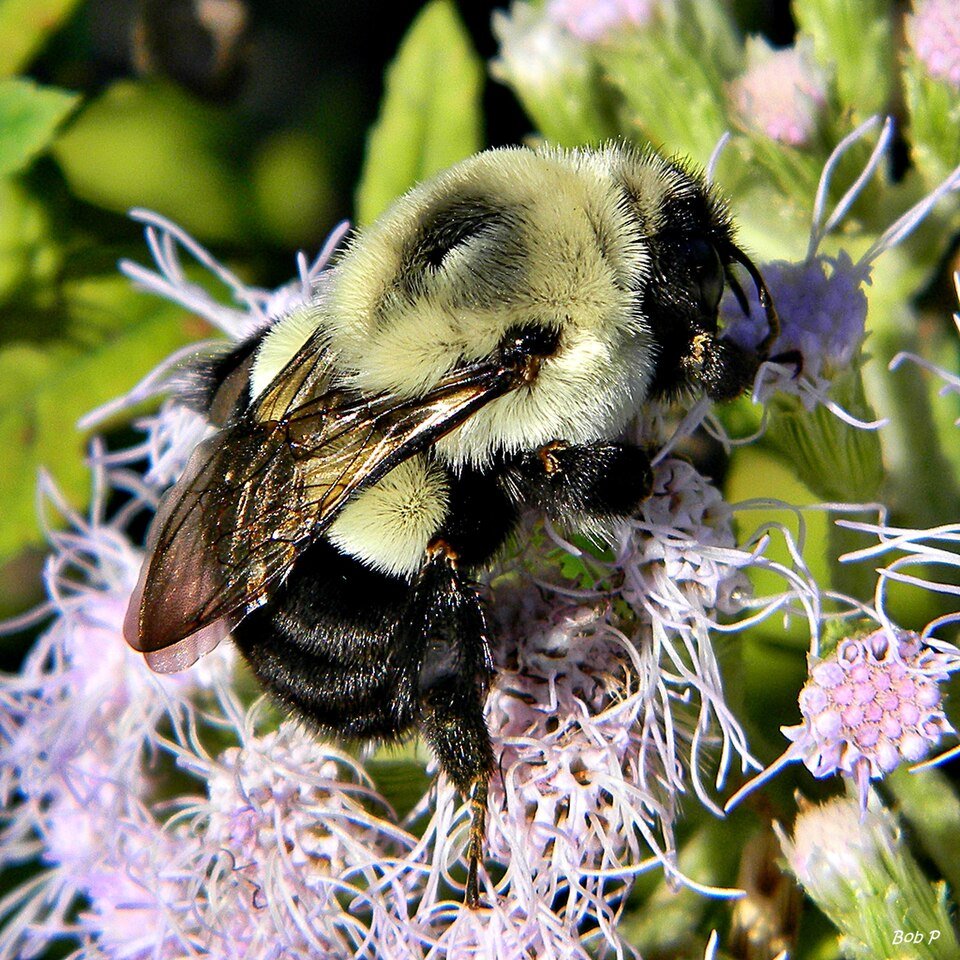
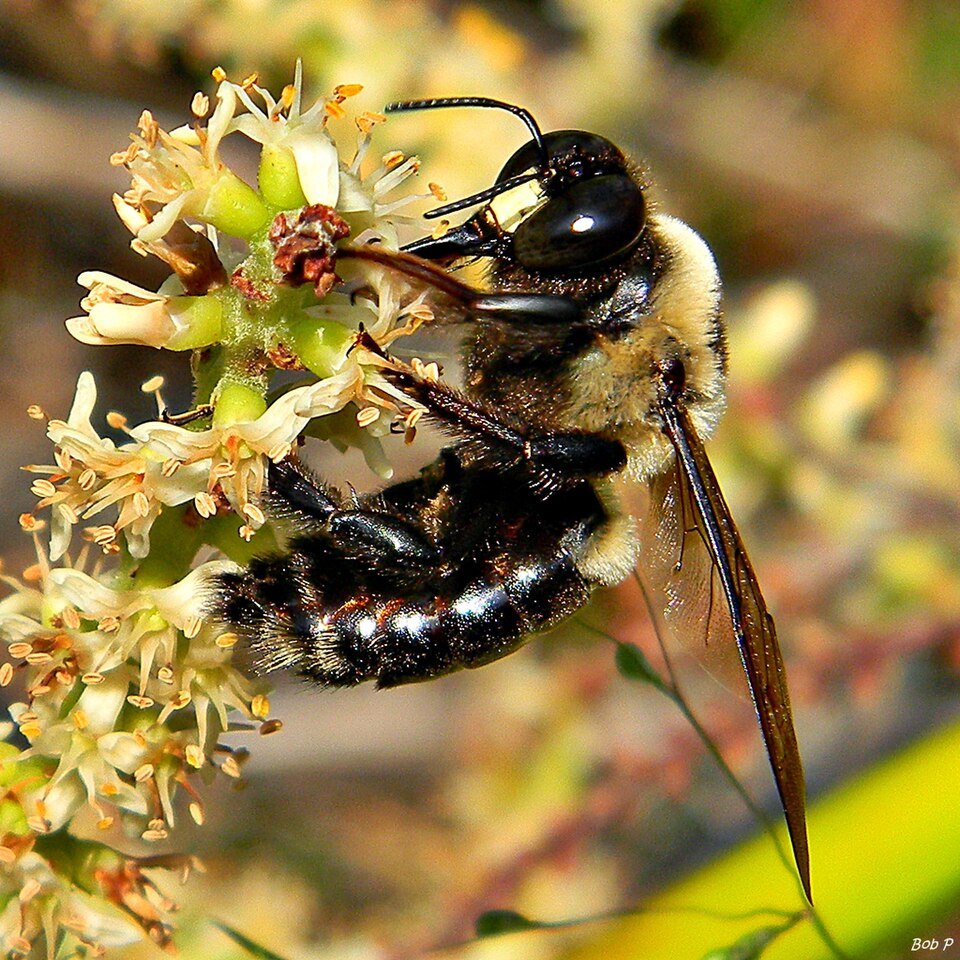
The abdomen decides. A bumble bee is furry over its entire body — the abdomen (rear section) carries a dense coat of yellow-and-black pile, matte and plush, like a flying pom-pom. A carpenter bee’s abdomen is bare, black, and glossy — it catches sunlight like patent leather, an unmistakable shine once you’ve seen it once. Every other feature is backup for distance calls. Flight behavior: bumble bees commute — flower to flower, purposeful, indifferent to you; male carpenter bees hover — stationary aerial territories at head height near wood structures, darting at anything that enters, including birds, other bees, and your face. Location: a big bee working the coneflowers votes bumble; a big bee patrolling the deck rail, fascia, or swing set votes carpenter. The hole evidence: perfectly round half-inch holes in wood with coarse sawdust below belong to carpenter bees exclusively — bumble bees excavate nothing, nesting instead in abandoned rodent burrows, compost margins, and cavities under sheds. Season and sound: both fly April onward, but the early-spring wood-hoverer is almost always a carpenter bee (they overwinter in the galleries and emerge on-site), and the carpenter’s flight drone runs slightly deeper and rougher — a connoisseur’s distinction the abdomen makes unnecessary.
Bumblebees nest in the ground and are worth leaving alone. Carpenter bees bore into your fascia, and that is a job for wasp, hornet and carpenter bee removal in Dayton.
The sting scorecard: two reputations, mostly bluff
Here’s the comparison’s most reassuring section. Male carpenter bees — the ones doing the aggressive hovering — cannot sting at all. No stinger exists; the territorial dive-bombing that keeps families off their own porches every May is pure theater, as our carpenter bee page details. Female carpenter bees can sting but essentially never do — they’re inside the galleries working, and documented stings involve hand-grabbing. Bumble bees can sting and — unlike honey bees — can sting repeatedly, but their threshold is famously high: away from the nest they are among the most docile large insects in North America, tolerating garden work inches away, and stings occur almost exclusively when a nest entrance is disturbed (the lawnmower-over-the-burrow scenario) or a bee is grabbed or trapped in clothing. The practical translation for both species: the big bee near you right now is overwhelmingly unlikely to sting you regardless of which it is, the hovering aggressive one is certainly not going to (it can’t), and the only genuine caution either species earns is respecting a discovered bumble nest entrance — a few feet of clearance for one season, since the colony dies at frost and never reuses the site. Allergy households get our standard priority scheduling on any stinging-insect question, and the Ohio bee guide carries the full sting ledger for the rest of the cast.
What each verdict means for your property
Verdict: bumble bee. Congratulations — you host one of Ohio’s premier pollinators, a species whose colonies work your tomatoes, berries, and natives with a technique honey bees can’t match (buzz pollination — they vibrate flowers at frequencies that shake pollen loose, which is why greenhouse tomato growers literally buy bumble colonies). The management plan is inaction: the colony is annual, dead at first frost, never reused, and defensive only within a few feet of its entrance. If a nest sits genuinely in harm’s way — under the porch step the kids use hourly — the bee guide’s options ladder applies: reroute traffic for a season, relocate via a specialist, and treat only as a documented last resort. Otherwise: plant more monarda and enjoy the tenancy. Verdict: carpenter bee. Your wood is in the early chapters of a compounding story — galleries extended and multiplied each spring, woodpecker amplification, moisture intrusion — that the full carpenter bee page tells in detail, along with the treatment that ends it (gallery dusting at the right season, sealing at the right moment) and the prevention that retires it permanently (paint or solid stain — carpenter bees overwhelmingly refuse finished surfaces; composite rails end the cycle outright). The cost calibration: a year-one carpenter bee response is one of the least expensive services we run; a year-five ignored one is a carpentry invoice. Either verdict, the five-second abdomen check just routed you correctly — which is the entire return on learning it.
The rest of the big-bee lineup (for completeness)
- Cicada killer wasp: July’s two-inch giant, sand burrows, cicada cargo — smooth-bodied, wasp-waisted, and covered in the cicada guide; males can’t sting, females won’t
- European hornet: big, brown-and-gold, flies at night around porch lights — the “giant bee” of after-dark reports and the subject of annual false murder-hornet alarms; a true social wasp, handled on the wasp page
- Honey bee: half the size of either headliner, golden-fuzzy, hive-based — swarms get the free beekeeper call, wall colonies get the coordinated cutout, both per the bee guide
- Hover flies: yellowjacket-costumed flies that hover like tiny helicopters — two wings, giant fly eyes, zero stingers; summer’s most successful impostors
- Mason and leafcutter bees: smaller solitary hole-nesters using existing cavities (never drilling) — the pollinator-hotel tenants, and further proof that “bee in a hole” needs the size-and-shine check before anyone panics
Bumble-or-carpenter questions, answered
It’s hovering aggressively at my head. Which one is that?
Male carpenter bee, with rare exceptions — bumble bees don’t hold aerial territories, and the head-height hover-and-dart near wood is the male carpenter’s entire spring job. Remember what he’s armed with: nothing. Walk through the territory at will; the theater parts around you, and the real conversation is with the wood behind him.
Big bees are going into a hole in the ground — carpenter bees underground?
No — carpenter bees are strictly wood-nesters. Steady traffic into a ground hole is a bumble colony (fuzzy, mixed sizes, gentle) or — smaller, brighter, smooth, and increasingly cranky through summer — yellowjackets, a genuinely different situation. The abdomen check works at the burrow too: fur means give it space until frost; shine and stripes mean call us before the mower finds it.
Can I just plug the carpenter bee holes and skip treatment?
Plugging untreated, occupied galleries traps bees that chew new exits — often inward — and leaves this year’s brood developing behind the plug. The sequence that works is dust, wait, then seal, per the treatment page; fall sealing of vacant galleries is the one DIY-friendly exception, since winter finds them empty.
Two life stories, one spring stage
The deeper reason the two bees read so differently up close is that their societies share nothing but a color scheme. The bumble bee is a social insect running an annual civilization: a lone overwintered queen founds a colony each April in a borrowed cavity, raises workers who take over foraging, builds toward a few hundred residents by August, produces next year’s queens, and dies entirely at frost — a complete rise-and-fall each season, with the colony’s defensive instinct (such as it is) concentrated at the nest and nowhere else. The carpenter bee is solitary: each female drills or renovates her own gallery, provisions her own brood cells, and defends nothing but her immediate tunnel — there is no colony, no workers, no collective response, which is precisely why the species poses zero swarm risk and why its control is carpentry-adjacent rather than nest-warfare. The overlap that confuses everyone — same size, same colors, same April debut — is mimicry economics: big, bold, yellow-and-black advertises “sting risk” to predators so effectively that both lineages converged on the uniform, the fuzzy one backing the warning with a real (if reluctant) sting and the shiny one’s males wearing the costume with an empty holster. Your deck, in other words, hosts an evolutionary bluffing contest every May — and now you’re the rare spectator who can score it from the porch swing.
The one-screen comparison
- Abdomen: fuzzy + banded = bumble bee · bare + glossy black = carpenter bee — the whole test
- Behavior: flower commuter = bumble · head-height wood hoverer = carpenter (male, stingless)
- Nest: ground/cavity colonies, annual, never reused = bumble · half-inch drilled wood galleries, reused and extended yearly = carpenter
- Sting: bumble — capable, repeatable, threshold famously high, nest-defense only · carpenter — males incapable, females nearly-never
- Property meaning: bumble = free elite pollination, do nothing · carpenter = compounding wood damage, treat + paint per the service page
- Garden meaning: both are strong pollinators — carpenter bees work flowers too (the treatment targets galleries, never foragers), so the wood defense and the garden’s interests never conflict
- When to call: holes + sawdust + hovering = quote the treatment · fuzzy traffic at flowers or a ground entrance = enjoy, give space, plant more · unsure = photo to (937) 569-3330, free, verdict within the hour
Fuzzy or shiny: five seconds, one glance at the rear bumper, and Ohio’s two biggest bees sort themselves into “protect” and “treat” before your coffee cools. Screenshot the table, teach it at the Memorial Day cookout, and put the number away for the shiny verdicts — the fuzzy ones were never going to need us.
A Miami Valley field calendar for the two big bees
Localize the comparison to our region’s calendar and the identifications practically schedule themselves. April: overwintered bumble queens — the year’s largest bumble bees — prospect low over lawns and mulch hunting burrow sites (a solo fuzzy giant zigzagging at ankle height is a queen house-hunting, not a threat), while carpenter bees emerge from last year’s galleries directly onto the wood they’ll re-colonize: the deck hover begins on-site, day one. May–June: peak overlap — bumble colonies staff up and work every bloom while carpenter females drill and provision; this is the month the five-second test earns its keep daily, and the month our treatment window does its best work. July–August: bumble colonies hit their few-hundred peak (fuzzy traffic everywhere, still gentle) as carpenter adult activity quiets — the galleries’ new generation develops unseen, and owners who mistake the quiet for departure learn otherwise at the late-August emergence. September–October: new bumble queens fatten on the asters and goldenrod before burrowing to overwinter — protect the fall bloom for exactly their sake — while new carpenter adults feed briefly and return to the wood for winter, making fall the sealing-and-painting season the treatment page prescribes. November–March: both stories sleep — one as scattered queens underground, one as adults in your fascia — and the smart property owner spends the quiet months on paint, composite, and the pollinator border that makes next April a win on both fronts. Two bees, one calendar, and a household that reads it correctly protects its wood and its garden in the same season — which is this page’s whole assignment, completed.
Why we wrote a whole page for a five-second test
Because the five seconds only work if you trust them, and trust takes the whole story. The bumble-versus-carpenter confusion is the most consequential mix-up in Ohio’s backyard: get it wrong one way and a family spends May avoiding a stingless bluff while their rail accumulates galleries; get it wrong the other way and a beneficial colony gets sprayed by a panicked weekend warrior — a loss the garden pays for all season and the region’s pollinator ledger pays for longer. Every year we take calls that started as the wrong verdict: the “aggressive bumble bees” that were harmless male carpenters guarding ruined fascia, the “carpenter bee nest in the ground” that was a gentle bumble colony one bad decision from destruction. The abdomen test, backed by the behavior tells and the sting scorecard, ends both errors — and publishing it in full, free, beside an honest description of which verdict we monetize and which we don’t, is exactly the editorial policy this entire library runs on. The fuzzy bee needs your tolerance; the shiny bee needs our dust and your paint; and both need the five seconds of attention that tells them apart: (937) 569-3330 for the photos, the quotes, and the cheerful acquittals alike.
Bonus round: the carpenter bee’s secret pollination rap sheet
Fairness to the shiny one before the page closes: the carpenter bee is itself a substantial pollinator — an early-season workhorse on open blooms and a specialist heavyweight on the big spring flowers its bulk suits — with one larcenous asterisk that delights gardeners who learn of it. On deep tubular flowers whose nectar sits beyond its reach (salvias, some penstemons, blueberry bells), the carpenter bee practices nectar robbery: it slits the flower’s base from outside and drinks without touching the pollen apparatus — taking payment while skipping the pollination job, a genuine heist the plant never consented to. Bumble bees, for the record, occasionally exploit the same slits secondhand, making them accessories after the fact. None of this changes the property calculus — the galleries, not the foraging, are the treatable offense, and our gallery-targeted approach deliberately leaves foragers unharmed — but it completes the character sketch: the fuzzy bee is the garden’s honest laborer, and the shiny one is its charming burglar, guilty of structural mischief in your rail and petty larceny in your salvias, stingless bluffing all the while. Ohio springs are livelier for hosting both; your deck and your coneflowers just deserve to know which one they’re dealing with — and now, in five seconds flat, they do.
(And if this page’s verdict was “carpenter bee” and the holes are already in the rail: the treatment page picks up exactly where this one leaves off — the gallery process, the timing windows, the paint prescription, and the free quote that scopes it all. Five seconds to identify, one call to resolve, and one coat of paint to retire the question for a decade. The fuzzy ones, as ever, ride free.)
Frequently asked questions
How do I tell a bumble bee from a carpenter bee?
One glance at the abdomen: plush and fuzzy = bumble bee; bare, black, and shiny = carpenter bee. Same size class, same spring appearance, opposite files — one is a protected-grade pollinator, the other is drilling your fascia.
Which one is hovering aggressively at my deck?
Carpenter bee males — they patrol territory around nest wood, dive-bombing anything that moves, and carry no stinger whatsoever. Bumbles do not hover territorially; the deck sentry act is diagnostic by itself.
Do bumble bees drill holes in wood?
Never — bumbles nest in ground cavities, old rodent burrows, and the occasional birdhouse. Perfect half-inch round holes with sawdust below are carpenter bee work, exclusively.
Which one stings worse?
Bumbles can sting repeatedly but essentially never do away from their nest; carpenter females sting only if handled, and the aggressive males cannot at all. The practical sting risk from both, in a normal yard, rounds toward zero.
Why does the ID matter for treatment?
It forks the entire response: bumbles get distance and tolerance (colony dies at frost, elite pollination all season), carpenters at your structure get the per-gallery treat-then-seal program before the damage compounds. Fuzzy = leave; shiny = call.
Do bumble bees damage anything?
Nothing — no drilling, no digging beyond an existing cavity, no structural interest. Their entire cost is a defended nest entrance you learn to give six feet for one summer.
Are carpenter bees pollinators too — should I feel bad treating them?
Genuine pollinators, and our program reflects it: we target galleries in your structure, not the species in your yard. Bees at the flowers stay welcome; bees excavating the pergola get evicted. Painting bare wood prevents the conflict entirely.
What if the big bee is going into the ground?
Bumble bee (or a queen prospecting) — ground entry is their signature and the acquittal applies. Ground traffic that is glossy, fast, and voluminous is yellowjackets: a different page and a real call.
When do each appear in Ohio?
Both emerge April–May; bumble colonies build all summer and die at frost, while carpenter drilling peaks spring with a fall re-entry as offspring overwinter in galleries. A “bee problem” in October wood is carpenters; in October flowers, bumbles finishing the season.
Who do I call to sort out which I have?
Text the photo: (937) 569-3330 — identification free, the bumble answer costs you nothing, and the carpenter answer comes with the gallery-count quote and the paint advice that prevents next spring’s sequel.