
Half of the “bed bugs” brought to our identification line every month are something else — and every one of those misidentifications was about to cost somebody money in one direction or the other. Panic direction: a harmless carpet beetle triggers a four-figure treatment nobody needed. Complacency direction: a “probably just a beetle” shrug gives a real infestation three weeks of compound interest. Bed bugs have an entire supporting cast of look-alikes — small, brownish, rounded insects that turn up in bedrooms — plus a parallel cast of bite explanations (mites, fleas, allergies) that muddy the diagnosis from the skin side. This is the complete sorting guide from Greater Dayton Pest & Rodent: the reference features of a true bed bug, the eight look-alikes ranked by how often they fool people, the bite-based confusions including the dust-mite myth, and the evidence test that settles any bedroom in ten minutes. It’s the companion to our full bed bug treatment guide and the bat bug deep-dive — and the fastest version remains the free one: photograph the suspect beside a coin and text (937) 569-3330.
First, the real thing: five features that define a bed bug
Identification works by reference, so fix the genuine article in mind. An adult bed bug is apple-seed sized and shaped — 4 to 6 millimeters, broad oval, distinctly flattened top-to-bottom when unfed, swelling plumper and redder after a blood meal. It is rust-to-mahogany brown, uniform in tone, with fine horizontal segmentation lines across the abdomen like a ribbed shell. It is completely wingless — no wing cases, no flying, ever — with six real legs and short, four-segment antennae. It runs but never jumps: brisk scuttling into cover, no hopping, no flight. And it lives where sleepers are: mattress seams and piping, box-spring corners, headboard joints and wall side, within a few feet of the bed, leaving the supporting evidence — pepper-dot fecal spotting on seams, translucent amber cast skins, pearl-white glued eggs — that our main guide photographs in detail. Nymphs are the same design in miniature: pinhead to sesame-seed, translucent tan to amber, darkening after feeding. Every fake below fails at least two of these five tests; most fail four.
Eight impostors, and treating for the wrong one costs a month. If it really is bed bugs, that is bed bug treatment in Dayton.
The look-alikes, ranked by how often they fool the Miami Valley
1. Carpet beetle adults and larvae — our reigning false-alarm champion, with a full page of its own: the adults are rounder, domed, and mottled (or solid black) with visible wing cases and they fly to windows — three instant disqualifiers — while the bristly striped larvae look nothing like bed bugs but appear in beds and trigger the panic anyway, sometimes with the bite-like bristle dermatitis that completes the impersonation. 2. Bat bugs — the one genuine dead-ringer, indistinguishable without magnification and covered exhaustively on their own page; ceiling-and-upper-wall distribution plus any attic bat history is the tell that redirects the whole diagnosis. 3. Spider beetles — shiny, globular, reddish-brown pantry insects with long legs and a humpbacked, almost spider-like profile; they turn up in bedrooms near stored food and fool cameras constantly, but the gleaming round abdomen (versus flat and ribbed) and the pantry connection give them away. 4. Cockroach nymphs — freshly hatched German roach young are small, brownish, and bedroom-capable in infested buildings; the racing speed, cylindrical body, and long antennae separate them, and the correct panic is different but real — that identification matters as much as the bed bug one. 5. Booklice — tiny, pale, soft-bodied moisture insects on headboards and window sills; a fraction of bed bug size, translucent, and harmless, they’re the “baby bed bugs” of a thousand worried photos in humid summers.
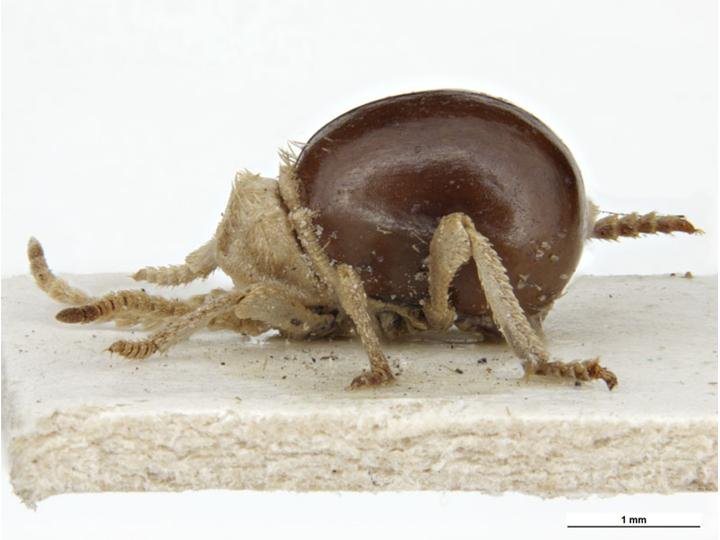
The lineup, continued: the occasional impostors
6. Fleas — wrong shape entirely (narrow, tall-sided, built like a sideways coin) and famous jumpers, but flea evidence overlaps bed bug evidence on the skin side: clustered ankle bites, pets in the bed, pepper-like flea dirt on sheets. The flea page’s white-sock test sorts a flea floor from a bed bug bed in five minutes. 7. Ticks — an engorged brown dog tick or a wandering deer tick reads “bed bug” to a worried eye, especially post-hike or in dog households; count the legs (eight — it’s an arachnid), note the fused, unsegmented body, and treat any attached specimen as a tick-protocol matter, not a pest-control one. 8. Swallow bugs and other bird-associated Cimex cousins — the bat bug’s feathered-host parallel, covered in the bat bug guide’s final section: nests in the eaves empty in late summer, apple-seed insects drift downward weeks later, and the roost-side fix outranks the bedroom-side one. Honorable mentions that occasionally make the photo line: drugstore and cigarette beetles (pantry, domed, fliers), immature brown-banded roaches (banded, fast), and — in the imagination more than the mattress — the completely fictional “paper mite,” which brings us to the skin side of this subject.
The bite-side confusions: mites, dust mites, and bites without bugs
Half this identification isn’t about an insect in hand — it’s about waking up itchy with nothing to photograph, and here the myths need direct handling. Dust mites do not bite. Full stop, and worth italics somewhere: the microscopic mites living in every mattress on Earth feed on shed skin flakes, never on people, and cannot be seen without magnification — the welts attributed to them are allergy, not bites: dust-mite allergen provokes eczema-like patches, morning congestion, and itchy skin in sensitized people, treated by allergen reduction (encasements, hot-wash bedding, humidity under fifty percent — usefully, the same encasements our bed bug protocol uses) rather than by any pesticide. Mites that genuinely bite humans exist but are specific: bird and rodent mites migrating from an abandoned nest or a mouse-infested wall (a real, findable source with a real fix), and outdoor chiggers from late-summer grass (ankle-and-waistband welts that started outdoors). Scabies is a medical diagnosis — burrow-line itching, worst at night, spread person-to-person — for a dermatologist, not an exterminator, and we say so plainly when the evidence points that way. And bites without any arthropod at all are common: folliculitis, dermatitis, drug reactions, and stress-related sensations account for a steady share of “bed bug bites” that no inspection ever corroborates. The rule that keeps everyone honest: skin evidence alone never diagnoses bed bugs — corroborating physical evidence (bugs, skins, spotting, eggs) does, which is exactly what the ten-minute test below hunts for.
The 10-minute bedroom test
- Minute 1–3, the seams: strip the bed; flashlight and credit card along every mattress seam, handle, and tag — you’re hunting live bugs, pepper-dot fecal spotting that smears rust when dabbed wet, amber cast skins, and pearl eggs in the piping
- Minute 4–5, the box spring: corners, staple lines, and the dust-cover underside — the single highest-yield habitat in most real infestations
- Minute 6–7, the headboard: pull the bed out; inspect the headboard’s back, mounting joints, and the wall behind — second-highest yield
- Minute 8, the perimeter: nightstand joints, outlet plates, baseboard gap, picture frame behind the bed
- Minute 9, the interceptors: if cups are under the legs, read them — they’re the running census; if not, tonight’s the night to install them
- Minute 10, the verdict: evidence found → bag a specimen, photograph everything, and start the real protocol; nothing found but bites continuing → widen the lens to the look-alike and bite-side lists above, and send us the photos either way — free, fast, and judgment-free
Why both wrong verdicts cost real money
The economics deserve their own section because they’re the reason this page exists. False positive — treating look-alikes as bed bugs: the carpet-beetle bedroom that gets a full bed bug protocol pays four figures to solve a two-figure vacuuming problem, and (worse) the “treatment’s” inevitable “success” against an enemy that was never there validates the misdiagnosis for next time. Less scrupulous corners of this industry are structurally tempted here — a scared caller describing seed-shaped bugs is a signed contract waiting to happen — which is why our protocol requires specimen-level confirmation before any bed bug treatment is scoped, no exceptions, and why the free photo ID exists as the public version of that discipline. False negative — waving off the real thing: the “it’s probably just beetles” shrug hands a genuine infestation the only resource it needs — time. At one-to-five eggs per female per day, three complacent weeks converts the one-room job into the multi-room program, and the budget difference funds a lot of ten-minute inspections. The asymmetry resolves cleanly: confirmation is nearly free (a photo, a bagged specimen, a ten-minute seam check, our no-charge verdict), while both wrong verdicts are expensive — so the rational household always buys the confirmation first. That’s the entire policy this page encodes, and it’s the same inspect-before-invoice spine running every guide on this site.
Look-alike questions, answered
I found ONE apple-seed bug and the ten-minute test found nothing else. Now what?
Bag it (tape works), photograph it beside a coin, and send it in — a single specimen with a clean bed is often a hitchhiker (yours from travel, or a wanderer from a neighboring unit) or a look-alike, and the response differs completely: hitchhiker means interceptors, vigilance, and a re-check in two weeks; look-alike means its own page’s advice; confirmed bed bug with clean surroundings means early-stage luck worth defending fast. The specimen decides — never the guess.
The bites are in a line of three. Doesn’t that prove bed bugs?
The “breakfast, lunch, dinner” line is folklore-grade evidence at best — bed bugs sometimes feed in lines, and so do flea encounters, and so does a sleeve’s pressure pattern on irritated skin. Reaction patterns vary so wildly between people (a third react to nothing at all, as the main guide covers) that skin geometry can’t carry a diagnosis. Physical evidence or no verdict — the ten-minute test exists precisely because the bites can’t testify.
Could it be fleas if we have no pets?
Yes — the flea page’s inherited-infestation section covers the classic no-pet scenarios: previous tenants’ pupal bank waking to your footsteps, or wildlife (raccoons, strays) seeding the crawlspace and yard. The white-sock walk distinguishes floor-level flea pressure from bed-level bed bug pressure in five minutes, and the two treatments share nothing — one more reason the sorting step pays.
The one-screen sorting table
- Reference bed bug: apple-seed size/shape, rust-brown, flat unfed, WINGLESS, runs never jumps, lives within feet of sleepers, leaves spotting + skins + pearl eggs
- Carpet beetle: domed, mottled or black, wing cases, flies to windows; bristly larvae — vacuum-and-storage problem, own page
- Bat bug: true dead-ringer; ceiling/upper-wall distribution + attic bat history = magnification call, own page
- Spider beetle: glossy, globular, long-legged, pantry-linked
- Roach nymph: fast, cylindrical, long antennae — different alarm, equally worth confirming
- Booklice: tiny, pale, translucent, humid-season sills — harmless
- Flea: side-flattened, jumps; white-sock test sorts it
- Tick: eight legs, fused body — medical-adjacent protocol, not pest treatment
- Dust mites: invisible, DON’T bite — welts are allergy; encasements + hot wash + humidity, no pesticide
- The test: ten minutes — seams, box spring, headboard, perimeter, interceptors; physical evidence or no verdict
- The rule: confirmation is nearly free, both wrong verdicts are expensive — photo to (937) 569-3330 before any money moves
Print it, tape it inside the linen closet, and let every future 2 AM discovery start with a coin, a camera, and a ten-minute test instead of a panic purchase — the cheapest insurance in this entire subject, underwritten free by the company that would rather identify a spider beetle tonight than treat an empty bedroom tomorrow.
Field notes: what a season of Miami Valley photo IDs actually looks like
For calibration, here’s the honest composition of a typical month on our identification line, because the base rates themselves are reassuring. Carpet beetle adults and larvae lead every spring — the window-sill season fills the inbox with mottled domes from Kettering to Lebanon. Spider beetles and pantry beetles spike in winter when indoor storage gets disturbed. Booklice surge with July humidity, especially in newer builds still drying out — a Springboro and Carriage Trails specialty. Genuine bed bug confirmations run a steady minority year-round, clustering after travel seasons and moving weeks, with Fairborn’s turnover calendar contributing its predictable share. Bat bug cases arrive in ones and twos each fall, always trailing an exclusion or a roofing job. And every month brings a few photos of lint, scabs, seeds, and — memorably — a chocolate sprinkle, all received with the same straight face and the same free verdict, because the whole system only works if no question is too small to ask. The pattern worth internalizing: most bedroom scares are not bed bugs, and the real ones announce themselves to a ten-minute test — which means the confident household is neither the one that never worries nor the one that always does, but the one that checks, photographs, and knows whom to text: (937) 569-3330.
The photo that gets you the fastest answer
Since the free ID is this page’s recurring prescription, close with the thirty seconds that make it work best. Coin for scale — a penny beside the specimen instantly separates the booklice-sized from the apple-seed-sized and saves a whole round of follow-up. Top-down, in focus, good light — the dorsal view carries the diagnostic features (segmentation, wing cases, body shape); a blurry side angle of a moving bug carries mostly suspense. Alive-but-contained beats squashed — a glass-and-card capture or a strip of clear tape preserves the anatomy; a thumb-flattened specimen can defeat even magnification, though send it anyway (we’ve called plenty from fragments). Context in the caption — where found (seam? sill? ceiling?), when, any bites and on whom, any travel, secondhand furniture, pets, or attic history: five facts that steer the verdict as much as the pixels do. And the evidence shots — seams with spotting, skins in the piping, the interceptor’s contents — often outrank the bug itself, because populations photograph more honestly than individuals. Send it all to (937) 569-3330 and the typical verdict lands within the hour: named, explained, and routed to exactly the right page of this site — which, whichever impostor or genuine article it turns out to be, now almost certainly exists. That’s what a complete pest library is for, and yours is one text away from proving it.
One last cross-reference to complete the set: this page, the bat bug guide, the carpet beetle file, the alcohol and bleach myth audits, and the master treatment guide now form the Miami Valley’s most complete public bed bug reference — six pages engineered so that whatever a worried 2 AM search begins with, it lands on an honest answer with a free next step. Bookmark whichever one found you first; the others are one click deep, and the phone line underneath them never changes.
Frequently asked questions
What bugs are most often mistaken for bed bugs?
The weekly lineup: bat bugs (nearly identical — microscope-grade distinction), carpet beetle larvae and adults (the most common false alarm), spider beetles, fleas, ticks, booklice (mistaken for nymphs), and cockroach nymphs. Roughly half the “bed bug” photos we receive acquit on inspection.
How do I know if it’s a bed bug or a carpet beetle?
Shape and diet: bed bugs are flat apple-seed ovals that never develop wings; carpet beetle adults are domed, patterned, and fly to windows, while their bristly larvae eat fabric (bed bugs never do). Fabric damage plus fuzzy shed skins says carpet beetle — a nuisance, not a bloodfeeder.
What is the difference between bat bugs and bed bugs?
Visually almost nothing (fringe-hair length under magnification) — behaviorally everything: bat bugs feed on roosting bats and appear in living space when a colony occupies the attic or chimney, biting humans only as substitutes. The fix is bat exclusion, not mattress treatment; our bat-bugs page runs the full file.
Are booklice baby bed bugs?
No — booklice are smaller, softer, mold-grazing insects of humid corners and cardboard, translucent like nymphs but narrow-bodied and utterly harmless. Humidity control ends them; no blood is involved at any point.
I found a bug in my bed — does that mean bed bugs?
Beds collect ALL household insects (warmth, CO₂, laundry traffic) — a single bed-found bug of any kind proves little. Evidence decides: pepper-fleck fecal spotting, shed skins, and eggs at seams convict; one wandering beetle acquits.
What bites like a bed bug but isn’t one?
Fleas (ankle clusters by day), mosquitoes (single puffy welts, summer evenings), mites (rodent or bird history), and — commonly — nothing at all: dermatological conditions and anxiety-driven “bites” account for a real share of callbacks. Bite patterns alone diagnose nothing; the mattress-seam evidence does.
Do bed bug look-alikes need treatment too?
Each has its own file: carpet beetles get fabric-protection and source-cleaning, fleas get the flea program, bat bugs get bat exclusion, booklice get a dehumidifier — and several need nothing but a vacuum. The ID is the treatment decision, which is why ours is free.
Can an exterminator tell the difference from a photo?
Usually — a sharp phone photo with a size reference (coin, ruler) settles most IDs same-day, and the ambiguous ones (bat bug vs. bed bug) get flagged for specimen inspection honestly. Never accept a bed bug treatment sold without a confirmed ID; half the industry’s worst invoices start there.
What should I do while waiting for an ID?
Bag the specimen (tape or a pill bottle), photograph the seams for evidence either way, hot-dry the bedding as no-regret insurance, and skip the sprays — whatever it turns out to be, scatter helps nothing and evidence helps everything.
Who identifies mystery bugs near Dayton?
Text the photo to (937) 569-3330 — free, fast, and often the best news of your week: the majority verdict is “carpet beetle, sleep easy,” and the minority verdict comes with the protocol and both visits priced up front.