
Here’s a bar-bet answer with an 8,000-search-a-month following: every locust is a grasshopper, but almost no grasshopper is a locust — and the difference isn’t species, it’s a behavioral transformation so strange it took entomology until the 1920s to believe it. Add the all-American confusion of calling cicadas “locusts” (Ohio’s own contribution to the mess), plus the genuinely operatic story of the locust that vanished from this continent entirely, and you have this page: the full locust-versus-grasshopper file, what Ohio actually has hopping in its August lawns, whether any of it threatens your garden, and who’s really singing from the trees in a “locust year.”
The Transformation: How a Grasshopper Becomes a Locust
“Locust” names a capability, not a family: a handful of grasshopper species — maybe twenty of eleven thousand worldwide — carry a hidden second personality that crowding unlocks. The trigger is astonishingly mechanical: when drought or food concentration jams enough solitary grasshoppers together, the repeated jostling of their hind legs releases serotonin, and within hours the insect begins changing — darker colors, bigger flight muscles, smaller bodies, gregarious behavior replacing lifelong solitary instincts. The offspring inherit the shift, and within generations you have the gregarious phase: billions of insects moving as one weather-system-scale organism, eating their combined body weight daily across whole regions. Same DNA, two different animals — the phases were classified as separate species until Boris Uvarov proved the switch a century ago. When the crowding ends, the line drifts back to solitary within generations. Locusts are what certain grasshoppers do under pressure, which is why “is it a locust?” is really a question about behavior, geography, and this year’s rainfall in someone else’s hemisphere.
Neither one is a household pest in Ohio. For the insects that genuinely come indoors, there is pest control in Dayton.

The Sorting Card: Locust vs. Grasshopper vs. “Locust”
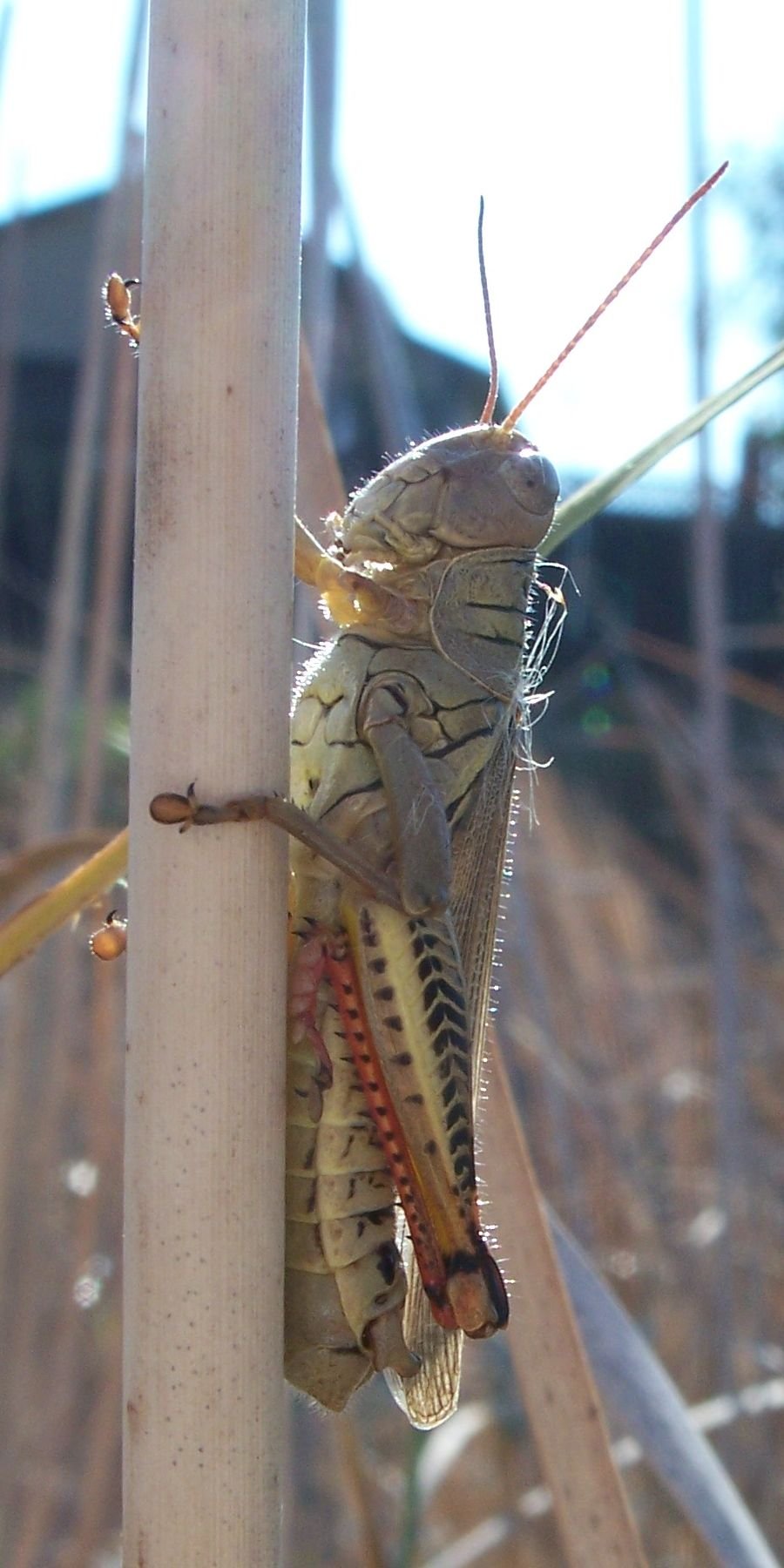
- Grasshopper: the everyday insect — solitary, green-to-brown, short antennae, launching off Ohio lawns and gardens all summer. Thousands of species; Ohio hosts dozens, none with the swarm gene.
- True locust: one of the ~20 phase-changing species in its crowded, gregarious form — Africa, Asia, the Middle East, Australia, and parts of Central and South America. The biblical/news-footage insect.
- “Locust” in American speech: usually a cicada — the fat, red-eyed, screaming tree insect of Ohio summers, which is no relation whatsoever (cicadas suck tree sap; grasshoppers chew leaves). Colonists meeting periodical cicada emergences reached for the only huge-insect-swarm word they had, and the misnomer stuck for four centuries. The “17-year locusts” of Ohio legend are 17-year cicadas — full story on our cicada page.
- Locust the tree: for completeness — black locust and honey locust are trees, unrelated to any insect, and responsible for a steady trickle of gloriously confused search traffic.
The American Ghost: the Locust That Vanished
North America had a true locust — the Rocky Mountain locust, whose 1875 swarm over Nebraska remains arguably the largest aggregation of animals ever recorded: an estimated 3.5 trillion insects in a cloud larger than California, darkening skies for five days over the plains states. Twenty-seven years later the species was extinct — the last living specimen collected in 1902 — done in, the leading theory holds, by plows and cattle destroying its river-valley egg beds during its solitary-phase population lows. It’s the only pest species humanity has ever accidentally eradicated, the reason American skies have no locust swarms today, and the reason every U.S. “locust” report since has been either a cicada year or a bad-but-ordinary grasshopper summer. The ghost earns its paragraph here because it answers this page’s question historically: could it happen here? It did. It can’t anymore — the species that knew the trick is gone.
What Ohio Actually Has (and What It Can Do to a Garden)
Ohio’s grasshopper roster runs to dozens of solitary species — differential, red-legged, two-striped, and Carolina grasshoppers headline the common list — peaking in late summer when August lawns crackle with launches. None carries the phase-change capability; the worst an Ohio grasshopper year can do is a dry-summer population boom that turns field edges, gardens, and new landscaping into a steady chew. That damage is real but bounded: ragged leaf margins on vegetables and ornamentals, occasional defoliation pressure on rural properties adjoining hayfields, and— in the historic worst droughts — agricultural losses that county extension offices track. For a typical Dayton-area yard, grasshoppers rank far down the garden pest lineup, behind Japanese beetles, hornworms, and rabbits, and the management menu is proportionate: row covers on prized beds, fall tilling that exposes egg pods, keeping field-edge grass mowed (eggs go into undisturbed sod), and tolerating the rest as bird food. Blanket-spraying a lawn for grasshoppers is almost always a misfire — mobile insects recolonize sprayed turf within days, and the collateral damage to the yard’s beneficial roster outlasts any benefit.
“Locust Years” in Ohio: What’s Actually Happening
When Ohio talk turns to a “locust year,” a periodical cicada brood has emerged — most recently and famously Brood X in 2021, next locally significant in the 2030s — and the confusion writes itself: sudden trillions, deafening song, branches flagging from egg-laying. But the differences matter practically. Cicadas don’t chew leaves (they drink xylem and lay eggs in twigs — only young trees need netting), don’t touch gardens, vanish on a six-week schedule, and their “damage” is a natural pruning most mature trees shrug off. Nothing about a cicada emergence calls for pest control, a sentence we publish cheerfully against our own interest and expand on in the cicada file. Meanwhile the insects that sound like the biblical story — actual crop-stripping swarms — exist today only overseas, where locust response is a matter for national governments and UN agencies, not exterminators. Ohio’s version of apocalyptic insect news is, on inspection, a very loud mating festival.
Why This Distinction Belongs on a Pest Control Site
Because misnamed insects buy mistreatment. The caller who “has locusts” might have cicadas (needs nothing but netting on saplings), a grasshopper boom (needs cultural controls, not sprays), or katydids in the maples (needs earplugs at most) — three different non-emergencies, each with a wrong-response cost if the name goes unexamined. It’s this site’s recurring sermon — from frass geography to misplaced western monsters: identification is the treatment decision, and the free photo-text to a local company beats acting on a four-century-old vocabulary error. Send the picture; we’ll send the name and the honest verdict, which around here is usually “enjoy the show.”
Something hopping, singing, or swarming that you can’t name? Send us the photo — identification is free, and the Ohio answer is calmer than the search results. Serving Dayton and all of Montgomery, Greene, Miami, Clark, Warren, Butler, Preble, and Darke counties.
The Field Marks: Telling the Cast Apart in Your Own Yard
The thirty-second outdoor version, since August yards host the whole ensemble. Grasshopper: launches from grass ahead of your feet, short antennae, chewing mouthparts, camouflage browns and greens — daytime insect of open sun. Katydid: the grasshopper’s leaf-green cousin with sweeping antennae longer than its body, singing its name-song from shrubs at night — the “giant green grasshopper on the window screen” report, and prey for the great black wasp. Cricket: ground-level, dark, night-chirping, occasionally indoors come fall (the camel cricket being the basement’s wingless cousin). Cicada: never in the grass at all — fat-bodied, up in the trees, screaming through summer afternoons, leaving crunchy shed skins on bark. Four insects, four soundtracks, zero emergencies: between them they feed the state’s birds, bats, and specialist wasps, and their August racket is the sound of an intact food web doing business. The lawn-level test: if it jumped, it’s the grasshopper family; if it sang from a tree, it’s a cicada or katydid; and if the word “locust” came to mind, this page has already handled it.
The Modern Locust Story, for Context
True locust plagues remain a live twenty-first-century phenomenon — the 2019–2021 East African upsurge put desert locust swarms the size of cities across Kenya, Ethiopia, and Somalia, eating in a day what tens of thousands of people eat in a year, tracked by satellite and fought with aircraft under UN coordination. It’s worth an Ohio paragraph for two reasons. First, perspective: the word “locust” belongs to that scale of event, which is why borrowing it for a cicada chorus or a chewed tomato patch misleads so thoroughly. Second, the science coming out of locust research keeps enriching pest control everywhere — the serotonin phase-change discovery reshaped how entomology thinks about density-triggered behavior in everything from armyworms to aphids, a reminder that the line between “fascinating biology” and “practical pest management” is thinner than it looks. Ohio’s applied version is humbler but real: knowing which insects here respond to density (none, locust-style) and which respond to weather, moisture, and food (nearly all of them) is exactly what separates a targeted local treatment plan from a calendar of guesswork.
A Short Ohio History of Grasshopper Years
Ohio’s own grasshopper record is a drought ledger. The historic marks — 1930s Dust Bowl-adjacent summers, the 1988 drought, stretches of 2012 — all read the same way: dry springs favor egg and nymph survival, parched field vegetation pushes populations into irrigated yards and gardens, and for one late summer the lawns crackle at every step while county extension offices field calls about “plagues.” Then ordinary rainfall returns and the roster resets to background levels, because without the phase-change gene there is no mechanism for a boom to become a swarm — Ohio grasshopper years are weather echoes, not outbreaks building toward anything. The forecast use is practical: a bone-dry May and June is your cue to net the prized beds and till the garden margins come fall, and a normal wet spring means the subject won’t come up at all. It’s the least dramatic pest-forecasting rule we publish, governing the least dramatic “plague” in the state’s vocabulary — which, after the trillions and extinctions this page has covered, feels like the right note for Ohio to end on.
And the bar-bet postscript, since that’s how most readers arrived: yes, locusts are edible and eaten widely (kosher rules even carve out an exception for them — the only insects so honored); no, cicadas aren’t locusts no matter what your grandfather called them; and yes, the serotonin that turns a shy grasshopper into a billion-strong swarm is the same molecule your antidepressant manages. Biology is under no obligation to be believable.
Frequently Asked Questions
What’s the difference between a locust and a grasshopper?
Locusts ARE grasshoppers — specifically, one of about twenty species (of eleven thousand) that can transform under crowding into a gregarious, swarming phase with different color, body, and behavior. “Locust” names the crowded phase, not a separate family. No Ohio species carries the capability.
How does a grasshopper turn into a locust?
Mechanically: crowding jostles their hind legs, triggering serotonin release that flips solitary insects gregarious within hours — darker, stronger-flying, swarm-seeking — with the change reinforced across generations while crowding lasts. Same DNA, two animals; it reverses when populations thin.
Are there locusts in Ohio?
No true locusts — Ohio’s dozens of grasshopper species are all permanently solitary. America’s only real locust, the Rocky Mountain locust, went extinct in 1902. What Ohioans call “locusts” are periodical cicadas — an unrelated sap-drinking insect wearing a colonial-era misnomer.
What are 17-year locusts?
17-year cicadas — periodical cicada broods that emerge by the trillion on a 17-year clock (Brood X, 2021, was Ohio’s latest big one). They chew nothing, drink tree sap, prune twigs by egg-laying, and vanish in six weeks. Only young trees need protection: netting, never spray.
Did America really lose its locust?
Yes — the Rocky Mountain locust, whose 1875 swarm of an estimated 3.5 trillion insects remains among the largest animal aggregations ever recorded, was extinct by 1902, likely because agriculture destroyed its river-valley egg beds. It’s the only pest humanity has ever accidentally eradicated, and the reason no U.S. skies darken with locusts today.
Do grasshoppers damage gardens in Ohio?
Modestly, mostly in dry years: ragged leaf edges, pressure on new landscaping and rural gardens near hayfields. Row covers, fall tilling, and mowed field edges outperform sprays — grasshoppers recolonize treated turf within days, and blanket-spraying costs more in beneficial insects than it saves in lettuce.
Do locusts bite people?
Neither locusts nor grasshoppers bite people meaningfully — a large grasshopper handled roughly might pinch and “spit tobacco” (harmless defensive fluid). The threat model is entirely agricultural, and entirely elsewhere.
What is the loud buzzing insect everyone calls a locust?
A cicada — fat-bodied, red-eyed (periodical) or green (annual “dog-day”), singing from trees July through September. Harmless to people, pets, and gardens; the song is a mating chorus, and the correct response is a porch chair and a beverage.