
The brown-banded cockroach is the Miami Valley’s most misdiagnosed roach — not because it’s hard to identify, but because almost nobody looks. Small and tan like the infamous German cockroach, it gets swept into the same verdict on sight, treated with the same kitchen-focused program, and then survives that program completely, because the brown-banded roach has read a different playbook its entire life: it avoids the kitchen’s damp zones, scatters through bedrooms and living rooms, roosts high on walls and ceilings, and breeds happily behind the picture frame the treatment never touched. This is the complete profile — identification against its German look-alike, the warm-and-dry lifestyle that changes everything, where the egg cases actually hide, and the whole-house program that works — from Greater Dayton Pest & Rodent, whose cockroach service treats both species weekly and whose free photo line settles the stripes-versus-bands question in minutes: (937) 569-3330.
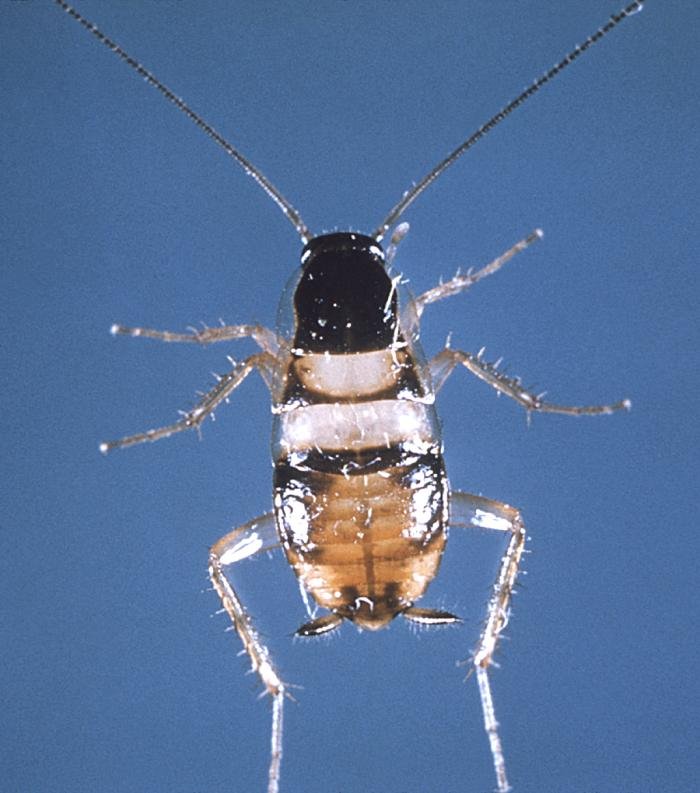
Identification: bands across, not stripes down
Both suspects are half-inch tan roaches, and one look at the right feature separates them forever. The German cockroach wears two dark parallel stripes running lengthwise down its pronotum — the shield behind the head — like racing livery. The brown-banded cockroach has a clean, unstriped dark pronotum, and instead carries two pale bands running crosswise over the abdomen and wings — brighter and almost yellow on nymphs, subtler on adults, visible as light hoops interrupting the brown. Supporting characters: brown-bandeds run slightly smaller and lighter overall; males are surprisingly capable fliers that launch when disturbed (a startling “jumping” roach on a warm evening is classically a brown-banded male — German roaches essentially never fly); females are darker and rounder-bodied; and the nymphs’ banding is bold enough that a phone photo of one settles the species instantly. Habitat testimony seals most verdicts before the magnifying glass comes out: a tan roach behind the refrigerator votes German; a tan roach on the bedroom ceiling, inside the TV cabinet, or under the desk hutch votes brown-banded — and the next section explains why that vote is nearly decisive.
Brown-banded roaches spread through a whole house rather than staying in the kitchen, which is why they need cockroach control in Dayton rather than a can of spray.
The warm-and-dry lifestyle: why this roach ignores your kitchen
German cockroaches are moisture hostages — they need drinking water frequently, which chains them to kitchens and bathrooms and makes plumbing zones the reliable center of any German infestation. The brown-banded roach broke the chain: it tolerates remarkably dry conditions, extracting most of its water from food, and it prefers temperatures on the warm side of comfortable — historically earning the nickname “furniture roach” for its distribution pattern. The practical consequences are everything. Brown-bandeds disperse house-wide: bedrooms, living rooms, offices, closets, hallway ceilings — anywhere warm — rather than concentrating where a spray tech expects roaches. They roost high: upper cabinet interiors, crown-molding lines, ceiling corners, the tops of door frames, inside light fixtures and smoke-detector housings (warmth again). They colonize equipment and furniture: television and console interiors, computer towers, cable boxes, picture frames, clocks, and the undersides of tables and chairs — the classic introduction route into Miami Valley homes is a secondhand TV, console, or dresser carrying egg cases. And they exploit clutter at height: closet shelves, stored boxes on wardrobe tops, the office’s cable nest. A kitchen-centric German protocol — gel dots at the sink line, harborage work behind appliances — misses this entire map, which is precisely how households end up “treating roaches for months” while the bedroom ceiling population thrives untouched.
The egg-case habit that makes them persistent
One more behavioral difference carries outsized treatment consequences. German females protect their egg cases by carrying them until the day of hatch; brown-banded females do the opposite — they glue their egg cases (oothecae) to surfaces early and abundantly: the undersides of furniture, inside drawer joints, behind frames, in the corrugations of stored boxes, on the warm interior walls of electronics. Each glued case holds roughly fourteen to eighteen eggs, a female produces a dozen or more cases in her life, and the cases are armored against every contact spray on the shelf. Two problems follow. First, persistence: a treatment that kills every walking roach leaves the glued generation ticking — cases hatch on a weeks-long delay (longer in cool rooms), and the “re-infestation” six weeks after a DIY victory is usually just the nursery graduating. Second, portability: glued cases ride furniture, electronics, and boxes between homes silently, which is why brown-bandeds surface in tidy houses with no roach history and why our intake questions ask about the estate-sale dresser and the marketplace TV before anything else. The program answer to both is below; the household answer is a flashlight habit — the underside inspection of incoming secondhand goods, thirty seconds per item, at the door.
The whole-house program that actually clears them
- Mapping first: sticky monitors placed high and low across rooms — not just the kitchen — plus a flashlight census of ceiling lines, fixture bowls, furniture undersides, and equipment vents; brown-banded jobs are won room-by-room, and the map is the win condition
- Bait matched to the biology: the same professional gel and station baits that defeat Germans work here — placed where this species forages: upper cabinet corners, closet shelf lines, behind frames, furniture joints, office cable zones; dry rooms get slightly wetter bait matrices since water is the scarce resource they’ll cross a room for
- Growth regulator throughout: the IGR component matters double against a glued-egg species — hatchlings emerging weeks later meet a chemical ceiling that sterilizes the rebound
- Void and fixture dusting: light residual dust into the fixture housings, frame voids, and furniture cavities the flashlight flagged — the high roosts contact sprays never reach
- Equipment protocol: infested electronics get bait stations adjacent and patience, not product inside (never spray into a TV); stubborn units can be bagged with a no-pest strip per label for a slow clean kill
- The follow-up census: monitors re-read at two and six weeks — the glued-generation window — with re-baiting to intercept hatch; two clean reads across the whole map, not just the kitchen, closes the job under the usual guarantee
Brown-banded questions, answered
How did they get into my bedroom of all places?
Almost always as freight: an egg case glued inside secondhand furniture or electronics, a stored box down from a relative’s attic, occasionally a unit-to-unit walk in multifamily buildings (they travel wall voids like their German cousins — the adjacency rules apply). The bedroom isn’t strange to them; it’s prime habitat — warm, dry, furnished, and full of undersides.
Are they as big a health problem as German roaches?
Same family, same file: allergen load from droppings and shed skins (asthma-relevant, especially for kids sleeping in infested rooms — which with this species is exactly where the infestation is), and mechanical bacteria transfer wherever they forage. Density usually runs lower than a German kitchen blowout, but the bedroom distribution makes the allergen exposure more intimate. Treat with the same seriousness; clear with the same thoroughness.
Can I just throw away the infested furniture?
Sometimes that’s rational triage for a single heavily-seeded piece — bag it, label it (“roaches — do not take”), and don’t donate the problem forward. But wholesale furniture purges usually overshoot: baiting plus dusting clears colonized pieces reliably, and the glued cases you can see peel off with a putty knife into a zip bag. Ask before you toss; we’ve saved a lot of good dressers from the curb.
Why Ohio’s furnaces wrote this roach’s local history
The brown-banded cockroach is a tropical native that colonized the American interior on a technicality: central heating. It cannot survive an Ohio winter outdoors — like the German roach, every local population lives entirely inside the heated envelope — but unlike the German, its warmth preference actively maps onto how our houses heat. Populations concentrate in the warm strata: upper floors over furnace runs, ceiling zones where heat pools, south-facing rooms, the cabinet over the refrigerator’s heat plume, electronics that run warm around the clock. Miami Valley housing offers this roach a banquet of microclimates — the radiator-heated pre-war homes of Dayton and Oakwood with their warm high ceilings, the forced-air ranches of Kettering and Huber Heights whose attic-adjacent upper cabinets ride warm all winter, and the student and rental turnover of Fairborn constantly redistributing secondhand furniture between units. The seasonal signature follows the thermostat, not the weather: populations build through the heating season in their warm roosts and reveal themselves in late winter — which is why a February bedroom roach, in our experience, votes brown-banded before the flashlight even comes out.
The one-screen summary
- ID: pale bands ACROSS the abdomen (bold on nymphs), clean unstriped head-shield; German = two lengthwise pronotum stripes; brown-banded males fly when startled
- Lifestyle: warm and dry beats damp — bedrooms, ceilings, furniture, electronics, upper cabinets; whole-house scatter, not kitchen concentration
- The persistence engine: egg cases glued to undersides and interiors, hatching on a weeks-long delay — armored against sprays, portable in secondhand goods
- The program: whole-house monitor mapping, high-placement baiting + IGR, void/fixture dusting, equipment protocol, two clean census reads to close — kitchen-only treatment is the classic failure
- Prevention: flashlight the undersides of every secondhand item at the door; peel and bag any glued cases found
- Free ID: photo to (937) 569-3330 — bands or stripes, answered within the hour, and the treatment map follows the verdict
Small roach, different playbook, entirely beatable once someone actually reads the bands — and now you have. If your “kitchen roach problem” has been living in the den all along, this page just saved you the second failed treatment; the service page handles the rest.
Case study: the six-month roach problem that was solved in six weeks
A composite from the route, because this exact arc repeats monthly. A Kettering family starts seeing small tan roaches — first the kitchen (naturally, that’s where the lights get flipped at midnight), then “everywhere.” Three DIY campaigns follow the German script: gel dots at the sink, foggers (against our every published word), bait stations behind appliances. Each buys two quiet weeks; each collapses. By month six the family assumes a super-infestation and calls expecting a fumigation quote. The inspection takes forty minutes and rewrites the case: the kitchen monitors read nearly clean — but the den’s entertainment center is seeded with glued cases, the master closet’s top shelf hosts a nursery in a box of stored sweaters, the hallway smoke-detector housing shelters a roosting cluster, and every roach photographed carries bands, not stripes. The program that follows is this page’s: whole-house monitor grid, high baiting with IGR, fixture and furniture-void dusting, the entertainment-center protocol, and case-peeling into zip bags as satisfying as it sounds. Week-two census: crashing. Week-six census: zeros across the map, guarantee active, family incredulous at the word “routine.” Total cost: less than the six months of failed products — and the moral is the one this entire guide exists to teach: the roach you misidentify is the roach you cannot beat. Bands or stripes, one photo, free answer — and the right map from day one.
Landlords, dorms, and the secondhand economy: where brown-bandeds travel
Because this species moves as glued cargo, its local geography follows the furniture. Rental turnover is the main artery: units furnished and refurnished from marketplace listings, curb finds, and storage units redistribute egg cases across the Miami Valley every move-in season, and the Fairborn student corridor plus every suburb’s apartment stock see the traffic. Landlords should fold the underside-flashlight check into unit turnovers (it pairs with the turnover protocol already on this site) and treat “roaches upstairs but the kitchen’s clean” complaints as a brown-banded flag rather than a tenant-credibility question. Offices and electronics-dense spaces are the quiet secondary market — warm equipment plus snack drawers plus nobody looking up; a monitor behind the break-room microwave and above the server rack reads that story early. Thrift, estate, and consignment flows deserve the same respect at home: the checkbox is thirty seconds — undersides, drawer joints, vents, one flashlight pass — and it intercepts the entire introduction route. None of this argues against secondhand anything (half our own office furnishings have biographies); it argues for the door inspection that keeps a bargain a bargain. The species’ one genuine weakness is that it must be carried in — and a household that checks its cargo simply never hosts the story this page tells.
Brown-banded vs. the rest of the tan-roach lineup, one last time
For completeness, the full small-roach lineup an Ohio flashlight might catch, since the bands question occasionally has other answers. German cockroach: lengthwise pronotum stripes, kitchen-and-bath concentration, the region’s infestation heavyweight — its full profile anchors our Ohio roach guide. Brown-banded: this page — crosswise bands, whole-house warmth-seeker, glued cases. Wood roach nymphs and small adults: the June porch-light visitors that wander in and die — no bands, no stripes that matter, no indoor breeding, no program needed. Field-guide rarities (spotted Mediterranean roach and other occasional introductions): small, patterned, mostly outdoor-adjacent, and worth a photo purely for curiosity’s sake. The identification stakes concentrate entirely in the first two — the only pair whose confusion costs months and money — and the resolution never changes: one clear photo, bands or stripes, free verdict, correct map. Of all the thirty-second identifications this site teaches, this one has the best ratio of effort to savings, and now it’s yours: (937) 569-3330, flashlight optional but recommended, roaches identified daily.
The deeper lesson this little roach teaches
Step back from the bands and stripes and the brown-banded cockroach earns its place on this site as a parable of everything pest control gets wrong when it runs on assumption. The species thrives specifically in the gap between what a problem looks like and what it is — a tan roach “obviously” meaning a kitchen problem, a failed treatment “obviously” meaning a tougher roach rather than a wrong map, a bedroom sighting “obviously” being a stray rather than a resident. Every failed campaign in its case file traces to a skipped identification, and every six-week success starts with someone finally looking at the abdomen instead of the assumption. That’s the operating philosophy of this whole company compressed into half an inch of insect: inspect before treating, identify before buying, verify before declaring victory — the same sequence that runs our bed bug protocols, our swarm identifications, our tunnel readings, and every free photo the identification line answers. The brown-banded roach bet its evolutionary strategy on humans not looking closely. This page — and the company behind it — is the counter-bet: (937) 569-3330, where looking closely is the entire business model.
One practical postscript for tonight: if this page found you at 11 PM with a specimen under a glass, do these three things before bed — photograph it beside a coin (top-down, good light, the abdomen in frame), note exactly where it appeared (room, height, near what), and check the undersides of the two most recent secondhand arrivals in that room. Send all three observations to the line in the morning and you’ll have a species, a map hypothesis, and a plan before lunch — which beats every midnight fogger run in the history of tan roaches. Sleep well; the bands will still be bands tomorrow.
Frequently asked questions
What is a brown-banded cockroach?
The German roach’s rarer, drier-living cousin: small, tan-to-brown with two lighter cross-bands, and the one house roach that AVOIDS kitchens’ damp zones — preferring warm, dry, elevated harborage: ceiling corners, electronics, picture frames, closet shelving, furniture joints.
How do I tell brown-banded from German cockroaches?
Geography first: German = kitchen and bath, low and damp; brown-banded = bedrooms and living areas, high and dry. Markings second: German’s two dark pronotum stripes versus the brown-banded’s lighter cross-bands on the abdomen. The distinction redirects the entire bait placement map.
Where do brown-banded roaches hide?
The upper story of every room: crown-molding gaps, ceiling-wall junctions, inside TVs and game consoles, behind wall art, in dresser and nightstand joints, closet shelf brackets — warm and dry beats damp and low for this species every time.
How did brown-banded roaches get into my house?
Importation exclusively — furniture, electronics, appliances, and moves; like Germans they cannot survive Ohio outdoors. The secondhand dresser and the hand-me-down TV are this species’ classic vehicles.
Why doesn’t my kitchen roach treatment touch them?
Placement mismatch — under-sink gel and hinge-line bait sits in territory brown-banded roaches barely visit. Their program moves the same tools UP: bait dots at ceiling-line cracks, behind frames, inside furniture joints, and growth regulator coverage in the living areas.
What do brown-banded roaches eat?
Higher-starch tastes than their cousins — glue, book bindings, wallpaper paste, nylon, and ordinary crumbs; electronics warmth plus dust plus adhesive makes a console practically a habitat kit. Starch-baited placements out-perform grease baits for them.
Do brown-banded roaches fly?
Males flutter short distances when disturbed (unusual among the indoor pest species) — a startled flier from a bookshelf or ceiling corner is one of the field marks that suggests brown-banded over German.
Where do they hide their egg cases?
Glued in the dry heights: undersides of furniture, inside electronics, closet shelf angles, frame backs — scattered widely rather than clustered near a single harborage, which is why their infestations spread through rooms Germans never reach and why the follow-up visit matters even more.
Are brown-banded roaches as bad as German roaches?
Slower-breeding and less common, but harder to corner — the dispersed, elevated harborage defeats casual DIY, and their furniture-riding habit spreads them between homes. Treat them with equal seriousness and different geography.
Who treats brown-banded cockroaches near Dayton?
We do — the species ID (photo or specimen, free) flips our placement map to the dry heights, with the starch-appetite baiting and living-area growth regulator the species actually requires: (937) 569-3330.