
You got stung by a red ant in your Ohio yard, the welt burned like its own weather system, and the search results are unanimous: fire ants. Here is the answer the search deserves, delivered up front: the red imported fire ant — the infamous mound-building terror of the South — is not established in Ohio. Not in the Miami Valley, not in the state; winter soil temperatures still hold the line, quarantine maps still stop at Kentucky’s southern latitudes, and the USDA’s decades of tracking say your yard does not contain the species your welt’s search results describe. So this page does the two jobs the situation actually requires: identifying what genuinely stung you — Ohio hosts several red-and-stinging candidates, and one look-alike family delivers a burn that fully earns the confusion — and giving the fire ant question its complete honest treatment: what the real thing is, why the range boundary sits where it does and how climate is renegotiating it, the European fire ant’s separate northern story, what to do if you believe you’ve genuinely found the southern species here (a real protocol — early detections matter and get reported), and the bite-versus-sting care file for whatever the culprit turns out to be. From Greater Dayton Pest & Rodent, where “fire ant” photos get graded same-day and have gone zero-for-everything so far: (937) 569-3330.
The real fire ant, and where the line actually sits
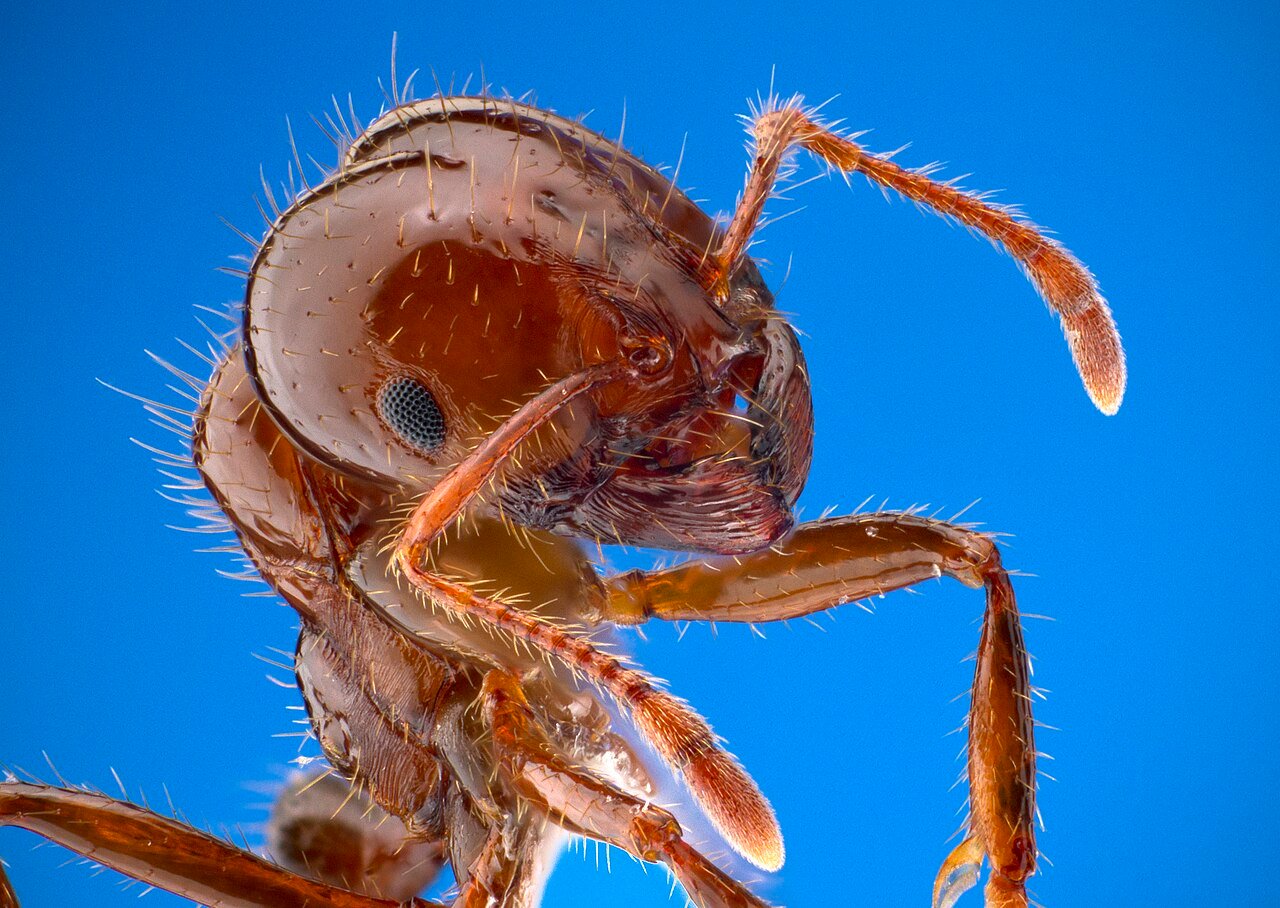
The red imported fire ant (Solenopsis invicta — the species name means “unconquered,” which the South considers earned) arrived from South America through Mobile in the 1930s and now occupies a permanent quarantine zone across the southern US: the Carolinas through Texas, up through Tennessee’s southern counties, with the boundary drawn by one variable — winter soil temperature: sustained deep-soil freezing kills colonies, and the Ohio Valley’s winters have historically run fatally cold for them. The identification package, for travelers and for grading the claim: small-to-medium workers (an eighth to a quarter inch, notably variable in one colony — polymorphic sizes are a genus tell), reddish-brown with darker abdomens, and the two signatures: the mound — a domed, fluffy-soiled hill up to knee height with no entrance hole on top (traffic runs through underground tunnels — the no-hole dome is the classic field check), and the response: disturb a mound and workers boil out in seconds by the hundreds, running upward onto anything touching the mound, stinging in coordinated waves (an alarm pheromone synchronizes them — the horror-story mechanism behind multi-sting events). The sting itself is unique equipment: the fire ant bites to anchor, then stings from the abdomen — injecting an alkaloid venom (solenopsin) that burns like the name and raises the diagnostic lesion no Ohio ant produces: a sterile white pustule at 24–48 hours. Hold that pustule detail; it’s the single best discriminator for every claim this page grades.
Ohio has no fire ants, so something else is stinging you, and it is usually treatable. Naming it is the first job in ant control in Dayton.
What actually stung you: the Ohio red-ant lineup
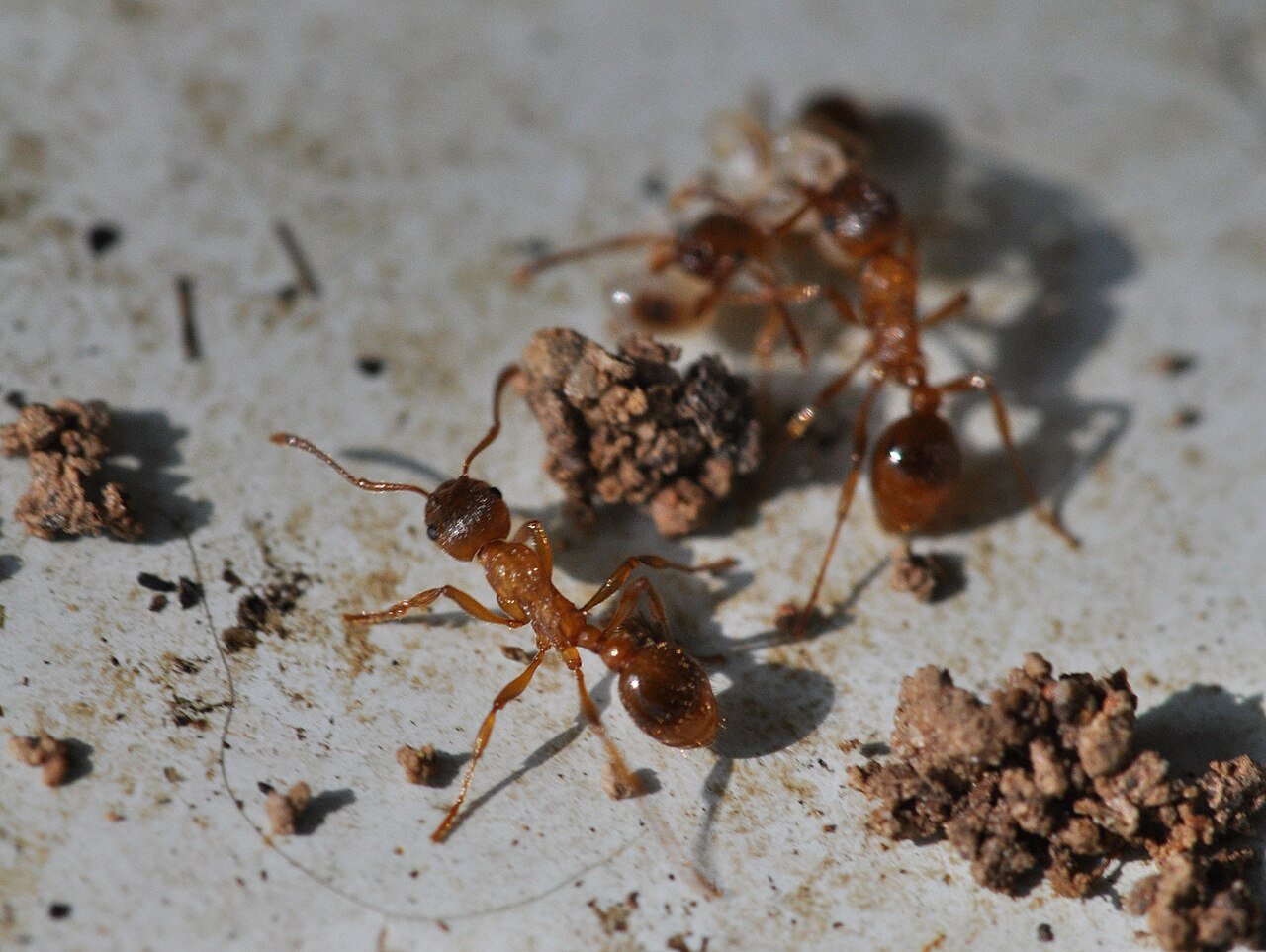
The genuine culprits behind the Miami Valley’s “fire ant” welts, in rough order of frequency from our photo line: Pavement ants — the brown-black sidewalk-crack colonists of every Ohio patio — can technically sting but rarely penetrate skin; their “bites” during a picnic are usually formic-acid nips: real pinch, brief burn, no pustule. The Formica field ants — including genuinely red-and-black species that build low soil mounds in lawns and meadows — are the mound-plus-red combination that launches most fire-ant reports: bigger than fire ants (a comforting field mark — real fire ant workers are small), they bite hard and spray formic acid into the wound for a sharp burning pinch, no true sting, no pustule, no coordinated swarm. The European fire ant (Myrmica rubra) — the northern complication worth knowing: a genuinely stinging red ant established in patches of the Northeast and Great Lakes shoreline states, delivering a real burning sting from damp lawns and garden margins; Ohio records remain scattered-to-absent, but it’s the one red stinger whose range argument runs north rather than south, and a repeat-stinging colony in a damp Ohio yard earns the photo-and-report protocol below. And the wildcard that isn’t an ant at all: velvet ants — the “cow killer” wingless wasps whose sting genuinely ranks among the continent’s most painful; a fuzzy, bright red-orange “ant” walking alone across a sunny Ohio yard with an unforgettable sting is that story, and it has its own page in this library’s queue. The sorting kit: size variability and pustules say fire ant; large-and-red with a pinch says Formica; damp-lawn repeat stings say the European question; solo, fuzzy and unforgettable says velvet ant; and the photo line says which, free, same day.
The climate question: is the line moving?
The honest forward-looking answer, because the question deserves better than either denial or alarm. The red imported fire ant’s range is thermally limited, the limit is warming, and the projection literature has spent two decades mapping the drift: models under continued warming scenarios show potential expansion up the Ohio Valley corridor over coming decades, with winter soil-freeze frequency — not summer heat — as the gatekeeper variable. The current scorecard still reads firmly in Ohio’s favor: no established populations, no quarantine counties, and the occasional hitchhiker colony (fire ants travel famously in nursery stock, sod and mulch shipments from quarantine states — the pathway that built their national range) discovered north of the line has historically died its first real winter. But the hitchhiker pathway is exactly why the reporting protocol matters: if you genuinely believe you’ve found the southern species — the no-hole dome, the boiling coordinated response, the size-variable small workers, above all the pustules — don’t treat it yourself: photograph everything, collect a few workers in alcohol if safely possible, and report it — to our line (we’ll grade it same-day and escalate a credible find), and to the Ohio Department of Agriculture and OSU Extension, who track exactly these detections. Early-detection removal of a hitchhiker colony is cheap and complete; a missed establishment is the Southern lawn-care economy’s biggest line item heading north. The odds say your find is a Formica mound; the protocol exists for the year the odds miss.
Care file: the burn, the pustule, and when it matters
Whatever delivered it, the red-ant welt’s care runs a short file. The standard case — formic-acid nips and single stings: wash, cold compress, the itch protocol, done in days. The genuine fire-ant scenario (the vacationing Ohioan’s souvenir from a Gulf beach or a Carolina lawn — the context where readers of this page actually meet the species): expect the burn, then the pustules at a day-plus — don’t pop them (sterile until opened; secondary infection is the sting’s main medical risk), cold and antihistamines for the itch, and the multi-sting events that mound contact produces warrant watching children and the allergy-prone closely. The escalation tier, verbatim from the sting pages: hives beyond the sting sites, facial or throat swelling, breathing trouble — epinephrine if prescribed and emergency care immediately; fire ant venom is a genuine anaphylaxis trigger for a sensitized minority, and the South’s emergency departments treat it as routine summer volume. The travel-prevention paragraph worth its space: in quarantine states, the mound-awareness habit (scan before standing still on any lawn — locals do it unconsciously), closed shoes for Gulf-lawn walks, and the child briefing that a fluffy dirt dome is a no-touch object — thirty seconds of orientation that prevents the vacation’s worst afternoon. Ohio’s contribution to the file remains, happily, the reading of it.
Managing what Ohio actually has
Since the welt’s author is local, the local playbook: pavement ant colonies at patios and walks respond to the bait doctrine — the slab-crack colonies are classic sugar-bait customers, and the spring sidewalk “ant wars” (the swarming battles between neighboring colonies that alarm households annually) need no response at all beyond spectating. Field ant mounds in lawns get the honest proportionality test: a low Formica mound at the yard’s edge is aeration and pest-predation services in residence (they’re significant predators of turf pests) — leave it; the mound in the play area or the colony farming aphids on your fruit trees gets targeted treatment — mound-drench or bait per species, placed, not broadcast, and our ant program handles the stubborn ones with the perimeter logic the ant library documents. The damp-lawn repeat-stinger scenario — the European fire ant question — gets the photo-first protocol before any treatment: species confirmation changes the playbook (Myrmica colonies run multi-queen and diffuse; conventional mound treatment underperforms), and a confirmed find is reportable for the same early-detection reasons as its southern cousin. And the household’s standing red-ant policy compresses to one line: photograph before treating, because in Ohio the red ant burning your ankle is either harmless, beneficial, baitable, or reportable — and the four playbooks share nothing but the camera step.
Fire ant questions, answered
My cousin in Cincinnati swears his yard has fire ants. Possible?
Almost certainly Formica field ants — the red-and-mound combination convinces half the state annually — but southern Ohio is exactly where a hitchhiker colony would make its attempt, so the claim gets the respectful protocol rather than the eye-roll: pustule check, size-variability check, no-hole-dome check, photos to the line. Zero confirmations to date; the protocol stands ready regardless. (And if it’s August and the “fire ants” are pouring out of a lawn hole at the mower — that’s the yellowjacket page, urgently.)
I just moved here from Texas. Do I need to keep treating the yard?
Retire the fire-ant budget entirely — the granular broadcast programs, the mound drenches, the twice-yearly ritual: none of it has a target here. Reallocate to Ohio’s actual outdoor calendar — the perimeter program’s September anchor, the tick moat, the mosquito margins — and enjoy the specific Midwestern luxury of barefoot lawn walks without the scan. It takes transplants about two summers to stop checking; the checking did you honor.
Could fire ants survive in a heated building here, like bed bugs do?
Structural infestations north of the range occur but stay rare and self-limiting — fire ants are soil-and-sun colonists, not structural specialists, and greenhouse-and-atrium detections (the plausible venue, via nursery-stock hitchhikers) get resolved by the facilities’ own pest programs. The indoor-ant calls our eight counties actually generate remain the odorous house ant’s franchise, where the bait doctrine reigns and nothing pustulates.
The verdict at the state line
So: are there fire ants in Ohio? The famous one, no — held at the border by winter itself, monitored by agencies that would like your photos if that ever changes, and impersonated locally by a cast of red look-alikes whose worst member is a hard pinch with formic seasoning. The welt was real, the culprit is identifiable, the care file is short, and the management — where any is warranted — runs through the same bait-and-proportion doctrine as the rest of the ant library. Grade your suspect through the free line, retire the Southern reflexes if you carried them north, brief the kids before the Gulf vacation — and let the state’s winters keep working the quarantine line they’ve held since the thirties: (937) 569-3330, Greater Dayton Pest & Rodent, Dayton and all eight counties, where the fire-ant file stays satisfyingly empty and every red-ant photo still gets its same-day verdict.
The invasion that defines the genre (and what it teaches Ohio)
The fire ant’s Southern century is worth a closing panel, because it’s the reference case for every invasion story this library tells. From one Mobile port entry, S. invicta conquered a third of the country: no co-evolved enemies, a boom-bust disturbance ecology perfectly matched to suburbia’s lawns, mated queens raining by air on every new subdivision, and — the accelerant nobody expected — the mid-century eradication campaigns whose broadcast insecticides cleared the competing native ants faster than the fire ants, handing the invader empty territory twice (the episode is a founding case study in why this library’s doctrine runs placed-not-broadcast). The modern South spends over a billion dollars a year managing the result — and modern biology has finally fielded real counterweights: the decapitating phorid flies (cousins of this batch’s scuttle flies) whose larvae develop in fire-ant heads, imported as biocontrol and now established across the range. Ohio’s takeaways: hold the pathway discipline (inspect the nursery stock and sod from quarantine states — the hitchhiker route is the only route north), keep the reporting reflex (early detection is the entire difference between an anecdote and an establishment), and preserve the native ant community that broadcast treatment squanders — the field ants holding your lawn are the incumbent defense the South wishes it still had. The line has held for ninety years on winter alone; the next decades ask the household layer to help — and the household layer, as this whole library keeps demonstrating, is mostly a camera and a phone call away from doing its part.
The red-ant flowchart, pocket-sized
- Stung on a Gulf/Southern lawn, pustules by day two: genuine fire ants — don’t pop, wash, cold, antihistamines; anaphylaxis signs = emergency care. Souvenir story, not an Ohio problem.
- Large red-and-black ants, low soil mound, hard pinch, no pustule: Formica field ants — beneficial incumbents; treat only play-area or aphid-farming colonies, targeted.
- Small brown ants at the patio crack, barely-felt nips: pavement ants — the borax-bait franchise; the spring sidewalk wars are free theater.
- Repeat burning stings from a damp lawn or garden margin: the European fire ant question — photo first, treatment second, report a confirmation.
- Solo, fuzzy, brilliant red-orange, unforgettable sting: velvet ant — a wingless wasp with its own page coming; look, don’t touch, tell the story forever.
- Small red-brown ants boiling by hundreds from a fluffy no-hole dome: the one that gets photographed, collected in alcohol, and reported same-day — the year the odds miss, you’re the early-detection system.
Six branches, one camera step at the root of each — and the state’s most-searched ant remains, for now and by the grace of January, a reading assignment rather than a resident. May the file stay exactly this empty.
The South’s billion-dollar resident, held at the river by winter and vigilance; Ohio’s red ants, sorted into pinchers, incumbents, questions and legends; and one more search-bar panic converted — per house style — into a flowchart, a camera habit, and a considerably calmer ankle. The line holds; the file stays empty; the welt heals by Thursday.
And for the record the next barefoot July demands: the lawn is yours here, scan-free, pustule-free, and patrolled only by incumbents doing honest work — a regional privilege the transplants understand best, and the rest of us should occasionally stop to appreciate, preferably barefoot, preferably today.
Red, burning, and definitely not what the search results said: case closed at the state line.
Next in the library: the dragonflies, the boxelder bugs, and the velvet ant the flowchart promised — the acquittals continue.
Frequently asked questions
Are there fire ants in Ohio?
Not the notorious red imported fire ant — Ohio winters still exclude established colonies, and no verified breeding populations exist here. What Ohioans call “fire ants” are almost always native look-alikes: pavement ants, cornfield ants, or the genuinely spicy European fire ant — rare but documented in pockets.
What are the red ants in my yard if not fire ants?
Usually pavement ants (brown-red, driveway volcanoes), cornfield ants (lawn mounds), or pyramid ants. Bites from any of them are minor-to-nothing — the dramatic welt-clusters of Southern fire ant lore need the Southern species, which is not here.
Do any Ohio ants sting like fire ants?
The European fire ant can deliver a genuine burning sting and has appeared in isolated Ohio pockets — still rare, moisture-loving, and nothing like the South’s mound-building scourge. A truly painful ant sting here is worth a photo to us precisely because it is unusual.
Could fire ants spread to Ohio eventually?
The range creeps north with warming — models put established Ohio colonies decades out, with hitchhiker introductions (nursery stock, mulch shipments) as the realistic near-term route. Isolated finds get eradicated; a suspicious aggressive mound is worth reporting.
What should I do if I think I found fire ants?
Photograph the mound and an ant close-up (do not kneel next to it — test with a long stick; genuine fire ants boil out in seconds), and send it to us or OSU Extension. Nearly all reports resolve as natives; the rare exception genuinely matters to document.
What are the ants that bit me at a picnic?
Likely field or pavement ants defending turf — pinch-grade, brief, no venom drama. Persistent burning welts point to something else entirely: chiggers, horse flies, or sweat bees out-bite every Ohio ant.
How do I treat the mounds I do have?
Same playbook as our outdoor ant guide: bait for trail species, proper drenches for located mounds in collision zones, and tolerance for the back-fence colonies doing free soil work. No Ohio mound needs the Southern fire-ant panic response.
Do fire ant killers sold in Ohio stores work on our ants?
The bait chemistry transfers fine — but products marketed for fire ants are formulated for a species you do not have. Ordinary ant baits matched to sweet-or-protein appetite outperform the specialty aisle here.
Are red ants in the house a fire ant risk?
No — indoor reds are pavement or pharaoh ants running standard kitchen economics. The house response is the ants-in-house doctrine: feed the trail, never spray, seal the seams after victory.
Who identifies ants in the Dayton area?
Send the photo to (937) 569-3330 — identification is free, the burning-sting reports get taken seriously, and the answer usually saves you a specialty-product purchase the actual species never required.