
The black widow is the one Ohio spider whose reputation is roughly earned — and precisely because the stakes are real, the details deserve better than the folklore delivers. This page is the deep file the venomous spiders overview points into: the two species Ohio actually hosts and how uncommon they genuinely are here, the male black widow (the search bar’s favorite question, and the answer defuses half the sightings — he’s small, brown, patterned, and medically irrelevant), the juveniles and egg sacs that confuse identification at every stage, where widows actually live in a Miami Valley yard (a short, specific list you can audit in an hour), the honest medical picture — serious, treatable, and fatal essentially never in the antivenom era — and the found-one protocol that neither panics nor pretends. Alongside the widow, the section the anxious searches deserve: the look-alikes — the false widows, the cobweb cousins, and the marbled orb weaver whose autumn photos flood our line labeled “widow?” — every one distinguishable in a decent photo, which is why the free ID line answers these first among equals: (937) 569-3330, Greater Dayton Pest & Rodent, where widow verdicts come back the same hour.
Ohio’s widows: two species, honestly uncommon
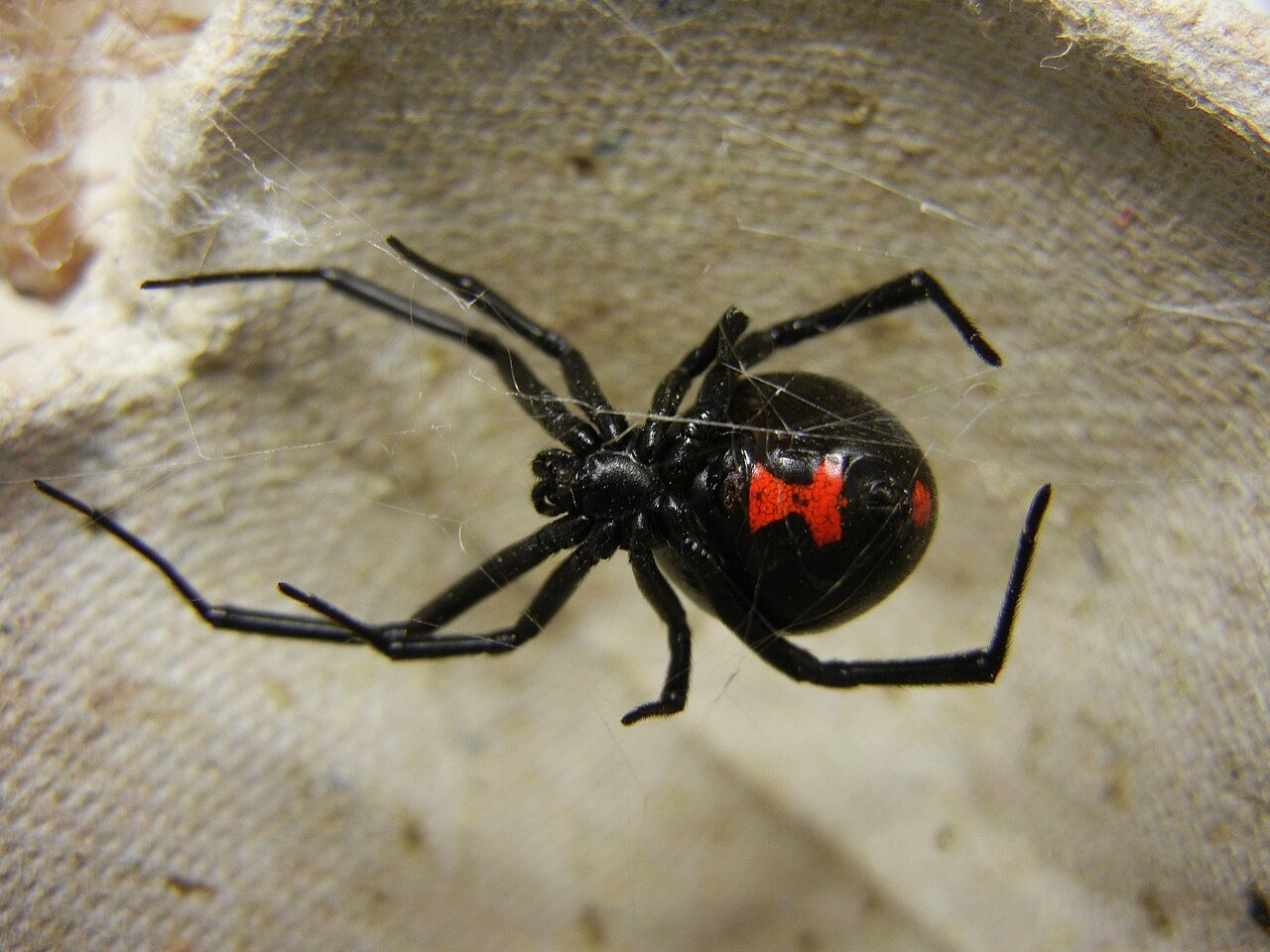
Ohio hosts two widow species at the northern edge of their comfort: the southern black widow (the textbook animal — female glossy jet-black, a half-inch body on inch-plus legs, the red hourglass complete on the abdomen’s underside) and the northern black widow (subtly different — the hourglass typically broken into two separated red bars, often with a row of red spots down the back’s midline; more common in the state’s southern counties and wooded edges). The distribution truth that calibrates everything: widows are established but genuinely uncommon in the Miami Valley — our eight counties sit at the range’s cooler margin, and across thousands of spider photos our line has graded, confirmed widows run a small handful per year, nearly all from the specific habitat list below. That’s not a reason to dismiss the check (the habitats are exactly where hands go), but it resets the odds: the dark spider in the basement corner is overwhelmingly a harmless cobweb spider or wolf spider, and the glossy-black-with-red verdict — the only one that matters — survives about one photo in fifty that claims it. The web is the pre-check, per the architecture triage: widows build strong, chaotic, three-dimensional tangles low in dark sheltered spots — silk so tough it audibly crackles when torn, the field mark old-timers swear by — never symmetrical wheels, never sheets, never in the open.
The male black widow: the search bar’s question, answered
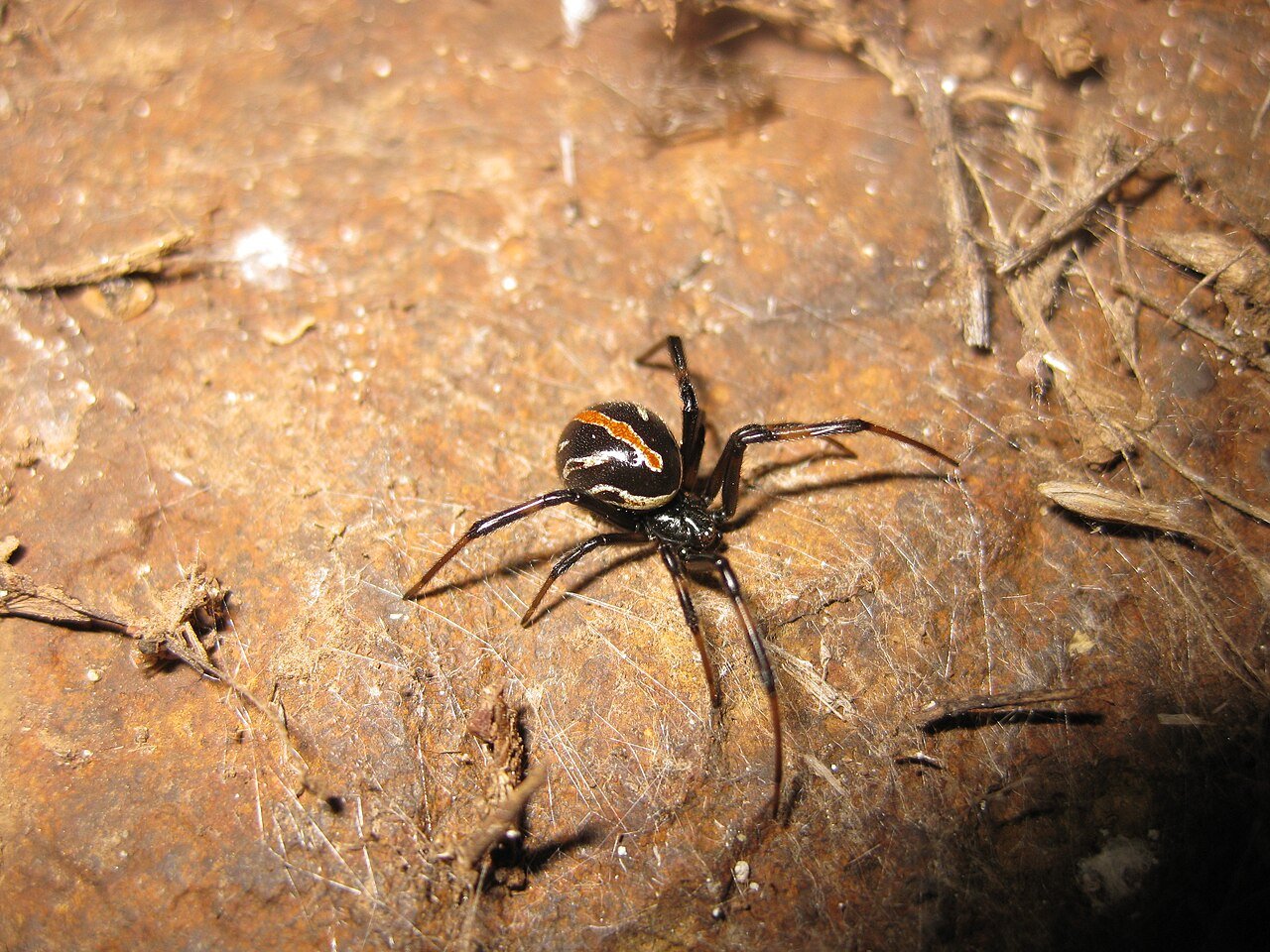
“Male black widow” outsearches almost every other widow query, usually asked mid-worry over a small brown spider near a suspected widow site — so here is the full answer. The male is a different-looking animal entirely: half the female’s size or less, brown-to-gray rather than black, with cream and red-orange bands and chevrons along the abdomen’s sides and back, long-legged and slim — closer to a patterned cobweb spider than to his famous mate, and routinely misidentified in both directions. The medical answer is the relieving part: male widows are functionally harmless — venom apparatus a fraction of the female’s, fangs that struggle with human skin, and essentially no documented envenomations of consequence; the same holds for the juveniles of both sexes, which start life tan-and-white-banded and darken female-by-molt toward the glossy black (a “baby widow” sighting is an identification curiosity, not an emergency — though it does flag that a mature female bred nearby, which aims the audit). And the famous name? Post-mating cannibalism is real but overstated — laboratory-frequent, field-occasional; most males walk away, live their few months, and die of being small in a world of birds. The practical takeaway our line delivers weekly: the banded brown spider is not the danger; the question he raises — is there a female’s tangle within fifty feet? — is worth the flashlight hour below, and nothing more dramatic.
The habitat audit: where widows actually live here
Widow encounters in the Miami Valley concentrate on a short, auditable list — dark, dry, undisturbed, structure-adjacent: the woodpile (the number-one address — between logs, under tarps; the reason gloves are the wood-carrier’s uniform); meter and valve boxes (the in-ground water-meter pit is a widow condominium across the South, and our few local confirmations skew exactly there — lift lids by the far edge, never fingers-under); garage and shed clutter zones — the undisturbed corner behind the mower, stacked flowerpots, the boots stored in the garage since last season (shake them — the folk rule earns its keep); under deck skirts, in block-wall voids, behind shutters, and — the modern classic — the gaps of outdoor furniture and grills stored against the house. The audit: one hour, headlamp, gloves, the crackle-web check in each zone, and a wand or stick doing the probing hands would otherwise do. Prevention falls out of the audit automatically: declutter the zones (clutter IS the habitat), elevate the woodpile per the tick-moat playbook, gasket the meter-box lids, and — the elegant layer — note that the blue mud dauber patrolling these same zones is hunting widows professionally: her presence on the audit route is a point in the yard’s favor, not another worry. Households that run the hour annually convert the widow question from ambient dread to a managed line item — which, for the one spider here that earns management, is exactly the right size.
The medical file, without the folklore
The honest severity picture, because both the dismissers and the catastrophizers get it wrong. A female widow’s bite delivers latrotoxin — a neurotoxin, and the mechanism behind the syndrome the folklore garbles: latrodectism — onset over 30–120 minutes of severe muscle cramping (abdomen and back classically — historically misdiagnosed as appendicitis), sweating, nausea, blood-pressure elevation, pain disproportionate to the tiny bite site (often just two faint punctures, no dramatic local wound — the necrotic-crater imagery belongs to recluse folklore, not widows). Duration: rough days, then resolution. The modern outcome data is the calming part: fatalities are essentially zero in the antivenom era — none reported in the US in decades — with serious courses concentrated in small children, the elderly and the cardiac-compromised, exactly the populations whose bites warrant the ER without debate. The protocol on a suspected bite: wash the site, cold pack, capture or photograph the spider if safely possible (the single most useful thing a bite victim can do — treatment confidence follows identification), and medical contact same-day for anyone symptomatic, immediately for the vulnerable groups — where antivenom and modern pain management have turned the historical horror stories into managed, miserable, temporary events. And the base-rate sentence that belongs in every widow conversation: widows bite only when pressed against skin — the boot, the glove-less log, the lid’s underside — and the audit-and-gloves culture above prevents functionally all of it. Respect, not fear; gloves, not folklore.
Egg sacs, look-alikes, and the photo checklist
The identification loose ends, closed: widow egg sacs are tan-to-gray, papery, roughly pea-to-marble sized, teardrop or globular, suspended in the tangle — each holding a hundred-plus eggs, and worth destroying on a confirmed find (into soapy water; crushing dry scatters spiderlings) since sacs are the population’s future. The look-alike roster that absorbs most widow anxiety: the false widows (Steatoda — same cobweb family, similar glossy build, chocolate-to-black with pale markings but no red hourglass; mildly venomous at worst, established statewide, and the single most common “widow” submission we grade); the common house spider (smaller, mottled brown, the cobweb-corner default); the black ground beetles and crickets that panic-glances convert to spiders; and October’s champion confuser, the marbled orb weaver, whose orange bulk on a wheel web fails the widow test twice before the photo loads. The photo checklist that lets our line answer in minutes: shoot the underside if safely possible (the hourglass lives there — a clear container over the spider, card underneath, flip for the belly shot), the web architecture in a wide shot, and the location noted — the three data points that separate “widow, here’s the protocol” from “false widow, carry on” with professional confidence. When in doubt, the container-and-photo beats both the shoe (which destroys the evidence) and the ignore (which leaves the question standing where hands return).
Widow questions, answered
We found one confirmed widow. Are there dozens more?
Not typically, here — at Ohio’s range margin, finds run solitary-female far more often than the aggregations southern states manage. One confirmed widow means: destroy any sacs, run the full habitat audit the same week (where there’s one suitable harborage there are usually several), and re-check monthly for a season. A second find in a different zone upgrades the response to the professional sweep; most households never make the second find.
Should I spray the yard after a confirmed find?
No — broadcast treatment for a solitary ambush spider is the fogger fallacy outdoors: it misses the animal in its sheltered tangle and taxes everything beneficial, the widow-hunting daubers included. The effective response is mechanical and specific: the tangle destroyed, the sac drowned, the harborage decluttered, the zone re-checked. Targeted crack-and-void treatment of specific harborages (block walls, meter pits) has a place in confirmed-multiple scenarios — placed, not broadcast, per this library’s standing doctrine.
Are widows moving north with the warming trend?
The range-edge question, honestly: modeling and scattered records suggest northern-edge expansion for many southern species and the widows plausibly among them, but Ohio confirmation data remains thin and our own line’s verdict rate has held steady-low for years. The practical posture doesn’t change either way — the audit hour, the gloves, the photo line — and if the rate ever shifts, the eight counties’ woodpiles will report it here first.
My kid is terrified after a school video. What’s the honest reassurance?
The numbers, kid-formatted: no one in America has died of a widow bite in longer than their parents have been alive; the spider hides from people harder than people hide from it; and the family rules that make the risk effectively zero — gloves for wood, shake the boots, lids by the edge — are the same “look before you grab” rules that cover most of childhood. Fear shrinks to a checklist; the checklist fits on an index card; and the spider goes back to being what it’s always been here: rare, shy, and beatable by a flashlight hour.
The one that earns the respect
Of everything eight-legged in this library, the widow alone carries a genuine medical file — and even hers resolves, on honest reading, into a managed risk: two uncommon species at their range edge, a male and a juvenile stage that defuse most sightings, a habitat list one flashlight hour audits, a bite syndrome modern medicine handles, and a prevention culture — gloves, shakes, edges — that costs nothing and covers everything. Run the audit, teach the rules, photograph before panicking, and send every glossy-black question to the line that grades them first in queue: (937) 569-3330, Greater Dayton Pest & Rodent, Dayton and all eight counties — where the widow gets the respect she’s earned, the false widows get their acquittals, and the woodpile gets picked up, gloved, exactly the way it should have been all along.
The widow in context: how the risk actually ranks
Because dread resists numbers, the comparison table this page owes its readers: the Miami Valley’s realistic widow-bite risk — a handful of confirmed spiders annually across eight counties, biting only under direct pressure, producing a treatable syndrome with essentially zero modern fatalities — ranks demonstrably below the region’s unglamorous everyday stingers: yellowjacket stings hospitalize more Ohioans every single August (anaphylaxis being the region’s one genuinely fatal envenomation risk, per that page’s emergency tier) than widow bites have in decades; the blacklegged tick’s Lyme file dwarfs the entire spider category for actual acquired disease; and the household ladder outscores the whole arthropod kingdom combined. None of that dismisses the widow — the gloves-and-audit culture exists precisely because the tail risk is real — but it aims the household’s finite vigilance where the numbers point: the EpiPen conversation for the sting-allergic, the permethrin boots for the trail family, the September caulk line for everything that overwinters — and one flashlight hour a year for the glossy tangle in the meter pit. Proportion is the last ingredient of every honest risk file, and the widow’s, held to the light, is the rarest thing in pest control: a famous danger that’s exactly as manageable as it is real.
The eight-county widow map
Where the rare confirmations actually cluster, for audit-targeting: the rural-southern edges lead — the wooded margins and outbuilding-rich properties of southern Warren and the Preble farm campuses, where northern widows work the woodpiles and barn-wall voids at the habitat density the species prefers; the meter-pit corridor runs through every county (the in-ground utility box is the single most repeated confirmation site in our files — the lid rule is not folklore); the storage-heavy suburbs contribute the garage-clutter finds (the flowerpot stack, the decade-stored camping gear); and the historic districts’ stone outbuildings and root cellars round out the list. What every zone shares: the finds live where hands reach into dark undisturbed gaps — never in the open, never upstairs, never in the bed-adjacent nightmare geography the dread assumes. Audit the real map, glove the real reaches, and the eight counties’ scariest spider stays what the data says it’s been all along: rare, findable, and losing ground to every household that reads this page. The flashlight hour is this weekend’s; the photo line is always open; and the woodpile — gloved, elevated, and audited — was never actually out to get anyone.
Glossy black, red glass, one honest hour of flashlight a year — the library’s only earned fear, filed at last at its actual size: small, specific, gloved, and handled. The widow keeps her respect; the household keeps its calm; and the myth, like every myth this library has met, keeps exactly nothing.
The found-one protocol, card-sized
- Confirm before acting: container over the spider, card under, belly photo — hourglass or bars = widow; anything else = the look-alike roster, stand down.
- Confirmed female: container sealed and relocated far from structures (or dispatched in soapy water — the one library resident where nobody argues); the tangle swept down; any sacs drowned, not crushed.
- Same week: the full habitat-audit hour, gloved; declutter what the audit flags; note the find location for monthly re-checks through the season.
- Second confirmed find, different zone: the professional sweep — targeted void treatments, full-property harborage map, done once and done right.
- Any bite with symptoms: wash, cold pack, capture or photograph the spider, medical contact same-day — immediately for children, elders, or cardiac histories. The photo is the treatment’s best friend.
- Always: gloves for wood, shake stored boots, lift lids from the far edge — the three habits that make every line above them nearly theoretical.
Index card written, woodpile gloved, file closed — and the one spider that earned its page leaves it, like every subject before it, smaller and more manageable than it arrived.
Frequently asked questions
Are black widows really in Ohio?
Established but uncommon — both northern and southern widows occur across southwest Ohio, concentrated in undisturbed outdoor-adjacent spaces: woodpiles, meter boxes, crawlspaces, barn corners, stacked stone. Most Ohioans never meet one; the storage-glove habit exists for the exceptions.
How do I identify a black widow?
The female: glossy jet-black, globe abdomen, red hourglass underneath (northern widows may show split red patches or dorsal spots), messy strong-stranded web low in dark cover. Males and juveniles are smaller, marked, and medically irrelevant.
How dangerous is a black widow bite actually?
Medically significant, rarely life-threatening — latrotoxin causes real pain, cramping, and sweating that peaks over hours; antivenom and supportive care handle severe cases, and deaths are historic rarities. Every suspected widow bite earns a medical call; panic does not improve the odds it already has.
What should I do if bitten by a black widow?
Wash, cold compress, and call your doctor or poison control (1-800-222-1222) with the timeline — escalating cramping, abdominal rigidity, or sweating means emergency care. Capture or photograph the spider if safely possible; confirmed ID changes treatment.
Where would black widows hide around my house?
The undisturbed inventory: woodpiles and lumber stacks, water-meter and irrigation boxes, crawlspace corners, garage clutter untouched since spring, outdoor furniture stored over winter, stacked pots and stone. The theme is months of stillness — widows abandon busy real estate.
How do I check for black widows safely?
Gloves plus flashlight, disturb-then-inspect: tap boxes and furniture before reaching, look for the distinctive strong tangle-web low in corners, and work storage areas in daylight. The glove habit alone converts widow risk from real to essentially theoretical.
How do you treat for black widows?
Harborage-by-harborage: direct treatment of confirmed webs and retreats, removal of egg sacs (each holds a hundred-plus eggs), sticky-trap monitoring for clearance, and the decluttering consult that removes the habitat — the only permanent fix. Broadcast spraying performs poorly; precision wins.
Do black widows come inside houses?
Rarely and reluctantly — attached garages, basements, and crawlspaces are the indoor limit, usually via firewood or stored boxes. Living-space widows are exceptional events; the interface zones are where the protocol focuses.
What eats black widows — any natural control?
Mud daubers famously provision nests with them, and cellar spiders kill them in web disputes — two more entries for the leave-the-harmless-spiders file. Neither replaces the gloves; both quietly help.
Who handles black widow concerns near Dayton?
We do — identification from photos free, storage-zone inspections, and the precision treatment protocol: (937) 569-3330. Widow calls get scheduling priority, and half of them resolve as false cottage-spider alarms — an outcome everyone enjoys.