
Ohio hosts roughly 500 species of bees — a number that surprises everyone, because the public bee imagination holds exactly two: the honeybee and the bumblebee, with everything else filed under “probably a wasp.” That filing error has consequences in both directions — harmless native pollinators get sprayed on sight, while the occasional genuine problem (a honeybee colony moving into a soffit; the carpenter bee drilling the deck rail) gets misread until it’s expensive. So this is the identification parade: the types of bees an Ohio yard actually hosts, sorted the way a working ID needs — by size, look, nest and season — with each species’ honest threat assessment (spoiler: the list of bees that warrant any action fits on one hand), the bee-versus-wasp fork that fixes most misfiles in two seconds, the how-honey-happens answer the search bar keeps asking, and the referral doctrine this company is proud of: honeybee swarms and colonies go to beekeepers, free — we don’t treat what a hive box can save. From Greater Dayton Pest & Rodent, where the photo line IDs bees all summer without charging anyone: (937) 569-3330.
First fork: bee or wasp? (Two seconds, most cases)
Before the parade, the gate: half the “bee” photos our line receives are wasps, and the tells are fast. Fuzz: bees are hairy — branched hairs for pollen-carrying are the family’s defining equipment — while wasps run smooth and polished; a shiny, hairless “bee” is a wasp. Build: bees are stocky with thick waists; wasps show the pinched wasp-waist and dangling legs in flight. Cargo: visible yellow-orange pollen packed on the hind legs or belly is a bee guarantee — wasps carry prey, not pollen. Diet and behavior: the insect working flowers methodically is a bee (or a harmless flower wasp); the one investigating your pop can, your burger, or your festival funnel cake is a yellowjacket, every time — bees have no interest in your lunch. The fork matters because the response forks with it: the yellow-and-black insect at the picnic table belongs to the wasp pages’ triage; everything past this paragraph is the gentler kingdom, where the correct response is nearly always none.
The heavyweights: honeybees and bumblebees
The honeybee — golden-brown, fuzzy-but-tidy, half an inch — is the parade’s only non-native celebrity (European import, working Ohio since the settlers) and its only perennial colony: tens of thousands strong, overwintering on stored honey, which is what makes honeybees the one bee whose real estate decisions matter. A swarm — the football of bees hanging off your maple in May — is a colony mid-move, docile to a degree that astonishes people (no home to defend, honey-stuffed, focused entirely on house-hunting), and it’s the referral doctrine’s finest hour: photo to our line, and we connect you with local beekeepers who collect swarms free — usually same-day, the bees get a hive, the keeper gets bees, nobody pays anyone. A colony that’s already moved INTO a structure — soffit, wall void, chimney — is the harder case: still beekeeper-first (cutout rescues save most), but time-sensitive, because an established colony builds comb and stores honey that outlast the bees (an abandoned or killed in-wall colony leaks honey, breeds larder-and-pantry scavengers, and slumps through drywall in summer heat — the reason “just spray the wall” is the worst answer available and we won’t sell it). The bumblebee — the flying plush toy, Ohio’s dozen-plus species from thumb-sized queens down — runs small annual colonies (dozens to a few hundred) in old rodent burrows, compost margins and birdhouse cavities: docile on flowers, defensive only at the nest mouth, dead by frost with only next year’s queens overwintering. The management answer for nearly every bumblebee nest is the leave-it tier with a season’s patience; the exceptions (nest in the mower path, sting allergy in the house) get careful relocation or, last resort, treatment — and the “do bumblebees sting” answer is yes-but-barely-ever: females can (and unlike honeybees, repeatedly — no barb), and virtually never do away from the nest. The males of many species — identifiable by their mustached faces and nest-free loitering — can’t sting at all, a theme this library’s cicada killer page has already celebrated.
The natives: the 490 species nobody recognizes
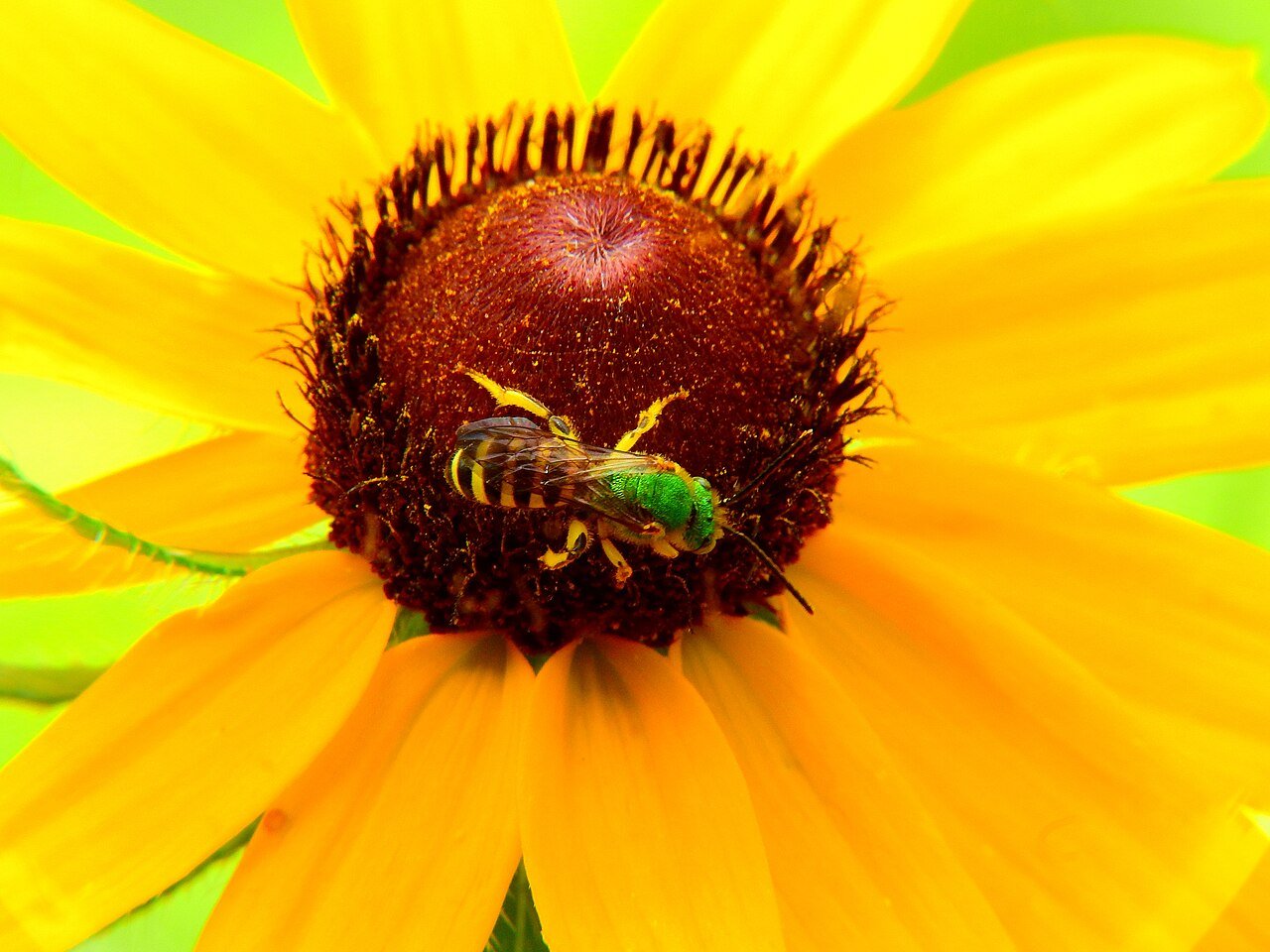
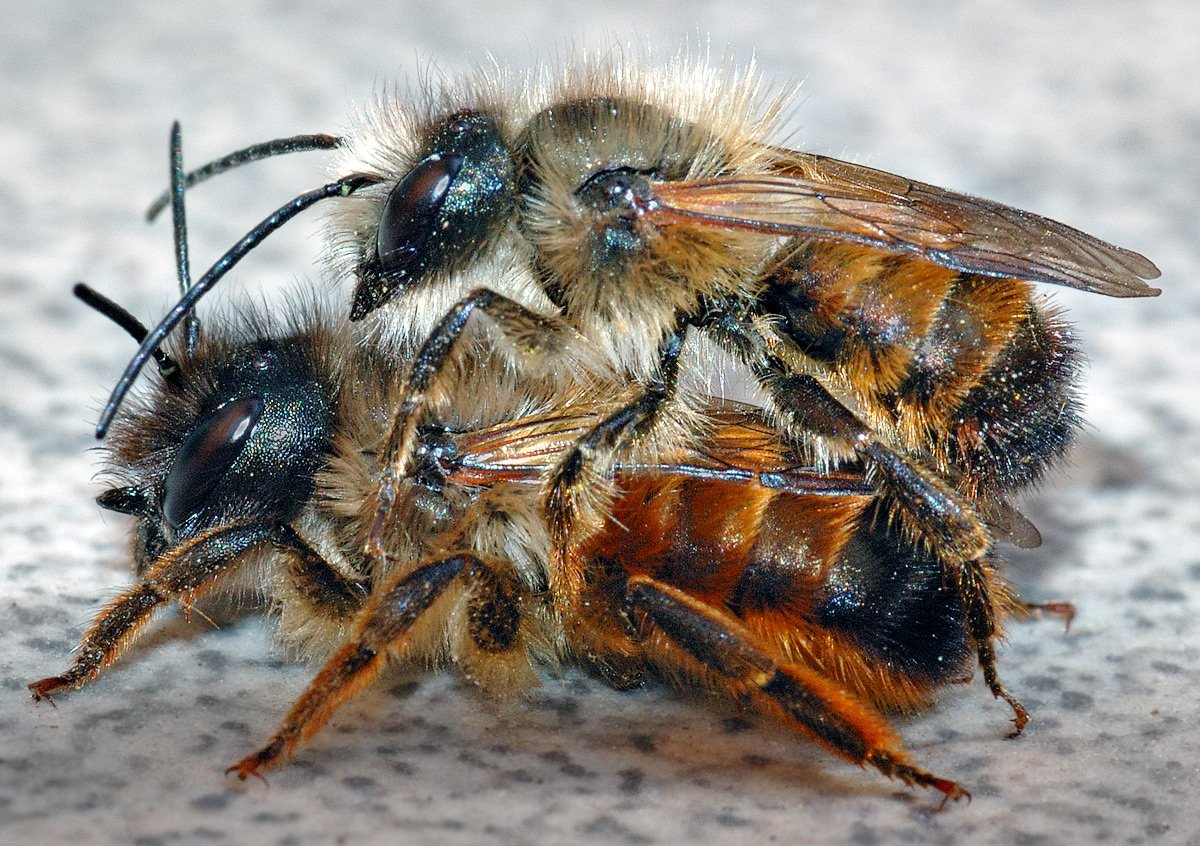
Past the two celebrities, Ohio’s bee fauna goes native, solitary, and almost universally harmless — each female her own queen, provisioning her own nest, with no colony to defend and therefore no meaningful sting motivation (the solitary-equals-safe theorem, bee edition). The recognizable cast: Carpenter bees — the bumblebee look-alike with the shiny black hairless abdomen, hovering territorially by the deck in April; the one native with a property-damage file (the half-inch drill holes in fascia and rails), fully covered on the carpenter bee page — and its hovering guard males are stingless bluff, the cicada-killer act in miniature. Mason bees — compact, blue-black metallic, the earliest spring workers, nesting in beetle holes and hollow stems and famously in the paper-straw “bee hotels” garden stores sell; gentle to the point of being handled bare-fingered by schoolchildren, and pollinators of legendary efficiency (a few hundred masons match a hive of thousands on an orchard — why orchardists culture them on purpose). Leafcutter bees — masons’ summer cousins, recognized less by sight than by signature: the neat circular notches scissored from rose and redbud leaves to wrap their nest cells — cosmetic, harmless, and a mark of a healthy yard (the notches are this parade’s only “damage,” and the correct treatment is showing the neighbors). Sweat bees — the tiny ones, including the metallic-green jewels in this page’s photo; the name comes from their harmless interest in the salt on summer skin, the source of most “tiny bee that landed on me” reports; brush, don’t swat, and the encounter ends. Squash bees in the vegetable garden’s dawn shift, mining bees whose spring lawn mounds get mistaken for yellowjacket holes (the fork that page settles: mounds with single polite residents in April are miners; holes with air traffic in August are the appointment), and the parasitic cuckoo bees rounding out the census. Threat assessment for this entire section: functionally zero — and collectively they carry the pollination economy this region’s gardens, orchards and soybean margins run on.
How honey happens (the question the search bar keeps asking)
Since “how do bees make honey” rides along with every bee search, the honest short course — and it’s better than the folklore: honey is nectar, dehydrated and enzymatically converted, by teamwork. A forager drinks flower nectar (roughly 80% water, mostly sucrose) into her crop — a dedicated honey stomach — where enzymes begin splitting sucrose into glucose and fructose. Back at the hive she hands the load, mouth-to-mouth, through a bucket brigade of house bees (the same trophallaxis economy this library keeps meeting — ants, termites, now sweetened), each transfer adding enzymes and shedding water. The processed nectar gets painted into open comb cells, and the colony fans its wings over them in coordinated shifts — an evaporation assembly line running the water content down below 18%, the threshold where nothing microbial can grow. Then the cell is capped with wax: shelf-stable essentially forever (edible honey has come out of pharaohs’ tombs), which was the entire point — honey is the colony’s winter payroll, some 50-plus pounds of it per hive per Ohio winter, distilled from something like two million flower visits per pound. Only honeybees do this at scale — bumblebees store nectar by the thimble for weekly cash flow, and the solitary natives pack each egg’s lunchbox once and seal it. Which adds the parade’s best punchline: the famous product comes from the imported species, while the native 490 do the region’s heavier pollination lifting unpaid — one more reason the spray-on-sight reflex this page retires was always aimed at the wrong insects.
The action list: the few bee scenarios that warrant one
- Honeybee swarm on a branch: photo to the line, beekeeper referral, free, usually gone by dinner — the happiest call in pest control.
- Honeybees trafficking a wall or soffit gap: time-sensitive beekeeper-cutout conversation — weeks matter because comb accumulates; never spray-and-seal (the honey-in-the-wall aftermath costs multiples of the rescue).
- Carpenter bees drilling structure: the treatment-and-fill program, ideally spring; the one native on the invoice list.
- Bumblebee nest in the wrong spot (mower path, playset, doorway) or any nest + household sting allergy: relocation-first conversation, allergy-priority routing, honest options.
- Ground-nest ambiguity: single spring mounds = mining bees, leave; August hole with heavy traffic = yellowjackets, appointment. The photo settles it in minutes.
- Everything else in the parade: no action, ever — and the yard is measurably better for their presence.
Bee questions, answered
Are Ohio’s bees actually disappearing, and does spraying my yard matter?
The declines are real — several Ohio bumblebee species have contracted sharply (the rusty patched bumblebee, once common here, is federally endangered), and native-bee trends track habitat loss and pesticide exposure. One yard’s choices genuinely register at the margin: broadcast spraying flowering plants is the single worst move (and label-illegal for most products during bloom), while the targeted crack-and-void doctrine this library teaches everywhere leaves foragers untouched. Our own applications follow pollinator-protection labeling as a floor, not a ceiling — it’s the operational version of the referral doctrine, and it costs nothing but care.
A “bee” keeps hovering in one spot and darting at anything that passes. Threat?
That’s a male — carpenter bee by the deck, or a territorial native elsewhere — running the stingless-bluff patrol this library has now documented in three species. He physically cannot sting; the hover is real estate marketing. Walk through it; the season ends in weeks.
Do I need to remove the old bee hotel? I heard they spread disease.
Partially true and fixable: neglected bee hotels can concentrate mason-bee pathogens and mites over years. The keeper’s habit — replaceable paper liners or fresh drilled blocks every second season, old ones retired after emergence — keeps the amenity a genuine one. A maintained hotel is excellent yard citizenship; an abandoned one is, like most abandoned things in this library, quietly working against its original intent.
Was that giant black bee a threat to the kids?
Almost certainly a carpenter bee (shiny abdomen) or a bumblebee queen (fully fuzzy) — and no, in either case, away from a nest. Ohio hosts nothing bee-shaped that hunts people; the region’s actual stinging risk lives on the wasp pages, wears smooth yellow, and wants your picnic, not your flowers. Teach the fuzz-check; it serves for life.
The parade, dismissed with honors
Five hundred species, two celebrities, one drilling delinquent, and a referral doctrine that saves every honeybee a hive box can hold: Ohio’s bees sort out as this library’s largest population of acquittals yet — pollinators wearing warning colors, doing unpaid agricultural work behind a reputation borrowed from wasps. Run the fuzz-check, read the nest-and-season table, act on the short action list, and send everything ambiguous to the line that has never charged for a bee verdict: (937) 569-3330, Greater Dayton Pest & Rodent, Dayton and all eight counties — where the swarm gets a beekeeper, the carpenter bee gets the one honest invoice in the parade, and the other four hundred ninety-some species get exactly what they’ve always earned: the yard, unbothered, in bloom.
The season ticket: a bee-watcher’s calendar for the Miami Valley
For the household that finishes this page curious instead of worried — the conversion we’re always hoping for — the year’s viewing schedule: March–April opens with the mining bees’ lawn mounds and the mason bees working the fruit blossoms in near-freezing air no honeybee will fly in; bumblebee queens — the year’s giants — prospect low over the leaf litter for burrow real estate. May is swarm season’s peak (the maple-branch football, the happiest referral of the year) and the carpenter bees’ drilling-and-hovering festival at the deck rail. June–July brings the full parade — leafcutter notches appearing in the roses, squash bees at dawn in the zucchini blossoms before the honeybees clock in, sweat bees’ green glitter on every coneflower, and the season’s first “giant bee” photos that are actually cicada killers beginning their patrols. August–September is the goldenrod economy — the year’s last great nectar flow, every species represented on one plant family, and the best single photo opportunity the region offers — while the new bumblebee queens fatten for hibernation. October closes the show: colonies die back on schedule, queens dig in, masons and leafcutters wait in their sealed tubes, and the yard’s bee year archives itself until the maples bloom again. Five hundred species, twelve months, zero tickets required — and a standing photo line for whichever act you can’t name: the parade runs annually, and now you have the program.
The referral doctrine, in full
Because it’s this page’s load-bearing promise, the honeybee policy deserves its complete statement. Greater Dayton Pest & Rodent does not exterminate honeybee swarms or accessible colonies — policy, not marketing. The reasons stack: the ecological one (managed and feral honeybees anchor the region’s pollination alongside the natives), the practical one (killed in-wall colonies leave the honey-and-comb aftermath that costs more than any rescue), and the network one — the Miami Valley’s beekeeping community actively wants swarm calls, maintains collector lists across all eight counties, and turns a homeowner’s alarming afternoon into somebody’s new hive at no charge. Our role is dispatcher and honest triage: the photo confirms honeybee-versus-wasp (the yellowjacket nest in the wall gets our own never-plug protocol instead), the referral goes out same-day, and the rare unrescuable case — deep structural colonies past cutout reach — gets the full-disclosure conversation about options, aftermath and costs before anything else happens. If a company quotes you a honeybee extermination without mentioning the beekeeper option, you’ve learned the same thing the swarm-chaser file teaches: who they work for. The bees on the branch have somewhere better to be, the keeper’s ladder is usually free, and the phone line runs the whole exchange — one more way identification-first turns out to be the cheapest doctrine in the book.
Five hundred species, one fuzz-check, one short action list, and a phone line that would rather call a beekeeper than a truck: the bee chapter closes the way the whole library aspires to — more identified than treated, more admired than sprayed, and the yard better off for every verdict. The parade continues outside, right now, working the last of the summer bloom; consider the program a season ticket, and the coneflowers front-row seats.
Fuzzy and on flowers: friend. Smooth and on your sandwich: the wasp pages await. Everything in between: the photo line, where every bee verdict is still free.
Ohio’s five hundred, sorted at last — and not one of them after your lunch.
Let the goldenrod season begin.
Frequently asked questions
How do I identify what type of bee I’m seeing?
Three quick axes: fuzz (bees are furry, wasps glossy), size-and-pattern (honey bees amber and slim, bumbles big and plush, carpenters big with bare shiny abdomens), and behavior (mining bees hover over lawns, carpenters hover at wood, sweat bees land on your arm). Photo to us settles anything: free.
What is the difference between honey bees and bumble bees?
Honey bees: slimmer, amber-and-brown, tens of thousands per managed or feral colony, honey stores, once-only stingers. Bumbles: big, plush, small annual colonies in ground cavities, no meaningful honey, reusable stingers they almost never deploy. Both get protection-grade treatment from us.
What bee looks like a bumble bee but isn’t?
The carpenter bee — same size and coloring except the abdomen: plush-furry = bumble, bare-and-shiny = carpenter. The distinction routes the response: bumbles get tolerance, carpenters drilling structures get the treat-and-seal program.
Are sweat bees real bees?
Very — the tiny green-metallic and dark landers drawn to perspiration’s salts. Sting only if pressed against skin, ranked among the mildest stings measured, and dismissible with a gentle brush rather than a swat.
What are mason bees and leafcutter bees?
Solitary cavity-nesters — masons pack mud into tubes and holes, leafcutters line them with circular leaf clippings (the neat half-moon holes in your rose leaves). Elite pollinators, sting-negligible, and the species bee-hotels are built for.
Which Ohio bees can actually sting?
Females of most species can technically; the practical sting file is honey bees defending colonies and bumbles defending nests — both avoidable by not disturbing either. Male carpenter bees, the most aggressive-SEEMING insects in the yard, carry no stinger at all.
Which bees make honey?
Locally, honey bees alone in harvestable quantity — bumbles store nectar thimblefuls for brood, everyone else stores none. “Honey in the walls” questions are honey-bee-colony questions, with real comb-removal considerations the beekeeper referral handles.
What bees nest in the ground?
Two-thirds of the roster — mining bees, sweat bees, and bumble bees all use soil, each covered on our ground bee page with the crucial distinction from ground yellowjackets: scattered quiet holes versus one rush-hour entrance.
Why does bee identification matter for pest control?
Because it forks everything: honey bees get referred, bumbles and miners get tolerance, carpenters get the wood program, and half of “bee” calls are actually yellowjackets needing wasp protocols. The ID is the treatment decision — which is why ours is free.
Are Ohio bees in decline — should I avoid treating them?
Native bee declines are real and our practice reflects it: no bee treatment without structural damage (carpenters) or genuine misidentification-corrected necessity. Planting for natives and skipping broadcast lawn insecticides is the homeowner contribution that costs nothing: (937) 569-3330 for the sorting.