
The tiny brown beetle keeps turning up — in the flour, on the spice shelf, walking the pantry wall, once memorably in the dog biscuits — and the identification search leads somewhere unexpected: the drugstore beetle, named for its Victorian-era habit of devouring pharmacy stock, including — famously — drugs that should have killed it. That résumé is the whole pest in miniature: Stegobium paniceum may be the least picky eater in the insect world, with a documented menu running from flour, bread, spices and pet food through leather, books, wool, museum specimens and prescription medications (strychnine included, in the literature’s most cited party fact) — which is why a drugstore beetle problem is never really about the beetle you caught, but about the forgotten package somewhere in the pantry currently running a nursery. This page covers the full pantry-beetle situation: the drugstore beetle’s ID against its twin (the cigarette beetle) and its cousins (the flour beetles already in this library, the grain beetles, the weevils), the larder beetle’s different protein-side racket, the source-hunt method that actually ends infestations, why sprays are the wrong aisle entirely for food areas, and the freezer-and-jar prevention doctrine that keeps the pantry closed for good. Greater Dayton Pest & Rodent, photo IDs free as always: (937) 569-3330.
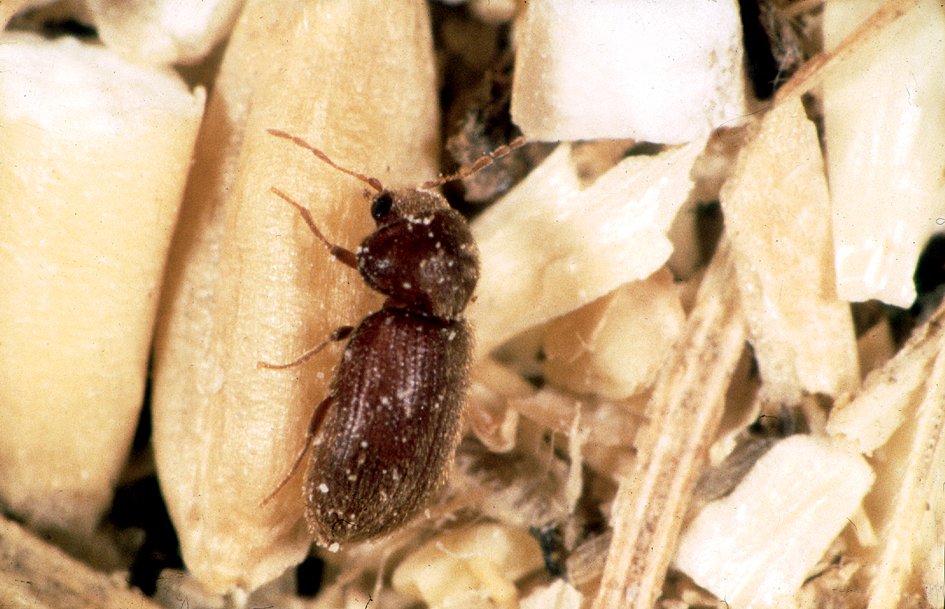
Meet the drugstore beetle (and its evil twin)
The drugstore beetle is a 2–3.5mm oval of reddish-brown, its head tucked under a hooded pronotum so it reads humpbacked from the side, its wing covers finely grooved in longitudinal rows — and it flies, which surprises people: adults are drawn to light, so pantry populations announce themselves at kitchen windows and light fixtures as often as in the flour. The look-alike that matters is the cigarette beetle — same size, same shape, same pantry: the separations visible in a phone macro are the wing covers (smooth on cigarette, grooved rows on drugstore) and the antennae (uniform and saw-toothed on cigarette; the drugstore’s end in a distinct three-segment club). The distinction is honestly low-stakes — both run the same infestation playbook and fall to the same source-hunt — but the ID habit matters because the next look-alike doesn’t: a similar small beetle near carpets, closets and window sills rather than food is the carpet beetle, a fabric problem with a different map entirely. Biology that drives the plan: females lay directly in or near foodstuffs; the larvae — tiny white grubs that do all the actual eating — live entirely inside the infested material, invisible until adults emerge; the cycle runs about two months in a warm kitchen, and adults live weeks without feeding at all (they’re essentially winged dispersal units hunting new packages to seed). Translation: the walking adults are the smoke; some package is the fire — and the fire has likely been burning a full generation before the first sighting.
The source hunt: how the infestation actually ends
Pantry beetle control is a search problem wearing an insect costume, and the search has a method. Empty the pantry — completely; the infested package is always the one you’d have skipped — and inspect with the checklist: the forgotten tier first (the paprika from two apartments ago, the pancake mix behind the crockpot, the birdseed, the dog treats, the ornamental Indian corn from a fall centerpiece — our route data’s single most common culprit category is pet and bird products, followed by spices); the evidence reads — fine powdery residue below a package, shot-hole punctures in cardboard and foil (drugstore beetle larvae bore through packaging in both directions; intact-looking boxes disqualify nothing), webbing-free clumping in flours (webbing points to Indian meal moths, a different pantry chapter), and adults inside the fold of a bag’s rolled top; the spice-rack rule — drugstore beetles are legendarily fond of paprika, chili powder and cayenne (capsaicin apparently reads as seasoning to them too), so the spice rack gets opened jar by jar, not waved past. Everything infested or suspect goes to the outdoor trash the same hour, sealed; everything questionable but precious goes to the freezer (below, in prevention); everything surviving gets wiped shelving, vacuumed crack lines (crumbs in shelf-pin holes and corner seams feed stragglers), and a fresh start in glass. No source found and adults keep appearing week after week? Widen the map — upholstered-room dried-flower arrangements, wreaths, potpourri, a wall void’s old rodent bait or abandoned wasp nest (both documented drugstore larders), and the neighbor question in multifamily buildings. The species’ whole strategy is hiding the nursery in plain sight; the method’s whole strategy is refusing to skip anything.
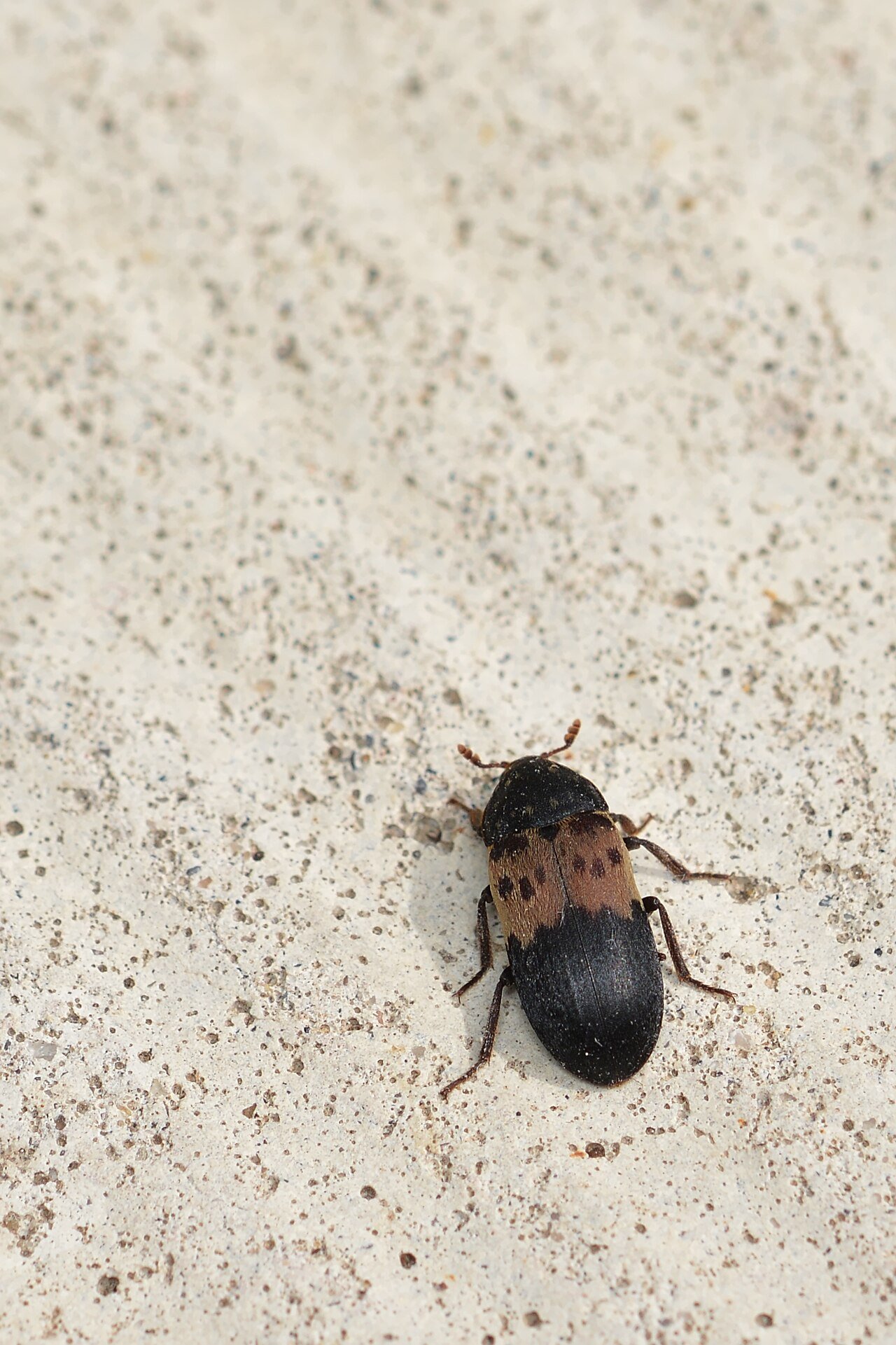
The larder beetle: the protein-side cousin
Sharing the search results and occasionally the pantry is the larder beetle — bigger (7–9mm), oval, dark with an unmistakable pale tan band across the front half of its wing covers, dotted with darker spots. Where the drugstore beetle works the carbohydrate shelf, the larder beetle is a protein and fat specialist — a member of the same dermestid family as the carpet beetle, historically the scourge of cured hams and cheese larders (hence the name), and in the modern kitchen a fan of pet food, grease deposits, and… less appetizing menus: dead insects in wall voids and light fixtures (a larder beetle bloom in spring often marks last fall’s fall-invader die-off being recycled inside your walls), abandoned rodent baits, the occasional bird nest in a soffit, and — the finding nobody enjoys but everyone should know — a mouse that died in a void: larder beetles are nature’s cleanup crew, and a sudden indoor population is one of the more reliable something-died-here indicators in the forensic toolkit (paired with the droppings guide, it narrows the where). The response follows the food: fresh pet-food discipline and grease-line cleaning for the kitchen cases; for the void cases, finding and removing the carcass or nest source beats any amount of spraying — and connects, as rodent aftermath so often does, back to the exclusion-first doctrine that prevents the die-off scenario entirely. Larder larvae add one hazard the drugstore side lacks: mature larvae bore into wood and structural materials to pupate — pencil-lead holes in joists, styrofoam insulation and even lead-sheathed cable in the literature — minor damage individually, worth ending the population over.
Why the spray aisle is the wrong aisle here
Pantry pests are the clearest case in this entire library for skipping insecticides, for stacked reasons: placement — the infestation lives inside food packages where no responsible application can follow; spraying shelves kills the occasional walking adult while the larvae feed on, sealed in with the flour (and now the flour shelf carries residue — a pure loss); biology — the drugstore beetle’s pharmacy-eating fame is a resistance-and-detoxification résumé; contact sprays underperform against exactly this insect even on contact; and the alternative is simply better — source removal ends the infestation causally, not statistically, usually within the two-to-four weeks it takes stragglers to age out. The honest toolkit beyond the hunt: pheromone traps (drugstore/cigarette beetle lures are cheap, retail-available, and superb as monitors — a trap line’s catch trend verifies the source removal the way interceptors verify a bed bug treatment; as elimination devices they’re modest — they catch males); the vacuum for cracks and shelf hardware; heat and cold for salvage (below); and the professional layer where it genuinely earns its place — commercial kitchens and food-handling accounts under audit (our commercial program runs pantry-pest monitoring as standard documentation), whole-structure cases where the source has defeated a genuine search (the wall-void scenarios above sometimes need a borescope and experience), and multifamily buildings where the source is someone else’s pantry. For the ordinary home case, this is one of the library’s honest “you probably don’t need us” pages — the method is the fix, and it’s free.
Prevention: the freezer-and-jar doctrine
Keeping pantry beetles out permanently costs one habit and some glass. Quarantine by freezer: the eggs and larvae arrive IN purchased products — infestation at the mill or warehouse, sealed at packaging — so the professional-grade habit for vulnerable goods (flour, meal, whole grains, spices bought in bulk, birdseed, dried pet food in paper) is four days in the freezer on arrival, which kills every stage before it meets your shelf. Museums run this exact protocol on incoming collections against these exact species; it scales down to a grocery bag perfectly. Glass and gasket: transfer the vulnerable categories out of factory paper and film into jars and gasketed containers — not because beetles chew in (though drugstore larvae bore packaging both ways), but because containment converts any missed introduction into a one-jar problem instead of a pantry problem: the infestation stays where it arrived, visible through the glass, disposable in one motion. Rotation and audit: first-in-first-out for the staples, a twice-yearly pantry clear-out timed to the seasonal cleaning the Friday-audit habit already scheduled, and the spice rack’s annual honesty review (the paprika from the previous decade is a liability, not a condiment). Households running quarantine-glass-rotation simply stop having this problem — our repeat pantry-pest calls come almost exclusively from kitchens that skipped step one, because the freezer was full.
Pantry beetle questions, answered
I ate cereal that had beetles in it. How worried should I be?
Medically, barely at all — pantry beetles carry no diseases, and accidentally consumed insects or larvae pass without incident (unappetizing is not the same as unsafe; the allergy-prone occasionally react to heavily infested grain products, which is the one caveat). The box goes out, the source hunt starts, and dinner conversation gets a story. Every household that has ever stored flour has eaten trace insect material; yours just made eye contact first.
The beetles keep appearing at the window, nowhere near the kitchen. Still a pantry problem?
Probably yes — window congregation is classic drugstore beetle behavior: newly emerged adults fly toward light hunting mates and new territory, and the window may be a full room away from the nursery. Treat the sighting location as the smoke alarm, not the fire’s address, and run the full hunt — including the non-food candidates (dried arrangements, wreaths, the void possibilities) if the pantry comes up clean twice.
Can these beetles infest books? My shelf has tiny holes in some spines.
They genuinely can — the drugstore beetle’s bibliophile cousin act (old bindings’ starch pastes and leather are on the menu) earned it the “bookworm” chapter in preservation literature, and shot-holes through spines and pages match its larval work. Home cases are uncommon and usually ride in with antique books; the freezer quarantine (bagged, four days) is the collector’s answer for suspect acquisitions, and heavy or heritage-collection cases share the archivist’s-corner playbook: isolate, treat by temperature, store sealed.
Are the beetles in my dog’s food bag dangerous to the dog?
The dog will be fine — dogs have eaten worse on purpose — but infested food is degraded food (larvae consume the nutritious fractions and their frass taints the rest), and pet food is the number-one source category on our routes, so: bag goes out, bin gets washed and dried, and the replacement lives in a gasketed container from day one. The pet-food bin is, quietly, the single highest-leverage jar in the whole glass doctrine.
The pantry, closed
The drugstore beetle’s superpower was never toughness — it’s that its nursery ships pre-hidden inside the products we buy and forgets itself on our shelves. The counter is method, not chemistry: hunt the source without skipping the spice rack, read the larder beetle’s darker forensics when the evidence points into the walls, monitor with pheromones instead of misting the food shelf, and run the freezer-and-jar doctrine that turns every future introduction into a one-container event. For the commercial kitchens, the audit trails, the wall-void mysteries and the multifamily source questions — and for the photo that settles drugstore-versus-cigarette-versus-carpet-beetle in one text: (937) 569-3330, Greater Dayton Pest & Rodent, Dayton and all eight counties. The beetle ate the pharmacy; it doesn’t get the pantry.
The pantry-pest family tree, sorted in one sitting
Since the pantry hosts a whole guild and the treatments rhyme, the complete cast in field-guide brevity: Drugstore & cigarette beetles — this page’s stars; everything-eaters, light-fliers, source-hunt responds. Flour beetles (red and confused) — the milled-grain specialists with their own full chapter; longer, flatter, flightless-in-practice red-brown beetles found IN the flour rather than flying at windows. Sawtoothed grain beetles — tiny, flat, with six saw-teeth visible along each side of the thorax under magnification; cereal and pasta specialists that squeeze into “sealed” packages through fold gaps. Weevils proper (rice, granary) — the snout noses; whole-grain and rice infesters whose larvae develop inside individual kernels, making rice that moves the classic discovery. Indian meal moths — the pantry’s other dynasty: the webbing in the flour, the zigzag flyers at dusk, the two-tone wings; same source-hunt, same freezer doctrine, plus pheromone traps that work dramatically well on their males. Bean weevils in the dried legumes, spider beetles in the truly neglected corners, and the larder beetle running the protein side per its section above. One method rules them all — hunt, purge, quarantine, glass — and one diagnostic opens every case: what, exactly, is the beetle standing in? The answer is the species half the time and the source most of the rest. The pantry keeps its own records; this guild just forces the audit.
A eight-county field note
The local sourcing patterns, for what they aim: the farm belt writes the biggest cases — bulk grain storage, livestock feed rooms and barn seed stock keep the Preble and Miami county routes stocked with drugstore-beetle and weevil calls, and the farm-scale version of the glass doctrine (gasketed drums, first-in-first-out, the feed-room audit) rides along on existing service visits. The bulk-buying suburbs supply the classic warehouse-club scenario: twenty-pound flour bags and forty-pound birdseed sacks stored in garages through a summer — quarantine-by-freezer matters most exactly where the packages are biggest. The historic districts’ contribution is the heritage clutter case — estate pantries, inherited spice cabinets and attic-stored holiday decorations (that Indian-corn centerpiece again) seeding kitchens during clean-outs; the garage-inspection habit from the arrival-stories file covers it. And every zip code contributes the pet-food bin. Wherever the beetles surface on the map, the arithmetic behind this entire page holds: the source hunt costs an afternoon, the freezer costs nothing, the glass costs twenty dollars — and the infestation that never establishes costs least of all, which has been this library’s favorite price since page one.
Three millimeters, a Victorian rap sheet, and a nursery hidden in the paprika — solved by a search, a freezer, and a shelf of honest glass. The beetle that survived the pharmacy meets the one thing it can’t bore through: a household that reads its pantry like evidence. Case jarred, and closed.
Next shelf over, the bees of Ohio await their identification parade — the library’s buzziest chapter yet.
Frequently asked questions
What are drugstore beetles?
Tiny (1/8-inch) reddish-brown cylinder beetles with a hooded head and lined wing covers — stored-product generalists named for their historic habit of eating pharmacy botanicals. Modern diet: everything — flour, spices, pet food, bread, dried flowers, books, even prescription capsules.
What is the difference between drugstore beetles and cigarette beetles?
Near-twins split by texture: drugstore beetles carry visibly grooved (striated) wing covers and serrated antennae tips; cigarette beetles are smooth-backed with uniform antennae. Same protocol either way — the ID mostly satisfies curiosity.
Why are drugstore beetles in my pantry?
Importation, like every stored-product pest: eggs and larvae aboard grain products, spices, dried botanicals, or pet food from upstream. Their claim to fame is menu breadth — the paprika, the dog biscuits, and the potpourri are all candidate sources.
What foods do drugstore beetles infest?
The widest menu in the pantry-pest league: flours and meals, spices (paprika and chili classically), dried fruit, bread products, pet food, bouillon, dried flowers and potpourri, book bindings, and pharmaceutical botanicals. The weird sources are the diagnostic ones.
How do I get rid of drugstore beetles?
The stored-product protocol with the wide-net inspection: purge the pantry AND the spice rack AND the craft/decor shelf (dried arrangements, potpourri, seed art), freeze questionable keepers four days, vacuum shelf cracks, restock airtight. Their breadth means the source hides outside the obvious aisle.
Are drugstore beetles harmful if eaten?
No toxicity or disease — accidental consumption is aesthetics, not hazard. Standard verdict: discard for quality, no medical concern.
Why do I find these beetles near windows?
Adults fly to light — windowsill accumulations are the visible symptom of a breeding source elsewhere in the house. Use the geography: which room’s windows collect them narrows which pantry, closet, or decor shelf feeds them.
Can drugstore beetles infest non-food items?
Famously — books (binding paste), leather, wool, museum specimens, and dried-plant decor; a beetle problem with a clean pantry sends the inspection to the bookshelf and the autumn wreath. The name is earned: they eat the drugstore.
How do I prevent drugstore beetles?
Airtight storage across the whole menu (spices included — the most-skipped category), the four-day freeze on bulk grains, dated rotation, and a skeptical eye on dried botanicals entering the house. Decor quarantine is the tip nobody expects.
When do drugstore beetles need professional attention?
Persistent windowsill accumulations after two wide-net purges — hidden sources (wall-void seed caches, old rodent stores, forgotten attic decor) are genuinely findable — and any commercial food or pharmacy setting: (937) 569-3330.