
If you’ve gotten a termite quote lately — ours or anyone’s — you’ve met the fork in the road: liquid barrier or bait stations. And if you’ve tried to research the bait side, you’ve met the problem this page fixes: most of what’s written about termite bait stations is either a manufacturer’s brochure or a competitor’s hit piece, depending on which product the author sells. This is the fuller account, from a company that installs bait systems as its lead termite product and will still tell you honestly where liquid wins: how bait stations actually work (the biology is genuinely elegant — the colony’s own food-sharing becomes the delivery system), what the in-ground hardware is and where it goes, the realistic kill timeline (months, not days — and why that’s the design, not a flaw), the monitoring layer that makes the system permanent rather than episodic, an honest bait-versus-liquid comparison including the cases where we recommend against our own product, the DIY-stakes-from-the-hardware-store question, and the full published pricing. Greater Dayton Pest & Rodent — Bryan’s 10B treatment license on every install, Category 12 on every inspection, and the free evaluation that starts every termite conversation: (937) 569-3330.
The elegant trick: making the colony poison itself
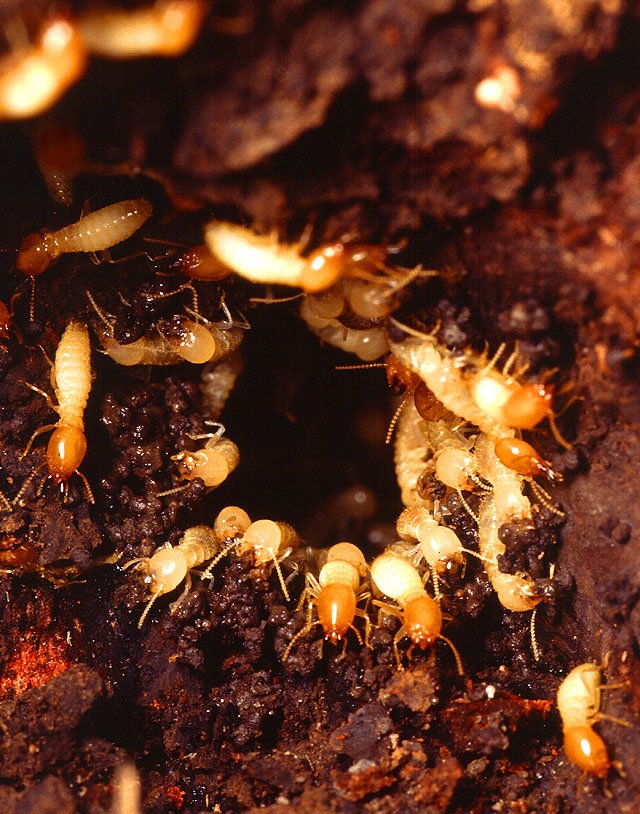
Bait stations exploit the two facts that make subterranean termites formidable in the first place. Fact one: a colony’s foraging network is enormous and blind — tens of thousands of workers tunneling outward from a nest that may sit a hundred-plus feet from your foundation, probing constantly for cellulose, with your house just one node on a network that’s also working the stumps, roots and mulch of the whole neighborhood. Fact two: termites run a total food-sharing economy — workers feed everyone: soldiers, nymphs, the queen herself, all by trophallaxis, the same colony-wide meal plan that makes ant baiting work, scaled up a thousandfold. The bait system turns both strengths into the delivery mechanism: stations intercept the blind foraging network, and the sharing economy distributes the payload. The payload itself is the refinement that separates modern baits from folk approaches — not a fast poison (fast kills at the station would be detected and the site abandoned — termites are excellent at connecting deaths to locations) but a chitin synthesis inhibitor (noviflumuron and its relatives): a slow-acting compound that does nothing until a termite tries to molt, at which point the molt fails. Workers molt on staggered individual schedules, so the colony experiences no alarming mass die-off — just a workforce that quietly stops replacing itself while carrying more bait home, until the population collapses from the inside over two to six months, queen included. It is, by the published research record, one of the few methods that reliably achieves colony elimination — not repellency, not local kill: the whole organism, gone.
The hardware and the install: what you’re actually buying
The physical system is unglamorous by design: cylindrical stations sunk flush with the soil every ten feet or so around the structure’s full perimeter — a typical Dayton-area home takes 15 to 30 stations (we compute the count from your actual foundation perimeter, the same measured-not-guessed approach as the pricing formula), placed a few feet off the foundation in the soil termites actually travel, with extra attention to the conducive-condition map the install inspection draws: downspout zones, mulch beds, old stump lines, the crawlspace margin, the porch slab seams. Each station holds the bait matrix — cellulose engineered to outcompete your house (termites genuinely prefer it to structural lumber in choice tests, which is the point) — loaded with the growth inhibitor. The install day is quiet work: no drilling through basement slabs, no trenching gallons of termiticide into the soil, no evacuating the family — the difference that matters enormously for the stone-foundation century homes our eight counties are full of, where liquid treatment means drilling historic masonry and bait means fifteen discreet cylinders in the flower beds. Install runs $675–$915 for most homes, $935–$1,265 for large perimeters, published like everything else — and the system starts monitoring the day it goes in.
The monitoring layer: why the system never really finishes
Here’s the structural difference between bait and every one-time treatment: the stations are a standing sensor network first and a weapon second. On the scheduled service visits, each station gets opened and read — no activity means the perimeter is quiet (a genuinely valuable negative, logged and dated); worker activity means the network has found the foraging front, and the active stations are now feeding inhibitor directly into the colony that found them. This inverts the timeline problem that haunts liquid treatment: a liquid barrier degrades invisibly over five-to-ten years, and its failure announcement is usually new damage; a bait network’s protection is verified alive at every reading, and a new colony’s arrival — from the neighborhood inventory that Ohio soil always holds, per the swarm-season census — is detected at the property line, months before structural contact, and eliminated by the same stations that detected it. That standing-guard economics is the monitoring fee: $24–29/month standalone, $22–26 bundled with a Protection Plan (the bundle discount is real routing economics — the stations ride visits we’re already making), annualizing around $260–350 against the $300–500 renewal fees the national franchises charge for renewing a warranty on a degrading barrier. One more line item worth naming at resale: a transferable, continuously monitored termite system with a dated activity log is genuinely worth something in a real-estate transaction — it answers the WDI inspection’s past-and-future question better than any document a one-time treatment produces.
Bait vs. liquid, called honestly
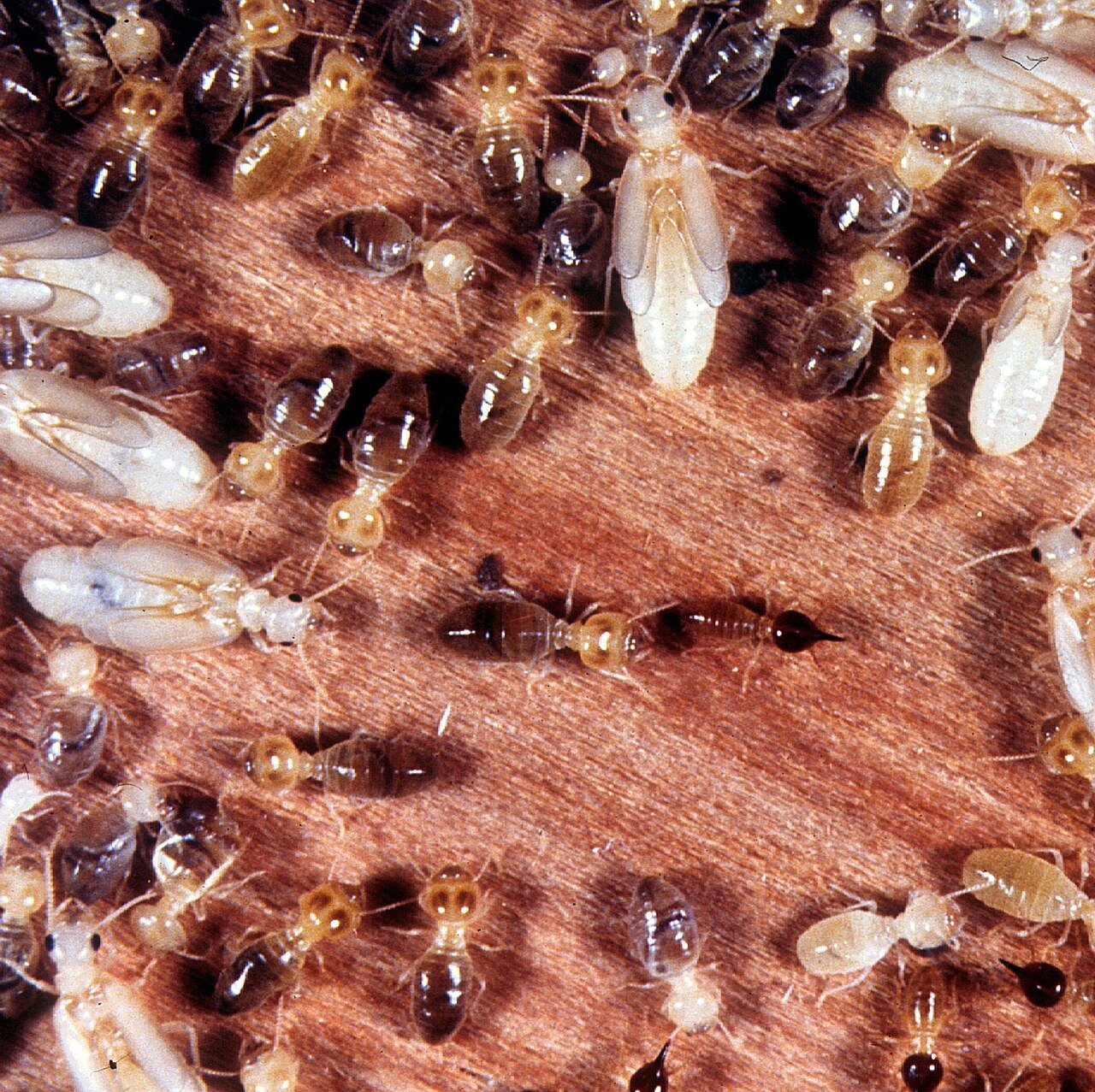
The comparison every quote-holder deserves, from a bait-led company with no incentive to lie about its own product’s limits. Where bait wins: continuous protection versus a degrading one-time barrier; verified monitoring versus silent aging; true colony elimination versus a chemical moat the colony may route around (liquid gaps at slab seams, bath traps and wells are the classic breach points); zero drilling for finished basements and historic masonry; minimal chemical load in the soil (grams of growth inhibitor in sealed stations versus hundreds of gallons of termiticide trenched); and the resale story above. Where liquid wins, and we say so: speed on an active structural infestation — a house with live termites in the sill plates needs the kill to start today, and a properly trenched non-repellent liquid (fipronil-class) begins killing on contact while bait’s colony collapse takes its months; our own protocol for hot active cases is frequently both — targeted liquid at the active zones for immediate knockdown, stations for the elimination and the standing guard. Liquid also edges bait on pre-construction treatment (soil treatment before the slab pours is cheap and lasts its full life undisturbed) and on the rare site whose geology fights station placement. The honest bottom line: for the standing question — “protect this house for the next twenty years” — the monitored bait network is the better answer for most Miami Valley homes, which is why it leads our product line; for the burning question — “there are termites in my wall right now” — the answer starts with an inspection and often includes liquid, and any company that gives the same answer to both questions is selling inventory, not protection.
The DIY station question
The hardware store sells bait stakes, so the honest assessment: the retail versions are detection tools wearing elimination costumes. The mechanical differences are real — consumer stakes carry smaller bait loads, most use slower or weaker actives, and several popular ones are simply wood-monitor stakes with no active at all — but the decisive gap is the program around the hardware: station placement built from a conducive-condition inspection (versus even spacing in convenient dirt), scheduled professional readings with documented response when activity appears (versus the homeowner glance that ends by July), bait replenishment at the label’s cadence through a months-long elimination (versus a dried-out cartridge feeding nobody), and a licensed applicator’s liability behind the outcome (versus a receipt). Where DIY stakes genuinely serve: as supplementary early-warning on outbuildings, fence lines and the farm-campus perimeters beyond the main system — cheap tripwires feeding information to the annual inspection. Where they fail expensively: as the primary defense on the structure itself, where a stake that’s detected termites without eliminating them has mostly documented the infestation you’re now paying to treat anyway, minus the months the documentation took. The standing DIY doctrine applies at full strength: termites are the one pest category where the stakes-to-savings ratio makes professional the default, and this page’s product is the rare case where the professional version is also the permanent one.
Bait station questions, answered
How long until the termites are actually gone?
Honest range: first station hits within weeks to a few months of install (faster when placed on an active foraging front); colony collapse two to six months after feeding begins. The slow arc is the mechanism — a bait fast enough to satisfy impatience would be detected and abandoned by the colony, which is precisely the failure mode of the old-generation baits. For the “something is eating my house today” case, see the hybrid protocol above: liquid handles today, the stations handle forever.
Will the stations attract termites to my yard?
No — the durable myth of the category. Stations don’t broadcast an attractant; they sit passively in the foraging paths termites were already probing (Ohio soil, per the swarm-season pages, holds colonies essentially everywhere). A station hit doesn’t mean the system invited termites; it means the system caught the termites that were coming regardless — which is the entire value proposition, working.
Are the stations safe around kids, dogs, and the vegetable garden?
This is bait’s quiet superpower: the active is a chitin inhibitor — chemistry aimed at a molting process mammals don’t have — sealed inside locked, child-resistant stations sunk flush with the soil, in gram quantities. No soil drenching, no root-zone termiticide, nothing for a paw to dig into a dose of. The comparison isn’t bait-versus-nothing; it’s grams-in-lockboxes versus gallons-in-trenches, and households with wells, gardens and dedicated diggers notice the difference in the quote conversation.
What happens if I cancel the monitoring after the colony is eliminated?
The honest answer: the hardware stays, the protection stops. Unread stations are just cylinders — the value was always the readings and the response behind them, and Ohio’s neighborhood colony inventory doesn’t retire when yours did. Canceling after elimination converts a standing-guard system back into a one-time treatment with extra steps; the $25/month question is really “is the next colony’s arrival worth detecting,” and in this soil, over a mortgage’s timespan, it was never close.
The standing answer
Termite protection is a decades-long question, and the bait network is the rare product built to the question’s actual shape: intercept the blind foraging that never stops, let the colony’s own economy deliver the ending, verify the quiet at every reading, and meet the next colony at the property line instead of the sill plate. Installed by measurement, priced in the open, monitored on the routes we already run, and recommended with its limits stated — including the active-infestation cases where the answer is liquid first and stations second. The evaluation that sorts your house into the right column is free, the licenses (10B, Category 12) are on the truck, and the number is the same as every page: (937) 569-3330. Greater Dayton Pest & Rodent — termite protection as a standing arrangement, not an annual scare, across Dayton and all eight counties.
A service visit, narrated
Since the monitoring fee buys a recurring visit, here’s what the visit actually contains — worth knowing because the difference between monitoring and theater is procedure. The technician walks the station map in order (every station has a number and a history), pops each cap with the access tool, and reads the cartridge: clean — bait intact, no workers, logged with date and condition; hit — live workers in the matrix, feeding damage measurable, which triggers the response tier: fresh bait loaded (a feeding front gets fed — interrupting an active hit to “save bait” is the amateur error the schedule exists to prevent), adjacent stations checked for front width, the finding photographed and logged, and the follow-up reading moved up. Spent — matrix consumed, workers gone: the signature of a colony that fed heavily and stopped, which paired with the timeline usually reads as elimination in progress; replacement bait goes in and the next two readings confirm. The log itself — dates, station numbers, hits, responses — accumulates into the property’s termite history: the document that answers a WDI inspector’s questions, a buyer’s lender, and the only question that matters in year seven (“is it still working?”) with data instead of assurances. Fifteen minutes a visit, four-ish visits a year, and the system stays what it was sold as: not a product in the ground, a protection with a pulse. That’s the $25; that’s the whole honest machine.
The eight-county fit
Why bait leads specifically here, mapped to the housing stock this site serves: the historic cores — Oakwood, Dayton’s pre-war districts, the courthouse squares of Troy, Lebanon and Eaton — are the no-drilling argument embodied: stone foundations, finished century basements, masonry nobody should be boring termiticide ports through, ringed instead by discreet stations that respect the architecture while out-monitoring any barrier. The riverside moisture belt along the Great Miami and Stillwater keeps foundation soils termite-friendly year-round — standing-guard territory if any exists. The mature suburbs’ slab porches and additions are liquid’s classic breach-point geometry — bath traps, expansion joints, attached slabs — that a perimeter network simply doesn’t care about. And the farm campuses of Preble and western Miami counties extend the logic outbuilding by outbuilding: stations on the barn and the granary feed the same monitoring log as the farmhouse ring, on the same route visit. Add the swarm-season reality that every spring re-proves — mature colonies throughout the eight counties, launching annually — and the standing-guard product isn’t a preference; it’s the shape of the local problem. The measurement visit that starts it is free, and the flower beds never look any different afterward — which, for most of the houses this page was written for, is precisely the point.
Fifteen cylinders, one elegant betrayal of the colony’s own economics, and a log that answers year seven’s question with data: the bait network is what termite protection looks like when it’s built to the length of the actual problem. The measurement is free, the pricing is published, and the flower beds keep their secret — which is exactly how a standing guard should work.
Grams in lockboxes, readings on a schedule, colonies met at the property line: the long war, won quietly, the way the best ones are.
Book the free measurement this week; the network can be standing guard by next.
Frequently asked questions
How do termite bait stations work?
Foraging workers find the in-ground stations ringing your foundation, feed on the bait matrix, and share it through the colony — a slow-acting growth inhibitor that collapses the colony including the queen. The delay is the design: workers must live long enough to distribute the dose.
How many bait stations does a house need?
One per roughly ten feet of foundation perimeter, twelve minimum — most Dayton homes land at 15–30 stations. We compute your actual perimeter from records rather than eyeballing, which is also exactly how the install is priced.
Are bait stations better than liquid termite treatment?
Different products for different jobs: stations give continuous protection with monitoring built in and zero drilling (the century-home argument); liquid gives immediate knockdown for heavy active infestations. We lead with bait and say plainly when a case calls for liquid.
How long do bait stations take to kill a colony?
Foragers typically find stations within weeks to months; collapse follows active feeding by two to four months. Prevention-mode installs are sentries the whole while — the timeline matters mainly for active-infestation cases, where heavy activity may warrant liquid alongside.
Do bait stations attract termites to my house?
A persistent myth, backwards: stations intercept foragers already probing your soil — Ohio ground guarantees the probing — and the bait is no more “attractive” than the wood mulch they were already investigating. The station is where you want them found: outside the wall, inside the monitoring.
What maintenance do bait stations need?
Scheduled checks — bait replenishment, activity documentation, station repair — which is the monitoring service (roughly $22–$29 monthly, cheaper bundled with the Protection Plan since the visits ride along). Neglected stations are lawn ornaments; the monitoring IS the product.
Are termite bait stations safe for kids, pets, and gardens?
Among the safest treatments in pest control — locked housings, in-ground placement, grams of insect-growth-inhibitor chemistry specific to molting insects. No soil drenching, no drilling, no indoor product at all.
What happens if a station shows termite activity?
That is the system working: activity triggers response at no extra treatment charge while monitoring is current — bait loading, adjacent-station checks, and structure re-inspection. You get the documentation either way; most customers’ stations stay quietly empty for years.
Can I install DIY termite bait stations?
Consumer versions exist and mostly fail on the two hard parts: placement science (spacing, depth, interception lines) and the monitoring discipline that never lapses. A $60 DIY ring checked twice then forgotten is worse than nothing — it manufactures false confidence.
What do termite bait stations cost?
Installs $675–$915 for most homes ($935–$1,265 large-perimeter), monitoring $22–$29/month, computed openly from your foundation’s linear feet — the full formula is published on our termite cost page, and the estimate is free: (937) 569-3330.