
Two questions arrive on our line in the same worried breath, usually after a midnight kitchen encounter went aerobatic: do cockroaches fly, and do cockroaches bite? Short answers, then the full story: some Ohio roaches can fly and mostly don’t (what looks like an attack run is a falling insect with steering); and yes, roaches can bite but essentially never do — you are overwhelmingly unlikely to ever be bitten by one, and the “roach bites” people wake up with almost always belong to a different insect entirely, which matters because the treatments have nothing in common. This page runs both questions to ground, species by species: which of Ohio’s four indoor roaches has working wings and what their flight actually looks like, why a roach flew “at” you (it didn’t), what the science says about roach bites and the rare circumstances that produce them, what’s really biting you at night, and the honest health picture — because the true medical problem with roaches isn’t their mouths or their wings, it’s their dust. From Greater Dayton Pest & Rodent, with the free photo ID line open as always: (937) 569-3330.
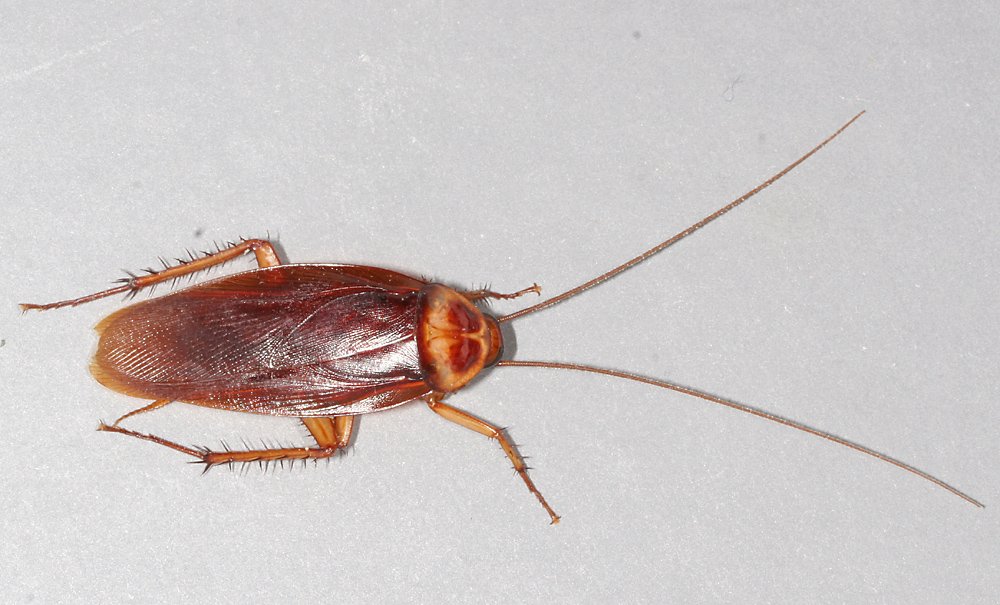
Do cockroaches fly? The species-by-species answer
Wings and flight are different questions in the roach world — most adult roaches own wings; few operate them. Ohio’s lineup, drawing on the full profiles in our species guide: German cockroach (the kitchen infester): full-length wings, functionally flightless — at most a wing-assisted flutter when dropping from a cabinet; you will never see a German in sustained flight. Oriental cockroach (the basement “waterbug”): the true pedestrian — males wear stubby half-wings, females mere pads, and neither leaves the ground, ever. Brown-banded cockroach: the split ticket — males fly readily when disturbed, females can’t; a small roach fluttering around a warm living room lamp is a fair brown-banded suspect. American cockroach (the two-inch furnace-room giant): the real flier — full wings, genuine gliding and even powered flight in warm conditions, capable of launching from a basement shelf and crossing a room. And the wildcard: wood roaches, the harmless outdoor species, are Ohio’s most enthusiastic aviators — males fly to porch lights in early summer by the dozen, blunder indoors, circle the ceiling fixture and die confused, having achieved nothing. So the flying-roach probability table for a Miami Valley home reads: at the porch light in June, almost certainly a harmless wood roach; a small flutterer near a lamp, possibly a brown-banded male; a large brown missile crossing the basement, an American; and if it’s in your kitchen and it’s not flying — which it won’t be — that’s the German story our nymph guide begins.
“It flew right at me” — the aerodynamics of panic
Every roach-flight story ends the same way: it came straight at my face. Here is the honest physics. Roach flight — even the American’s — is barely controlled ballistics: a heavy body on big fluttering wings, launched from height, gliding on a shallow descending path with primitive steering. When startled (by the light you just switched on, the shoe you just raised), a roach on a wall or shelf drops and glides toward open space and away from the disturbance behind it — and you, standing in the middle of the room being the light source’s nearest silhouette, are directly on the flight path, not the target. The insect has no concept of you as a destination; you are terrain. It wants the dark gap under the workbench beyond you. This is genuinely comforting arithmetic once absorbed: a flying roach is a fleeing roach, the encounter means you startled it (not vice versa), and the correct response — sidestep, let it land, note where it went for the monitor-trap map — costs nothing but composure. Bonus identification value: any Ohio roach confident enough to fly indoors is telling you its species (American or brown-banded male) and therefore its harborage (infrastructure or warm heights), which aims the response better than a week of guessing. Even the panic moment is data, if you keep your feet.
Do cockroaches bite? The evidence file
Cockroaches own chewing mouthparts that handle cardboard, soap and leather, so the mechanical capacity to nip human skin exists — and documented cases are real but vanishingly rare, essentially confined to one scenario: severe, crowded infestations with exhausted food supplies, the ship-hold and hoarding-house conditions of the historical record, where desperate American or German populations have grazed fingernail edges, eyelash margins, and food-residue traces on sleeping people (children’s hands after bedtime snacks account for most of the plausible accounts). The bite itself, when it genuinely happens, is a minor red bump — less than a bee sting, more than a mosquito — with the usual secondary-infection caveat any skin break carries. Now the practical translation for a Dayton-area household: if your roach population were anywhere near bite-risk density, the bites would be the last evidence you noticed — you’d have seen droppings on every shelf, roaches in daylight, the odor, the works. A normal-to-heavy residential infestation carries effectively zero bite risk; the roaches have better food than you, and they want nothing less than contact. Roaches rate as one of the least bite-prone pests in the entire library — which is precisely why waking up with bites points the investigation somewhere else entirely.
So what IS biting you at night?
The “roach bites” that walk through our phone line resolve, in rough order of frequency, into: bed bugs — the overwhelming leader; clustered or lined welts on sleep-exposed skin (arms, shoulders, neck), delayed itching, and the mattress-seam evidence our bed bug guide teaches you to find in ten minutes with a flashlight and a card; fleas — ankle-and-calf bite clusters, pets in the household, the jump test; mosquitoes — single welts, summer, a bedroom window or a breeding site nearby; chiggers after yard work — waistband and sock-line welts (see the tiny red bugs guide); and — a genuinely underdiagnosed cause — no insect at all: dry-skin dermatitis, allergic responses to detergents, and stress hives account for a meaningful share of “something’s biting me” cases, which is why physicians and pest inspectors both ask for the same thing — a specimen or evidence, not just welts. Our standing offer covers this fork perfectly: photograph the bites AND whatever insects you can find, text both to (937) 569-3330, and the ID comes back free with the right playbook attached — because treating a bed bug problem with roach bait, or vice versa, is how months get lost. The bite pattern is a clue; the specimen is the verdict.

The real health story: forget the mouth, mind the dust
Here’s the section that deserves the anxiety the flying and biting questions attract. The documented medical burden of cockroaches has almost nothing to do with bites and everything to do with what they shed: roach droppings, saliva, and the fragments of molted exoskeletons break down into a potent airborne allergen load, and the research record here is deep — cockroach allergen is one of the strongest known triggers of childhood asthma, with inner-city studies linking roach-allergen exposure to dramatically higher rates of asthma morbidity, emergency visits and sensitization in children. The allergen persists in dust long after the roaches die, concentrates in kitchens and bedrooms, and — the practical kicker — is the best argument that “a few roaches” is a health decision, not a cosmetic one, particularly in households with asthmatic kids. Add the better-documented disease mechanics — roaches commuting from drain interiors to countertops carry salmonella, E. coli and other pathogens mechanically on their bodies (the same reason their droppings rank high in our droppings guide’s caution tier) — and the honest health ranking inverts the folklore completely: flight, irrelevant; bites, negligible; the invisible allergen economy, the entire ballgame. It’s also why proper elimination includes cleanup: our protocol pairs the bait-and-IGR program with guidance on HEPA-vacuuming the harborage zones and damp-wiping the surfaces, because killing the roaches without removing their dust finishes only half the health job.
Flying roach flowchart: what your sighting means
- Tan roach circling the porch light or bouncing off screens, May–July: male wood roach. Outdoor species, cannot breed indoors, zero action beyond the warm-LED bulb swap. The most common “flying roach” report we take, and the happiest answer we give.
- Small roach fluttering near a lamp, TV or high shelf, any season: brown-banded male candidate. Meaningful — brown-bandeds breed indoors in warm, dry, elevated spots. Check furniture undersides and electronics for the glued egg cases; monitors on high shelves, not under sinks.
- Large red-brown roach gliding across a basement, boiler room or restaurant kitchen: American. Points at infrastructure — drains, steam tunnels, warm voids. Water the floor drains, check the sump, and treat it as the building-systems story from our waterbug guide.
- Roach “flew” out of a cabinet when you opened it: almost certainly a German drop-and-flutter, not flight — and a German at eye level means established harborage in that cabinet zone. That’s a flashlight-audit trigger, tonight.
- Something flew in the window at dusk and you lost it: wait for the reappearance before spending anything — odds favor a beetle, moth or wood roach. The species that matter will show themselves again; the ones that don’t, didn’t matter.
Roach bite questions, answered
I woke up with a red mark and we definitely have roaches. Coincidence?
Probably, statistically — but don’t settle for probably. Run the ten-minute bed bug inspection (mattress seams, box-spring corners, headboard screw holes) from our bed bug guide first, since cohabiting roach and bed bug problems are common in multi-unit buildings. Roach bites remain a last-resort diagnosis even in roach-positive homes; bed bugs remain the first suspect for sleep-window bites, every time.
Can flying roaches get in through open windows?
Wood roaches and the occasional American, yes — which is why summer arrivals through screens don’t automatically mean infestation. One flier is weather. What converts arrivals into establishment is species (wood roaches can’t), moisture and harborage — the conditions, as always, decide. Screen repair is cheap; panic is optional.
Are flying roaches a sign the infestation is worse?
Flight itself, no — it’s species behavior, not desperation. The density signals that DO grade severity: daylight sightings, multiple nymph sizes, droppings spread, odor. A single gliding American in the basement outranks none of those; a daylight German nymph outranks the American. Grade on the evidence table, not the aerobatics.
Should I swat a flying roach mid-air?
You’ll lose — erratic glide beats hand-eye coordination at 11 PM — and swatting risks the crush-and-smear that spreads allergen exactly where you don’t want it. Let it land, watch where it goes, and let the landing spot join the monitor map. The roach’s destination is worth more to the elimination than its corpse.
Both answers, one response
So: some fly, barely, and always away from you; all can bite, and essentially none ever will. Neither question changes the playbook that actually ends a roach problem — identify the species (free, by photo), map the harborage, run the bait-and-IGR protocol with both visits, fix the moisture, and vacuum the legacy dust for the lungs that live there. Greater Dayton Pest & Rodent runs that complete version across Dayton and all eight counties, one-time or under the Protection Plan’s re-treatment guarantee — and the line answers the midnight what-was-THAT photos with straight species verdicts, no drama included. (937) 569-3330.
Why roaches keep their wings (a short evolutionary aside)
A fair question hides under all this: if German and Oriental roaches never fly, why do they bother growing wings at all? The answer is a nice window into how infestations work. Wings are ancestral equipment — roaches have carried them for over 300 million years — and evolution discards slowly what costs little, so indoor species retain the hardware while the behavior atrophies. But watch what natural selection HAS optimized instead, because it’s the exact list that makes them hard to evict: the flattened body that fits a credit-card gap (flight is useless to an animal whose entire strategy is crevices), the sprint speed that outruns predators in the two feet between cover and cover, the antennae-first navigation that works in absolute darkness, and the thigmotaxis — the drive to keep both body surfaces touching something — that steers them into exactly the wall-void, hinge-gap, drain-margin world where sprays don’t reach. A German cockroach is what you get when you optimize an animal for the spaces humans can’t inspect: it traded the sky for the crack, and the trade built the most successful indoor pest on Earth. Which is also, read backward, the entire logic of professional treatment — gel baits and dusts go INTO the crack world because that’s where the animal actually lives; the open surfaces people spray are just its highway shoulders. Understand the wings it doesn’t use, and you understand the treatment that does work.
Two midnight questions, fully answered — and if tonight’s kitchen encounter left you with a photo and an adrenaline spike, you know where both go: the free ID line, where every dramatic flight story so far has ended in a species name, a plan, and a calmer week two. The roach service page handles the rest.
The eight-county flight report
Local calibration, from the route logs: wood roach season peaks first — late May through early July, when the porch lights of tree-heavy neighborhoods (Oakwood, Waynesville, the wooded south of Beavercreek, every farm lane in Preble County) collect tan aviators nightly; our photo line runs hot with them each June, and every verdict is the same happy no-action answer. American roach glides cluster in the infrastructure buildings — downtown Dayton basements, restaurant rows on the courthouse squares, the steam-and-boiler layer of older commercial stock — and spike during summer heat when warm nights raise flight motivation. Brown-banded flutters follow the electronics: we see them most in home offices and apartment living rooms, any county, any month, because their habitat is the 78-degree shelf, not the weather. And German flight reports remain what they’ve always been — misread drops from cabinet height, followed by the flashlight audit that finds the real story at the hinge line. The pattern holds across all eight counties: the flier is rarely the problem, and the problem rarely flies. Judge the sighting by the species, the species by the photo, and the photo costs nothing — which has been the deal on every page of this library since page one.
And the next time one launches off the basement shelf and sails past your ear on its clumsy paper wings: sidestep, breathe, note the landing zone. It was never aiming at you — it was fleeing toward the dark, the way everything in this library eventually does when the flashlight finds it. Your job is just to know where the dark is, and now you do.
Frequently asked questions
Can cockroaches fly?
Species-dependent: American cockroaches glide clumsily (downhill flights from high perches, occasionally toward light and memorably toward faces); German roaches carry full wings and essentially never use them; Oriental roaches cannot fly at all; and the strong porch-light fliers are outdoor wood roaches that die indoors.
Why did a cockroach fly at my face?
American cockroach navigation, not aggression — startled gliders launch toward light or open space, and your lamp-lit silhouette qualifies. It is the single most traumatizing non-event in household entomology.
What is the flying roach at my porch light?
A male wood roach — an outdoor species that flies TO light in early summer, cannot survive or breed indoors, and signifies nothing about your kitchen. The indoor pest species conspicuously avoid light; the porch-light flier is practically an alibi.
Do German cockroaches fly?
Functionally never — wings present, flight muscles unused; they sprint. A small tan roach in your kitchen arrived by cardboard or appliance, not by air, which is why the origins page never mentions windows.
Does a flying roach mean a worse infestation?
No — flight correlates with species, not severity. The flightless German colony behind your fridge outranks a dozen gliding American tourists on every metric that matters; score by species and count, per the flashlight census.
Can roaches fly in through windows?
Wood roaches in June, occasionally, chasing your lights — screens end it. Pest-species arrivals remain ground and cargo routes: drains, gaps, boxes, appliances; aerial invasion is not among the origin stories.
Why do roaches seem to fly more in summer heat?
Warmth loosens the gliders — American cockroach flight is temperature-gated, and Ohio’s muggy nights hit the threshold. The same heat accelerates everything else in the roach economy, which is why summer is both peak sightings and peak treatment-response season.
Are flying cockroaches attracted to light like moths?
Split verdict: wood roaches yes (they navigate to light), American gliders sometimes (launch orientation), German and Oriental never (hard-wired light-avoiders). The light relationship is one more species fingerprint for the ID.
How do I stop roaches from flying into my house?
Screens intact, amber porch bulbs in wood-roach season, door sweeps for the ground routes — and for the species that matter, the standing program: drains wet, cardboard managed, gel bait where evidence prints. Flight is the least of any roach strategy.
Flying or not — when do roaches warrant a call?
The standard triage regardless of wings: any daytime German sighting, handful-plus flashlight counts, multi-room evidence, or post-fogger scatter: (937) 569-3330 — and porch-light wood roach photos get the cheerful acquittal they deserve.