
Ohio’s pest story has always been an immigration story — the stink bug on your curtains, the bed bug’s global resurgence, the earwig itself all arrived from elsewhere — but the current decade’s arrivals are rewriting the state’s landscape at a pace worth every household’s attention. The spotted lanternfly is now established in Ohio and spreading along its rail and highway corridors; the emerald ash borer has already erased an entire tree genus from Miami Valley streets within living memory; jumping worms are churning garden soil into coffee grounds; and the reporting apps on your phone have quietly made every resident a sensor in the state’s detection network. This is the complete invasive species briefing from Greater Dayton Pest & Rodent — the established invaders you already live with, the active front arriving now, the watch-list species Ohio wants your photos of, what “invasive” actually means (and doesn’t), and the honest household playbook, including which of these are our job, which are the state’s, and which are yours: (937) 569-3330, free ID for anything unfamiliar — which, on this page’s subject, occasionally matters far beyond your own yard.
The active front: spotted lanternfly, Ohio edition
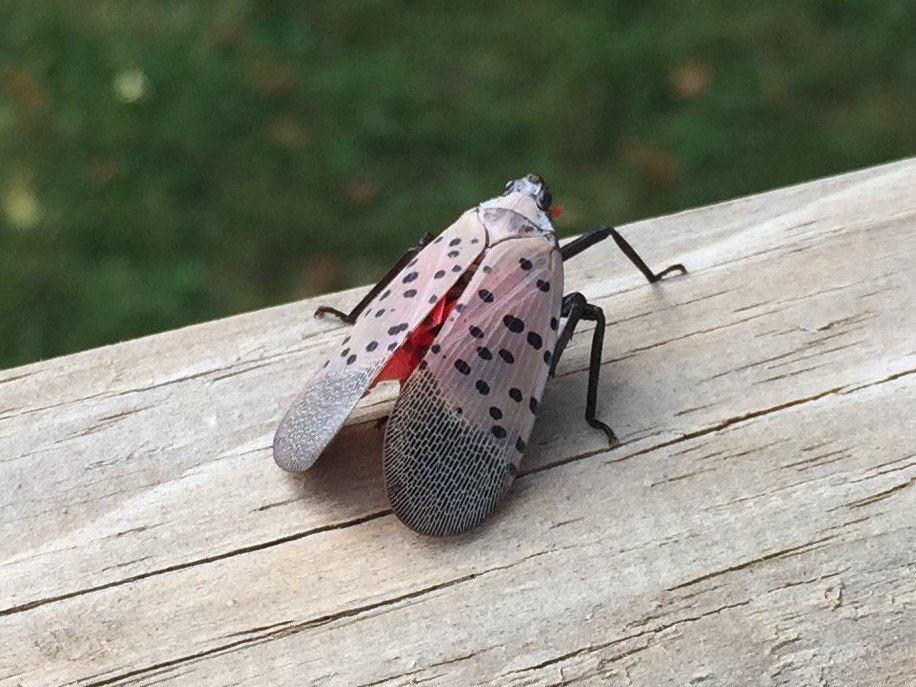
The spotted lanternfly — a thumb-sized planthopper wearing gray polka-dotted forewings over a scarlet flash — is the state’s current priority invader, established in multiple Ohio counties since 2020 and expanding along the rail lines and interstates its egg masses hitchhike on. The threat model is agricultural and quality-of-life rather than structural: lanternflies feed in masses on grapevines, fruit trees, maples, and their beloved tree-of-heaven host, weakening plants and excreting honeydew rain that coats patios, cars, and decks in sticky film that then grows sooty mold — vineyard country’s nightmare and a suburban nuisance at density. The Ohio Department of Agriculture’s standing request of every resident is simple and this page repeats it verbatim: photograph, report, destroy. Report sightings (with photo and location) through ODA’s reporting tools or the Great Lakes Early Detection Network app; then squash the insects — the official guidance genuinely endorses the stomp — and scrape any egg masses (gray, mud-like smears of 30–50 eggs on bark, stone, vehicles, and outdoor furniture, laid September onward) into a bag with rubbing alcohol or hand sanitizer, which finally gives the alcohol bottle a pest assignment it can win. The household’s biggest contribution is the vehicle check: lanternflies and their eggs spread by riding — trailers, campers, firewood, patio furniture in transit — and the two-minute walk-around before an autumn road trip is the state’s cheapest quarantine. Our treatment lane: heavy residential feeding pressure on ornamentals and the tree-of-heaven management conversations that reduce a property’s attractiveness; the regulatory lane belongs to ODA, and this page’s reporting links are the bridge.
The invader you already survived: emerald ash borer’s Miami Valley legacy
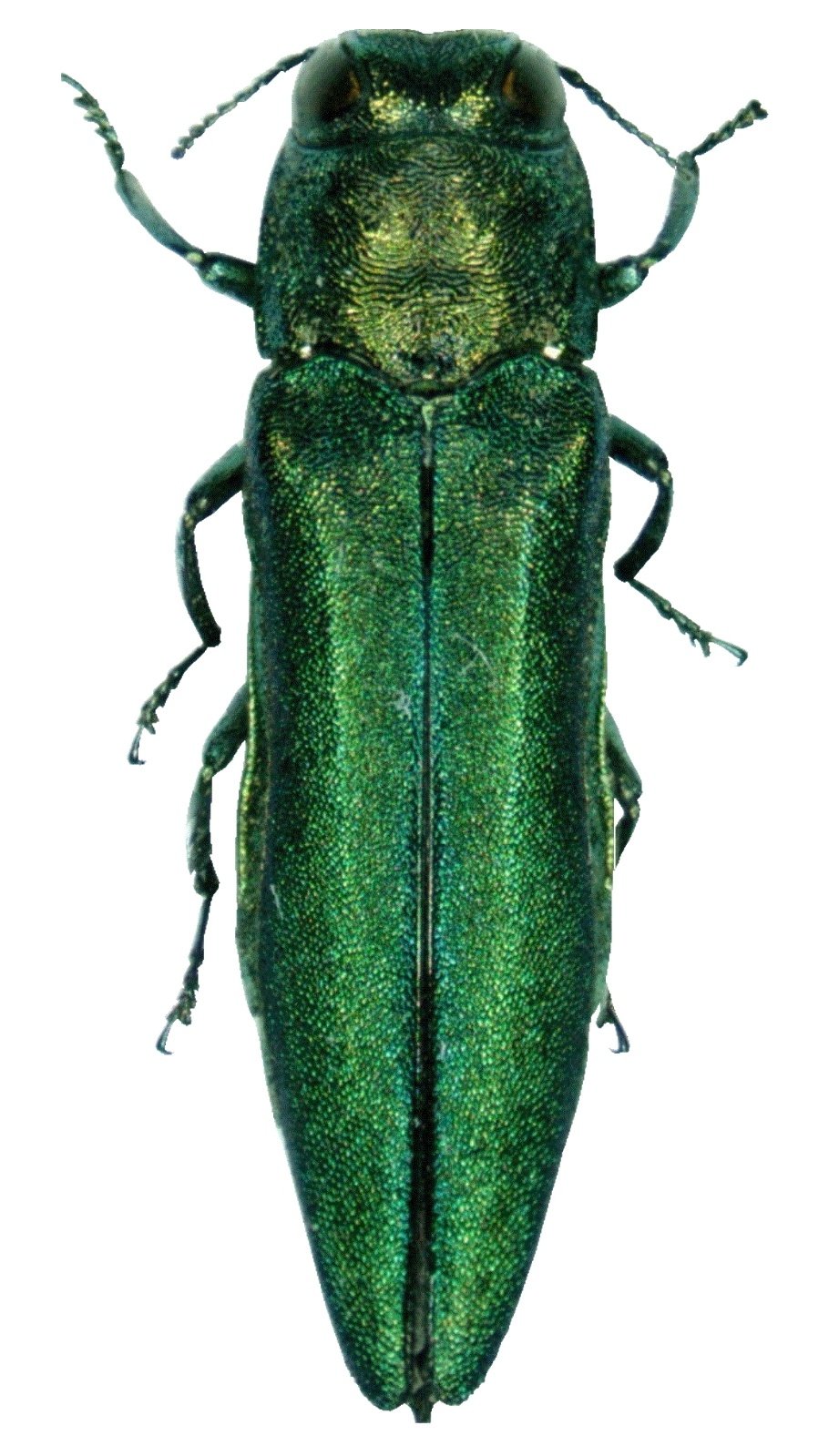
To understand why the lanternfly briefing matters, look at what the last headliner did. The emerald ash borer — a jewel-green Asian beetle half an inch long — reached Ohio in 2003, and within fifteen years it had functionally erased ash from the region: tens of millions of Ohio trees dead, entire Kettering and Centerville street canopies replanted, and the D-shaped exit holes in standing gray snags now a permanent field mark of Miami Valley woodlots. The household legacy is threefold and current. Standing dead ash is a hazard economy — brittle, unpredictable droppers that arborists still price into every wooded lot from Bellbrook to Englewood; if your property carries gray snags, the removal conversation is overdue. Dead and dying wood feeds the secondary cast — carpenter bees, carpenter ants, and the borer beetles that follow decline, which is how an EAB casualty becomes a pest-pressure generator for the houses around it. And surviving treated ash needs its schedule kept — the systemic treatments that saved feature trees run on two-to-three-year cycles that lapse at owners’ peril. The strategic lesson EAB taught Ohio, at the cost of a genus: early detection and slow-the-spread buy years, and years are what municipalities and homeowners need to adapt — which is exactly the logic behind every reporting request on this page.
The established class: invaders you already live with
A briefing is honest only if it separates the arriving from the arrived, so here’s Ohio’s naturalized invader roster — species past containment, now permanent management subjects with pages across this library. The brown marmorated stink bug (2000s arrival) runs the fall wall-massing economy and a genuine agricultural tax; the multicolored Asian lady beetle (introduced deliberately, naturalized enthusiastically) owns the October ceiling corners; the European earwig, German cockroach, and house mouse arrived so long ago their invasions read as furniture; the Japanese beetle skeletonizes the region’s roses each July on a century-old lease; and the Asian tiger mosquito — the striped daytime biter our mosquito page profiles — is the invasion most Miami Valley backyards feel weekly. Add the plant kingdom’s enablers — Callery/Bradford pear (now illegal to sell in Ohio), bush honeysuckle strangling every woodlot understory, and tree-of-heaven, the lanternfly’s favorite host — and the pattern completes: yesterday’s emergency is today’s maintenance schedule. The household moral cuts two ways: naturalized invaders prove that containment windows close (fueling the reporting urgency above), and they prove that life goes on manageably after establishment — the stink bug seemed apocalyptic in 2012 and is now a calendar entry with a treatment window. Vigilance without doom: the briefing’s required emotional setting.
The watch list: what Ohio wants your photos of
- Spotted lanternfly — the active front above: photograph, report to ODA, destroy insects and egg masses, check vehicles before travel
- Asian longhorned beetle — the catastrophic-if-established hardwood borer (big, glossy black, white spots, dramatic antennae); Ohio’s Clermont County infestation triggered massive eradication cutting — any sighting is a same-day ODA report, and its look-alikes (the native whitespotted sawyer) make the photo essential
- Northern giant hornet — NOT in Ohio, ever, despite annual panics; candidates are European hornets and cicada killers, but the report costs nothing if a specimen genuinely puzzles
- Jumping worms — the thrashing, coffee-ground-soil earthworms spreading through Ohio gardens via mulch, compost, and plant swaps; no eradication exists, so containment is hygiene: buy heat-treated mulch, inspect swap plants bare-root, never relocate soil
- Box tree moth — the boxwood destroyer confirmed in Ohio in 2023; webbed, defoliated boxwoods get reported and treated fast or replaced
- Elm zigzag sawfly and hemlock woolly adelgid — the forest-pest undercard, mostly a woodlot-owner’s watch; eastern Ohio’s hemlock ravines are the stakes
- The reporting toolkit: Ohio Department of Agriculture’s plant pest reporting portal, the Great Lakes Early Detection Network (GLEDN) app, and — for anything you’d rather triage first — our free line, which forwards genuine finds with your permission: (937) 569-3330
What “invasive” means — and the two words it doesn’t
Precision matters on this subject because the word gets stretched into uselessness. Invasive means non-native AND ecologically or economically harmful — the lanternfly, EAB, and honeysuckle qualify on both counts. It does not mean non-native alone: the honey bee is an import Ohio agriculture depends on, and most garden plants are guests in good standing. And it does not mean native-but-annoying: the periodical cicada, carpenter bee, and mole are Ohio originals doing Ohio jobs, whatever your deck and lawn think of them — and “invasive” panic aimed at natives fuels exactly the over-treatment this library spends its pages preventing. The distinction drives real decisions: invasives justify aggressive response precisely because the local ecosystem lacks their checks (report-and-destroy is the right posture toward a lanternfly and would be vandalism toward a cicada), while natives get the managed-coexistence playbook their pages prescribe. One vocabulary test, applied before any campaign: is this species new here, and is it breaking things? Two yeses make it this page’s subject; anything less makes it a neighbor with a file elsewhere in the library.
The household playbook: your actual jobs in the invasion economy
- Job one — don’t be the vector: buy firewood where you burn it (the EAB-era rule that still moves half these species), check vehicles/trailers/outdoor furniture for lanternfly egg masses before travel, source mulch and compost heat-treated, and bare-root inspect plant-swap acquisitions for jumping worms
- Job two — know your ten: lanternfly adult and egg mass, ALB silhouette, jumping worm thrash, box tree moth webbing, EAB exit holes, plus the false alarms (sawyer beetle, European hornet, cicada killer) — this page is the flashcard deck
- Job three — report with photos: two minutes on GLEDN or ODA’s portal turns your sighting into the state’s early-warning data; the Clermont County ALB find that saved Ohio’s hardwoods started with one resident’s report
- Job four — manage your parcel’s contribution: tree-of-heaven removal (with proper herbicide timing — cut-alone triggers root suckering), honeysuckle clearing, dead-ash triage, and boxwood monitoring are the property-level moves that lower the whole block’s invader carrying capacity
- Job five — route the response correctly: regulatory invaders (ALB, new-county lanternfly) to the state; residential pressure (lanternfly ornamental feeding, established-invader households) to us; tree pharmacology (EAB treatments) to certified arborists — one free call sorts any case: (937) 569-3330
Invasion questions, answered
I found ONE lanternfly. Does one matter?
In a known-infested county, one is data confirming the map; in an uninfested county, one is potentially the most important insect photo an Ohio resident takes that year — new-county detections drive the state’s quarantine and response decisions, and the species’ hitchhiking habit means lone advance scouts are exactly how new fronts open. Report it either way (the app makes it two minutes), squash it afterward, and check your own vehicle and firewood stack for how it might have arrived.
Are any of these a danger to my family or house directly?
Refreshingly, almost none — the current invader class threatens trees, crops, gardens, and ecosystems rather than people or structures: no stings, no bites, no wood-eating (the termite remains a native problem). The household costs are landscape and nuisance: honeydew film, dead ash hazards, defoliated boxwoods, ruined soil structure. Calibrate accordingly — urgency in reporting, calm in the living room.
Why bother squashing lanternflies if they’re already established?
Because establishment is a gradient, not a switch: local density drives local damage (your grapevine, your patio film), slow-the-spread genuinely delays new-county establishment years — time vineyards and cities use to prepare — and the egg-mass scraping in particular removes thirty-plus future insects per thirty seconds of card-scraping. It’s the rare pest situation where individual household action aggregates into real landscape effect, which is precisely why the state keeps asking.
The one-screen invasion briefing
- Active front: spotted lanternfly — established and spreading in Ohio; photograph → report (ODA portal / GLEDN app) → destroy insects and scrape egg masses into alcohol; check vehicles before fall travel
- Highest-stakes watch: Asian longhorned beetle — same-day report; know the native sawyer look-alike
- Legacy lesson: emerald ash borer — triage standing dead ash, keep treated-tree schedules, expect secondary pests at casualties
- Garden front: jumping worms (hygiene containment — heat-treated mulch, bare-root swaps) and box tree moth (report + treat or replace)
- Naturalized class: stink bugs, Asian lady beetles, tiger mosquitoes, German roaches, house mice — managed on their own pages, not this one
- Vocabulary discipline: invasive = non-native AND harmful; natives (cicadas, carpenter bees, moles) get coexistence playbooks, never eradication panic
- Your five jobs: don’t vector, know your ten, report with photos, manage your parcel, route responses right
- The routing line: (937) 569-3330 — free ID, honest lanes: state for regulatory, us for residential pressure, arborists for tree pharmacology
One briefing, five jobs, two minutes per report — Ohio’s invasion defense runs on exactly the resident attention this page just calibrated. The lanternfly is counting on you not bothering; disappoint it.
Why a local pest company keeps the state’s watch list
The lane-sorting on this page invites a fair question — if the lanternfly belongs to ODA and the ash trees to arborists, why does a residential pest company maintain the briefing? Three working answers. First, we’re the region’s de facto first-read network: the free identification line fields exactly the “never seen this before” photos that early detection depends on, and a technician base running daily routes across Montgomery, Greene, and Warren County sees landscape changes — the first honeydew-slicked patio, the new gray snag line — seasons before the data catches up. We’ve forwarded genuine finds to the state before, and the two-minute triage that routes a sawyer beetle to reassurance and a suspicious longhorn to ODA is precisely our trade’s identification discipline applied at civic scale. Second, invasions reshape our actual work: EAB’s dead ash feeds today’s carpenter ant and borer calls, lanternfly honeydew will drive tomorrow’s patio-pest complaints, and the briefing keeps our clients’ expectations tuned to the landscape they actually live in. Third — the reason that runs this whole library — calibrated households make every system work better: the resident who can tell a cicada killer from a giant hornet neither floods the state’s portal with noise nor sits on the signal that matters. Ohio’s invasion defense is a network of paying-attention; this page is our node, and your photos are yours: (937) 569-3330.
The long view: what a century of arrivals teaches about the next one
Close the briefing with the perspective the subject deserves. Ohio’s landscape has absorbed invasion waves for two centuries — the chestnut blight that deleted a forest king before living memory, the Dutch elm disease that unmade Main Street twice, the gypsy-moth campaigns, EAB’s ash erasure, and now the lanternfly’s sticky advance — and the pattern across all of them is consistent enough to be strategy: the invaders that met early detection and honest public engagement cost years and money; the ones that met denial and delay cost genera. The household-scale version of that lesson is this page’s entire ask — a flashcard deck’s worth of recognition, a reporting app, a firewood habit, and the refusal to either panic at natives or shrug at genuine arrivals. It’s also, not coincidentally, the same evidence-first posture every other page in this library teaches at kitchen scale: identify before treating, respect the biology, act at the cheap early moment, and route the response to whoever actually owns the fix. The next invader is already in transit somewhere — a container ship, a firewood bundle, a nursery pallet — and the Ohio that meets it will be exactly as ready as its households are calibrated. Sixty-some pages into this library, yours is. Keep the apps installed, the photos coming, and the free line saved: (937) 569-3330 — for the yard’s daily cast, and for the occasional visitor that turns out to be history arriving early.
Frequently asked questions
What are the worst invasive pests in Ohio right now?
The household roster this library fights: brown marmorated stink bugs, multicolored Asian lady beetles, Asian tiger mosquitoes, German cockroaches (the original invasive), and the spotted lanternfly — Ohio’s newest arrival, established in several counties and spreading. Beyond households: emerald ash borer’s aftermath still shapes every woodlot.
What is the spotted lanternfly and is it in Dayton?
The gray-winged, red-underwinged planthopper devastating vineyards eastward — established in eastern Ohio counties with detections spreading westward; the Dayton area sits in the watch zone. Report suspected finds (photo, location) to ODA’s reporting line — early detection genuinely matters for this one.
Why do invasive species become such bad pests?
The escaped-predator equation: transplanted species leave their specialist enemies behind, and populations run on habitat alone — the stink bug’s bean-field booms and the lady beetle’s thousand-strong wall masses are enemy-free dividends. Native pests carry native brakes; invasives arrive brakeless.
How do invasive pests reach Ohio?
Freight, overwhelmingly: tires (tiger mosquito), packing wood (emerald ash borer), stone and nursery stock (lanternfly egg masses), produce and cargo (roaches, pantry pests) — plus deliberate misfires like the Asian lady beetle’s USDA-era releases. Global shipping is the vector; your driveway is the last mile.
Can homeowners actually help against invasives?
Meaningfully: scrape and report lanternfly egg masses (gray putty patches on smooth bark and stone), do not transport firewood (the ash borer rule generalizes), report unusual finds with photos, and run the fall-sealing program that denies the invader guild its winter quarters. Citizen detection has caught real infestations first.
Are invasive pests worse for houses than native ones?
The household burden says yes: the fall-invasion complex (stink bugs, lady beetles, boxelders’ expansion), the tiger mosquito’s daytime yard takeover, and the German roach’s global career are all invasion stories. Most of this site’s nuisance traffic is invasive-species traffic.
What should I do if I find a spotted lanternfly?
Photograph, kill it (the official guidance — this is the one insect with a standing execution order), note the location, and report to the Ohio Department of Agriculture’s lanternfly line. Egg masses get scraped into alcohol or sealed bags; every report maps the front line.
Do invasive species affect pest control methods?
They wrote half our playbook: the September barrier calendar exists for the invader flight, resistance patterns in German roaches drive the bait-rotation discipline, and the tiger mosquito’s container biology inverted mosquito control from spraying to source-hunting. Invasion biology is applied daily on our routes.
Will climate change bring more invasives to Ohio?
The northward creep is documented and ongoing — kudzu bugs, additional termite pressure, and expanded tick ranges all track warming models. The practical posture: the detection habits above, plus a pest program that adapts — which is what the quarterly inspection rhythm is for.
Who do I report or ask about invasive finds near Dayton?
Unusual insects: photo to us, free ID, honest routing — (937) 569-3330; lanternfly and agricultural threats: the Ohio Department of Agriculture’s reporting system (we will point you to it); and household invader pressure of any species, native or naturalized: that is the day job.