
Two questions bring people to this page — how long do ants live? and what do ants eat? — and they turn out to be the same question wearing different clothes, because an ant colony is a single economic organism whose lifespans and menu are two views of one system. The answers are stranger than expected (a worker measured in months, a queen measured in decades — one documented at nearly 29 years), and they’re also the practical foundation of ant control: everything that works against ants, from bait stations to timing, exploits exactly the lifespan structure and appetite rules this page explains. Consider it the biology briefing behind every ant strategy we sell — and a genuinely good story besides.
How Long Do Ants Live? (By Job Title)
- Workers: weeks to about a year. The ants you actually see — all sterile females — live a few weeks to several months for most Ohio species, up to a year-plus for larger ones. They also “retire” outward: young workers nurse indoors, mid-career workers maintain, and the oldest take the dangerous outdoor foraging shifts — the ant on your counter is often a senior making her risk-adjusted final contribution.
- Males: days to weeks. Born for one mating flight, dead within days of it. The winged males in a spring swarm are the shortest-lived ants alive.
- Queens: years to DECADES. Ohio’s common queens routinely live 5–15 years; carpenter ant queens commonly pass a decade; and the scientific record — a black garden ant queen in a lab — reached 28.75 years, among the longest insect lifespans ever documented.
- The colony itself: as long as the queen(s). Single-queen colonies age and die with her; multi-queen species (Ohio’s odorous house ant, infamously) are effectively immortal networks that re-queen indefinitely — the single most important fact behind why some kitchen ants “never go away.”
The control translation is immediate: killing workers — the only caste you can see — removes employees with weeks left on contracts the queen refills daily (hundreds to thousands of eggs a day in season). Every effective ant program is therefore a queen program, delivered through the workers’ own logistics — which is where the menu comes in.
A queen outliving several generations of workers is exactly why killing the ants you can see changes nothing. That is the whole case for ant control in Dayton.
What Do Ants Eat? The Two-Budget Economy
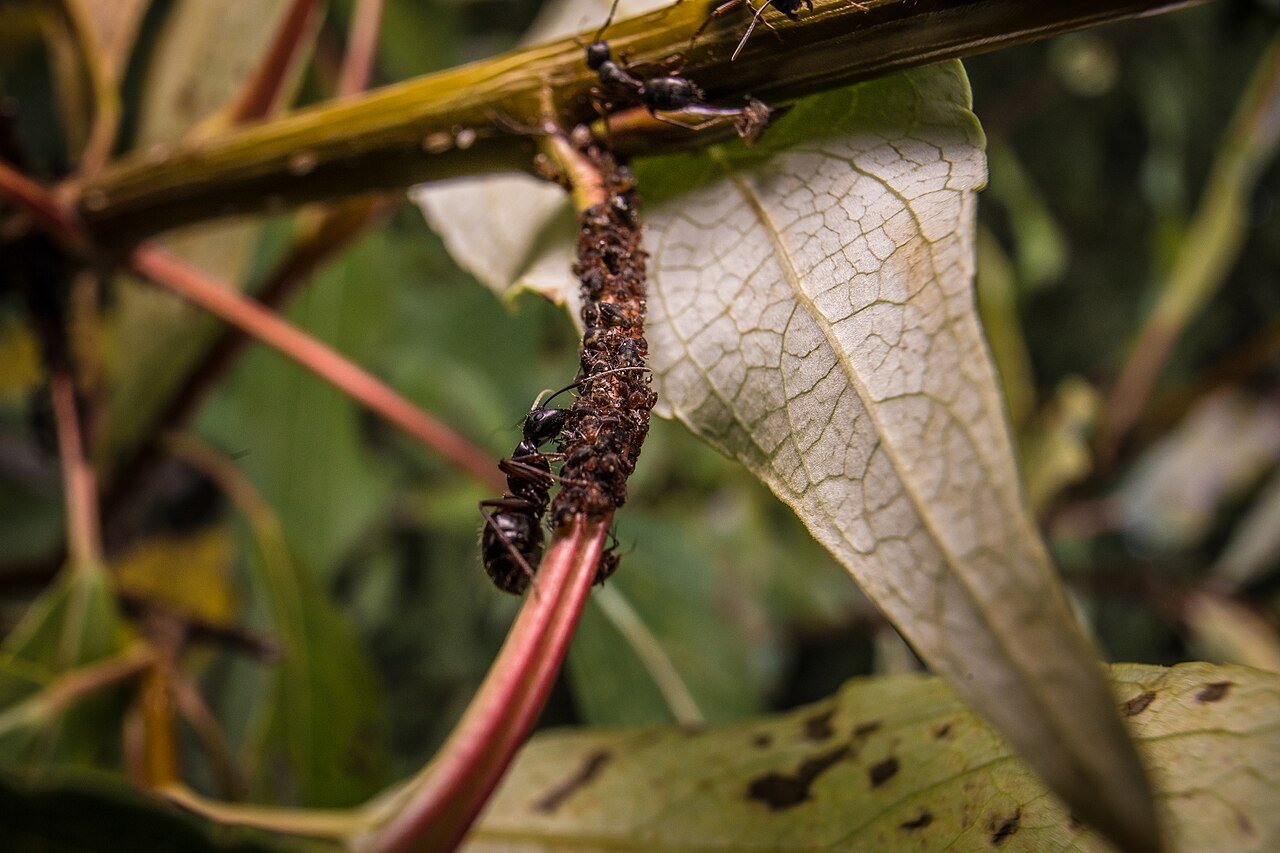
Ant colonies run two food budgets, and knowing which one is active is half of ant control. The carbohydrate budget — sugars — fuels the adult workforce, and its flagship source isn’t your pantry: it’s honeydew, the sweet excretion of aphids and scale insects, which many species farm like livestock (guarding herds, moving them to better leaves, milking them on schedule — the photo below is a working dairy). Nectar, fruit, and your soda spill are the same budget line. The protein budget — insects, grease, meat, seeds — feeds the larvae and the queen’s egg production, and demand for it surges in spring and early summer when colonies are growing broods. This is the seasonal appetite swing our bait guide keeps hammering: the same colony that ignored sweet gel in May inhales it in August, not from fickleness but because the budget shifted. Run both flavors and let the colony vote — it’s reporting its ledger.
The Menu, Species by Species (Ohio Edition)
- Odorous house ants: sugar devotees — honeydew outdoors, anything sweet indoors. The tiny kitchen-trail ant, and the reason sweet baits headline the aisle. Multi-queen networks: the lifespan rules barely apply, which is why they’re our most persistent indoor client.
- Carpenter ants: honeydew plus insect protein — and famously NOT wood; they excavate it for housing and dump the shavings. Their menu swings hardest by season, making them the hardest baiting case.
- Pavement ants: the omnivores — grease, seeds, sweets, insects, whatever the sidewalk provides; famous for spring turf wars over territory (their page covers the battles on your driveway).
- Thief ants: grease-and-protein specialists that ignore sweet stations wholesale — the classic “bait didn’t work” species.
- Field and mound ants: honeydew ranchers at scale plus seed harvesters — yard citizens that rarely enter houses.
What the Lifespans Mean for Your Ant Problem
Assemble the facts and the strategy writes itself. Because workers are disposable (weeks-long lifespans, replaced by a queen laying daily), spraying visible trails accomplishes payroll churn a healthy colony absorbs without blinking — and repels survivors into founding satellite trails besides. Because the queen is the colony’s clock, only chemistry that rides the food-sharing network to her chamber (slow-acting baits carried by foragers, non-repellent transfer treatments) actually shortens colony lifespan — a queen with a decade left on her biological warranty must be reached, not waited out. Because appetite follows the two-budget calendar, bait flavor is seasonal intelligence, not preference guessing. And because multi-queen species break the death-of-the-queen rule, odorous house ant work targets the whole network or wins a month at a time. Every one of these sentences is the biology on this page converted directly into the methods on our ant service page — which is the point: good ant control isn’t stronger chemistry, it’s accurate biography.
The Winter Question
“Where do ants go in winter” gets its answer from the lifespan chart: nowhere — they slow down. Colonies overwinter in place (soil below frost line, wall voids, under slabs), metabolisms dropped to embers, living off fall’s stored budget; workers cluster around the queen and wait. Which is why our winter-trail doctrine is unambiguous: ants marching through your kitchen in January cannot be commuting from a dormant outdoor colony — they’re nesting in the structure, drawing on your heat, and January is, counterintuitively, an excellent month to solve them: the colony is concentrated, hungry, and has nowhere else to be.
Trail you’re tired of, or a colony whose biography you’d like ended professionally? Get a quote — we’ll bring the chemistry that reads this page the way the ants do. Serving Dayton and all of Montgomery, Greene, Miami, Clark, Warren, Butler, Preble, and Darke counties.
Why Queens Live 100x Longer Than Workers (the Science Worth Knowing)
The lifespan gap inside an ant colony is one of biology’s standing marvels: queen and worker share essentially identical genomes, yet one lives months and the other decades — a difference driven not by different genes but by which genes get switched on, steered by larval diet and hormones. Queens receive richer feeding as larvae, develop functioning ovaries and flight muscles, and then activate what researchers describe as enhanced cellular repair and antioxidant programs their sterile sisters never run; the colony’s protected core does the rest, wrapping its irreplaceable member in guarded chambers, constant grooming, and first claim on food. Workers, by contrast, are built for expenditure — evolution spends them on risk exactly as fast as they can be replaced. The same plasticity runs the retirement-in-reverse career path: an aging worker’s shift from nursery to foraging is chemically scheduled, moving each ant toward the dangerous jobs as her replacement cost falls. Gerontologists study ant queens seriously for exactly this reason: they’re a natural experiment in how the same genome can fund a 50-fold lifespan difference on diet and expression alone.
The pest-control footnote to the marvel: everything that makes a queen long-lived — the buried chamber, the food tasters, the layered protection — is also why no spray ever reaches her, and why the industry’s queen-killing tools all impersonate groceries. Her defenses were engineered for predators; the Trojan horse walks in on worker legs.
The Shared Stomach: How One Meal Feeds Ten Thousand
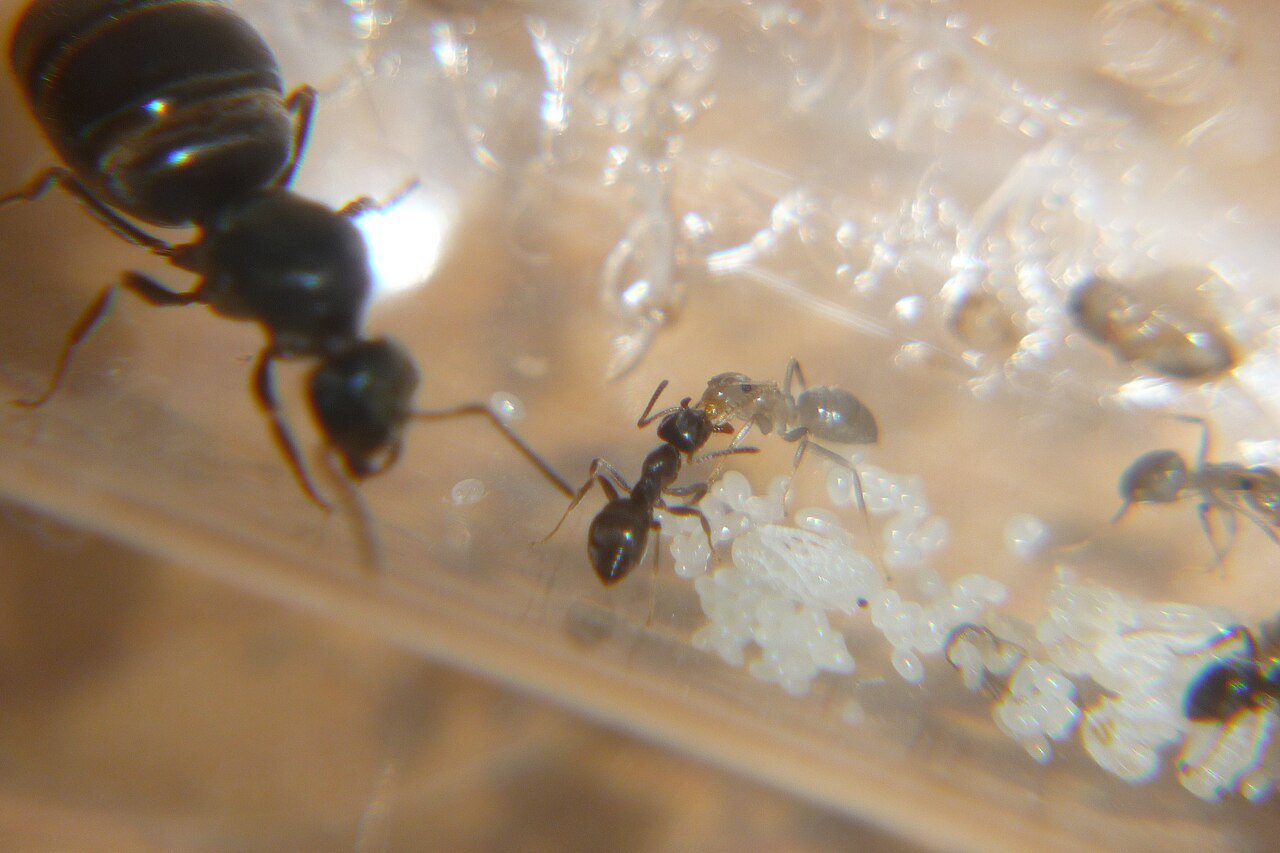
The mechanism connecting lifespan to menu — and both to control — is trophallaxis, the mouth-to-mouth food sharing in this page’s first photo. Foragers don’t eat for themselves; they fill a social stomach (the crop) and return to redistribute, each transfer passing food, chemical signals, and colony news down the line — forager to nest worker to nurse to larva to queen, a bucket brigade that moves one ant’s find through thousands of bodies within days. It’s why colony hunger is collective (the whole network feels a budget shortfall together), why the two-budget appetite shifts so cleanly (larval protein demand broadcasts upstream through begging signals), and — the practical punchline — why a pea-sized dot of slow-acting bait can end a colony of ten thousand: the brigade does the distribution, faithfully, all the way to the chamber no human tool reaches. Ant civilization’s greatest strength and its one engineered vulnerability are the same behavior, which is as close to poetry as pest control gets.
An Ant Year in Ohio (the Calendar Both Budgets Follow)
March–April: colonies wake, queens resume laying, and protein demand spikes to rebuild the workforce — early trails hunt grease and insects, and protein baits have their best month. May–June: swarm season — winged reproductives launch on humid afternoons (check the wings-and-waists sort before worrying), pavement ant turf wars carpet driveways, and new queens dig founding chambers. July–August: the sugar economy peaks — aphid dairies at full production, honeydew flowing, sweet baits inhaling — and mature colonies hit maximum headcount, which is when kitchens meet their trails. September–October: the storage push: colonies bank both budgets for winter, foraging urgency rises, and fall baiting rides that hunger straight into the overwintering chambers — quietly the highest-leverage treatment window of the year. November–February: ember season, with the indoor-trail rule in force. One species, two budgets, five acts; every ant you’ll ever see is somewhere in this script.
Two records to close the biography, because they frame everything above: the oldest documented ant — that 28.75-year black garden ant queen — outlived the laboratory careers of some of the researchers studying her; and a single odorous house ant supercolony can hold hundreds of queens across dozens of linked nests, making “how long do ants live” genuinely unanswerable for the species most likely in your kitchen. Between those poles sits every trail you’ll ever meet: a workforce measured in weeks, serving a sovereign measured in decades, funded by an aphid dairy and a shared stomach. Know the biography, and the trail on the counter stops being a mystery — it’s a supply line, it has an address, and its clock, for all its strangeness, can be ended on schedule.
(Related reading in the library: the full species files for every ant named above, the borax and baking-soda myth tests, and the outdoor colony playbook — all indexed under Ants & Termites in the Bug Identification Library.)
Frequently Asked Questions
How long do ants live?
By caste: workers a few weeks to several months (up to a year-plus for large species), males days after their mating flight, and queens 5–15 years commonly — with the scientific record at nearly 29 years. The colony lives as long as its queen(s), which is why real ant control is queen control.
How long does an ant colony last?
Single-queen colonies age and die with their queen — years to decades. Multi-queen species like Ohio’s odorous house ant re-queen continuously and function as effectively immortal networks, which is why some kitchen ant problems recur until the whole network is treated.
What do ants eat?
Two budgets: carbohydrates (honeydew farmed from aphids, nectar, your sweets) fuel adult workers; protein and grease (insects, meat, seeds) feed larvae and the queen’s egg production. The budget in demand shifts with the season — the fact that makes bait flavor matter.
Do ants eat wood?
No — carpenter ants excavate wood for nesting and dump the shavings as frass, but they eat honeydew and insects like their cousins. Termites eat the wood; the distinction changes the entire treatment.
Why does killing ants never end the trail?
Because visible workers are disposable weeks-long employees a queen replaces daily from years of reserve. Sprays churn payroll and scatter survivors; only slow chemistry carried home through food-sharing reaches the queen whose lifespan IS the colony’s.
What do ants do in winter?
Slow down in place — clustered below frost line or in structural voids, living on stored food at ember metabolism. Active indoor trails in winter therefore mean an indoor nest, and winter is actually a strong season to treat: the colony is concentrated and hungry.
How many eggs does an ant queen lay?
Hundreds to thousands per day in season for mature colonies, sustained across a reign of years to decades. One mated queen founding a nest alone can build a colony of tens of thousands — the arithmetic every “I only see a few ants” conversation eventually meets.
Why are ants farming aphids on my plants?
For honeydew — the sugar excretion that funds most colonies’ carbohydrate budget. Ants guard, herd, and “milk” aphids like livestock, which is why serious ant pressure and aphid outbreaks arrive together, and why treating plants for aphids sometimes quiets an ant trail no bait touched.