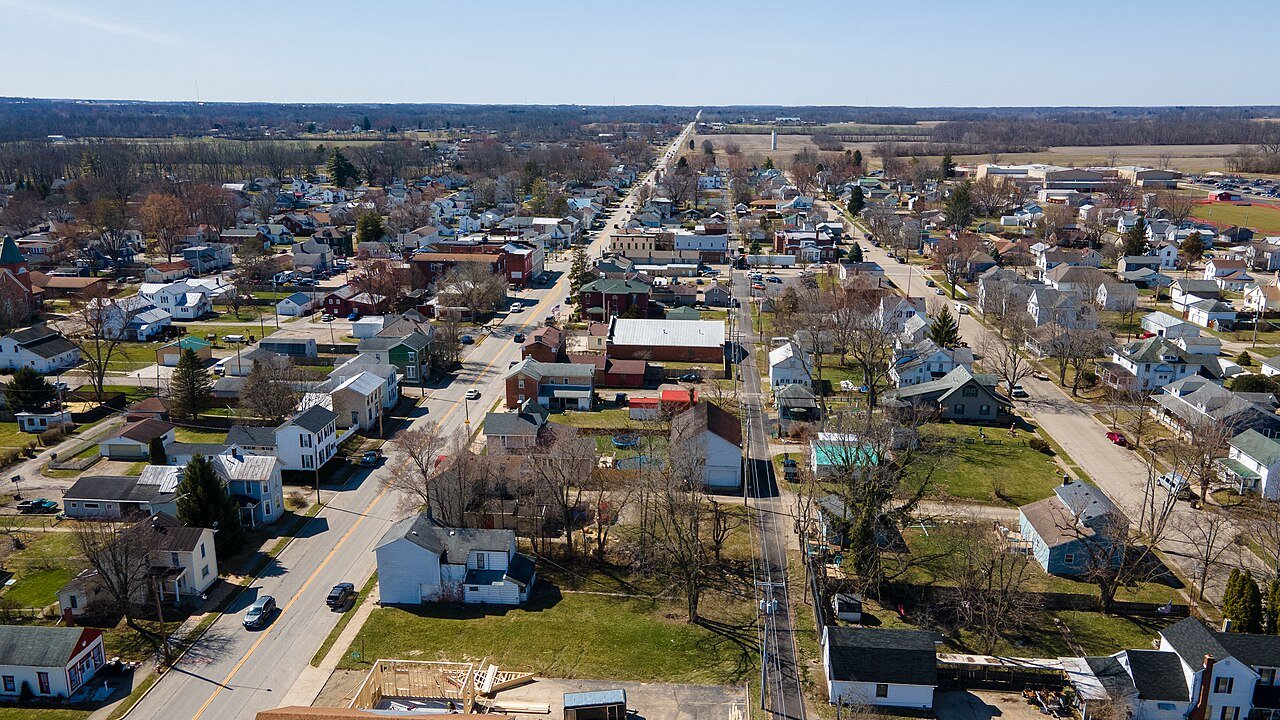
West Alexandria is the gateway: the first Preble County village on US-35 heading west out of Dayton, sitting on Twin Creek where Lanier Township’s sections begin — which makes it both the closest Preble stop on our route map (twenty minutes and change from our Salem Ave office) and a textbook creek-village pest profile: older Main Street stock with stone cellars, low ground running Twin Creek’s moisture economy through the middle of town, and grain fields opening at the village edge in every direction. Greater Dayton Pest & Rodent serves West Alexandria and the Lanier Township lanes on every Preble route day — the full service list, Dayton pricing, and the re-treatment guarantee that runs this whole site.
Creek, cellar, and field: the West Alexandria triangle
The village’s three geographies each write a chapter. Twin Creek keeps the low blocks’ mosquito season long and their cellars honest — wet springs push the moisture guild (camel crickets, sowbugs, the spiders that follow) indoors along the valley grade, and flood-history basements carry the elevated moisture-and-termite vigilance our Camden page details for its own creek. The old stock along Main Street and Dayton Street runs the pike-village playbook: stone foundations, balloon frames, porch wasps, and the exclusion craftsmanship they reward. The field edge delivers the county calendar — the harvest mouse push, cluster flies, and the lady beetle flights off the soybean ground — with the village’s compact footprint meaning nearly every address qualifies as edge. The September barrier-and-exclusion visit earns its keep here as much as anywhere in the county, and being first on the route makes it the easiest Preble appointment to book.
The West Alexandria playbook
- September first — exterior barrier plus exclusion check before harvest and the invader flights
- Creek-block moisture work — dehumidification guidance, sill inspections, and mosquito service for the low ground
- Old-stock exclusion — mortar-and-mesh on the Main Street foundations
- Village commercial — scheduled programs for the US-35 businesses, documentation included
- Rural campus scoping — Lanier Township’s farmsteads read as whole properties (county logic)
A West Alexandria seasonal calendar
- March–May: ants wake along Main Street; termite swarm season in the old stock — winged insects in a creek-village basement get photographed the same day; the low blocks empty their buckets and barrels as mosquito prep
- June–August: Twin Creek’s mosquito season peaks; porch wasps scale; the valley’s insect economy keeps spiders busy at every light
- September–October: the gateway village gets the county’s double wave first on our route — harvest mice and invader flights — and the scheduled September visit meets both
- November–February: interior mouse season; cluster flies at sunny windows; exclusion and inspection season in the quiet months
West Alexandria questions we hear
Being closest to Dayton — can we get same-day service like the suburbs?
Closer than the rest of the county, honestly not quite the Dayton core: West Alexandria rides every Preble route day, which makes next-day the working norm and same-day genuinely possible when a route is already westbound — and true emergencies (stings at entries, transaction deadlines) jump the queue exactly as they do everywhere. The twenty-minute proximity shows up most in follow-ups and guarantees: re-checks and warranty visits book effortlessly here, which is one more reason the gateway village gets the county’s most attentive service.
Our place floods when Twin Creek runs high. What should we be doing between events?
The between-years are when the pest ledger is written: keep the basement’s drying infrastructure honest (sump serviced, dehumidifier holding under 50%, downspouts thrown far), store on shelving rather than the slab so the next event costs cardboard instead of habitat, and give the sill line an annual look — chronically damp sills are the county’s quietest termite invitation, and flood-history houses carry them more often than anyone likes. Our inspections write these findings up plainly, fix what is ours to fix, and flag what belongs to the gutter contractor — the division of labor that keeps creek villages standing.
Preble coverage: county hub · Eaton · Lewisburg · Gratis · full service area.
Lanier Township and the Twin Valley farms
Around the village, Lanier Township runs the Twin Creek valley’s farm campus properties, and the county protocol applies in full: whole-property scoping, feed-room-first exclusion, the deer-mouse protocol for wintered equipment, barn wasp management at scale, and the honest crop-versus-structure lane-sorting with the co-op. The valley farms add the creek variable their village neighbors know well — bottomland outbuildings carry the same flood-memory moisture logic as Main Street cellars, wet years push the ground-dwelling wildlife (and its mite passengers) upslope toward structures, and the September visit doubles as the annual walk that catches what the water moved. Twin Valley country has been managing water and timber together since the pike days; we are glad to carry tools in that tradition.
The bottom line for the gateway village
First on the route, closest to the guarantee, and carrying all three of the county’s pest geographies in one compact map — West Alexandria gets the complete Preble playbook with the easiest logistics in the county: creek-block moisture management, Main Street exclusion craftsmanship, September’s double defense, commercial documentation for the US-35 businesses, and township campus work up and down the valley. Free quotes, free photo identification, no mileage lines, Saturdays by appointment: (937) 569-3330. The village that greets every westbound traveler now greets our trucks too — several mornings a week, right on schedule.
Is the ant problem here really different from Dayton’s?
Same species, shifted proportions: the odorous house ant still owns the village kitchens and still punishes spray-bottle instincts with its budding response, but the creek-village versions run their satellite networks through damper ground — under the low-block slabs, in the flood-fill soils, along the moisture gradients old cellars provide — which makes the moisture-management half of ant control weigh heavier here than in a dry Beavercreek subdivision. The playbook holds (bait, never spray; erase trails after collapse; strip the sugar economy), with the West Alexandria addendum that the dehumidifier and the downspout extension count as ant control too. Species biology travels; village hydrology is local — and reading both is the job.
Who handles the school and church buildings in a village this size?
We do, comfortably — institutional buildings in small villages get the same commercial programs as the corridor businesses, scaled to their actual pressure and scheduled around their calendars (treatments timed to breaks and off-hours, documentation written for boards and inspectors, and the sensitive-population placement standards from our family-safety playbook applied as the default). Village institutions also inherit village-building realities — old structures, deep cellars, belfry wildlife — and the coordination habits from the rest of this page apply. One call covers the sanctuary, the fellowship hall, and the parsonage on one route day.
Who actually turns up in West Alexandria: Greater Dayton Pest & Rodent is owned and operated by Bryan Camden, licensed by the Ohio Department of Agriculture — firm #115079, commercial applicator #170858, categories 10A, 10B and 12. When you call, you talk to the person who does the work. No call center, no rotating crews, and the same technician on every visit.
Frequently asked questions
Do you provide pest control in West Alexandria?
Yes — the Twin Creek village rides the western rotation; full program, known lanes.
What pests are most common in West Alexandria?
Creek-and-belt blend: Twin Creek’s moisture and mosquito corridors, harvest rodent surges, older-core foundation mice, farmstead wasps, and the September flights.
How much is pest control in West Alexandria?
County formula: most homes $39–$55/month quarterly; campuses walked; free: (937) 569-3330.
Does Twin Creek change the local pattern?
Meaningfully — the corridor adds floodwater mosquito waves and valley-humid basements to the standard belt files; creek-adjacent addresses get the moisture-first emphasis.
Why the October mice every year?
Belt equation — harvest displacement, first frost, older doors; September sealing answers it annually.
How fast can you reach West Alexandria?
Weekly rotation — days typically, no travel charges.
Do you serve village businesses?
Yes — storefronts and ag operations alike, matched programs and documentation.
What about the farms?
Campus model — systems quotes, harvest scheduling, grain protocols, deer-mouse defaults.
Is mosquito season manageable creek-side?
Honestly managed — barrier timing, container patrol, fans; interception, not abolition, and patios stay usable.
How do I start service in West Alexandria?
Instant quote, free photo ID, or (937) 569-3330 — free estimates, route days weekly.