
Of all the ants that enter Miami Valley houses, exactly one earns structural respect: the carpenter ant. Ohio’s biggest ant — the black carpenter ant, Camponotus pennsylvanicus, runs to over half an inch — does not eat wood, but it excavates it, carving smooth gallery networks for nesting that expand season over season, and it flags moisture problems with better accuracy than most home inspectors. Between the homeowner who panics at every big ant and the one who ignores “a few ants” for three years, there is a correctly calibrated middle, and this page builds it: identification (including the termite question that decides everything), the parent-and-satellite colony system that explains the weird sightings, what the damage actually is and is not, and the treatment logic that works — drawn from the wooded-neighborhood jobs this region hands us weekly, from Hills & Dales to every tree-lined street in Oakwood.
Identification: big, black, and one node
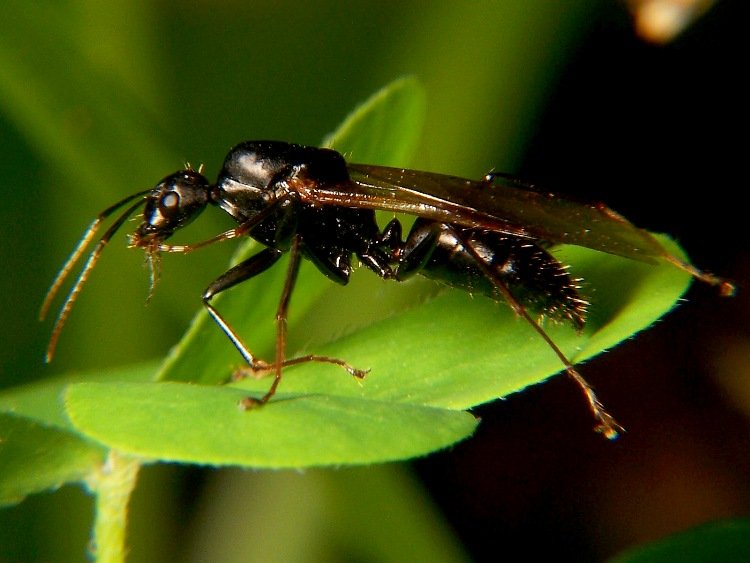
Size is your first filter — workers range from a quarter inch to well past half an inch (polymorphism within one colony, so mixed sizes on one trail is itself a carpenter clue), dwarfing the kitchen ants. Color runs black to reddish-black; the profile shows an evenly rounded back (thorax) versus the bumpy profile of many small ants; the waist carries a single node. Behavior seals it: carpenter ants are mostly night-shift foragers (the big ant on the counter at 11 p.m. is on schedule), they trail loosely rather than in dense columns, and indoors they appear disproportionately high — window heads, ceiling lines, skylights — because satellite colonies favor upper-structure voids. And the finding that ends all debate: frass — the excavation debris they eject from galleries, a distinctive pile of fine wood shavings mixed with insect fragments, looking like pencil-sharpener output accumulating below a slit in fascia, window trim, or a porch column. Sawdust that reappears after you vacuum it is not construction debris; it is an active mine announcing its shaft.
The question that outranks every other: ant or termite?
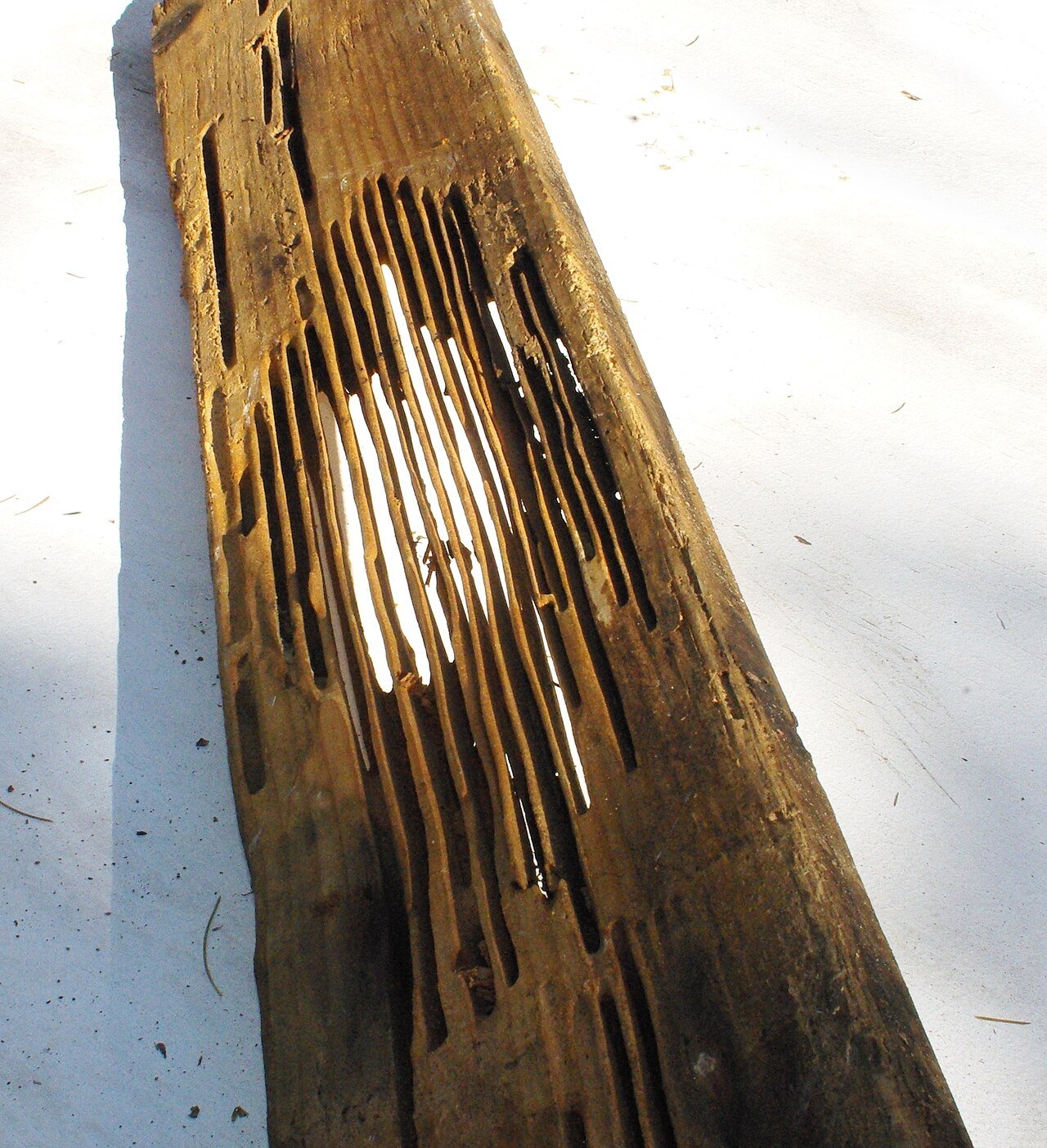
Twice a spring, a Dayton homeowner sweeps up winged insects and guesses wrong in one direction or the other, and the two errors cost very differently. The fast checks, from our full comparison guide: carpenter ant swarmers have elbowed antennae, pinched waists, and unequal wing pairs (front longer than rear); termite swarmers have straight antennae, thick waists, and four equal gossamer wings they shed in drifts. Worker-level evidence differs just as sharply — carpenter galleries are clean, smooth, almost sanded, running with the grain and kept debris-free (hence the frass piles outside); termite workings are mud-lined, gritty, and follow soft springwood, and termites build the mud tubes carpenter ants never do. The stakes: misreading termites as ants postpones a structural emergency; misreading ants as termites buys an unneeded termite contract. Bag a specimen, photograph the wings against a ruler, and send it to (937) 569-3330 — the free ID exists precisely for this fork, and we are licensed for both roads.
Parent, satellites, and the hundred-yard commute
Carpenter ant control fails when it imagines one nest, because the species runs a distributed system. The parent colony — queen, brood, thousands of workers — lives in moist dead wood outdoors: the ravine snag, the old pruning wound in the street maple, the stump nobody ground, the retaining-wall timber. Once mature, it spins off satellite colonies of workers, older brood, and sometimes secondary reproductive activity into drier protected voids nearby — hollow doors, porch columns, foam sheathing, the box header over a picture window, attic insulation voids — connected to the parent by trunk trails workers walk nightly, up to a hundred yards each way, along fences, wires, and branch highways. This architecture decodes every confusing pattern homeowners report: ants indoors but never a nest found (satellite in a void, parent in the yard or the neighbor’s); ants appearing at the same window head every June (seasonal satellite reoccupying a proven void); spraying that “works” for three weeks (you interrupted one trail; the network rerouted); winged swarmers indoors in late winter or spring (a satellite matured enough to host reproductives — the strongest indoor-nest evidence there is). Control that lasts has to think in networks: find the satellites, disrupt the trunk trails, and address the parent or its highways — which is exactly the treatment sequence below.
What the damage really is (and is not)
Calibration matters, because carpenter ants occupy the anxiety space between nuisance and catastrophe and belong at neither pole. Unlike termites, they eat nothing structural — galleries are housing, expanded as colonies grow, concentrated in wood that moisture already softened: the sill under the chronic gutter overflow, the porch column wicking off concrete, the window header behind failed flashing, the deck ledger. Damage accumulates at renovation-annoyance scale over years, not collapse scale — but two multipliers deserve respect. First, the moisture flag: a satellite colony is a moisture finding, and the water problem it marks (leak, condensation, failed seal) is often doing more damage than the ants are — every carpenter ant job we run includes pointing at the water, because fixing it is half the treatment and all of the prevention. Second, compounding tenancy: voids and galleries reoccupied season after season — the “we see a few every summer” house — eventually present real repair bills in fascia, trim, and framing ends, all of it preventable at any earlier point in the timeline. The honest framing: not an emergency this weekend, absolutely a this-season problem, and cheapest at its youngest — a sentence that could headline half the pages on this site.
Finding the satellite: the detective section
The nest hunt is the craft of carpenter ant work, and homeowners can run the first passes themselves. Follow the commuters: watch the trail at dusk and pre-dawn (peak shifts), outward to find where it exits the structure and inward to where workers vanish into a void — the disappearing point is the door. Listen: an active satellite in a quiet wall produces a faint dry rustling — crinkling cellophane — audible with an ear or a stethoscope cup against the drywall on a still night; tapping the suspect area sometimes provokes an audible alarm response. Track the frass: fresh piles reappear below the gallery slit within days of cleaning; the slit is usually within a couple feet above the pile. Probe the usual suspects: the moisture map is the nest map — window and door headers below any flashing history, porch columns and railings, sill plates behind grade-level planting beds, the deck ledger, hollow-core doors, skylight curbs, and the voids above porch roofs. Mind the highways: every branch touching the roof, every wire and fence line into the structure is a trunk-trail candidate worth a flashlight check at night — you will sometimes catch the commute in progress. Even a partial map — “they enter at the northeast soffit and there is frass below the kitchen window” — cuts professional diagnostic time dramatically and sharpens the quote.
Treatment that respects the biology
The playbook, in the order that works. Direct satellite treatment where the nest is located: dusts or non-repellent products delivered into the void through existing gaps or discreet drilled access — the highest-value single action in carpenter ant control, ending the indoor population at its address. Non-repellent perimeter and trunk-trail treatment: modern undetectable chemistry along the foundation, entry points, and known trails, carried through the network by the ants themselves — the anti-budding, anti-reroute class that replaced the failed spray-the-trail era. Baiting as the flanking move: carpenter ants bait less reliably than sugar ants (their menu shifts hard between honeydew and protein), so baits support rather than carry the plan, matched to season and placed on the commute. Highway and habitat correction: the limb off the roof, firewood off the ground and away from walls, the stump ground, the mulch pulled back — each one a permanent subtraction from the network map. And the moisture fix, named in writing on every job: the gutter, the flashing, the grading, whatever invited the satellite — because a dried void does not get re-let. What has no place in the plan: repellent aisle sprays on trails (three weeks of quiet, then rerouted traffic — the pattern that brings most of our carpenter calls in already frustrated) and treating swarmers at the window while ignoring the void they announce.
The Ohio carpenter ant calendar
Late February–April: the earliest indoor sightings of the year — and among the most diagnostic: a big ant wandering the kitchen during a February thaw did not stroll in from a frozen yard; it woke inside the envelope, and swarmers at a window in late winter announce a mature indoor satellite outright. May–June: peak season — outdoor colonies at full forage, satellite establishment in structures, the year’s heaviest trail traffic and most of our carpenter calls. July–August: steady-state foraging with the protein appetite spike; frass piles grow fastest as galleries expand for the year’s brood. September–October: consolidation — activity retracts toward nests, making it the strategic window for perimeter and void treatments that catch populations concentrating rather than dispersing. November–January: dormancy outdoors; indoor satellites in heated walls stay minimally active, which is why any midwinter carpenter sighting is a satellite confession worth acting on rather than a fluke worth shrugging at. The calendar’s practical compression: winter sightings mean indoor nests, spring swarms mean mature indoor nests, and fall is the professional’s favorite month to end both.
Carpenter ant questions we hear
Do carpenter ants mean my house has rotten wood everywhere?
They mean it has rotten-or-damp wood somewhere, and usually somewhere specific: satellites need softened entry wood even though galleries extend into sound material from there. Treat the finding as a free moisture audit with an insect bibliography — the ants have already located the flashing failure or gutter problem your next paint cycle would have found expensively later. Fix the water, treat the void, and both problems close together.
Can I just use the big-box carpenter ant spray?
The label kills the workers you soak; the network shrugs. Retail repellent sprays interrupt one trail segment while the satellite, the parent, and the trunk system persist — three quiet weeks, then rerouted traffic, the cycle our callers describe verbatim. If DIY is the budget, the honorable versions are the detective work above plus habitat correction (limbs, firewood, moisture) — genuine value — with void treatment left to non-repellent professional chemistry that colonies cannot map around.
The ants are in a tree, not the house. Do I care?
A colony in a yard tree is ecology until it is within trunk-trail range of the structure — then it is a parent colony with your address on its expansion list, especially with a branch highway touching the roof. The tree itself: carpenter ants colonize wood already dead or decaying (they are a symptom of the cavity, not its cause), so the arborist question is about the tree’s health and the pest question is about the commute. Prune the highway, watch for frass at the house, and no treatment may ever be needed — the cheapest carpenter ant outcome there is.
Prevention for the wooded-lot Miami Valley
- Six feet of clearance: limbs pruned off the roofline — the single highest-value carpenter ant prevention in tree country, deleting the primary highway
- Firewood discipline: off the ground, away from walls, oldest burned first — a wood pile against the siding is a satellite starter kit
- Stump and snag audit: ground or removed within trail range where practical; where a ravine or wood line is the neighbor, accept the parent pressure and defend the structure instead
- Moisture patrol: gutters flowing, flashing sound, sprinklers off the siding, grade shedding away — every dry board is a board off the market
- Seal the upper entries: soffit gaps, fascia joints, cable penetrations, and window-head cracks — carpenter ants enter high more than any other Ohio ant
- Annual spring walk: ten May minutes checking the frass stations (porch columns, window heads, deck ledger) catches new satellites in their first season, when they are an afternoon’s job
The bottom line
Carpenter ants are the thinking homeowner’s pest: genuinely worth respect, never worth panic, and always carrying useful information — every satellite marks a moisture problem, every trunk trail maps a fixable highway, every frass pile gives away an address. Identify honestly (big, black, one node, elbowed antennae — and rule out the termite fork the same day), read the network instead of the individual ant, treat the void and the water together, and put the wooded-lot preventions on the calendar. Or hand us the whole file: inspection, satellite location, non-repellent treatment, moisture findings in writing, and the re-treatment guarantee across all of it — the same service we run under the canopies of every tree-lined neighborhood on this site. (937) 569-3330: free quotes, free big-ant identification, and a healthy professional respect for the only Ohio ant that earns it.
Related: termites vs flying ants · odorous house ants · professional ant control · termite control · the forest-edge deep dive.
A case study from the routes: the window that swarmed every March
One composite from our files, because it assembles every concept on this page into a single familiar house. A Kettering family — mid-century brick, mature silver maple over the southwest corner — saw winged ants at the same living-room window three Marches running, sprayed the sill each time, and enjoyed eleven quiet months per cycle. Year four’s inspection read the house in twenty minutes: frass trace below the window’s exterior trim, a branch resting on the gutter line directly above, moisture staining at the header from a flashing seam, and the faint rustle in the wall on a quiet evening. The network, mapped: parent colony in a maple cavity twenty feet up, trunk trail down the branch to the gutter, satellite in the moisture-softened header void, and an annual spring swarm from a satellite mature enough to host reproductives — with the annual sill-spraying never touching any of it. The fix took one visit and one arborist referral: void treated through the trim gap, non-repellent line on the entry route, branch pruned, flashing seam sealed — and the family’s Marches went permanently quiet. Total cost: less than four years of spray cans plus the header repair that another few seasons would have earned. The moral is the whole page: carpenter ants are never mysterious, only networked — and a network, once read, is just a to-do list.
If tonight’s eleven o’clock brings a half-inch ant across the counter, you now know the whole drill: no panic, no spray, one photo beside a coin, one flashlight pass of the window heads and porch columns for frass, and one free text to (937) 569-3330. Big ants carry big information — let’s read yours together.
Related: What a carpenter ant actually looks like up close.
Related: Every ant you are likely to meet in Ohio.
Frequently asked questions
How serious are carpenter ants in a house?
Serious enough to act, not panic: they excavate moisture-softened wood for nesting (they do not eat it), enlarging damage over years rather than weeks. The ant is a symptom twice over — of a water problem that softened the wood, and of a nest that now needs finding.
How do I know if I have carpenter ants or termites?
Carpenter ant galleries are smooth, clean, and sawdust-adjacent (look for the “frass” piles like pencil shavings below kick-out holes); termite galleries are mud-lined and dirty. The insects: big black ants with pinched waists vs. pale straight-bodied termites. Both warrant a call; the protocols differ completely.
What does it mean if I see carpenter ants in winter?
An indoor nest, almost certainly — outdoor colonies are dormant in January, so winter activity means the colony lives inside your envelope, typically in moisture-compromised wood near baths, roofs, or leaks. Winter carpenter ants are our highest-priority ant call.
Where do carpenter ants nest in houses?
Wherever water went first: window and door frames below leaks, bathroom voids, roof edges with failed gutters or flashing, sill plates over damp foundations, and deck ledgers. The parent colony often sits outdoors (stump, woodpile) with satellite nests indoors — both ends need finding.
What are flying carpenter ants?
Reproductive swarmers — big winged ants emerging indoors in spring mean a mature indoor colony announcing itself. Photograph before panic (pinched waist = ant, straight body = termite) and treat an indoor swarm as the inspection trigger it is.
Can I treat carpenter ants myself?
The visible trail, occasionally; the colony, rarely — carpenter ants forage far from the nest and mostly at night, and the nest is the entire job. Sweet baits underperform on this species, sprays scatter foragers, and satisfaction requires the nest-location work that is genuinely a trade skill.
How do professionals treat carpenter ants?
Trail-tracing at dusk (peak foraging) to locate parent and satellite nests, direct void treatment or dust into confirmed galleries, non-repellent perimeter for the commuters, and the moisture diagnosis that prevents recolonization — because dry wood is carpenter ant repellent that never wears off.
Do carpenter ants mean my house has water damage?
Almost always somewhere — they colonize wood at elevated moisture, so the nest maps the leak: the gutter overflowing into fascia, the flashing gap, the sweating pipe void. Fix the water or the wood re-qualifies for the next queen.
How much damage can carpenter ants really do?
A neglected decade hollows structural members — but the timescale is years, and early-found colonies cost repair-bill footnotes. The compounding argument applies gently here: this year’s inspection beats next year’s carpentry.
What kills carpenter ants in Ohio?
Professionally: non-repellent perimeter products, targeted gallery dusts, and protein-cycle baiting matched to season. What does not: spraying the countertop trail, which removes the two percent you can see and educates the rest.
Do carpenter ants in trees or woodpiles matter?
Within fifty feet of the structure, yes — outdoor nests stage satellite moves into buildings. Grind stumps, rack firewood off soil and away from siding, and trace any dusk trail along fences or cables before treating either end.
Who treats carpenter ants in the Dayton area?
We do, across all eight counties — nest-location work, moisture diagnosis, and the treatment that follows both: (937) 569-3330. Winter sightings and indoor swarmers get priority scheduling; bring photos of any frass piles you have found.