Every fall, somewhere in the Miami Valley, a family watches winged insects boil up from a crack in the basement floor, crushes one in alarm — and gets hit with a blast of lemon citronella scent, as if the invader came pre-marinated. Meet the citronella ant: Ohio’s strangest common ant, a yellow-gold subterranean farmer that smells like a tiki torch when threatened, spends its life tending herds of root aphids in total darkness, and surfaces into human awareness almost exclusively during its dramatic autumn swarm flights — which are misread as termite emergencies so reliably that this page exists half as ant biography and half as panic prevention. The complete file from Greater Dayton Pest & Rodent: the smell explained, the underground farming economy nobody suspects beneath their slab, the swarm-versus-termite identification worth real money, why these ants essentially never want anything you own, and the honest short list of situations that justify any response beyond a vacuum and a story: (937) 569-3330, free ID for every lemon-scented specimen and everything else that swarms.
The smell: chemical defense you can identify blindfolded
The citronella ant’s namesake is the most reliable field mark in Ohio myrmecology: disturbed or crushed workers release citronellal and related lemon-terpene compounds from mandibular glands — the same chemical family that scents actual citronella candles and the lemon balm in your garden border — producing an instant, unambiguous citrus burst that no other local ant matches. The chemistry is defensive signaling: alarm pheromone to rally nestmates and repellent against the ground beetles and predatory ants that raid subterranean colonies. For identification purposes it’s a gift — the sniff test outranks the magnifying glass: one gently crushed specimen settles “citronella ant” against every look-alike in seconds, including the small yellow thief ants of kitchens (no scent, and actually interested in your food) and the pale pharaoh ant of heated buildings. Visually, workers are 3–4 millimeters of uniform yellow-to-golden-amber — a color scheme almost nothing else in the region wears — with the smaller, darker-winged reproductives appearing only at swarm season. The sniff, the gold, and the swarm calendar below make this the most amateur-diagnosable ant in Ohio, which is convenient, because the diagnosis almost always ends the emergency.
A lemon-scented swarm in the basement is alarming and almost never structural. Confirming which it is takes ant control in Dayton.
The underground economy: ants that farm in the dark
What citronella ants do all year, invisibly, is agriculture. The colonies live entirely below ground — under slabs, stones, and soil against foundations — and they subsist almost exclusively by farming root aphids and mealybugs: tending herds of sap-sucking insects attached to plant roots, protecting them from predators, moving them between root pastures, and harvesting the sweet honeydew the herds excrete, exactly as their above-ground cousins farm aphids on rose stems, transposed into permanent darkness. The lifestyle explains every practical fact that matters to a homeowner. They don’t forage in your kitchen — a food economy based on underground livestock has no use for your crumbs, which is why citronella ants essentially never appear in pantries and why bait programs aimed at them fail (nothing you offer competes with the herd). They love the slab-edge microclimate — the warm, moist soil along foundations and under basement floors is prime pasture, which is why colonies announce themselves at floor cracks, sump pits, and slab joints, particularly in the slab-built suburbs and older basements of Dayton. And they damage nothing — no wood excavation (the carpenter ant’s beat), no food contamination, no stings, no meaningful bites; soil displacement at a crack’s edge is the entire property impact. An economy that ignores you completely: it’s the rarest arrangement in this library, and the ant pulls it off while smelling like a summer patio.
Swarm season: the termite false alarm of the Ohio autumn
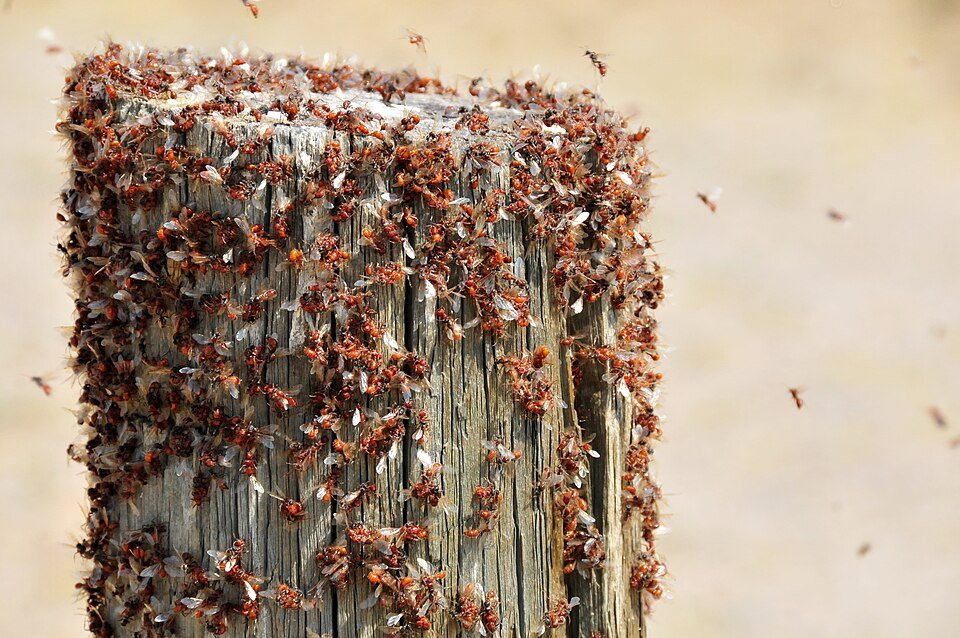
The citronella ant’s one public event is its mating flight, and the staging could not be better designed to trigger termite panic. The swarms favor late summer through fall (with occasional late-winter indoor events from slab-warmed colonies — a January “termite swarm” in a heated basement is citronella ants until proven otherwise), they emerge indoors from basement floor cracks, slab joints, and sump pits when a colony’s territory extends under the house, and they arrive in volume — hundreds of dark-winged reproductives streaming from a gap in the concrete, exactly the scene our termites-versus-flying-ants guide trains for. Run that page’s three checkpoints and the verdict lands fast: citronella swarmers have the pinched ant waist, the elbowed antennae, and unequal wing pairs — plus two bonus tells the species adds free: the golden workers often milling at the exit point (termite workers never appear in the open), and the sniff test, which works on swarmers too. The stakes of getting it right run both directions, as ever: a citronella swarm mistaken for termites has sold many an unnecessary treatment contract to a frightened household (fall “termite specials” from door-knockers time themselves to exactly these events), while a real termite swarm dismissed as “those lemon ants again” donates a season to the colony. Sixty seconds of checkpoint-and-sniff, or one photo to the free line, buys the correct verdict — and with citronella ants, the correct verdict is almost always “vacuum the swarmers, seal the crack at your leisure, and save the treatment budget entirely.”
The response ladder: from “do nothing” to the one real job
- Rung one — the swarm event (most cases): vacuum the winged reproductives, enjoy the citrus notes, and know the show ends on its own within hours; swarmers neither bite nor found colonies indoors, and the parent colony returns to its herds under the slab
- Rung two — the housekeeping seal: caulk the floor crack or slab joint the swarm used — worthwhile less for the ants (they’ll swarm from the next gap) than because a basement crack is also mouse, waterbug, and radon infrastructure; the citronella ants merely flagged it first
- Rung three — the moisture read: repeated indoor swarms and visible golden workers at the slab edge mark warm, moist soil against the foundation — the same downspout-and-grading audit every page in this library bills to a different messenger; dry the perimeter and the pasture (and its farmers) relocates
- Rung four — the one real job: the rare colony whose excavations under a slab section or patio produce persistent soil pushing through joints and cosmetic settling concerns gets a targeted professional treatment at the colony — a modest, specific visit we run occasionally, always after the sniff-and-checkpoint identification, never off a swarm sighting alone
- Never on the ladder: kitchen-style bait programs (their economy ignores your bait), broadcast slab-perimeter sprays for a swarm event, and any “termite treatment” sold same-day off winged insects nobody identified — the second-opinion rule stands guard here permanently
Citronella ant questions, answered
They swarmed in my basement — does that mean the colony is IN my house?
Under, not in — the colony’s galleries run in the soil beneath and beside the slab, and the swarm simply exited through the most convenient gap into your airspace. Nothing lives in your walls, nothing feeds in your kitchen, and the post-swarm basement returns to hosting zero resident ants. The distinction matters emotionally more than practically, but it’s the honest geometry: you don’t have ants in the house; the house has a farm under its floor, which is a different and much smaller sentence.
My dog snapped at the swarmers and now smells like lemon furniture polish. Problem?
A cosmetic one at most — the citronella compounds are alarm chemistry, not toxin, and a mouthful of swarmers is a scented protein snack with no veterinary significance. The smell fades; the story survives.
Are they related to actual citronella — could they repel mosquitoes?
Chemically parallel, practically no — the ants produce citronellal-family compounds convergently with the citronella grasses, but in defensive puffs, not ambient output; a colony under your patio contributes nothing measurable against mosquito pressure, delightful as the concept is. The plant border remains the botanical route; the ants remain the underground farmers who happen to share a perfume supplier.
The one-screen citronella file
- ID: golden-yellow 3–4mm workers + the sniff test — crushed specimens smell unmistakably of lemon citronella; nothing else in Ohio matches
- Lifestyle: fully subterranean root-aphid farmers — they never forage in kitchens, never nest in walls, never damage wood
- The event: late-summer/fall (occasionally winter) swarm flights from basement cracks and slab joints — Ohio’s premier termite false alarm
- The checkpoint: pinched waist + elbowed antennae + unequal wings = ant; golden workers at the exit + lemon scent = citronella specifically; the full guide covers the stakes
- Response ladder: vacuum the swarm → seal the crack → dry the foundation perimeter → (rarely) targeted colony treatment for persistent slab excavation — never baits, never panic contracts
- Harm total: zero bites, zero stings, zero contamination, zero structural damage — soil at a crack edge is the entire rap sheet
- Free verdicts: (937) 569-3330 — photo or scent description both accepted; lemon-positive results delivered with congratulations
One sniff, three checkpoints, and Ohio’s most theatrical ant files under “wildlife documentary” instead of “emergency” — the cheapest resolution in this entire library, scented accordingly.
Two species, one perfume: the larger and smaller citronella ants
For completeness, Ohio’s citronella franchise runs two species with one household story. The larger yellow ant (Lasius interjectus) is the headliner — the bigger, brighter-gold species behind most basement swarm events, with reproductive flights favoring late summer through fall and the occasional midwinter indoor surprise from colonies warmed under heated slabs. The smaller yellow ant (Lasius claviger) runs a size down and a shade duskier, farms the same root-aphid pastures, and skews its flights toward late fall and even early spring — meaning a Miami Valley household can theoretically host two lemon-scented swarm seasons from two different farms without ever seeing a worker in between. The distinction is entomology-club material rather than practical (both species’ files read identically: subterranean, harmless, sniff-diagnosable, response ladder unchanged), but it explains the households that report “the lemon ants swarmed AGAIN” months apart and wonder if something failed — nothing failed; a second franchise location reported in. Both species also share the deeper Ohio distinction this page has circled all along: they are among the region’s most abundant ants by biomass — colonies under practically every yard, sidewalk, and slab in the Miami Valley — while ranking among its least-encountered, a combination that makes the citronella ant the great silent majority of local myrmecology: everywhere, farming, lemon-armed, and asking absolutely nothing of the humans upstairs except sixty seconds of correct identification once a year: (937) 569-3330 when that minute arrives.
The door-knocker’s favorite swarm: a consumer-protection interlude
This page owes its readers one blunt consumer warning, because the citronella ant funds a small autumn industry. The species’ swarm calendar overlaps the pest-control sales season, its emergence staging (winged insects from basement cracks) is termite-identical to the untrained eye, and its abundance guarantees thousands of Miami Valley households witness an event each fall — a combination that makes “I was in the neighborhood and noticed signs of termites” the region’s most reliable door-to-door script from September through November. The defense costs nothing and this library has already armed you with it: no same-day contracts off winged insects (the second-opinion rule — legitimate findings survive a week and a photo), demand the specimen (any honest inspector will show you the insect and walk the checkpoints; waist, antennae, wings, and the sniff settle it on the doorstep), and price the claim against the biology (a genuine termite finding produces mud tubes, damaged wood, and evidence a Category 12 inspection documents — never just a jar of swarmers and a clipboard urgency). We carry the licenses to treat real termites and the incentive structure to find them honestly — free inspections, written findings, and a guarantee — which is exactly why we can afford to tell you that most fall “termite swarms” in Ohio basements are lemon-scented farmers having their one public day. Smell before you sign: (937) 569-3330.
The farming footnote that reframes your whole yard
Leave with the picture the citronella ant actually paints, because it’s bigger than one species. The herds these ants tend — root aphids by the uncounted million — graze the root systems of your lawn, shrubs, and street trees continuously, and the ants’ husbandry (protection, transport between pastures, even overwintering aphid eggs inside their own nests like seed corn) makes the partnership one of the oldest agricultural systems on Earth, predating human farming by tens of millions of years. Multiply by the colonies under essentially every slab and sidewalk in the Miami Valley and the suburban lawn resolves into what it biologically is: a vast, layered ranch — aphid herds below, ant ranchers among them, the earthworm-hunting moles tunneling through the same soil, the mining bees and pavement ant nations claiming their strata — all of it running silently beneath the mower lines, surfacing only in the occasional volcano mound, April bee aggregation, or lemon-scented autumn swarm. Pest control, properly understood, was never about sterilizing that world — it’s about managing the narrow border where it meets your kitchen, your wood, and your sleep, which is the entire editorial policy of these seventy-odd pages compressed into one underground farm. The citronella ant, farming on regardless, makes a fitting mascot for the whole enterprise: everywhere, essential, harmless, and asking only to be correctly named. Consider it named: (937) 569-3330 for everything else the yard surfaces.
Tonight’s sixty-second swarm response, one more time
For the reader who arrived mid-event with wings rising from the floor crack: contain your evidence first — tape or cup a few specimens, phone video of the emergence point — then run the sequence this library has drilled across three pages now. Checkpoint the body: pinched waist, elbowed antennae, unequal wings say ant; straight tube, beaded antennae, four equal panes say the other page, tonight. Sniff one crushed worker or swarmer: lemon means this page, and the emergency is over — vacuum at will, seal the crack this weekend, sleep untroubled. Golden workers milling at the crack corroborate; a shed-wing scatter with no workers argues termite and argues fast. Photograph everything regardless and send it — (937) 569-3330 — because the free verdict beats the confident guess in both directions, and because the identification line genuinely enjoys the citronella calls: they end with congratulations, a caulk recommendation, and one more Miami Valley household fluent in its own basement. Sixty seconds, one sniff, zero contracts — autumn’s most dramatic false alarm, permanently defused.
(Parting trivia for the swarm-night storyteller: the citronella ant’s underground aphid ranching is so refined that entomologists have documented colonies moving their herds seasonally between shallow summer pastures and deep winter root cellars — transhumance, the same seasonal livestock migration Alpine shepherds practice, executed in miniature under your patio since before the Alps had shepherds. The swarm you vacuumed tonight was the ranch’s annual county fair. Some pest stories end with an invoice; the best ones end with a fact nobody at the table saw coming.)

Frequently asked questions
What are citronella ants?
Yellow to orange-amber ants, subterranean, that release a strong lemon-citronella scent when crushed — root-aphid farmers that live under foundations and slabs and surface mainly during fall and winter swarms. Mostly harmless, spectacularly misidentified.
Why do citronella ants smell like lemon?
A defensive gland compound (citronellal) — the same family of chemistry as the candle scent, produced by the ant. The crush-and-sniff is diagnostic: lemon = citronella ant; rotten coconut = odorous house ant; nothing = keep investigating.
Are citronella ants the same as termites?
The confusion is constant because both swarm from foundations — but citronella swarmers are amber ants with pinched waists and unequal wings; termite swarmers are darker, straight-bodied, equal-winged. It is the highest-stakes ID mix-up in the basement, and a photo to us settles it free.
Why are winged ants coming out of my basement floor?
If amber and lemon-scented: a citronella ant mating flight from a colony under the slab — dramatic, brief, and structurally meaningless. They do not eat wood, invade pantries, or damage foundations; they farm root aphids in the soil below.
Do citronella ants damage houses?
No — no wood excavation, no food interest, no structural anything. Their entire offense is the occasional indoor swarm through slab gaps and the heart attack it causes before identification.
How do I get rid of citronella ants?
Mostly: vacuum the swarmers and wait — flights end in days. Persistent annual swarms indoors warrant sealing the slab gaps and expansion joints they emerge through; colony-level treatment is rarely justified for a species this benign.
Do citronella ants bite or sting?
Neither meaningfully — they are docile, subterranean, and interested exclusively in their root-aphid livestock. The lemon smell is the whole defensive arsenal.
Why do they swarm in fall and winter?
Colony reproductive schedule — citronella ants fly late in the year, often triggered by warm spells, and heated slabs can prompt midwinter indoor flights. A January “termite swarm” in Ohio is nearly always citronella ants; termites fly in spring.
What are citronella ants doing under my slab?
Farming — tending root aphids on plant roots for honeydew, the same dairy model their odorous cousins run above ground. The colony’s presence signals nothing wrong with your foundation; slabs just offer stable climate.
Should I ever worry about citronella ants?
Only enough to confirm the ID — because the worry belongs to their look-alike. Any foundation swarm gets the photo test: amber-and-lemon earns a shrug; dark-and-straight-bodied earns the termite inspection, same week: (937) 569-3330 either way, free.